The corner of your bedroom has been empty for a year. Or it holds a chair that gave up being a chair months ago and now works as a clothes rack. Either way the problem is rarely taste. The bedroom chair most people buy is the wrong size for the room it lands in: too deep for the corner, too low to read in or wide enough to eat the walkway it was meant to sit beside. Size first is not the glamorous order of operations, but it is the one that ends with a chair you actually sit in.
This page runs in that order. It gives you the footprint math first, then the chair types one by one, then the clearances that decide placement. It finishes with how to mix a new chair with the furniture you already own. Every idea carries a measurement, a budget band or a renter note, because a chair is a working piece of furniture and not a styling prop. For the wider room plan it belongs to, start with our pillar collection of bedroom ideas and treat this page as the seating chapter.
Before you start: measure, budget, rules
Measure four things before any chair gets a chance to charm you. One: the length and width of the floor you can honestly give it, wall to bed edge and wall to door swing. Two: the height of the bed’s mattress top, because a chair that sits far below or above it looks off and reads oddly every day. Three: the door swing arc, drawn on the floor with tape if you have to. Four: the distance from the chair’s likely spot to the nearest outlet, because reading light has to come from somewhere.
The budget bands on this page are under $100, $100 to $300, $300 to $600 and $600 plus. Most bedroom chairs that survive daily use sit in the middle two bands. Under $100 is thrift and slipper chair territory. It can be excellent. Over $600 buys upholstery quality and joinery you feel in year five rather than week one.
Two standing rules govern everything below. Clearance is a feature, not leftover space: a chair squeezed into a gap reads as storage whether you sit in it or not. And renters, protect the floor from day one. Hard chair legs on wood or vinyl will sign their work within a season.
Measure: write down the free floor rectangle, the mattress top height and the door swing before you open a single shopping tab. Renter-friendly version: felt pads under every leg the day the chair arrives.
Choosing the size before the style
1. Tape the footprint on the floor before you shop
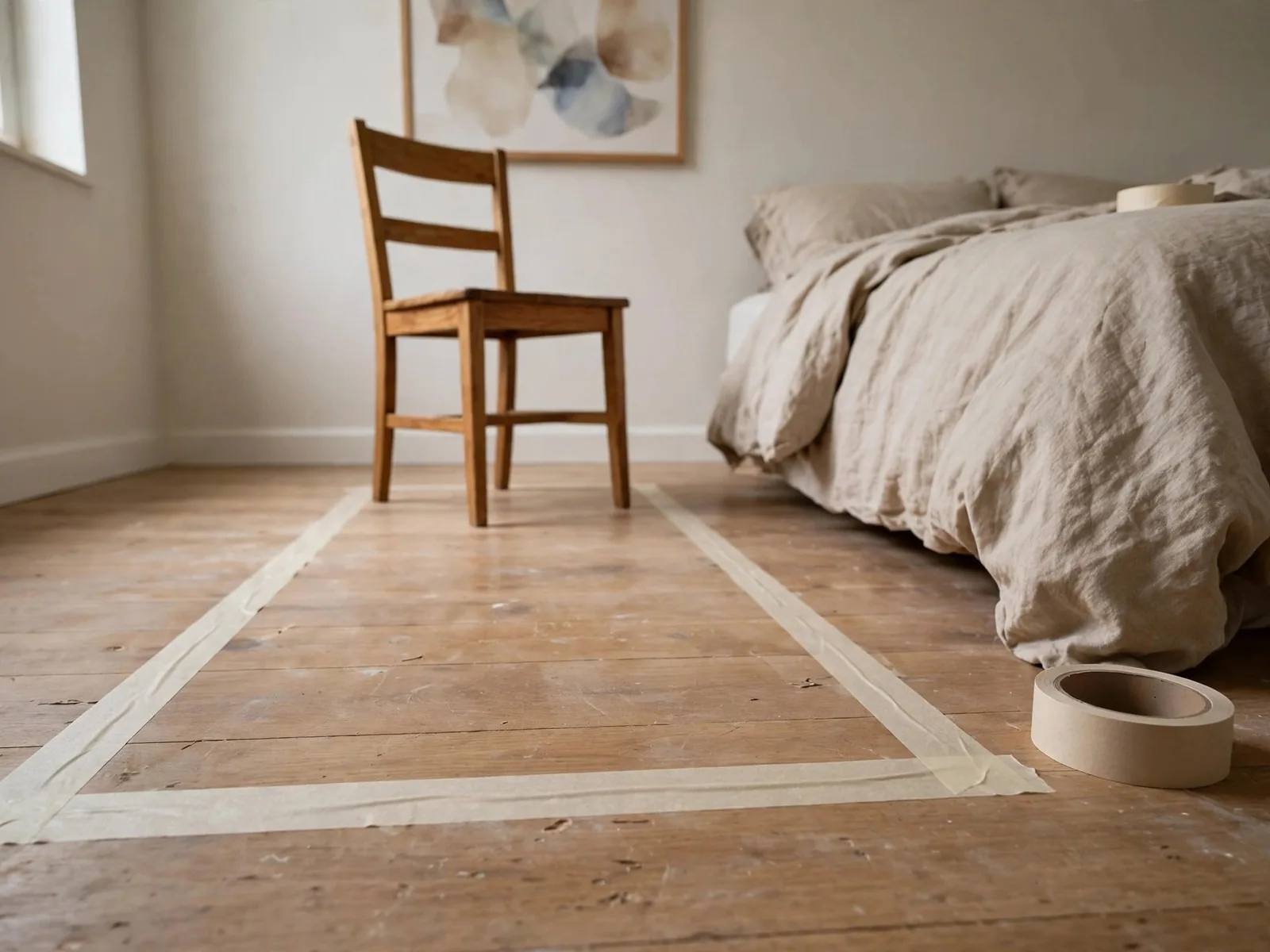
Retail photographs lie about scale with a straight face. A chair photographed in a warehouse studio looks modest; the same chair in a 10 by 12 bedroom can swallow the corner and bully the bed. Painter’s tape tells the truth for about a dollar. Mark the chair’s full footprint on your floor at the size the listing claims and live with the outline for a day.
Walk around it. Open the door against it. Make the bed beside it. Pull a dining chair inside the tape and sit in it at reading distance from the wall. If the taped box already annoys you, the upholstered version will annoy you with return shipping attached.
Standard footprints to start from: an accent chair runs 28 to 32 inches wide and 30 to 34 inches deep. A reading or lounge chair runs 32 to 36 wide and 34 to 38 deep. Add the invisible part of the footprint too, the 18 inches in front where your legs and feet actually live.
Measure: tape a 32 by 34 inch outline for a standard accent chair and add 18 inches of legroom in front of it before you judge the fit.
2. Match the chair width to the room size
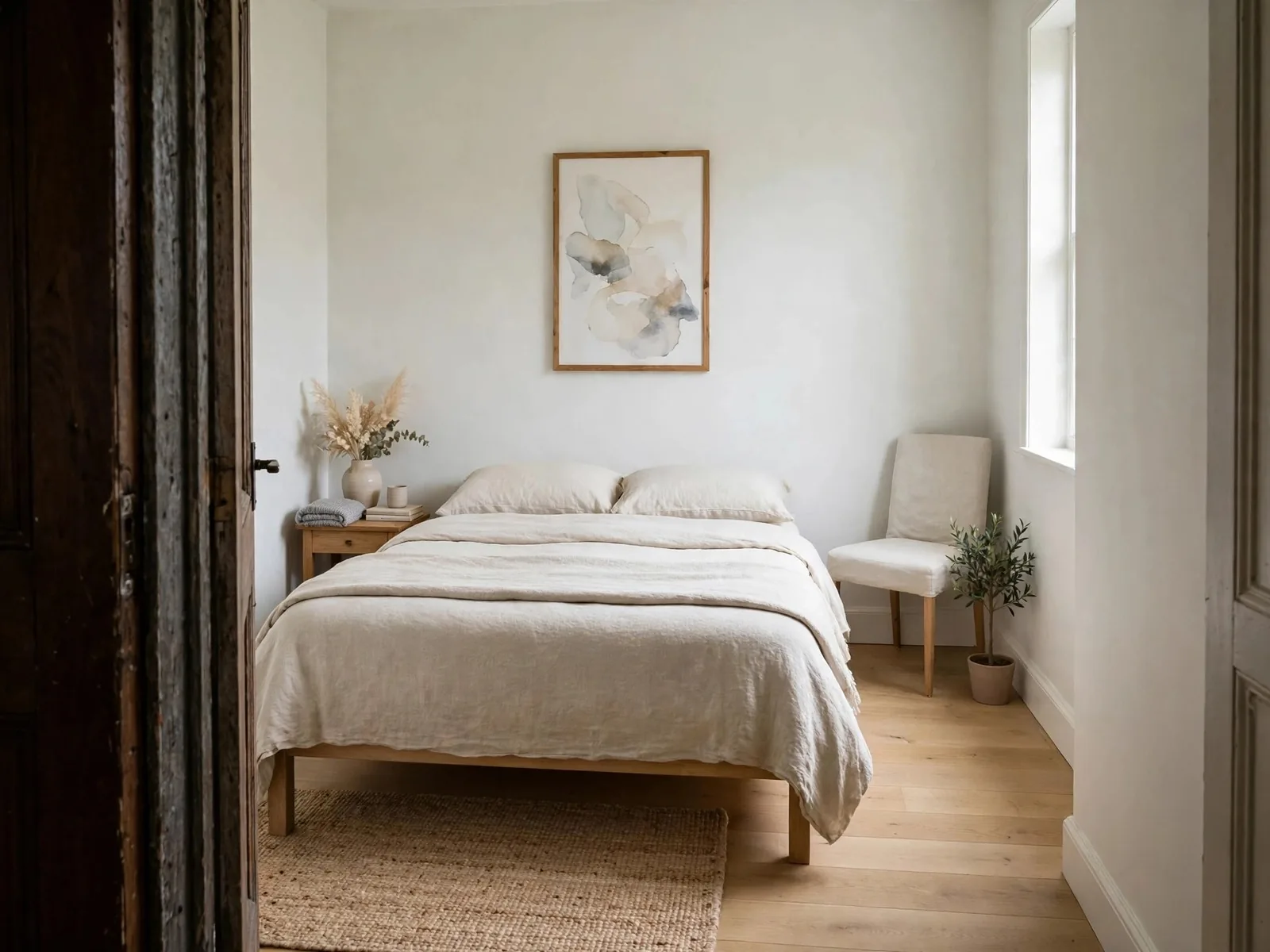
Chair width should scale with the room, not with your hopes for it. In a bedroom under 120 square feet, cap the chair at 28 inches wide and choose an armless pattern if you can. Arms are the expensive inches: two padded arms add 6 to 8 inches of width and buy almost nothing in a chair you sit in for twenty minutes of shoe-putting.
Between 120 and 180 square feet, a 28 to 33 inch chair with slim arms fits a corner without negotiating with the walkways. Over 180 square feet, the room can carry a 34 to 38 inch lounge chair and still breathe. The same ladder runs through our small bedroom ideas for every other piece. The chair obeys it like the rest.
The failure this prevents is the master-bedroom chair bought for a first-apartment room. It fits through the door, technically. Then it spends years being walked around like a parked car.
Measure: under 120 square feet, 24 to 28 inches wide and armless. From 120 to 180, up to 33 inches. Over 180, the lounge sizes open up.
3. Set the reading chair seat height at 16 to 19 inches
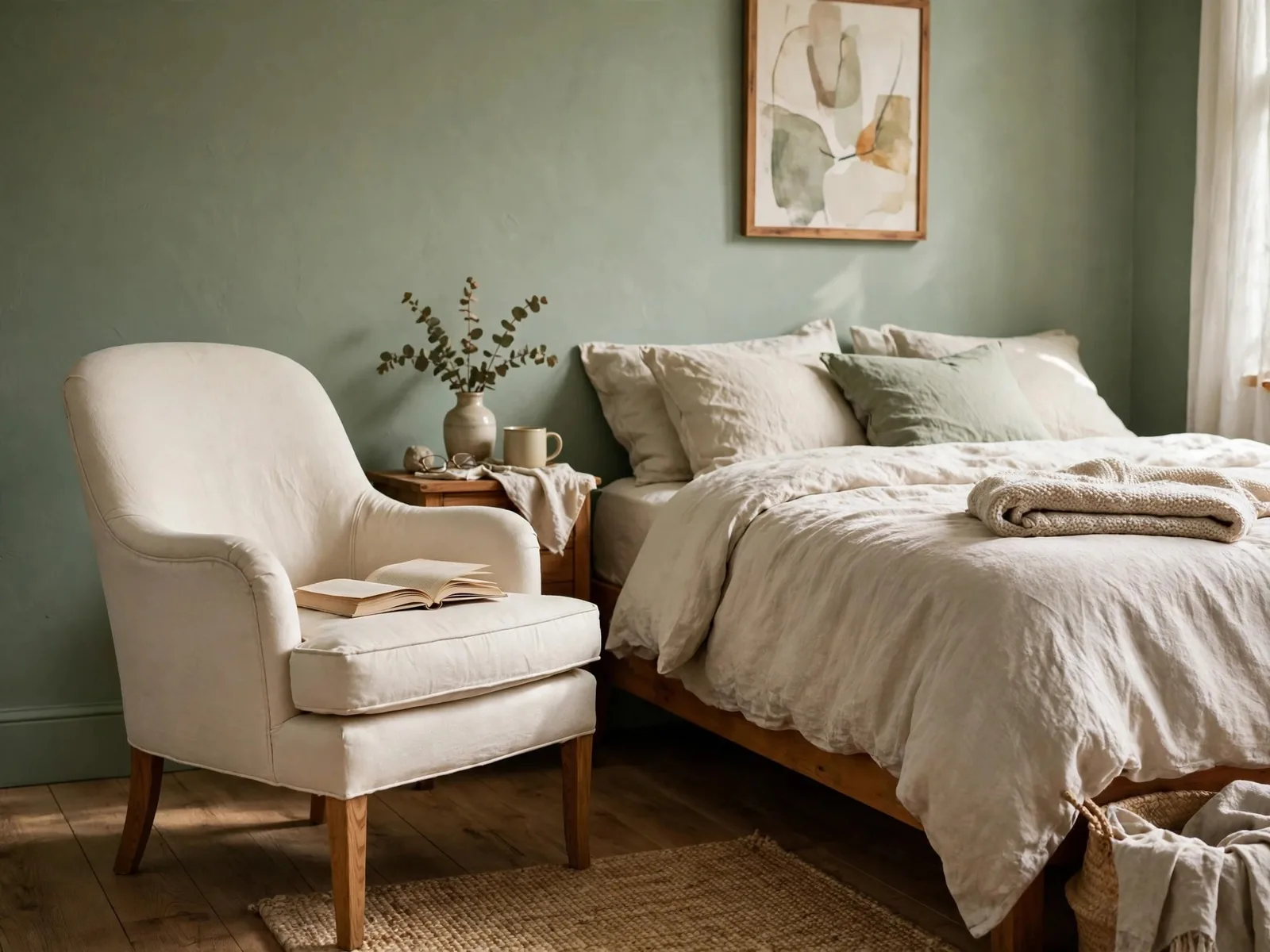
Seat height decides whether a chair gets read in or merely looked at. For a reading chair the working band is 16 to 19 inches, measured from the floor to the top of the seat cushion with the cushion compressed the way your weight will compress it. Listings usually quote the uncompressed number, so mentally subtract half an inch to an inch on anything plump.
Inside that band, your feet rest flat, your knees sit level with your hips or a touch lower and a book rests at a natural angle without your shoulders creeping up. Below 16 inches the chair becomes a lounge you sink into and climb out of. Above 19 it becomes a perch, fine for a vanity stool moment and wrong for a chapter.
A dining chair at 18 inches makes a fair test seat before you buy. Sit in one with a book for twenty minutes. If your feet dangle or your knees ride high, adjust the target band before you spend anything.
Measure: 16 to 19 inches to the compressed cushion top. Test it with a dining chair and a book before the money moves.
4. Check seat depth before the fabric seduces you
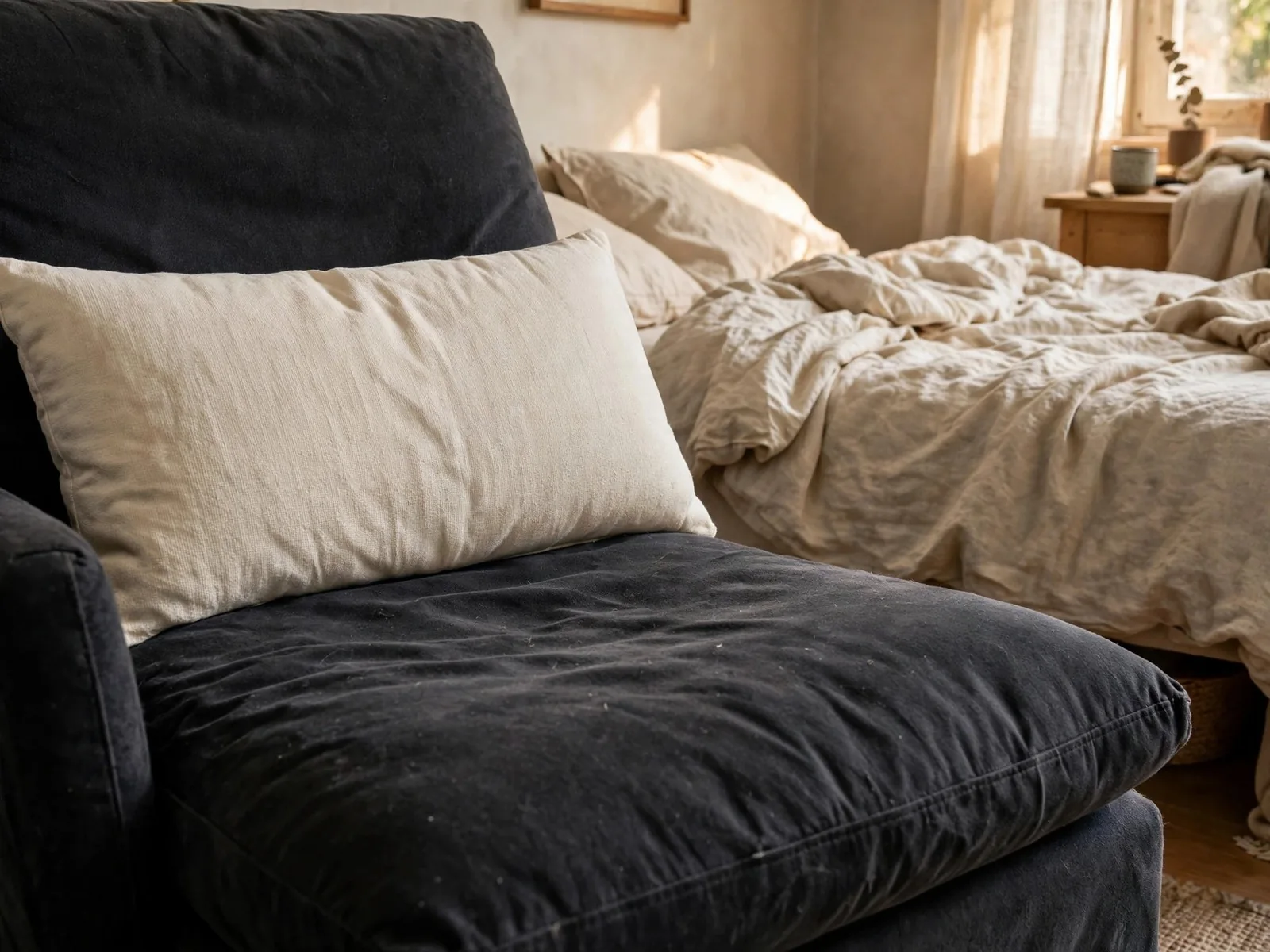
Depth is the quiet dealbreaker. A seat 20 to 22 inches deep suits most adults for reading and conversation. Past 23 inches, shorter legs end up perched on the edge with no back support. The chair’s destiny as a laundry shelf is set: nobody settles into a seat they cannot sit back in.
If a deep lounge seat is the look you love, budget the fix into the same purchase: one firm lumbar cushion, 12 to 14 inches wide, that brings the effective depth back into range. It is a $20 to $35 correction and it has to arrive with the chair, not in some later order that never happens.
Back height matters at the other end. A back that tops out at 28 to 32 inches supports shoulders for reading. A low sculptural back under 26 inches is a perch and an accent. It should be bought with that honest job description.
Measure: seat depth 20 to 22 inches without help. Deeper than 23, add a firm lumbar cushion to the same order.
The pieces, one by one
5. Choose a reading chair with arms and a surface within reach

The reading chair for the bedroom earns its name from its supporting cast. Arms at 24 to 26 inches high give elbows a place to land. A side table or stool within arm’s reach holds the book, the glasses and the drink. A light source lands on the page from over your shoulder. Miss one of the three and the corner looks right while feeling wrong.
Table height is the detail most corners flub. The table top should land within 2 inches of the chair’s arm height, so a mug travels sideways rather than down a cliff or up a shelf. A 22 to 26 inch table beside most reading chairs does it.
Light follows the same geometry. The bulb rules live in our bedroom lighting ideas and the short version is warm white, shaded and placed so the page is lit without glare bouncing off it.
Budget: a reading chair that survives daily use runs $200 to $450. The table and lamp beside it add $60 to $120.
6. Swivel the chair when the corner faces two ways
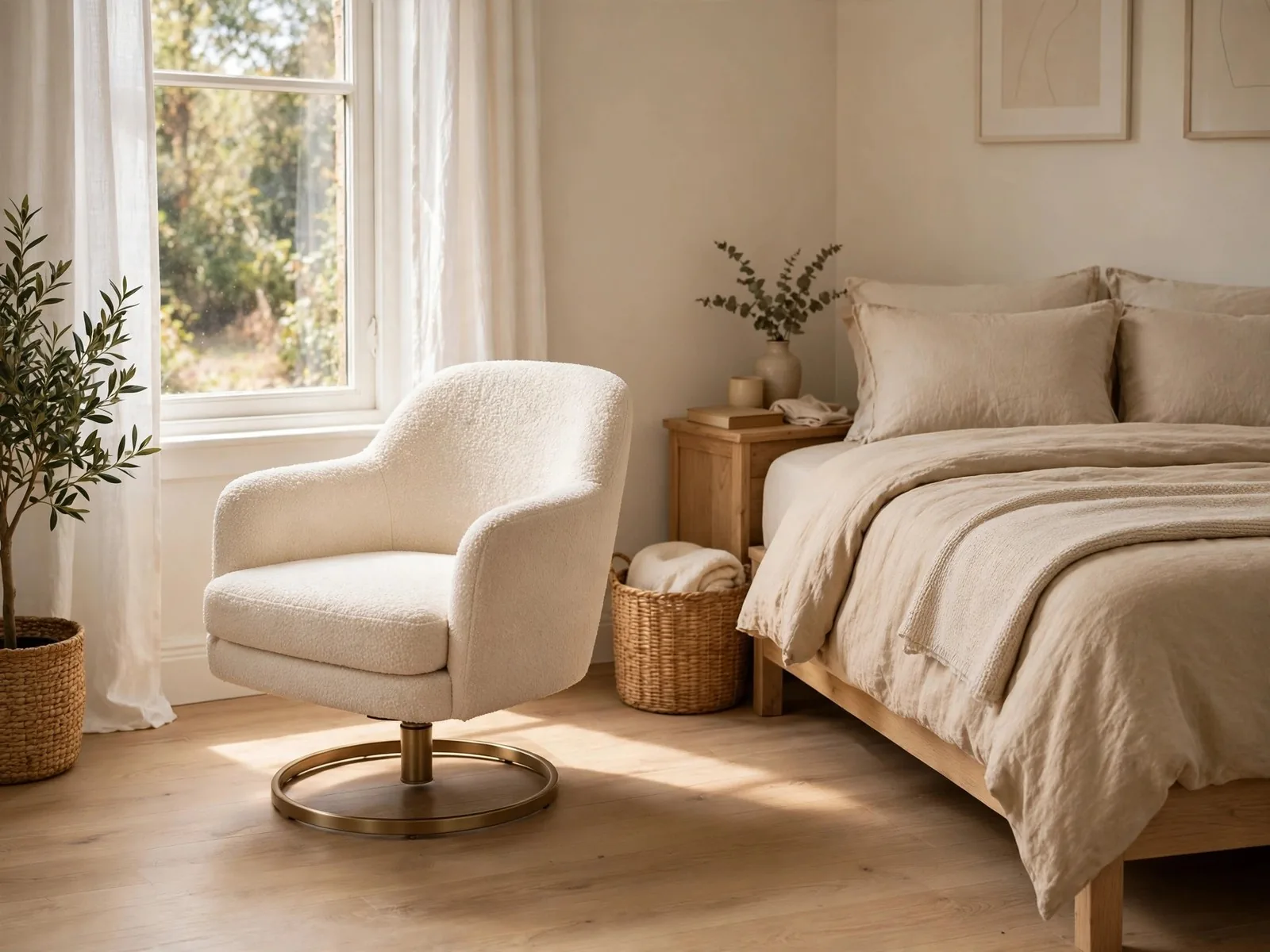
Some corners have two audiences: the window by day and the bed or television by evening. A swivel chair serves both without being dragged. Dragging is what kills chair legs and floors. The swivel patterns sold for living rooms work in bedrooms at the same sizes, which widens the secondhand pool nicely.
The catch is the turning circle. A swivel needs clear space equal to its diagonal from corner to corner or the rotation ends in a wall scuff. For a standard 30 inch chair that circle is about 40 inches across. Tape the circle, not the square, before you commit.
Swivels also forgive imperfect angles. A fixed chair placed slightly wrong grates every day. A swivel forgives the placement because the sitter corrects it without thinking.
Measure: clear a turning circle the width of the chair’s diagonal, roughly 40 inches for a standard swivel chair.
7. Use an armless slipper chair where the floor is tight

The slipper chair is the small bedroom’s honest answer: no arms, a low profile and a footprint of 24 to 27 inches wide by about 28 deep. It reads as a real chair rather than a stool, it slides into the gap between dresser and wall and it doubles as the vanity chair on the mornings the room needs one.
Its seat sits low, typically 16 to 17 inches, which flatters the proportions of a small room and makes it the easiest chair to tuck under a window sill. What it will not do is hold a reader for an hour. This is the perch, the shoe chair and the five-minute sit. Rooms need those too.
Because the pattern is simple, slipper chairs are the strongest thrift find on this page. The frames outlast their fabric by decades and a slipcover or reupholstered seat pad refreshes one for the price of a pizza night.
Budget: $80 to $180 new. The most common quality chair in thrift stores at $25 to $60.
8. Give a master room the lounge chair or chaise its floor can carry

Scale flips in a master bedroom. The dainty accent chair that suits a small room looks lost beside a king bed. The room’s corners ask for a piece with presence. A lounge chair at 34 to 38 inches wide or a chaise along the window wall matches the bed’s visual weight and gives the room a second real seat rather than a token.
A chaise asks for length instead of width: 55 to 65 inches of clear wall or window run, plus walkway past its foot. Measure the run the way you would for a dresser, because a chaise is a dresser-sized commitment that happens to be soft.
The oversized chair is also the Pinterest hero of this topic for a reason. It photographs as luxury. Just confirm the room in the photograph resembles yours in square feet before it resembles yours in shopping cart. Our master bedroom ideas run the same scale-first logic across the whole suite.
Measure: a chaise needs 60 to 65 inches of clear run and 24 inches to walk past its foot. Under that, buy the wide lounge chair instead.
9. Hang a chair only where a joist can carry it

The hanging chair is the boho corner’s signature and the most searched silhouette in this cluster after the reading chair. It is also the one idea on this page that can fail structurally, so it gets its rules stated plainly. The hook goes into a ceiling joist or a rated stand. It never goes into plasterboard alone, whatever the kit’s marketing implies.
The swing needs room to be a swing: about 24 inches of clear space behind the chair and a full arc free of the bed frame and the wall. In a small room that arc usually settles the argument. The honest fallback is a stand-mounted version that costs more floor but no ceiling.
Renters, the stand is your version. It reads the same in photographs and leaves the ceiling exactly as it found it. The fabric and cushion vocabulary that makes this chair sing lives in our boho bedroom ideas.
Needs drilling: joist-mounted hardware rated for the load or a stand. The swing arc needs 24 inches clear behind the chair.
Placement and clearances
10. Angle the chair into the corner instead of flattening it
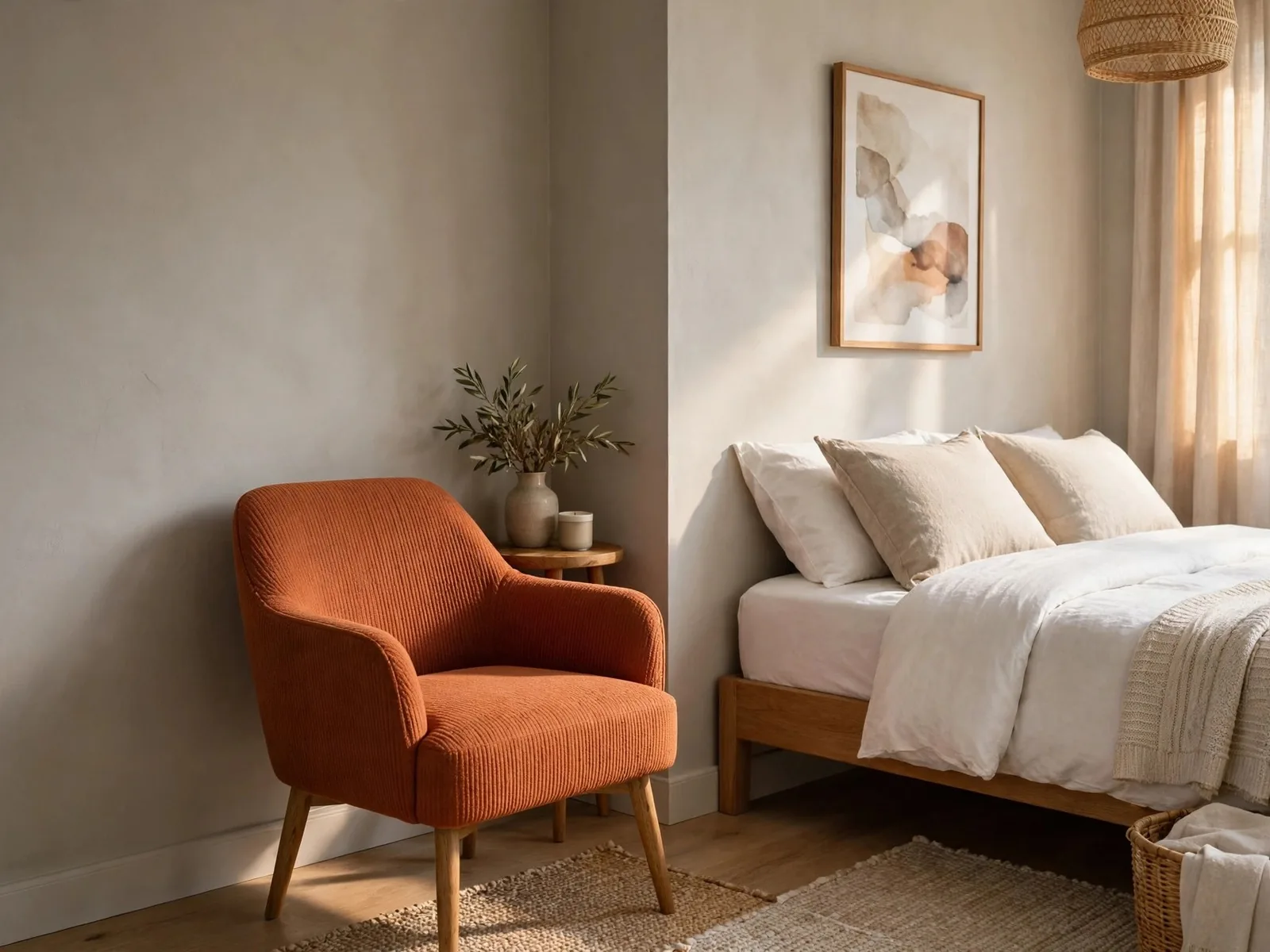
A chair pushed flat against one wall of a corner faces the other wall. Nobody sits facing a wall six inches of paint away. Turn the chair 30 to 45 degrees across the corner and it faces the room, the bed and the door at once. The corner chair is a placement, not a product. This turn is the whole trick.
Angling costs a little depth, roughly 4 to 6 inches more than the flat position. It buys back a wedge of dead space behind the chair. That wedge is where a small round side table, a basket or the floor lamp base earns its keep, so the footprint is spent rather than lost.
Test the angle with the tape outline from idea 1 before the chair arrives. Corners differ: a door swing or a radiator can veto the pretty diagonal. Tape is cheaper than returns.
Measure: angle at 30 to 45 degrees across the corner and budget about 6 extra inches of depth for the turn.
11. Hold the clearances: 24 inches to walk and 18 to pass
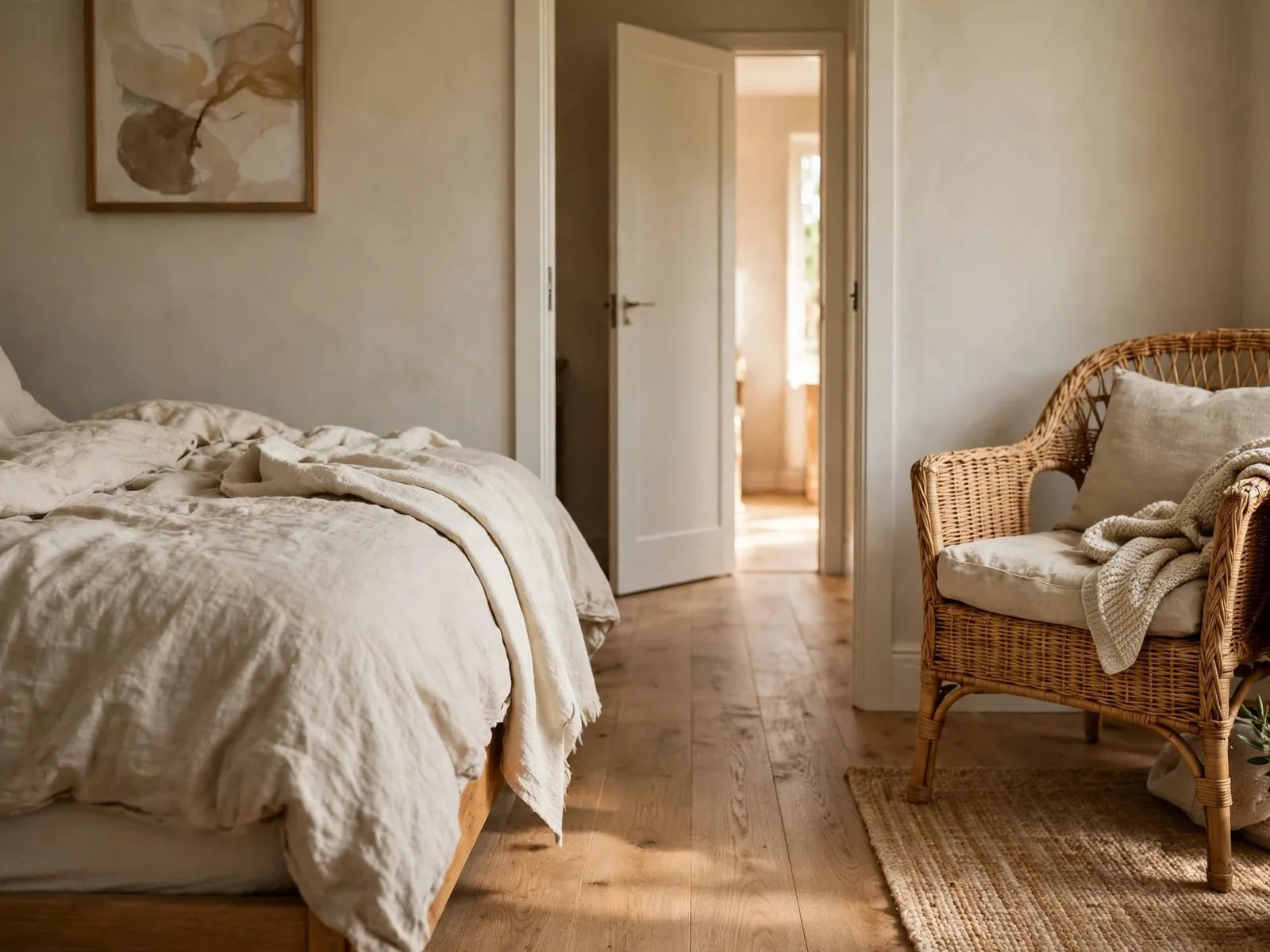
Clearance numbers decide whether a chair placement survives contact with daily life. In front of the chair, 24 inches to the next obstacle is the floor of acceptable: legs extend, feet land and nobody shuffles sideways out of a seat. The main walkway past the chair, usually the bed-to-door route, wants 30 to 36 inches.
Between the chair and the bed’s edge, 18 inches is the working minimum for making the bed without a daily wrestling match. Less than that and the chair migrates, a few inches a week, until it blocks something and gets exiled to the hallway.
Doors vote too. A chair inside the door’s swing arc will be hit, regularly and with feeling, until either the door or the chair loses. The swing was in your Before you start measurements for exactly this reason.
Measure: 24 inches in front of the chair, 18 inches minimum beside the bed and the door swing kept fully clear.
12. Place the chair where the light already is
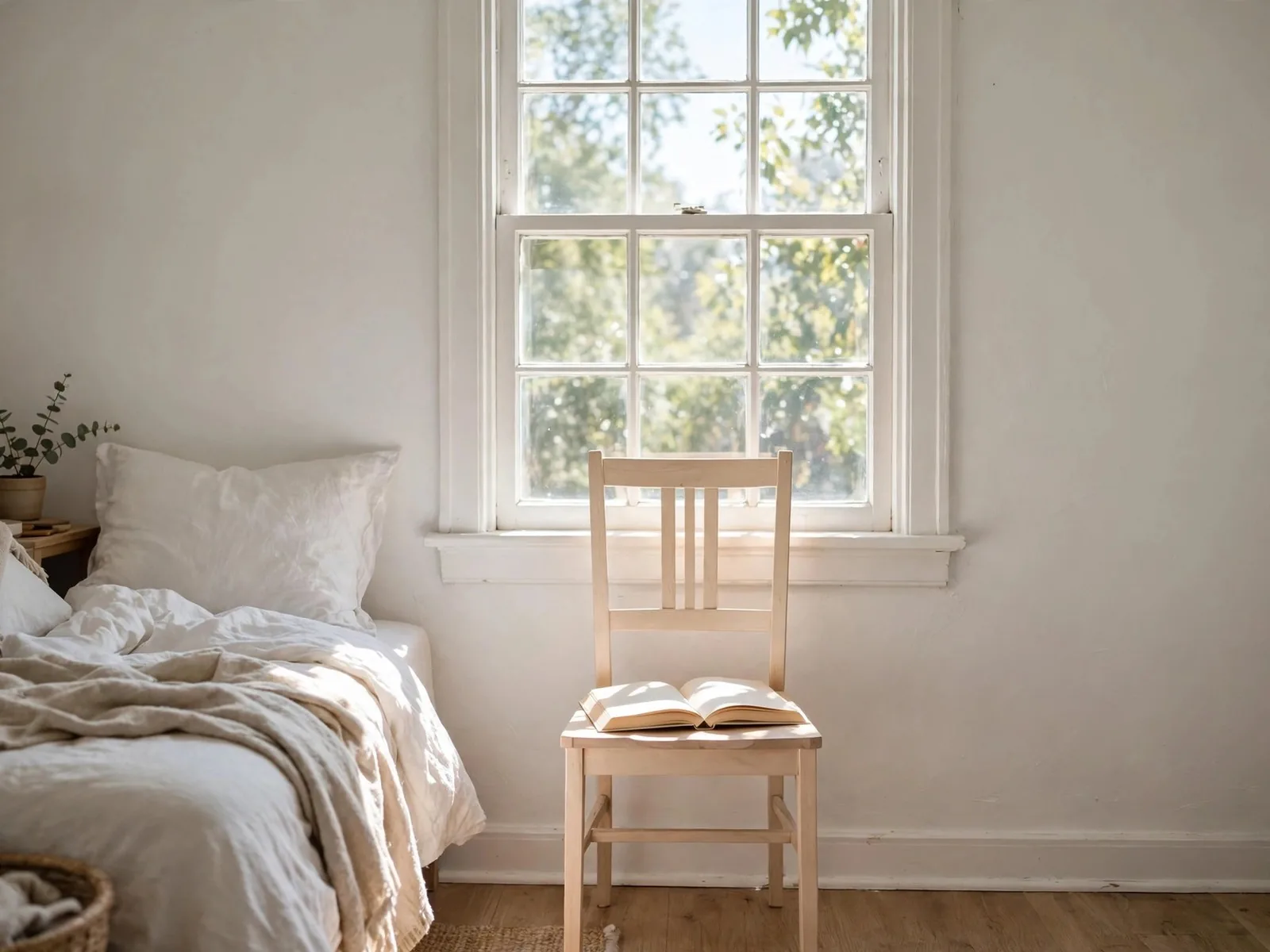
Reading corners fail in the dark more often than they fail at the furniture store. Before you place the chair, sit in the taped footprint at the hour you actually read. Morning readers belong near the window, angled to take daylight over one shoulder. Evening readers belong within cord reach of an outlet, because an extension cable across a walkway is a debt the room collects nightly.
Window placement has one more dividend: a chair under a window takes the low wall that dressers and wardrobes cannot use, since its back usually tops out under the sill. In small rooms that dead band of wall is often the only free placement left.
If the light cannot come to the chair, move the idea, not the sun. A corner that stays dim at every hour is a better home for the storage ottoman in idea 14 than for the reading chair.
Measure: the chair back under a standard sill needs a back height under 30 inches. Check the sill before the style.
Mixing pieces you already own
13. Match one thing only: wood tone or fabric family
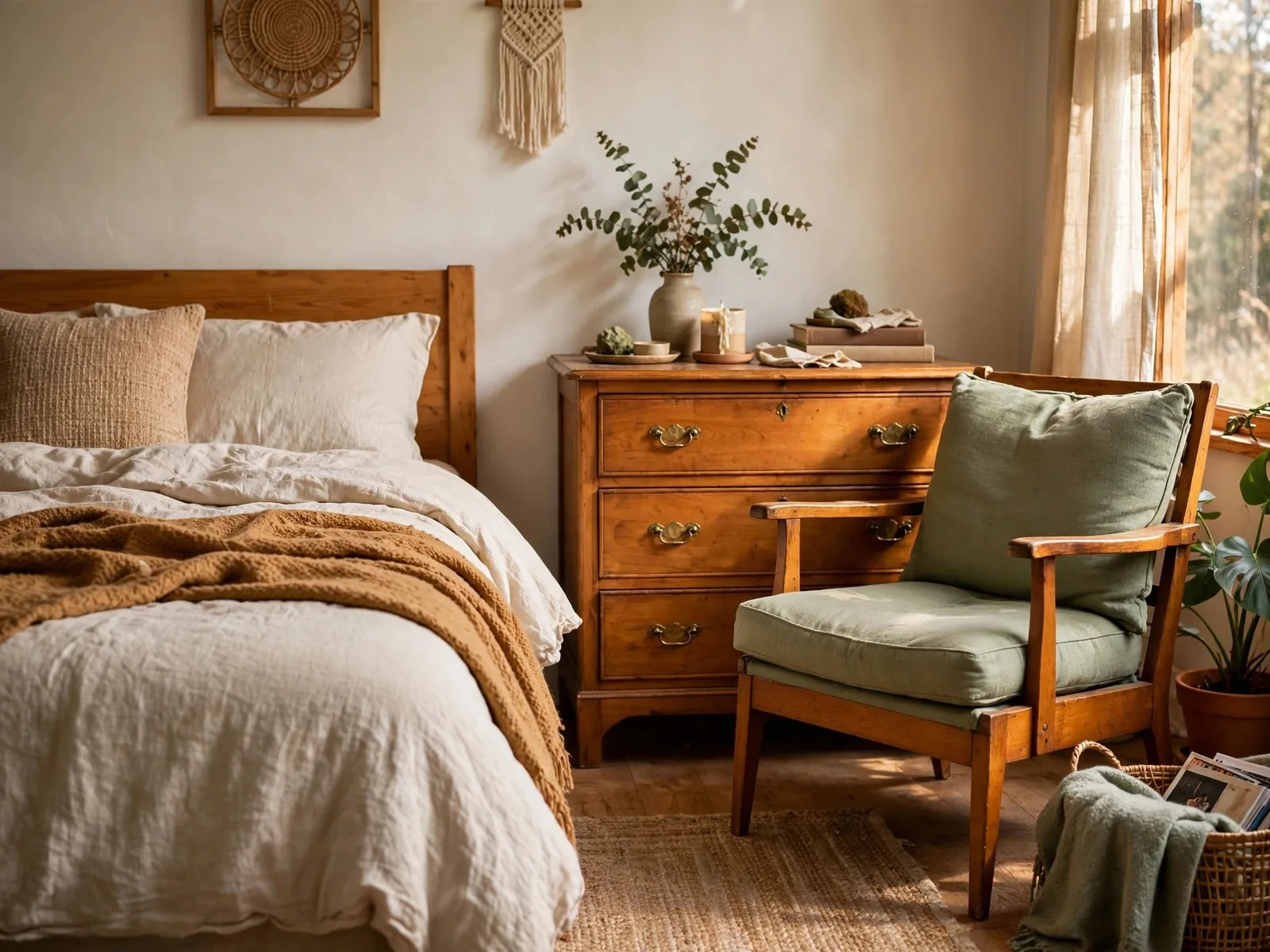
Should the chair match the bed frame and the dresser? No. The matching bedroom set is the fastest route to a room that looks rented by the week. Full matching sets flatten a room because every surface repeats the same tone at the same weight. One shared thread is what a collected room actually runs on.
Pick the thread deliberately. Either the chair’s wood legs land inside the room’s wood tone family, warm with warm and pale with pale or its fabric joins the room’s textile palette in a neighboring shade. One thread is enough. Two is a coincidence. Three is a set again.
This is also the rule that frees the thrifted find. A $40 chair with the right tone family looks intentional beside furniture that cost ten times more, while a matched suite piece in the wrong room still looks like it arrived on one truck.
Budget: $0. Mixing by tone or fabric family costs nothing and it is the difference between collected and catalogued.
14. Make the chair earn its floor with storage inside
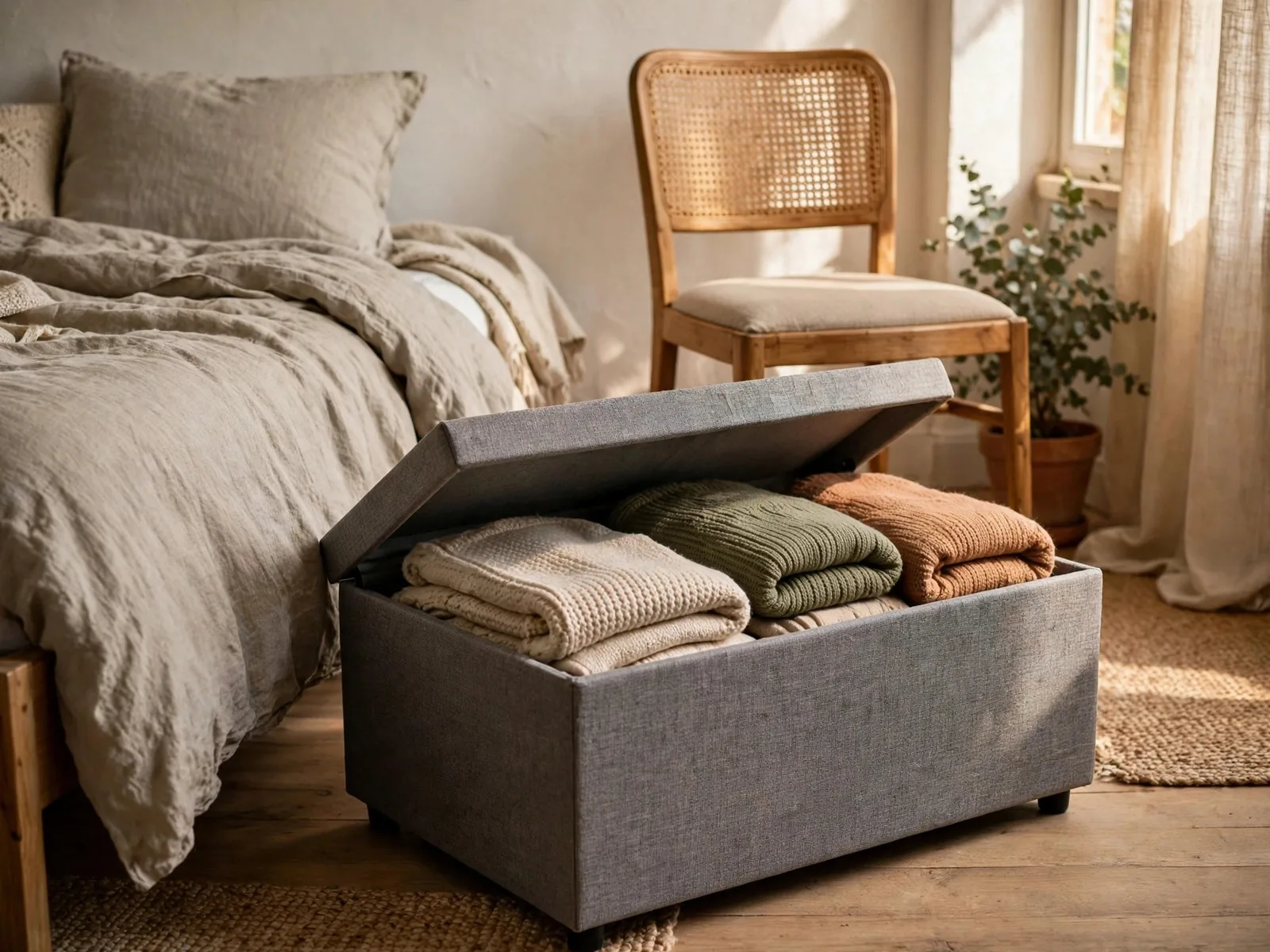
Under 120 square feet, a chair that only sits is a luxury the floor may not fund. The fix is a chair or ottoman pairing that stores: a lift-seat storage chair or a storage ottoman parked in front of a simple chair as its footrest and its second job. The spare throw, the out-of-season duvet and the book pile all disappear into it.
Size the storage honestly. An ottoman around 30 inches wide, 18 deep and 18 high swallows two folded throws and a spare duvet set. A storage seat shallower than 6 inches inside is a gesture rather than a system, so measure the cavity and not the outside.
This is the multifunction rule the whole small-room end of this site runs on: every piece under 120 square feet should hold something, hide something or fold away.
Measure: storage cavity at least 6 inches deep inside or the piece is a seat with a lid and not storage.
15. Buy the chair second: after the bed and before the small things
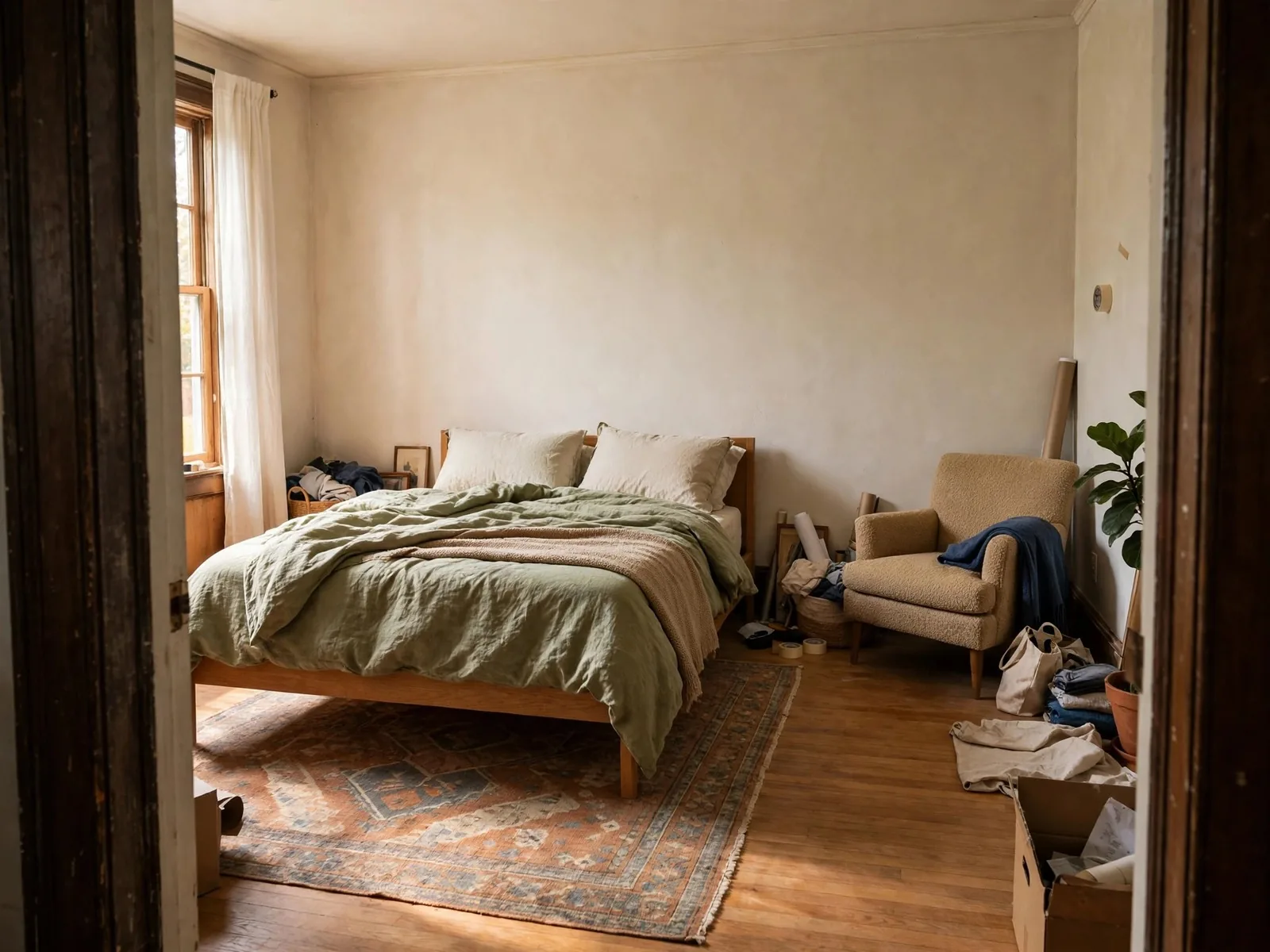
Order matters because sizes cascade. The bed goes first since it owns the room’s dimensions and its height sets the chair’s visual scale. The chair comes second, while the floor plan still has choices. The side table and lamp come last, because both size themselves off the chair: table height off the arm, lamp reach off the seat.
What can wait: the ottoman, the throw and every decorative layer. What cannot wait is the decision about the chair’s footprint, because the rug size, the walkway and the dresser position all lean on it. Readers ask what to buy first in almost these words. The honest answer is the bed, then this chair, then everything that touches it.
Buying in this order also protects the budget. The chair bought last is the chair bought with leftovers. Leftovers buy the wobble-legged version that gets replaced within two years.
Budget: reserve the chair its own line in the room budget, roughly 15 to 20 percent, instead of funding it from what survives the bed.
Bedroom Chair on a budget
The budget version of this page is a sequence, not a smaller chair. Start at $0 with the tape test from idea 1 and the dining chair sit-test from idea 3, because the most expensive chair mistake is a return you pay freight on. Then shop the thrift order: slipper chairs first, since simple frames flood secondhand stores at $25 to $60, then simple wooden armchairs that a $15 cushion turns into reading chairs. Under $100 total, the slipper chair plus a thrifted side stool and a warm bulb builds a working corner. The next $100 upgrades the seat you chose rather than the decor around it: better cushion, real lumbar support for a deep seat, felt pads and a lamp that lands light on the page. Hold the real money for the reading chair in the $200 to $450 band when the corner proves it gets used daily. The same spend-in-order discipline structures our bedroom makeover ideas. A first rented room can run this whole page through our dorm room ideas with the slipper chair doing double duty.
Mistakes that make it fall flat
- Buying the showroom photograph. Studio rooms are warehouses with bedding. A chair that reads modest in a listing photo can be 38 inches wide in your doorway. The tape test exists because listings count on you skipping it.
- The chair becomes the wardrobe. A chair turns into a clothes pile when it is uncomfortable to sit in and perfectly placed to catch laundry. Deep seats without back support cause the first half. The fix is the right seat depth and a hook or basket nearer the door than the chair is.
- Matching the whole set. Bed, dresser and chair in one finish from one range gives a showroom, not a bedroom. Match one thread, tone or fabric. Let the chair be the piece with a past or a color.
- Blocking the swing and the walkway. A chair inside the door arc gets hit until it is hated. A chair that trims the walkway under 24 inches gets climbed around until it is exiled. Clearances are the placement, not an afterthought.
- Perch where a reader was promised. A low sculptural chair with a 25 inch back cannot hold a chapter. Buying an accent piece for a reading job is the mismatch behind most returned bedroom chairs.
Questions people ask about this
What size chair should I buy for a small bedroom? Stay at or under 28 inches wide and choose an armless slipper pattern where you can. A seat height of 16 to 17 inches and a depth near 28 inches keep the proportions low against the bed. Before ordering, tape the footprint on the floor and confirm 24 inches of walkway survive it.
How much clearance do I need around the bed? Keep 18 inches between a chair and the bed’s edge as the working minimum for making the bed and getting past. The route from bed to door wants 30 to 36 inches. The space in front of the chair itself needs 24 inches for legs and feet. The door swing stays clear entirely.
Should bedroom furniture match? No. A full matching set flattens the room and dates it to the year of the truck. Match one thread instead: the chair’s wood tone inside the room’s wood family or its fabric inside the existing textile palette. One shared thread reads as collected. Three reads as a furniture store floor.
The bottom line
A bedroom chair succeeds on numbers before it succeeds on looks: a footprint the room can carry, a seat height between 16 and 19 inches for reading, clearances that respect the walkway and the door and one shared thread with the furniture already there. Get those right and almost any style of chair becomes the right chair. This week, tape the footprint of the chair you keep looking at onto the corner where it would live, sit a dining chair inside the outline with a book for twenty minutes and let the tape deliver the verdict before your card does.