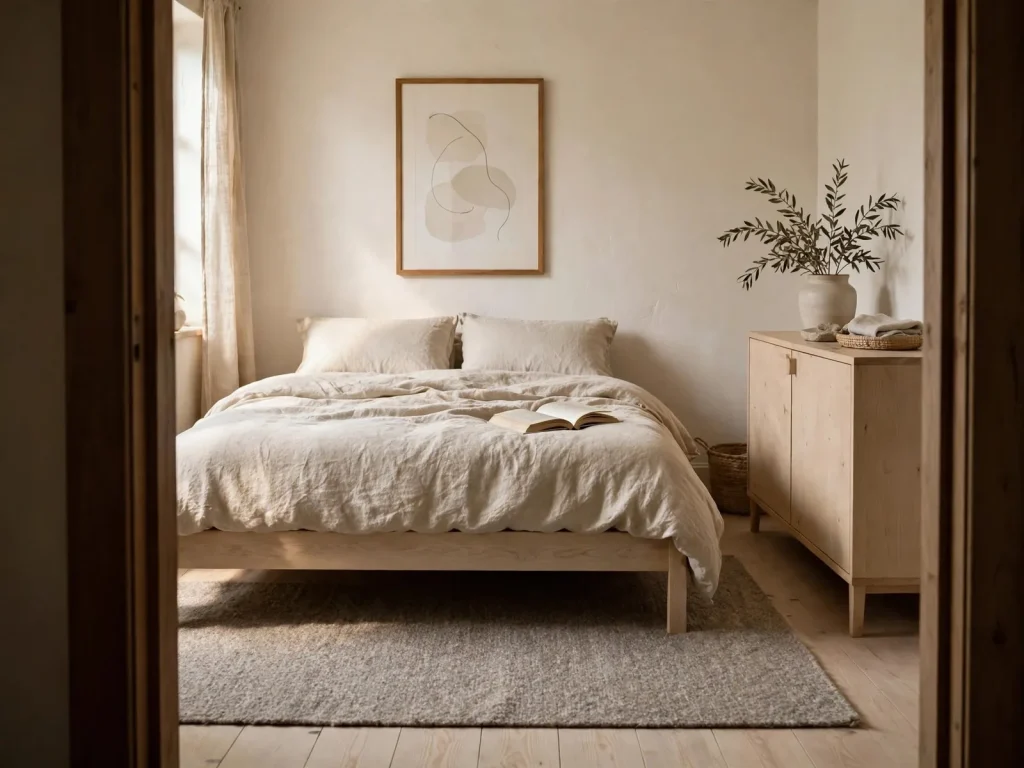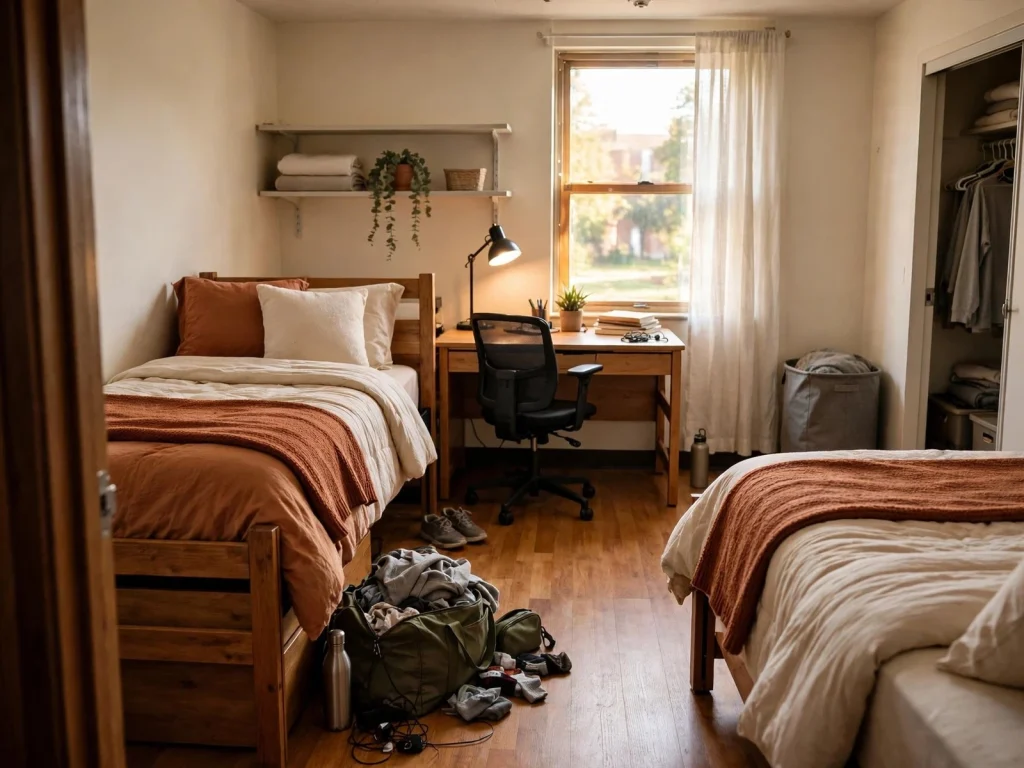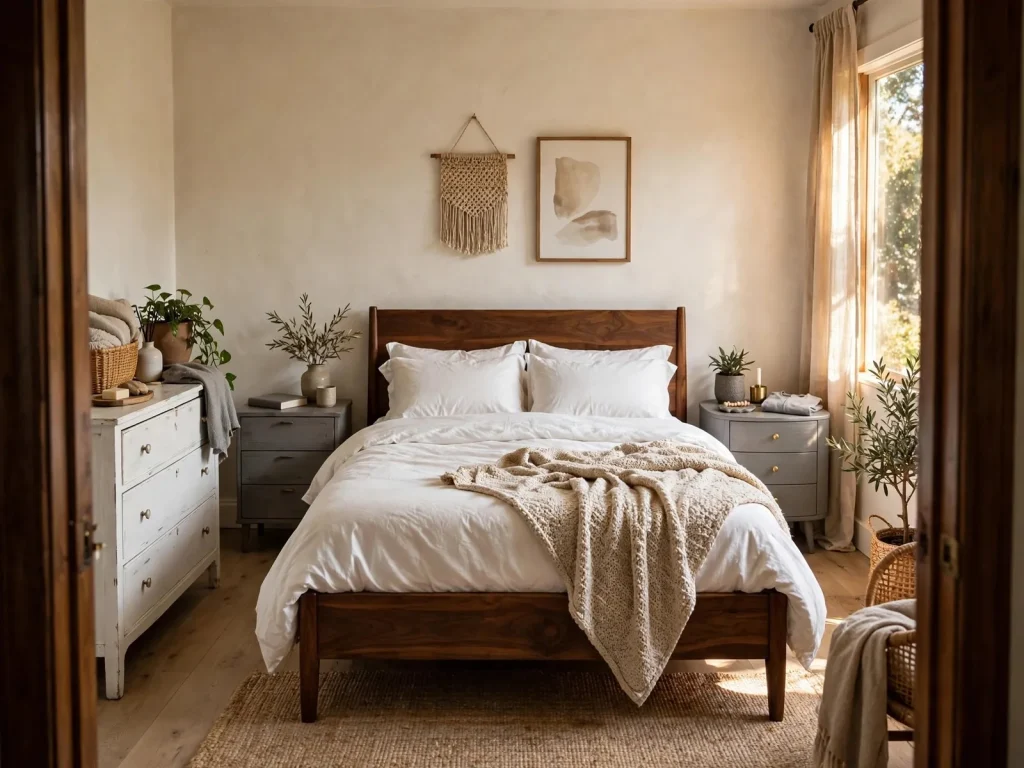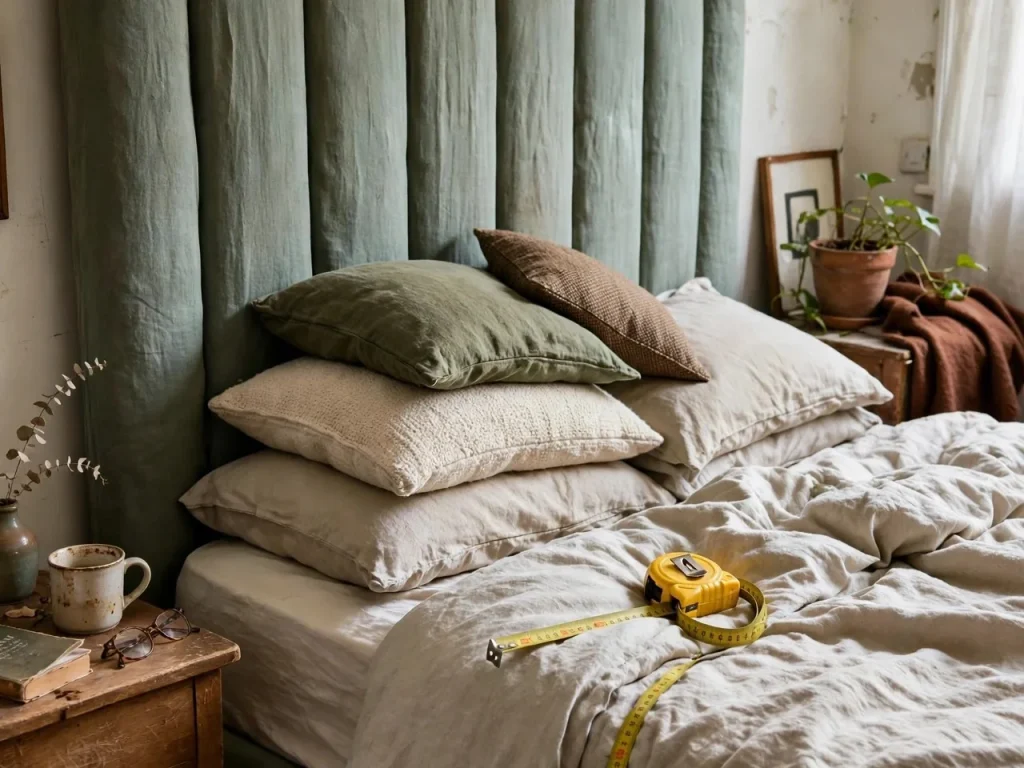
The rug arrived and the room went wrong. It is a pretty rug and it was not cheap, but it stops six inches past the bed on one side, vanishes under the mattress at the head and leaves your feet landing on cold floor every morning exactly where you step out. Most bedroom rug ideas fail this way. The pattern was right and the size was guessed.
This page works the other way round. Every idea starts with the measurement that decides it: the rug size for your bed size, the border your feet need on each side and the clearances that keep doors and drawers working. Style comes second, inside numbers that already fit. These are bedroom rug ideas you can order from with confidence, because the tape measure did the decorating first. The full room-by-room idea bank sits in our bedroom ideas pillar.
Before you start: measure, budget, rules
Measure the bed before anything else. A twin is 38 inches wide and 75 long, a full is 54 by 75, a queen is 60 by 80 and a king is 76 by 80. Those four numbers pick your rug size on this page, because a rug is sized to the bed it serves and not to the room around it. Then measure the room wall to wall and note the door swing, because the prettiest placement fails if the door shaves the pile every time it opens.
The budget bands on this page are quoted for the workhorse size, 8 by 10 feet. Under $150 buys flatweave cotton and budget synthetics that fade gracefully and wash well. The $150 to $400 band buys denser wool blends and vintage-look pieces with real border detail. Above $400 sits hand-finished wool that can anchor a room for a decade. Every size also needs a pad, so hold back $40 to $90 of any budget for the pad before you fall for a pattern.
Renters, two rules. A rug is the biggest color change you can make with no permission and no deposit risk, so this page is friendly territory. Choose washable or flatweave pieces you can lift alone, because a rug you cannot move is a rug you cannot clean under. If your lease bans nothing on the floor, you are still fine here: every idea on this page sits loose on a pad and lifts out in minutes.
Choosing the size before the style
1. Size the rug to the bed, not to the room
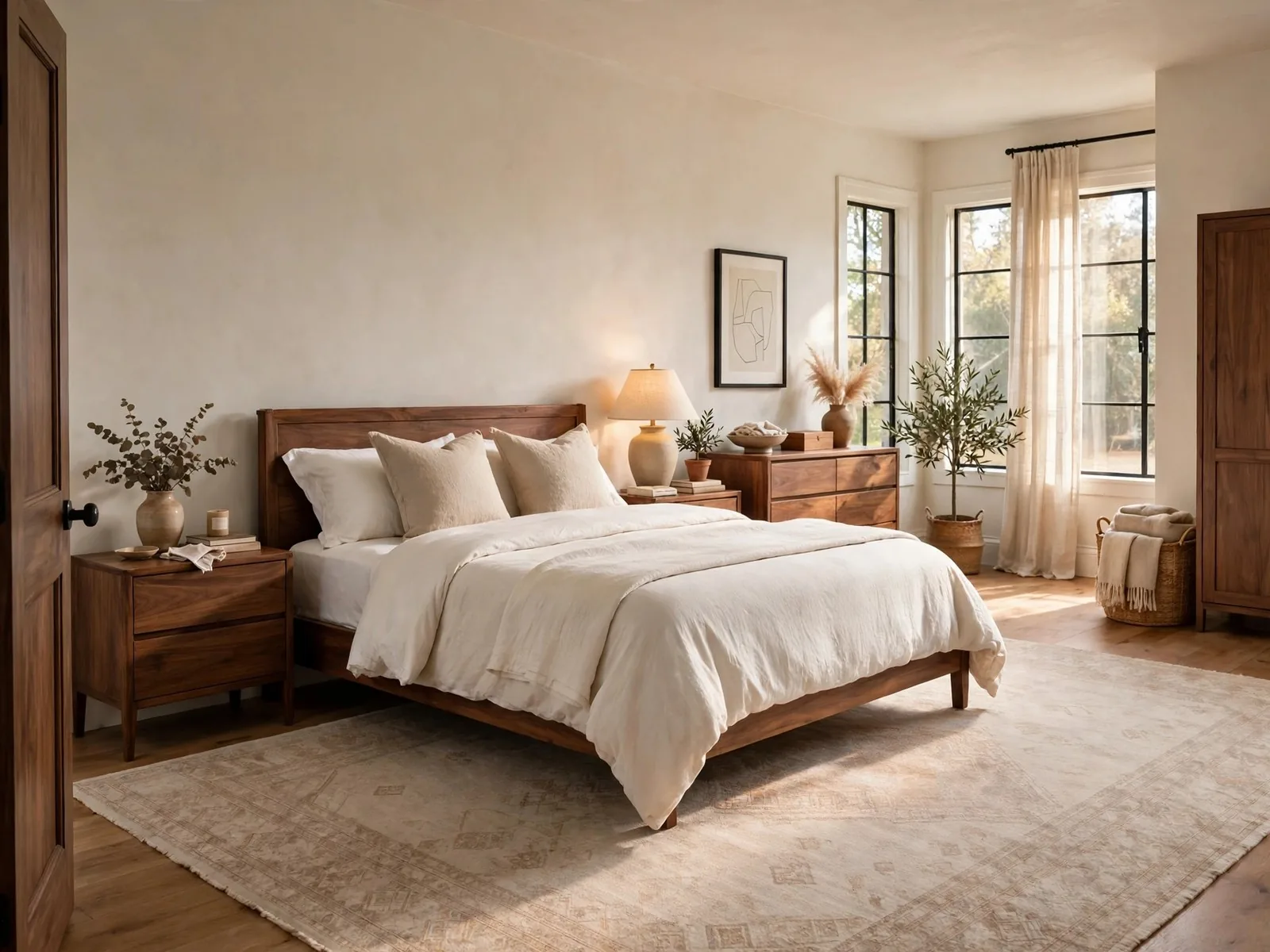
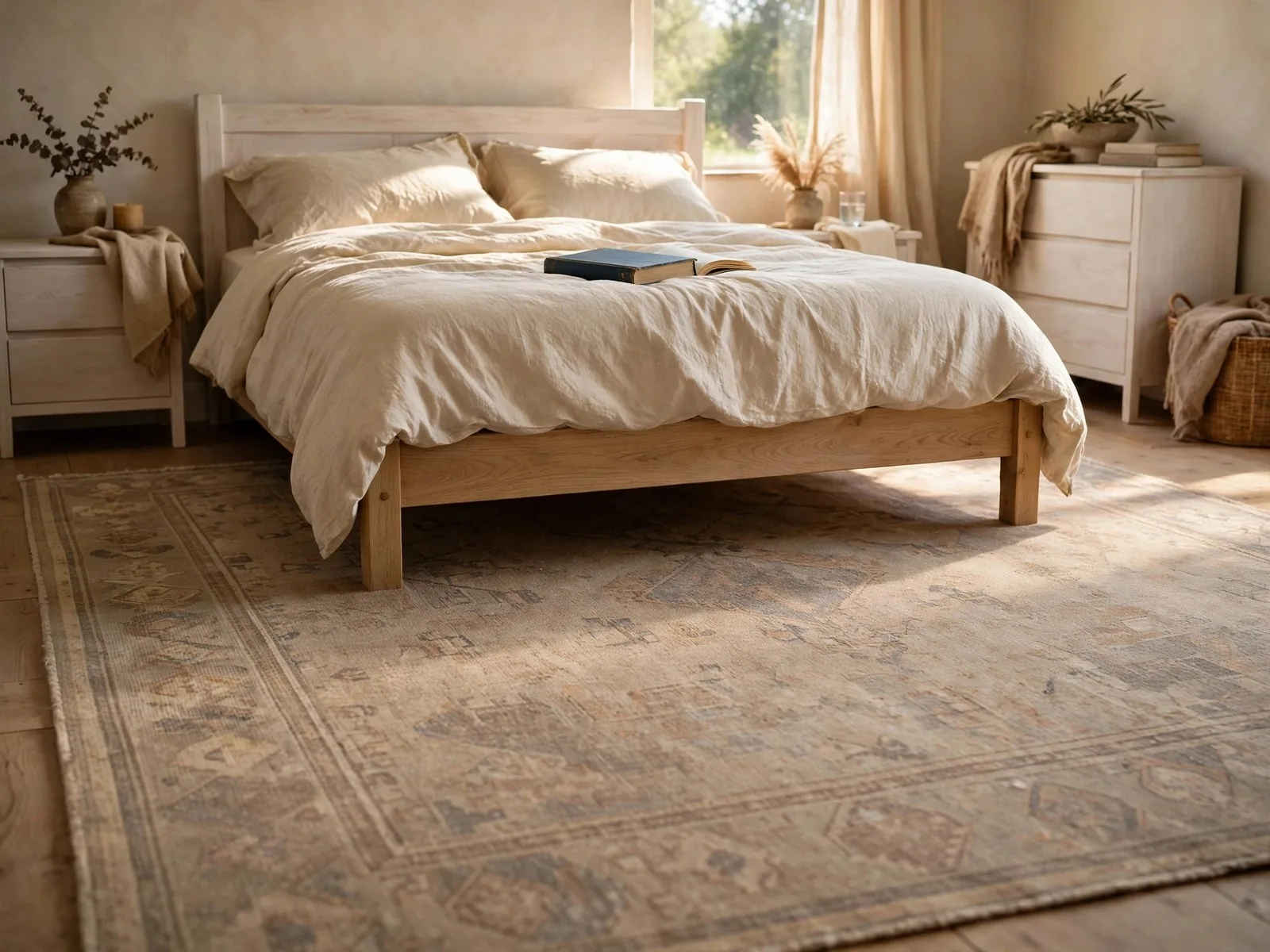
The standard pairings exist because they solve the same problem in every room. A twin bed at 38 inches wide takes a 5 by 8 rug. A full at 54 inches wide takes a 6 by 9 or an 8 by 10. A queen at 60 inches wide takes an 8 by 10 at minimum and a 9 by 12 when the room allows it. A king at 76 inches wide starts at 9 by 12 and reads properly on a 10 by 14.
Run the math once and the pattern becomes clear. The rug has to be wider than the bed by enough to matter on both sides, which is why one size down always looks mean in photographs and in person. When your bed size sits between two rug sizes, buy the larger one. Floor is cheaper to cover than regret is to return. Return shipping on an 8 by 10 is nobody’s idea of a good Saturday.
The catch is the room cap. If the bigger rug leaves less than 8 inches of bare floor at the walls, the room is telling you to change the layout instead, which is what idea 3 and the runners in idea 5 are for. Master bedrooms with kings get the full treatment in our master bedroom ideas post.
Measure: twin 5 by 8, full 6 by 9 or 8 by 10, queen 8 by 10 or 9 by 12, king 9 by 12 or 10 by 14.
2. Run the border rule before you fall for a pattern
Your feet set the real size. Swinging out of bed, you want rug under your feet and room to stand, which takes 18 to 24 inches of rug beyond each side of the bed. At the foot, 18 inches is the minimum past the mattress and 24 to 30 inches is better if a bench or blanket box sits there. Check your shortlist against those borders before you look at a single colorway.
This is the measurement most people get wrong, because showroom rugs are photographed under beds with the borders cropped out of frame. A queen on an 8 by 10 gets 18 inches a side, which passes. The same queen on a 6 by 9 gets 6 inches a side, which is a picture frame, not a floor covering. Bedroom rug placement ideas live or die on this one number.
Small rooms get a pass down to 12 inches a side, below which the rug stops working as a landing zone at all. If 12 inches is all the room gives you, spend the pattern money on the foot of the bed instead and let the sides go to runners.
Measure: 18 to 24 inches of rug past each side of the bed, 12 inches as the small-room minimum, 18 inches minimum past the foot.
3. Shrink the plan, not the borders, in a small bedroom
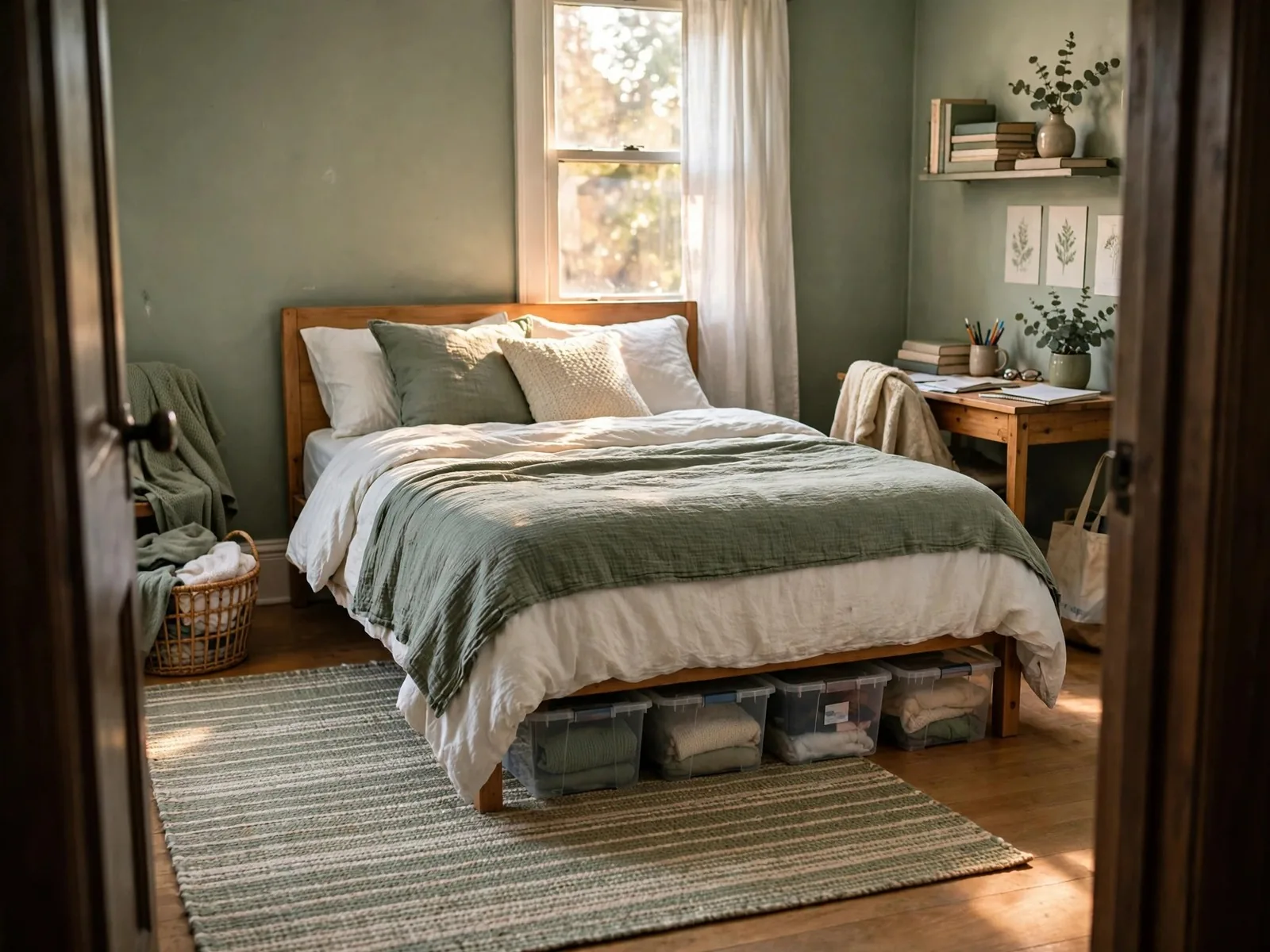
Small bedrooms punish the full-coverage instinct. In a room under 120 square feet, a big rug wall to wall fights everything: under-bed storage bins cannot slide past it, the door catches it and the room reads smaller because the floor border disappears. The fix is to keep the borders honest and shrink the coverage instead.
Two shapes work. A 5 by 8 slid under the lower two-thirds of a full or queen bed keeps the foot border and one side border real while leaving the storage side free. Or skip the under-bed rug entirely and run two runners down the sides, which is idea 5 with the math already done. Both keep the landing zones warm and leave the under-bed zone open for the drawers and bins a small room depends on.
The same footprint-first thinking runs through our small bedroom ideas post, where the floor plan decides before the shopping starts.
Measure: in rooms under 120 square feet, keep 8 to 12 inches of bare floor at the walls and leave the under-bed storage run clear of rug and pad.
The pieces, one by one
4. Pick the main rug by pile before pattern

Pile height decides where a rug can live. Low pile, under a quarter inch, slides under doors and takes bed legs and casters without denting into ruts. Medium pile, a quarter to a half inch, is the comfort zone for the part of the rug your feet actually use. High pile over a half inch feels wonderful at the foot of the bed and turns into a maintenance argument anywhere a leg or a wheel stands on it.
Match the fiber to the life of the room. Wool wears longest and hides soil in its crimp, flatweave cotton washes and rotates cheaply, jute gives texture at a low price and hates water. Modern synthetics shrug off spills and come in washable builds that suit kids rooms and rentals. Bedroom carpet ideas and wall-to-wall looks start here too: a low-pile wool rug wall to wall in feel is the closest loose-laid version.
Choose pile by zone if one rug does two jobs. The under-bed field can be flat and hard-wearing while the foot border carries the pile you feel, which is exactly the split the layering in idea 6 exploits.
Measure: low pile under 1/4 inch where doors and legs land, medium 1/4 to 1/2 inch for the foot border, high pile only where nothing stands on it.
5. Put runners where feet actually land
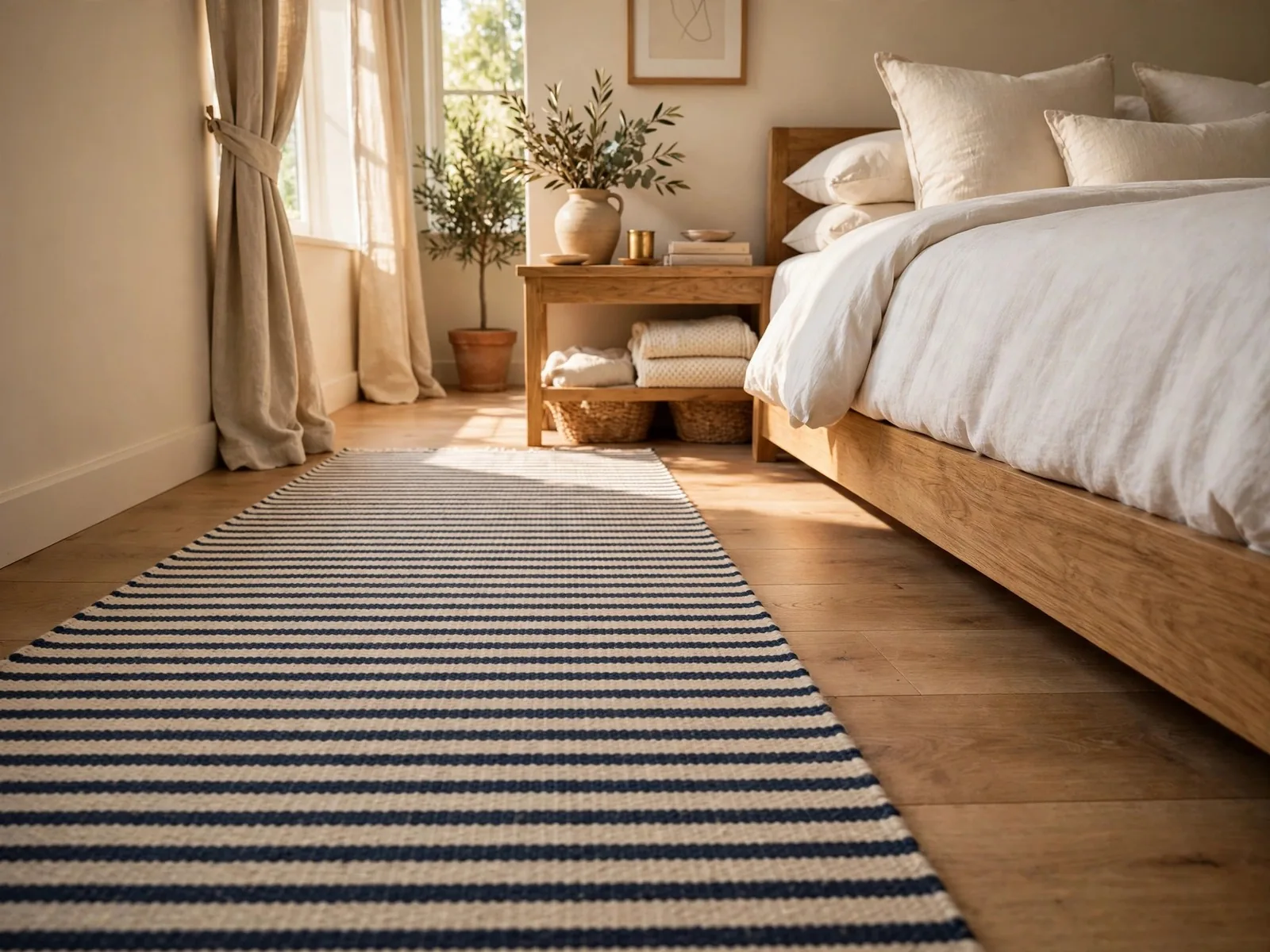
A runner is the honest rug. It covers the two strips of floor a bedroom really uses: the long side where you get out of bed and the path from door to closet. A standard runner at 2.5 by 8 feet dresses one side of a queen with border to spare. A pair, one per side, gives a big bed its finished look for a third of the price of the 9 by 12 that would do the same job.
Runners also solve the rooms a full rug cannot. Long narrow bedrooms, beds pushed against one wall and dorm rooms all take runners better than rectangles. In a rental or a dorm, a washable runner is the whole flooring plan in one roll, which is why our dorm room ideas post treats it as a first purchase.
Width is the number to check. A runner narrower than 24 inches reads as a mat and trips the eye; 30 inches reads as a floor decision. Leave 3 to 6 inches of floor between the runner and the bed frame so the edge sits flat and visible.
Measure: runners 24 to 30 inches wide, 6 to 8 feet long for one side of a queen, set 3 to 6 inches out from the bed frame.
6. Layer a patterned rug over a plain jute base
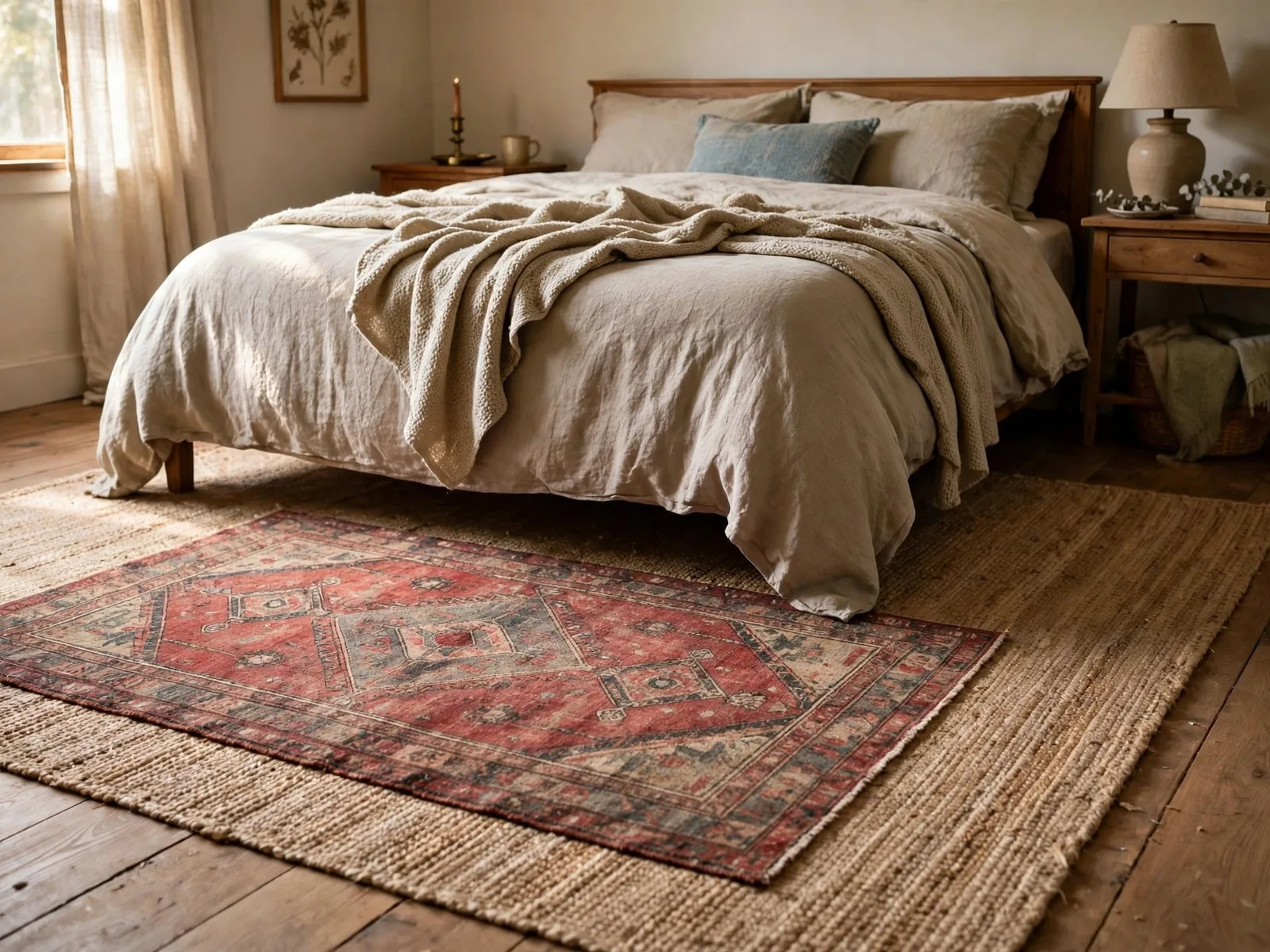
Layering is how a small or rented rug budget buys a big rug look. Put down a plain jute or sisal base one size up from the patterned rug you love, then center the patterned piece on top. The base gives you the borders the top rug cannot afford. The top rug gives you the color and pattern the base never had. This is the classic boho bedroom rug build. The boho bedroom ideas post runs the same two-layer logic across the whole room.
The proportions are the whole trick. The base should show an even border of 8 to 12 inches of jute on every visible side of the top rug. One size up usually lands there: an 8 by 10 jute under a 5 by 8 vintage-look top is the pairing that shows up in half the saved photos for a reason. Keep the top rug low pile so the step between layers stays a texture change and not a trip edge.
Layering also rescues the too-small rug you already own. If a 5 by 8 sits lost under your queen, it is not a mistake to return. It is a top layer waiting for its base.
Budget: a jute base runs $80 to $180 in 8 by 10, so the layered pair often lands below one big patterned rug. Show 8 to 12 inches of base on every side.
Placement and clearances
7. Choose one of the three placements and commit
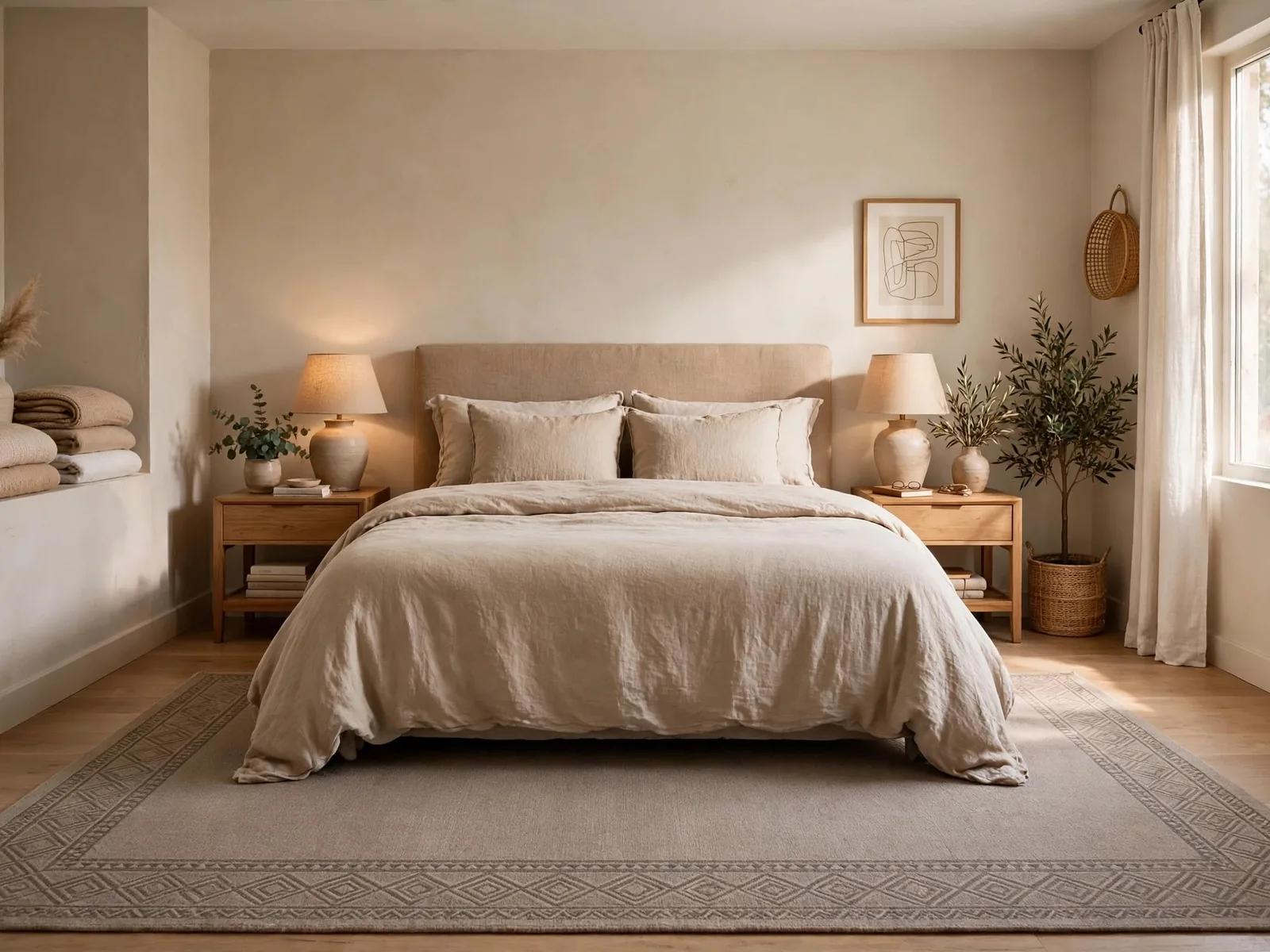
Every under-bed rug on the internet is one of three placements. All under: the rug runs the full bed and the nightstands stand on it too, which needs the biggest size and suits large primary rooms. Two-thirds under: the rug starts just below the nightstands, the bed’s head end sits on bare floor and the rug carries the sides and foot, which is the placement behind most good photographs. Foot only: the rug lies across the foot third of the bed like a wide runner, covering the standing zone and nothing else.
Bedroom rug placement ideas get argued about because all three are right in different rooms. All under reads luxurious and eats budget. Two-thirds under is the value pick, because the hidden third under the head of the bed is floor you paid to cover and never see. Foot only is the small-room and budget answer. It is the only placement that lets you change the rug seasonally without moving the bed.
Pick by what the placement hides. If the floor at the head of your bed is ugly, go two-thirds and cover the sides well. If the whole floor needs help, all under earns its price.
Measure: two-thirds placement starts the rug 18 to 24 inches below the headboard wall, clear of the nightstands, with side and foot borders from idea 2 unchanged.
8. Keep the door swing and the walkways clear
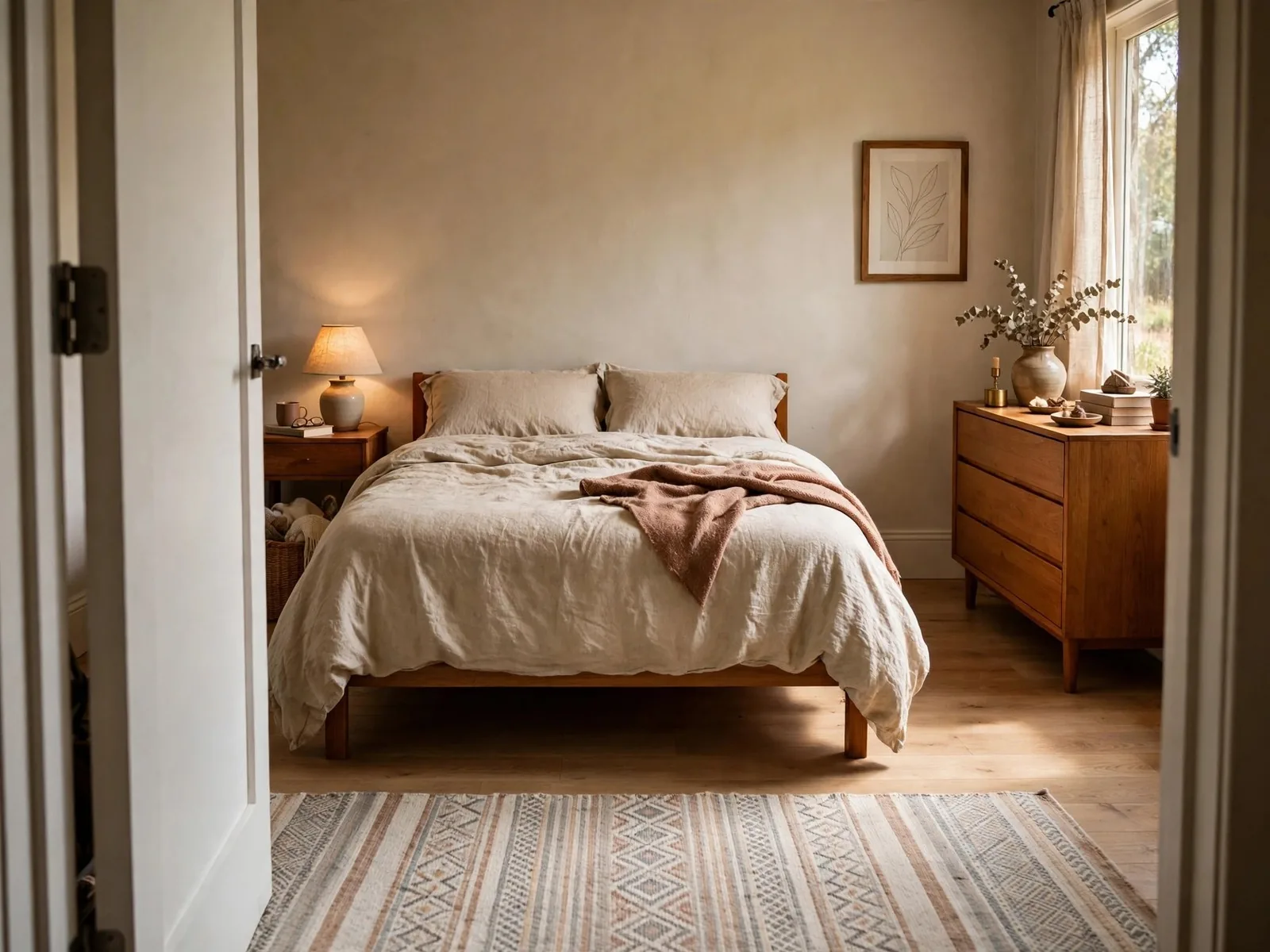
A rug fails quietly at its edges. The bedroom door usually needs its swing kept free of anything thicker than low pile plus pad, so test the full arc before the rug settles. Dresser drawers and closet doors get the same check: a drawer that shaves the pile every morning will winch the rug crooked within a month.
Walkways want numbers too. Leave 24 inches minimum between the bed and the wall or dresser on a passing side. The side you walk daily wants 30 to 36 inches. The rug edge should either sit fully inside the walkway or fully outside it. A border that lands mid-stride, half on and half off, is the one your heel finds in the dark.
This is where a rug plan meets the room plan, so if your clearances come out under these numbers the layout needs the fix and not the rug. Shrink the bed or move the dresser first, then size the rug to the room you actually have.
Measure: 24 inches minimum passing clearance, 30 to 36 inches on the daily walk side. Test the door swing over rug plus pad before you commit.
9. Put a real pad under it, cut smaller than the rug
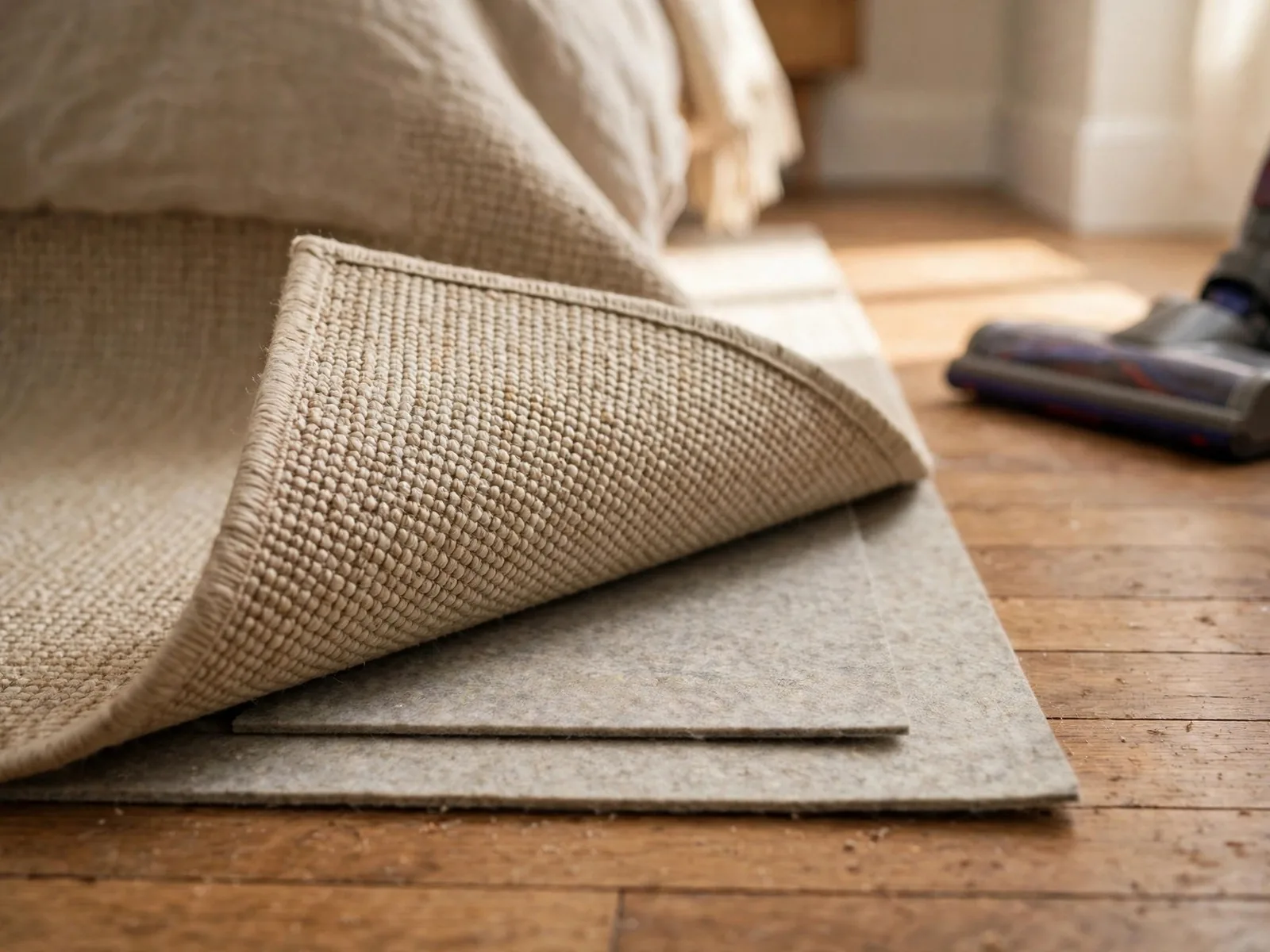
The pad is the least photogenic purchase in the room and the one that decides how the rug feels, sounds and lasts. A felt-and-rubber pad at a quarter to three-eighths of an inch adds the cushion your feet expected from the rug photo, stops the creep that walks a rug sideways across wood floors and keeps grit from grinding the rug backing against the floor.
Cut or buy the pad 1 inch smaller than the rug on every side, so 2 inches smaller in each dimension. That inset lets the rug edge taper down to the floor instead of teetering on the pad edge, which is the difference between a finished border and a visible lip that catches toes and vacuum heads.
On carpet the pad changes jobs. Skip the thick felt and use a thin rug-on-carpet pad or gripper sheet made for the purpose, because a standard pad under a rug on carpet bunches into ridges. Idea 10 picks this thread up.
Budget: $40 to $90 for a felt-and-rubber pad in 8 by 10. Buy the pad 2 inches smaller than the rug in both dimensions.
Mixing pieces you already own
10. Lay a rug over carpet without the creep
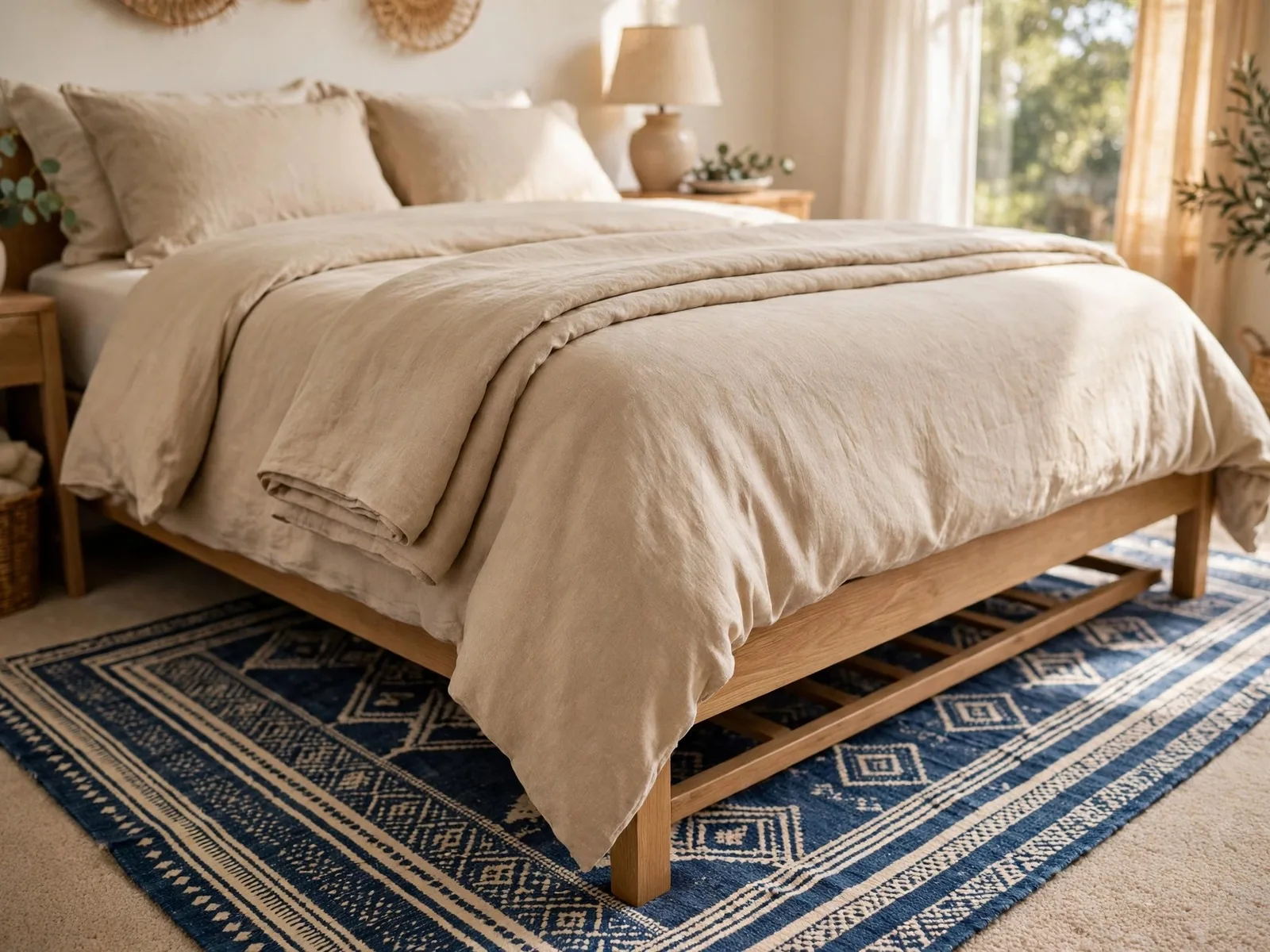
Rentals and plenty of primary suites come with wall-to-wall carpet you cannot change. A rug over it is the standard fix for a color or a worn patch you dislike. Pinterest boards tag it plainly as rugs on carpet. The rooms that work share one setup: a low-pile or flatweave top rug, a stiff rug-on-carpet pad beneath it and furniture weight pinning at least two edges.
The failure mode has a name every renter learns once: creep. A soft rug on a soft carpet walks, ripples and piles into a ridge against the bed leg. Fight it with structure, not tape. A flatweave cannot ripple the way a plush rug does. A pad made for carpet grips the pile below instead of skating on it. Keep high pile out of this stack entirely.
Size helps here too. An 8 by 10 with the bed standing on its top third is pinned by the heaviest object in the room, so the layering reads deliberate and stays put.
Renter-friendly: a flatweave over carpet plus a rug-on-carpet pad lifts out at move-out with nothing to repair. Keep the top rug low pile.
11. Mix the wood tones and let the rug do the bridging
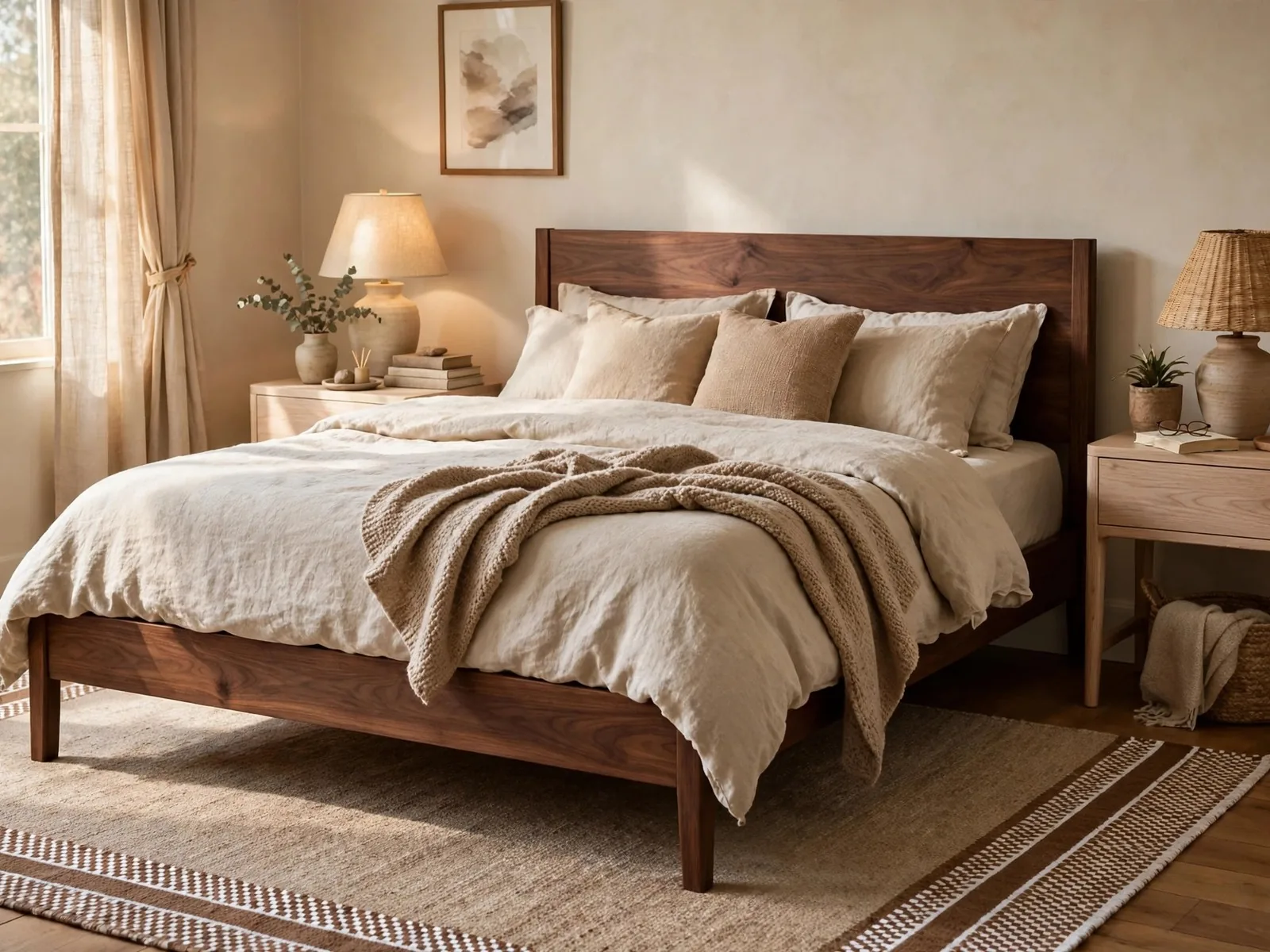
Should the furniture match? No. The rug is the reason it does not have to. A bed in walnut, nightstands in white oak and a dresser in a painted finish look collected rather than confused when one rug carries two of those tones in its border or its pattern. The rule from the furniture pages holds here: no full matching sets unless the set is styled as one deliberate story. A rug counts as the piece that ties mixed pieces together.
Name your tones before you order. Warm woods (walnut, cherry, honey oak) want a rug with warm threads in it, even a mostly neutral one. Cool and pale woods (ash, whitewash, grey-stained) want the rug’s neutrals leaning grey rather than cream. Upholstery follows the same logic: a linen headboard in oatmeal sits happily on a rug with oatmeal in the field.
This is also where rug color meets wall color. Pull one rug thread from your wall or bedding palette and let the rest of the rug be new, the same one-link rule we use across our bedroom color ideas post.
Measure: pick a rug that repeats at least two tones already in the room, one from the furniture and one from the bedding or walls.
12. Set a reading chair fully on the rug or fully off it
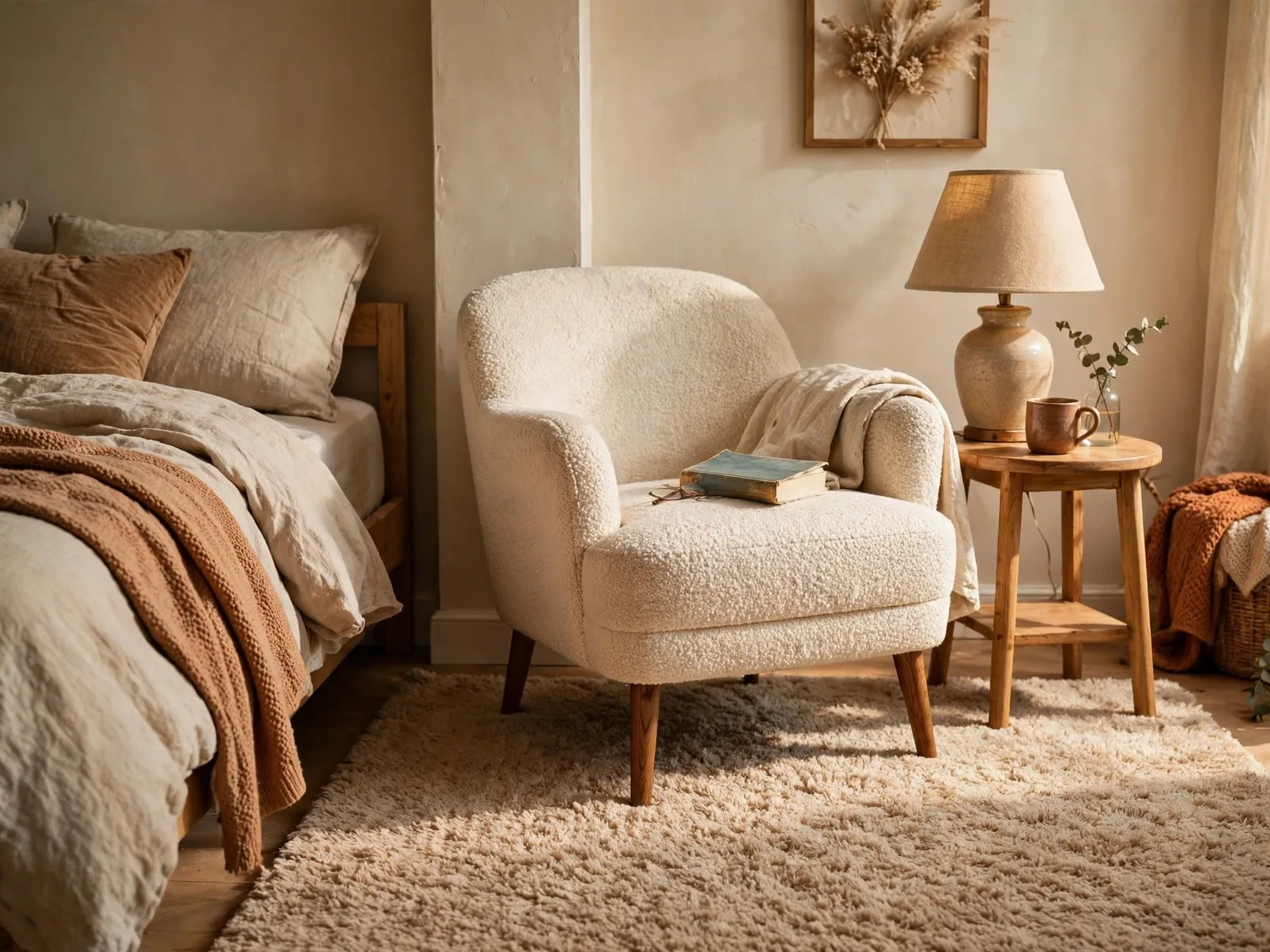
The corner chair is where rug plans quietly break. A chair with its front legs on the rug and its back legs off rocks on the border, chews the edge and drags the rug out of square. The rule is binary: all four legs on or all four legs off. Extending the main rug to take the whole chair is the cleaner answer when the chair lives at the bed corner.
Size the chair spot like a furniture spot. A reading chair with a seat height of 16 to 19 inches puts your feet flat on the rug pile, which is where the comfort of the corner actually happens. Give the chair a rug field of at least 36 by 36 inches under it, plus its side table on the same surface if the table has a round base that can tip on an edge.
If the main rug cannot reach, give the chair its own small rug at 3 by 5 and treat the corner as a separate room zone. Two rugs that each fit their job beat one rug failing at both.
Measure: chair seat height 16 to 19 inches, all four legs on one surface, with 36 by 36 inches of rug field under the chair minimum.
Bedroom Rug Ideas on a budget
The budget version of this page is an order of operations. First, the question every other section assumes: what should you buy first? The rug and its pad, before the nightstands and before the bench. The rug is the piece whose size constrains everything else in the room. It is also the piece that costs the most to return when guessed wrong. Furniture can be chosen around a rug that fits. A rug cannot be re-cut around furniture that does not.
Spend the money in that order. The free move comes first: pull your current rug out, tape its corrected outline on the floor with painter’s tape at the borders from idea 2 and live with the tape for two days. Half of all wrong rugs were the right rug in the wrong placement. Tape costs nothing. Then the pad, because a $60 pad under a $120 rug feels better than a $180 rug skating on bare floor.
Then shrink the coverage before you shrink the quality. Two washable runners at the sides of a queen do the daily job of a 9 by 12 for under $120 total. The foot-only placement turns a 5 by 8 into a finished look in a small room. The makeover logic is the same one our bedroom makeover ideas post uses: fix the biggest surface first and let small pieces wait. Vintage and flatweave cotton are the budget materials that age kindly, so a cheap rug reads as a choice instead of a compromise.
Mistakes that make it fall flat
- Buying the size that matches the bed’s name instead of its borders. A “queen rug” at 5 by 8 leaves 6 inches a side. The room looks furnished in the listing photo and mean in person. Run the border math from idea 2 before the size in the product title.
- Skipping the pad to save money. The rug then feels thin, sounds hollow, creeps across the floor and wears from underneath. The pad is not an accessory. It is half the product. It costs less than the return shipping on the rug it saves.
- Placing the rug half under the nightstands. One leg on and one leg off tilts the nightstand and walks the rug crooked every time a drawer opens. Start the rug below the nightstands or carry it fully under them. There is no stable middle.
- Choosing high pile for the whole field. It dents under every leg, fights the door and turns vacuuming into a workout. Keep high pile at the foot border where feet are the only traffic.
- Matching the rug to the furniture set. A rug bought to match a matched set doubles down on the showroom look and dates the whole room at once. Mix the woods and let the rug bridge them, as idea 11 sets out.
Questions people ask about this
What size rug should I buy for a small bedroom?
Start with a 5 by 8 under the lower two-thirds of the bed, which keeps an honest border at the foot. In rooms under 120 square feet, two runners at 24 to 30 inches wide often beat any rectangle. Hold 12 inches of rug past the bed sides as the minimum and leave 8 inches of floor at the walls.
How much clearance do I need around the bed?
Plan 24 inches as the minimum passing space between bed and wall and 30 to 36 inches on the side you walk daily. Inside that space the rug should extend 18 to 24 inches past the sides of the bed. Test the door swing over rug plus pad before the rug settles, because thick pile catches.
Should bedroom furniture match?
No. Mixed wood tones read collected when one rug repeats at least two of them in its border or pattern. A walnut bed, white oak nightstands and a painted dresser settle once the rug bridges them. Full matching sets are the exception and only work styled as one deliberate story, with the rug adding the contrast the set lacks.
The bottom line
A bedroom rug is a measurement with a pattern on it. Get the size from the bed, the borders from your feet and the placement from the clearances. The style layer becomes the easy part because almost any pattern reads well at the right size. This week, tape the outline of your corrected rug size on the floor at the borders from idea 2 and walk it for two mornings before you order anything. The tape will tell you your real size faster than any size chart. It costs one roll of painter’s tape.