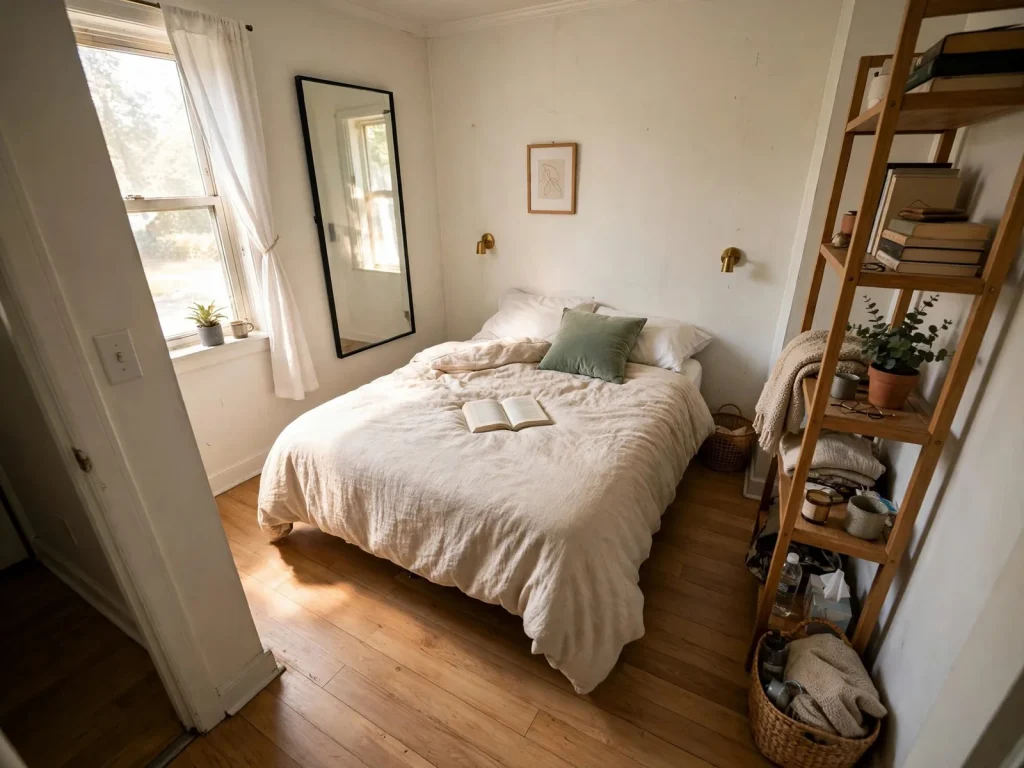
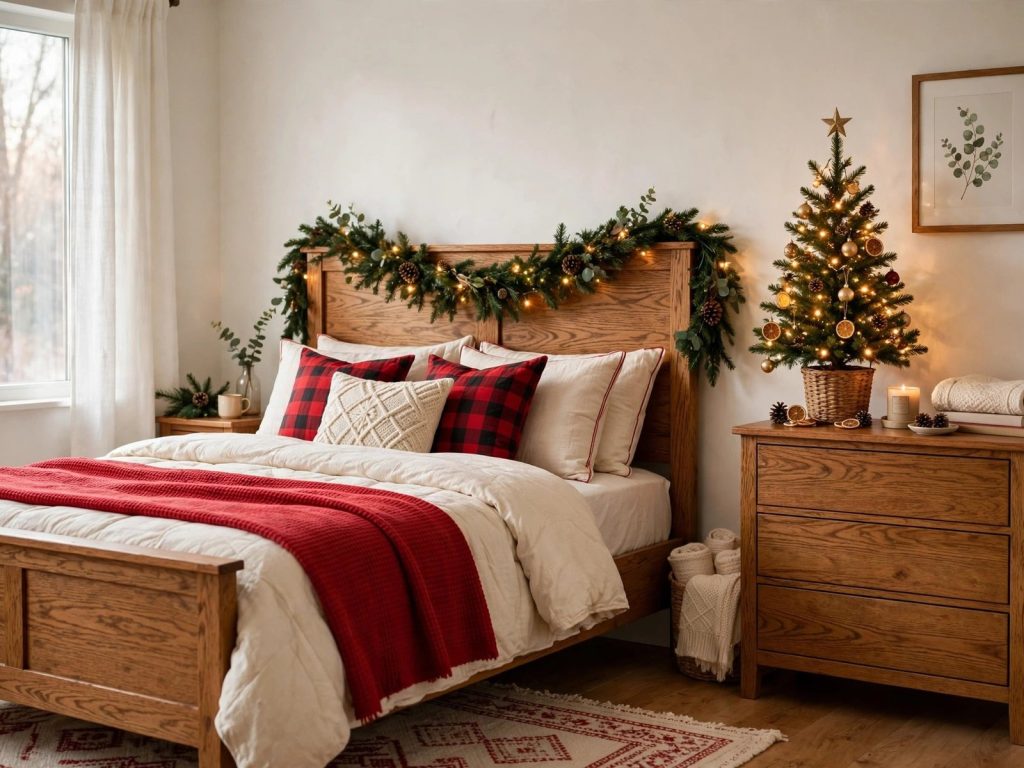
Every boho guide on the internet tells you there are no rules and then shows you rooms that obey several strict ones. The boho bedrooms that work are not accidents of eclectic shopping. They run on a quiet formula: a calm neutral base, natural materials everywhere, texture in every layer, one pattern family repeated and editing ruthless enough to keep “collected” from sliding into “cluttered”. The ones that fail broke the formula while believing there wasn’t one.
This page gives you the formula first, then 18 ideas zone by zone (bed, walls, floor and the living layer of plants, light and personal things), each with its proportions and its price band. Boho is one of the cheapest styles to do well and one of the easiest to do badly; the difference is almost never money. More styles live in our bedroom styles section, the full idea bank is the bedroom ideas pillar and the closest cousin to this page is earthy bedroom ideas.
Before you start: the boho audit
Walk your room and count two things. Textures: linen, wool, jute, rattan, cane, wood grain, ceramic, cotton weave: a working boho room has at least five within sight of the door. Patterns: count the unrelated pattern families competing (a floral, a geometric, a tribal, a stripe that belongs to none of them). A working boho room has one dominant pattern family, repeated, plus texture doing the rest of the talking.
If your counts come out backwards (two textures, five patterns), you own the standard failed boho room and the fix is subtraction and swapping, not shopping. Boho budgets go further than any other style’s because the materials are old, natural and thrifted by design.
Measure: nothing to measure this time. Count. Five textures minimum, one pattern family in charge.

The formula: what makes this style
Four commitments and the style follows. A neutral base carries about 60 percent of what you see: warm white or cream walls, undyed linen, pale wood, jute. This is the part the “no rules” guides skip and it is why their rooms photograph calm while yours feels busy. Natural materials do the decorating: if it grew, it belongs; plastic and chrome are the foreigners here. Texture replaces color as the interest: where a modern room uses contrast, boho uses the difference between nubby and smooth, woven and carved. One pattern family repeats: a vintage rug’s motifs echoed in a cushion and a throw is a scheme; four unrelated prints is a jumble sale.
Hold those four and you can add almost anything personal. Break the first and third and no amount of macramé will save the room.
The bed: where boho is won
1. Start with undyed linen or cotton bedding as the base
The boho bed’s foundation is plain: washed linen or crinkled cotton in white, cream or oatmeal, deliberately un-ironed. This base is what lets everything layered on top be patterned and colored without chaos. It is also the most comfortable bedding most people ever sleep in, which is not a coincidence; boho began as a way of living, not a way of photographing.

Buy the best base set you can and let it be boring. Its job is peace.
Budget: $60 to $120 for a linen or linen-blend set that outlasts three fashion sets.
Wash it before the first sleep. Linen softens with every wash. Cotton crinkle arrives ready. Either way, skip the iron entirely. Creases are not a flaw here. They are the texture. A boho bed that looks pressed looks wrong and everyone who enters the room will feel it before they can name it.
2. Layer two throws: one patterned, one pure texture
Across the foot of the bed, the boho signature: two throws, never three. One carries the room’s pattern family (the vintage print, the woven stripe, the block print). The other carries texture only (chunky knit, tasseled cotton, a nubby weave) in a color pulled from the first. Folded in thirds or draped with intent; “thrown” is a styling decision, not an accident that photographs well by luck.

Rotate them seasonally and the bed changes its personality for the price of storage space.
Budget: thrifted throws run $5 to $20; this layer is the cheapest style per dollar in the room.
3. Run the cushion formula: three sizes, odd numbers, one pattern
Boho beds look abundant, but the good ones are counted: sleeping pillows, then two large squares, then one long lumbar or a single round cushion in front. Three sizes, an odd total and only one patterned fabric among them, echoing the throw. The rest are texture (linen, embroidery, a woven stripe) in the palette’s colors.

The failure mode is seven cushions in five patterns, which reads as a soft-toy shelf and makes the bed nightly. If you have to move more than four cushions to sleep, the bed is decorated past its job.
Budget: cushion covers in natural fabrics run $10 to $25 each; the formula needs three to five, total.
4. Choose a rattan, cane or carved-wood headboard
The headboard is boho’s main furniture statement and the materials are the message: rattan’s curves, cane’s weave, or wood carved with a pattern. All three bring texture at the room’s focal point and none of them needs upholstery’s formality. A peacock or sunburst rattan shape is the exuberant version; a simple arched cane panel is the calm one.

Secondhand rattan is plentiful and cheap because it was everywhere in the 1970s too. Check cane tension and frame joints; both are repairable, neither is free.
Budget: $40 thrifted to $300 new. Light enough to hang, which keeps renters in this idea.
5. Drape a sheer canopy or a length of fabric over the bed
The canopy is boho’s romance move: sheer cotton or linen draped over a canopy frame, hung from ceiling hooks over a plain frame, or swagged from a branch or rod above the headboard. It softens the bed’s outline, filters morning light and makes an ordinary bed feel like a destination.

Keep the fabric washable and the draping loose; a tight, styled canopy reads bridal, a loose one reads bohemian. In rentals, two removable hooks and a length of muslin achieve it with no frame at all.
Renter-friendly: the hook-and-muslin version entirely. Budget $15 to $40 of fabric for the full effect.
Walls and ceiling: texture overhead and behind
6. Hang one large woven piece above the bed: macramé, tapestry or a rug
The wall behind a boho bed wants fibre, not frames: a macramé hanging with real scale, a woven tapestry, or a flat rug hung as art. Size follows the house rule, at least two-thirds of the bed’s width, because a small hanging on a big wall reads as a dreamcatcher that got promoted beyond its ability.

Macramé is the craft-store version and it is fine; the woven rug is the heirloom version and it is better. Either way, one piece, hung flat, at the center of the bed wall.
Budget: $25 to $80 buys scale in macramé; a thrifted rug-as-art often costs less and weighs more, so hang it accordingly.
7. Build the gallery wall with a frame discipline
Boho gallery walls exist and the good ones cheat: the frames share a family (all wood tones, or all thin and dark), the art shares a temperature (warm prints, textiles, photographs in sepia or warm color) and the arrangement has aligned edges somewhere in it, a common top line or a central axis. Inside that discipline, the content can be as personal and mixed as you like.

Without the discipline you get the common failure, a wall of unrelated frames that reads as storage. The personality is in the pictures; the calm is in the frames.
Measure: lay the arrangement on the floor at full size and photograph it before a single hook goes in.
8. Cluster woven baskets as wall art
A grouped cluster of flat woven baskets or trays on the wall (five to nine pieces, overlapping slightly, sharing natural tones) is boho’s cheapest large-scale art and its most forgiving: there is no level line to get wrong and the arrangement grows one thrifted basket at a time. Start with the largest at the visual center and build outward in odd numbers.

Baskets with one accent color woven in can carry the room’s accent better than any print. Keep the cluster’s edge irregular; a perfect circle of baskets reads as a shop display.
Budget: $3 to $10 per basket secondhand. A whole wall for under $50 is normal, not lucky.
Hang them with small nails or removable hooks. Vary the depths a little. Flat trays and deep baskets together make shadows and shadows are free texture. Stand back after the fifth basket. Look for the cluster’s silhouette, not its contents. If the outline pleases you, the wall is done. If it looks like a row, break the row.
9. Hang a woven pendant and light the ceiling's texture
A rattan, bamboo or seagrass pendant over the room’s center (or woven shades on the lamps) does three boho jobs at once: it puts a natural material overhead, it patterns the light into dapples and it gives the ceiling a focal point that is not a bare bulb. Woven shades run warm by nature, so pair them with 2700K bulbs and let the shadows be the decoration.

Scale up: a pendant that looks slightly too large in the shop looks right over a bed, because the bed is a large object asking for company.
Budget: $30 to $90 for a woven pendant shade that fits an existing fitting. No rewiring, all effect.
Floor and furniture: the grounded layer
10. Layer the rugs: a jute base with a vintage-pattern top
The signature boho floor: a large, flat, natural jute or sisal rug as the base, with a smaller patterned vintage-style rug layered over it at the bed’s foot or side. The base gives scale and texture cheaply; the top gives the pattern family its biggest statement. Extend the base rug well under the bed (the standard sizing rules apply) and let the top rug sit where feet land.

Layering also solves the vintage-rug size problem: beautiful old rugs come in odd, small sizes and the jute base makes any of them big enough.
Budget: jute runs about $1 to $2 a square foot; the vintage top is a thrift or marketplace hunt, $30 to $150 in runner and small sizes.
One honesty note. Jute is not soft. It is honest, textured and slightly rough and that roughness is the point of the base layer. Bare feet get the top rug. The base is for the eye and the budget. Anyone who promises you a plush jute experience is selling something. Layer and let each rug do the job it is good at.
11. Mix wooden furniture freely within one tone family
Boho furniture does not match; it harmonises. The discipline is tone: keep every wooden piece inside one family (all warm mid-tones and honey woods, say) and shape, era and origin may vary as wildly as the thrift stores provide. A carved Indian side table beside a plain pine dresser works, because their wood speaks the same warmth.

What breaks it is tone collision: an orange pine, a grey-wash and a dark walnut in one small room read as three rooms arguing. Test pieces by photographing them together in daylight before they move in permanently.
Budget: this idea is the thrift economy’s home ground. Mismatched within a tone costs less than matched ever did.
12. Put seating on the floor: cushions, a pouf, a low bench
Floor cushions and a leather or woven pouf give boho its campfire sociology: people sit low, close and informally. One floor station is enough (a cushion pair beside a low bench, or a pouf at the dresser’s side), placed where a person might actually sit to put on shoes or read.

Keep floor textiles in the cleaning plan. If the vacuum cannot reach it and the washing machine cannot take it, it will become the room’s quiet shame by spring.
Budget: poufs run $30 to $80; large floor cushions $20 to $40 and both thrift beautifully.
13. Let one vintage piece anchor the room
Every strong boho room has one piece with a past: a trunk at the foot of the bed, a carved mirror, a worn leather chair, a dresser whose handles have been changed by three owners. It anchors the room’s story and licenses everything newer around it. Choose it for love, not for coverage and give it the position of honour, because it is carrying the room’s claim to be collected rather than purchased.

One anchor is the dose. Three “statement vintage pieces” compete and the room becomes an antique stall.
Budget: unknowable and that is the point; trunks and mirrors in honest condition run $30 to $150 in most markets.
14. Make baskets the storage system, visibly
Boho storage is not hidden; it is woven. Baskets hold the throws, the laundry, the chargers, the clutter that other styles conceal and displaying them in natural fibres turns storage into texture. A lidded basket is the style’s junk drawer; an open one by the bed is its nightstand overflow.

Sizes graduate (large for blankets, medium for laundry, small for the bedside tangle) and the system works because it is honest about how rooms actually live.
Budget: $8 to $25 a basket new, less thrifted. The system costs less than one closed cabinet.
The living layer: plants, light and personal things
15. Plant in threes: one tall, one trailing, one small
Boho’s greenery has a composition: a tall plant giving the corner height, a trailing plant spilling from a shelf or hanging planter and a small one on a surface. Three plants at three heights read as a garden; seven small pots on one sill read as a collection awaiting a decision.

Choose forgiving species (pothos trails and forgives; snake plants stand and forgive) unless you are genuinely a plant person, because dead plants are the one boho accessory that argues against the whole philosophy. Dried grasses and eucalyptus stems are the zero-maintenance branch of this idea and they suit the palette exactly.
Budget: three real plants in simple terracotta run $25 to $50 total. Terracotta is the style’s default pot for a reason.
Terracotta drinks water through its walls. That is a feature. It keeps roots from drowning and ages into a patina no plastic pot can fake. Group the pots odd-numbered. Water on one schedule, weekly, same day. Plants in this style are composition first and botany second, but they do have to survive their composition. Forgiving species are not a compromise. They are the professional choice.
16. Light low and warm: lanterns, woven shades, candles
Boho light is firelight’s family: low sources, warm color, patterned shades. Lanterns with candles or flameless equivalents, woven lamp shades and one string of warm lights (once, per the lighting page’s restraint rule) build an evening that matches the textiles. The ceiling light is this style’s natural enemy and should be off by default after dark.

Dappled light through woven shades is the signature effect: it turns plain walls into patterned ones for the cost of a lampshade.
Budget: lanterns and candles run $10 to $30. This layer is mostly arrangement, not purchase.
17. Display personal objects under an edit: one shelf, chosen things
Boho’s soul is personal objects and its discipline is the edit: one shelf or surface where the travel finds, stones, photographs and small artworks live, chosen and rotated, rather than every surface carrying three objects each. An edited display makes visitors look; an unedited one makes them glance and move on.

The test for each object: does it have a story you would tell? If not, it is texture and texture should be a basket or a textile, not a souvenir. Rotate seasonally and the room stays a memoir instead of becoming a museum of itself.
Budget: $0. Editing is free, which is why it is the most skipped step in the style.
Rotation is the trick that makes editing painless. Box the overflow. Swap pieces at the season’s turn. Objects rest and returning ones feel new again. Museums do this. Galleries do this. Your shelf can do this. The box in the closet is not a failure of minimalism. It is the style’s lending library.
18. Leave one surface and one wall genuinely bare
The final idea is the formula’s enforcer: boho needs negative space to read as calm. One wall with nothing on it, one surface (usually the dresser’s far half or the nightstand) kept clear. The eye rests there and everything textured nearby reads richer for the contrast.

If every surface in your boho room holds objects, you do not have a boho room yet; you have the supplies for one. Edit until one wall breathes. It is the cheapest idea on this page and the one that photographs best.
Budget: $0 and it cannot be bought later at any price once the room is full.
Color and textile combinations that hold the style
The warm earth scheme (the classic): cream base, terracotta and rust as the mid-tones, olive or deep green as the cool note, natural wood and jute as the frame. This is the 29,800-searches-a-month boho most people mean and it suits north and south light alike because its warmth is carried by textiles, not walls.
The modern neutral scheme: ivory, oatmeal, sand and pale wood, with black or charcoal in tiny doses (a frame, a lamp stem) for definition. Texture does all the work. This is the version for small rooms, bright rooms and anyone whose partner fears the word boho; it reads as calm Scandinavian until the woven wall gives it away.
The blue exception: dusty blue and faded denim can carry boho if every other element stays warm and natural (rattan, warm wood, cream). Blue boho fails when the textiles also go cool; keep the fiber palette warm and the blue reads as a collected indigo textile, which is historically the most boho fabric of all.
Boho bedroom on a budget: the order to buy
First $50: two throws and three cushion covers in the formula, all thrifted or discounted, on your existing bedding. The bed carries the style furthest per dollar. Next $50: the basket wall or one large macramé, plus the basket storage system started. Next $100: the jute base rug, which grounds the room and makes every smaller vintage rug usable later. Furniture, frames and canopies come after, bought slowly and secondhand, because speed is the one thing this style never needs. A boho room assembled in a weekend looks assembled; the style’s whole point is that it was not.
Mistakes that make it fall flat
- Skipping the neutral base. Pattern on pattern on color is the failed version. Sixty percent calm is the formula’s first rule and it is the one the “no rules” guides never mention.
- Texture poverty. A boho room with smooth bedding, a smooth rug and painted furniture is a room wearing a macramé hat. Count five textures or the style is not present.
- Pattern anarchy. One family, repeated. Four unrelated prints is not eclecticism; it is four rooms sharing a bed.
- The souvenir landslide. Personal objects without an edit. One shelf of stories beats six surfaces of stuff, every time.
- Cool light. A 4000K bulb undoes a day of textile work every evening. Warm bulbs are load-bearing in this style.
- Newness everywhere. A boho room bought entirely new in one order smells of the warehouse. The style needs age somewhere: one vintage piece, minimum and thrifted textiles wherever possible.
Questions people ask about this
What defines this style in a bedroom? A calm neutral base carrying natural materials and layered texture, with one pattern family repeated and personal objects edited rather than scattered. In practice: linen and jute and rattan in view, five or more textures, warm light and at least one piece with a past. With those, a room reads boho in a thumbnail; a lone macramé hanging does not.
How can I get this look on a budget? Thrift the layers in the order this page gives: throws and cushions first, baskets second, a jute base rug third and furniture slowly and secondhand after that. Boho is the most thrift-compatible style there is, because its materials are natural and old by design. Two hundred dollars and patience outperform a thousand dollars spent in one new order.
What colors go with this style? Warm earth first: cream and oatmeal bases, terracotta, rust, clay and mustard as mid-tones, olive as the cooling note. The modern version runs ivory, sand and pale wood with tiny black accents. Blue works only as dusty, faded indigo with everything else kept warm. A cool grey-blue palette never works; it fights the natural materials.
What is the most common mistake with this style? Believing it has no rules and filling the room until collected becomes cluttered. The fixes are the formula: restore the neutral base, get patterns down to one family, edit personal objects to one display surface and leave one wall bare. Most failed boho rooms are one afternoon of subtraction away from working.
The bottom line
Boho is not the absence of rules; it is a short list of them, generously applied: a calm base, natural materials, texture everywhere, one pattern family and an edit with the courage to leave a wall bare. Get those five right and the room can absorb anything you love. This week, do the audit: count your textures and your patterns, then fix whichever number is upside down. The style is usually already in the room, waiting for its subtraction.