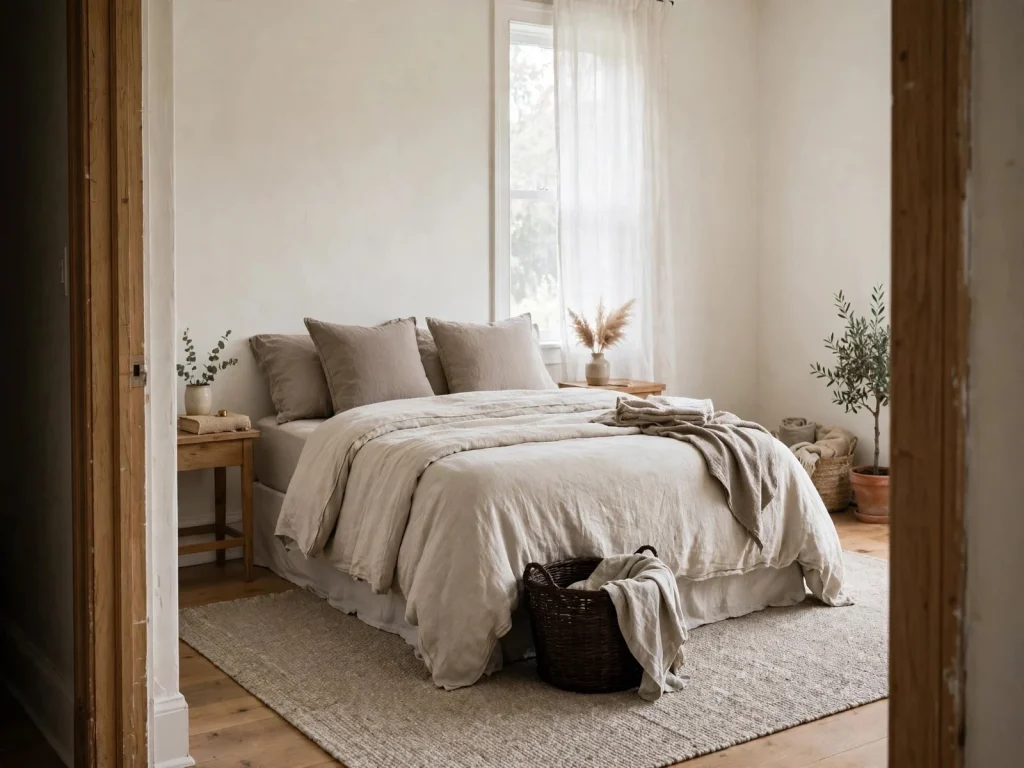
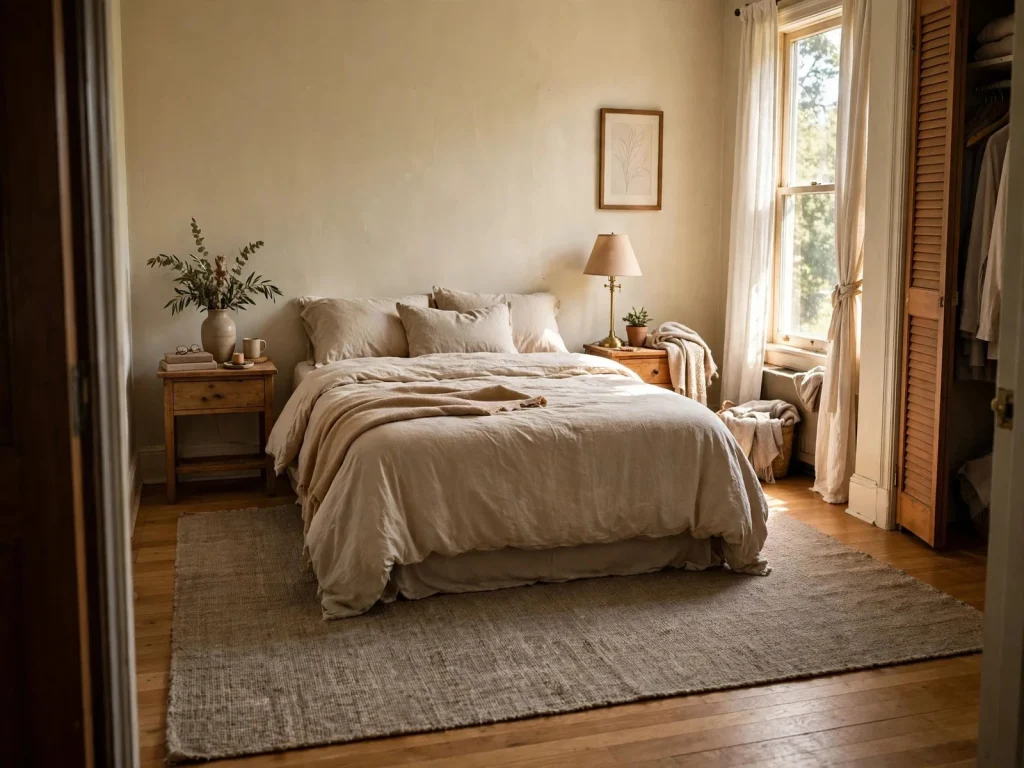
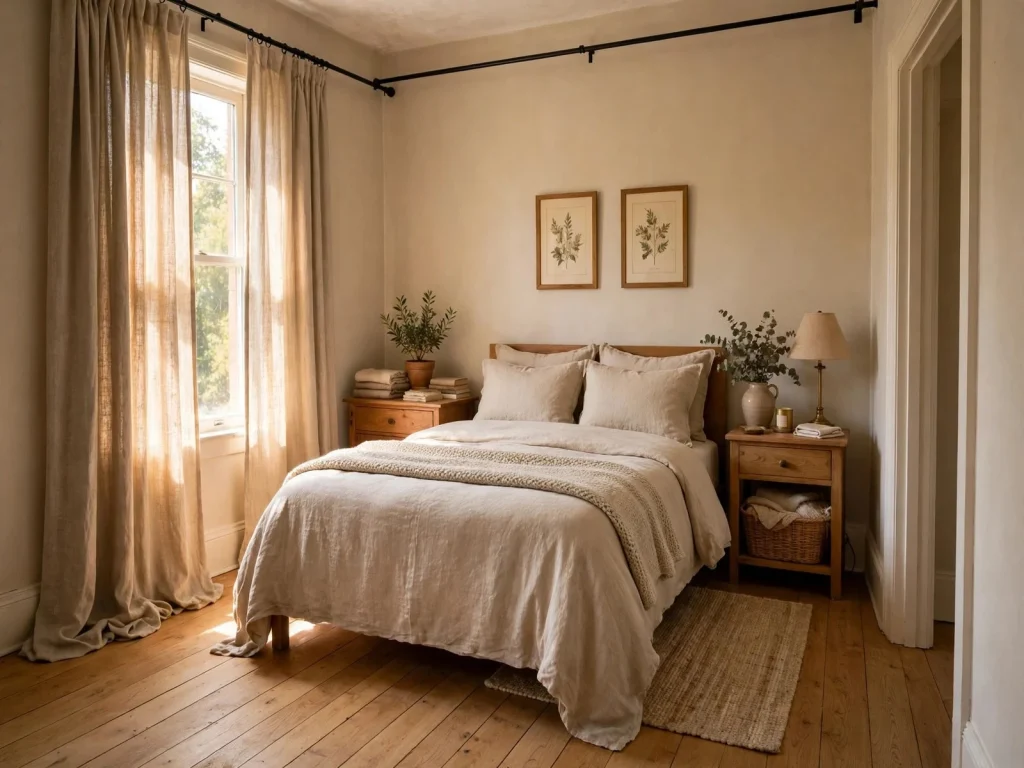
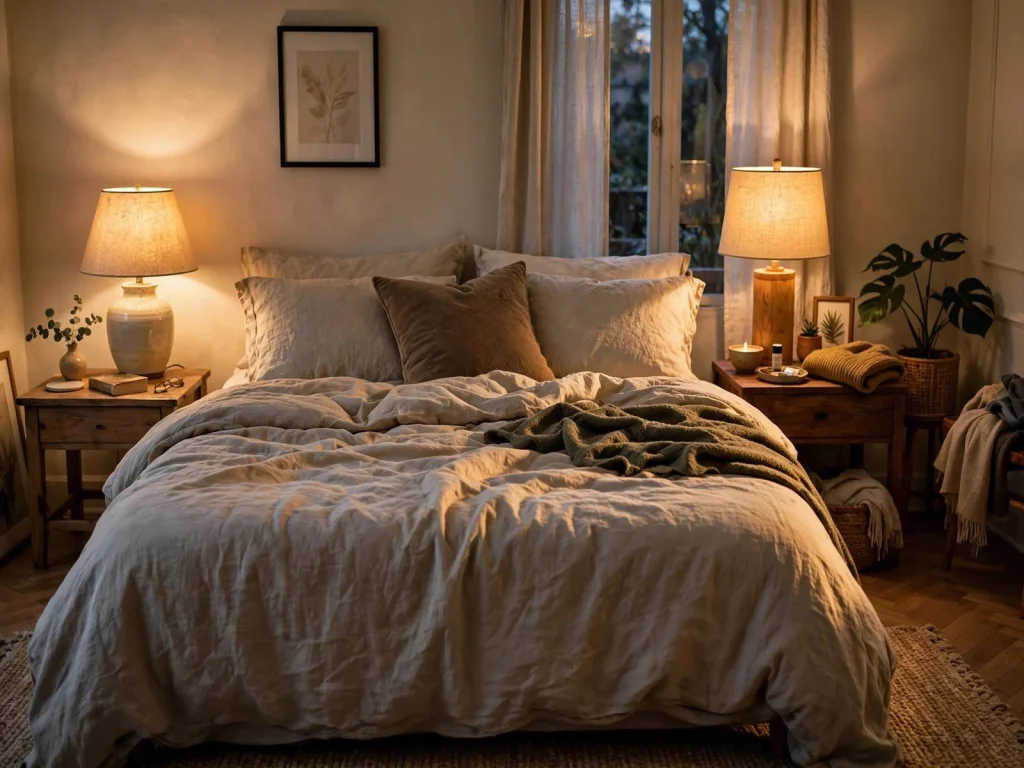
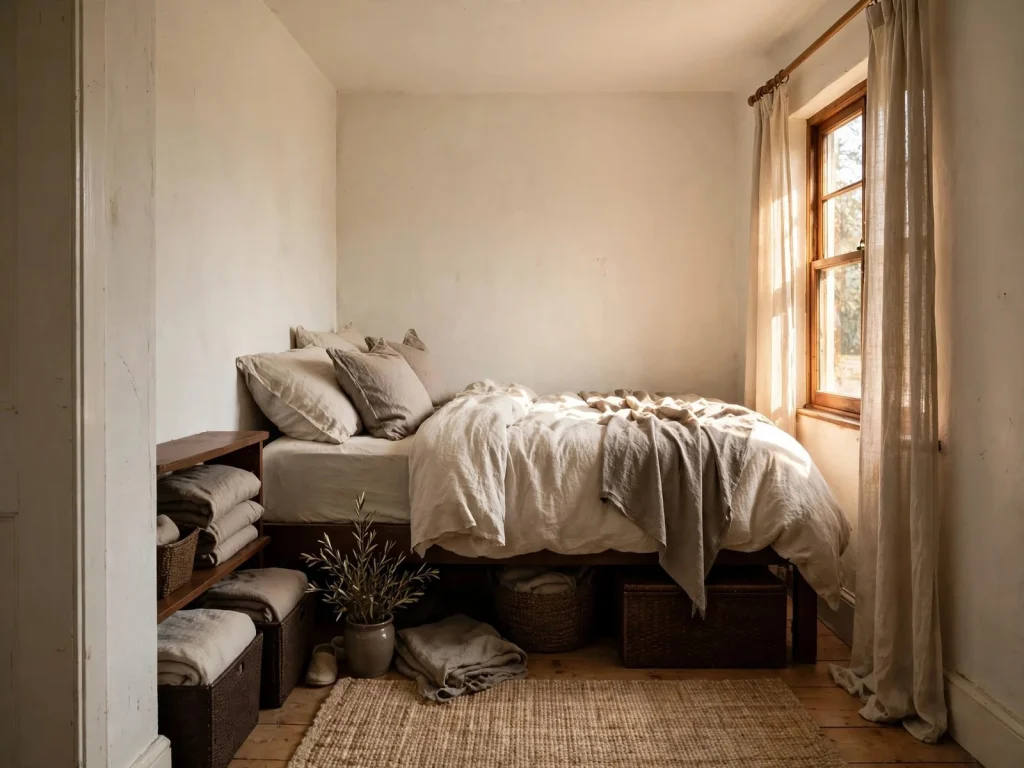
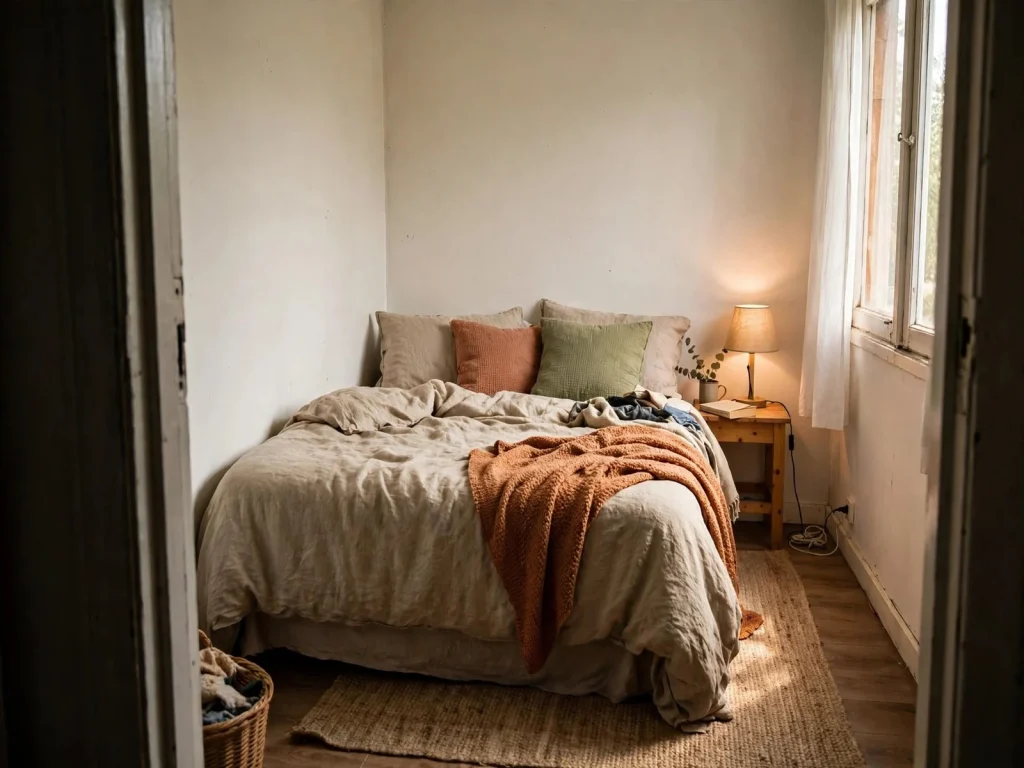
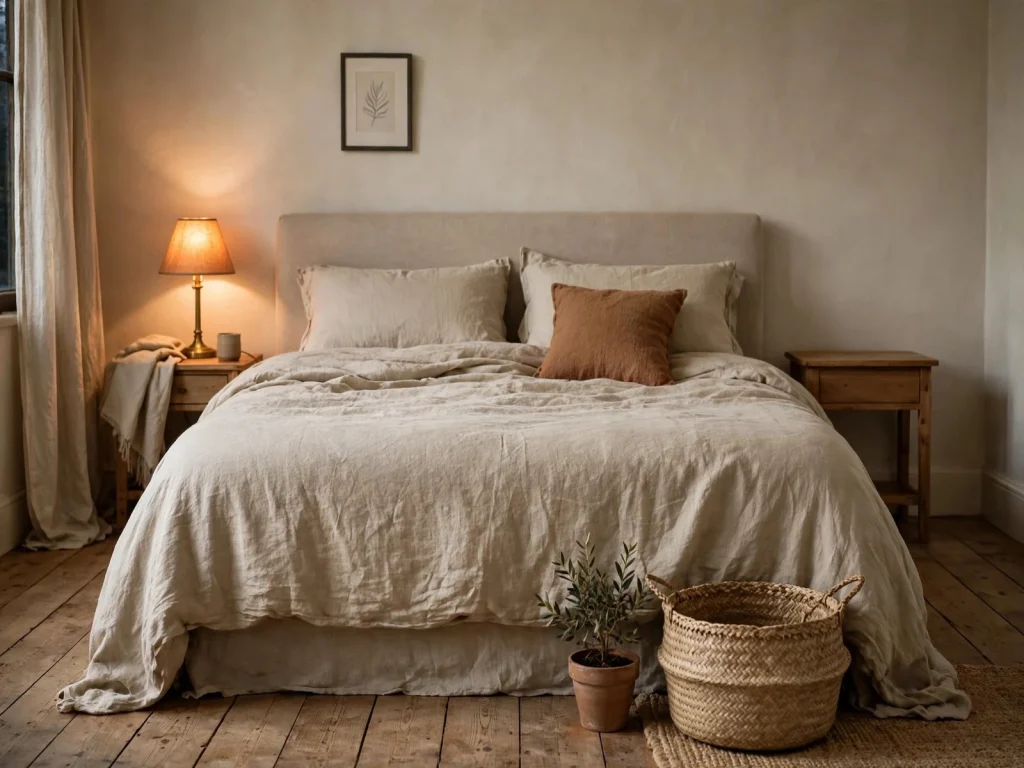
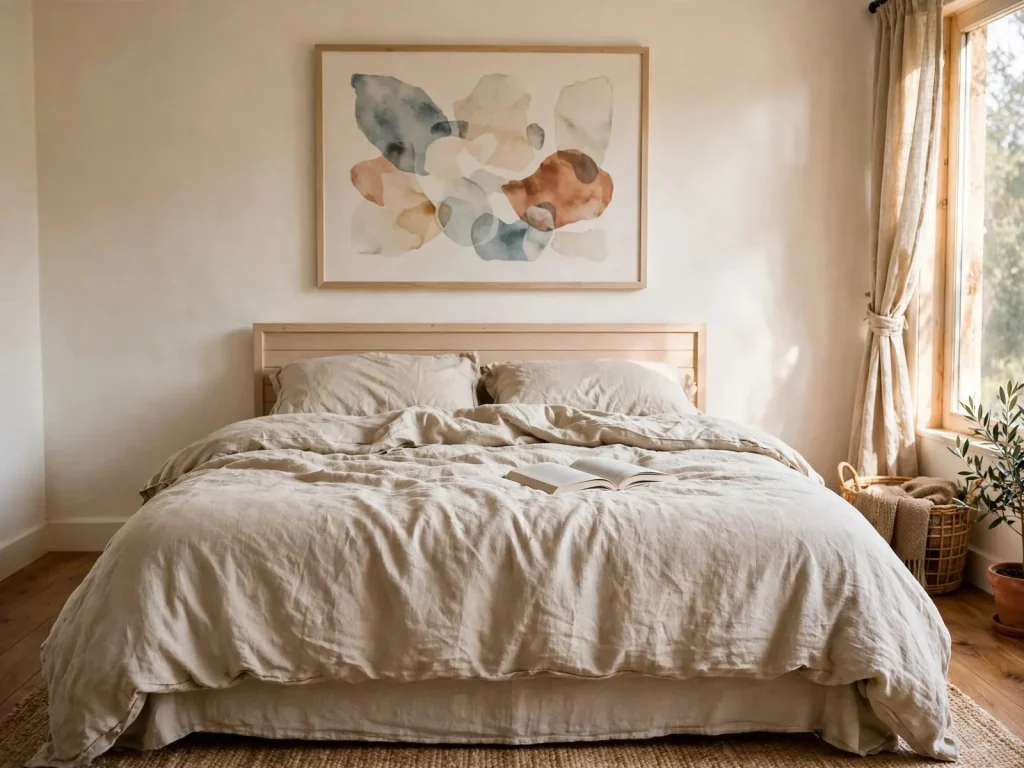
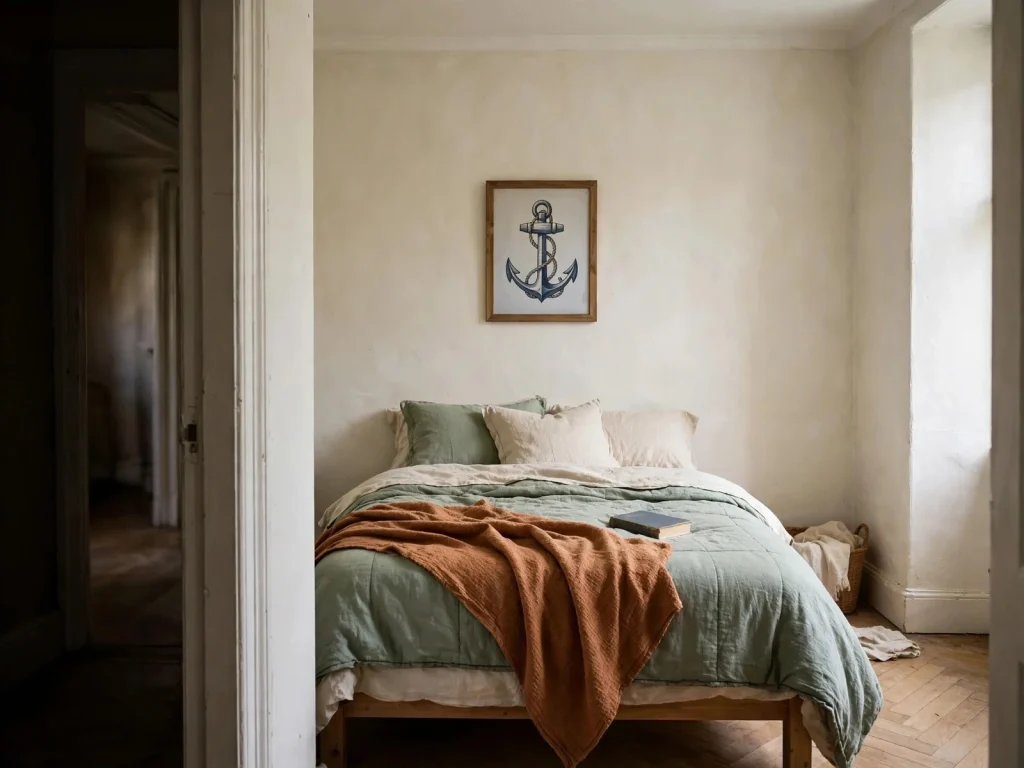
Your bedroom is already neutral and it already feels flat. The walls are pale, the bedding is pale and the rug is pale, so the room reads cold in the morning and grey by lamplight. You do not want a loud color to fix it. You want the same quiet palette to feel warm at night.
These cozy neutral bedroom ideas fix the cozy half instead of swapping the palette. Every idea states its tone count or its texture count or its light temperature, so you can count what your room is missing. Warm neutral bedroom ideas are covered inside this method rather than split into a competing page. The plain palette starting point sits in our first post on this palette.
Before you start: measurements, costs and renter rules
Measure the bed before anything else. A twin is 38 inches wide and 75 long, a full is 54 by 75, a queen is 60 by 80 and a king is 76 by 80. Then measure the wall behind the bed and the floor area a rug has to cover. Tone work fails when scale is wrong, because five tones squeezed onto a twin read as clutter while the same five spread across a king read as depth.
Costs here are rough cost notes for single pieces. A knit or wool throw runs $35 to $90, woven cushion covers run $25 to $60 for a pair and a 5 by 8 warm neutral rug runs $120 to $300. A bulb swap for the whole room runs $15 to $30 and comes first in any budget, because light changes every tone you already own.
Renters, most of this page needs no permission. Throws, cushions, bedding, rugs and plug-in lamps leave no marks. Ideas that need drilling are flagged on their idea line. Keep receipts for a week, because undertone clashes often show up on day three under different weather.
Building a neutral palette with 3 to 5 tones
1. Run 3 to 5 tones from lightest to darkest
A neutral bedroom needs 3 to 5 tones from lightest to darkest in one room, named as a range: warm white, oatmeal, greige, taupe and espresso brown. Assign one tone per layer.
The catch is skipping a step. A jump from warm white straight to espresso reads harsh, so fill the middle with oatmeal or greige first.
Measure: count 3 to 5 distinct tones from the doorway, with no gap bigger than one step.
2. Test undertones against the bedding in daylight and lamplight
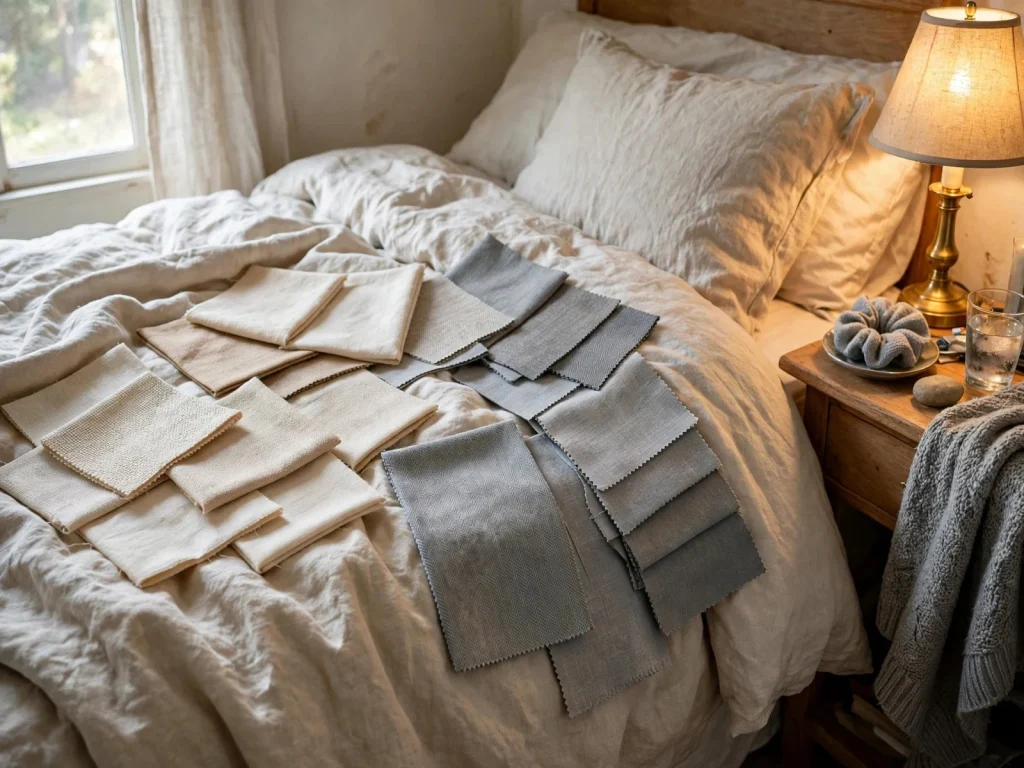
Warm neutrals carry a yellow or pink undertone and cool neutrals carry a blue one. A blue-undertone grey beside a yellow-undertone cream fights all day.
Test every paint or fabric against the bedding in daylight and again under lamplight. The catch is testing in one light only.
Measure: test each new tone twice, daylight and lamplight, held directly against the bedding.
3. Put one darkest item and one lightest item in every view
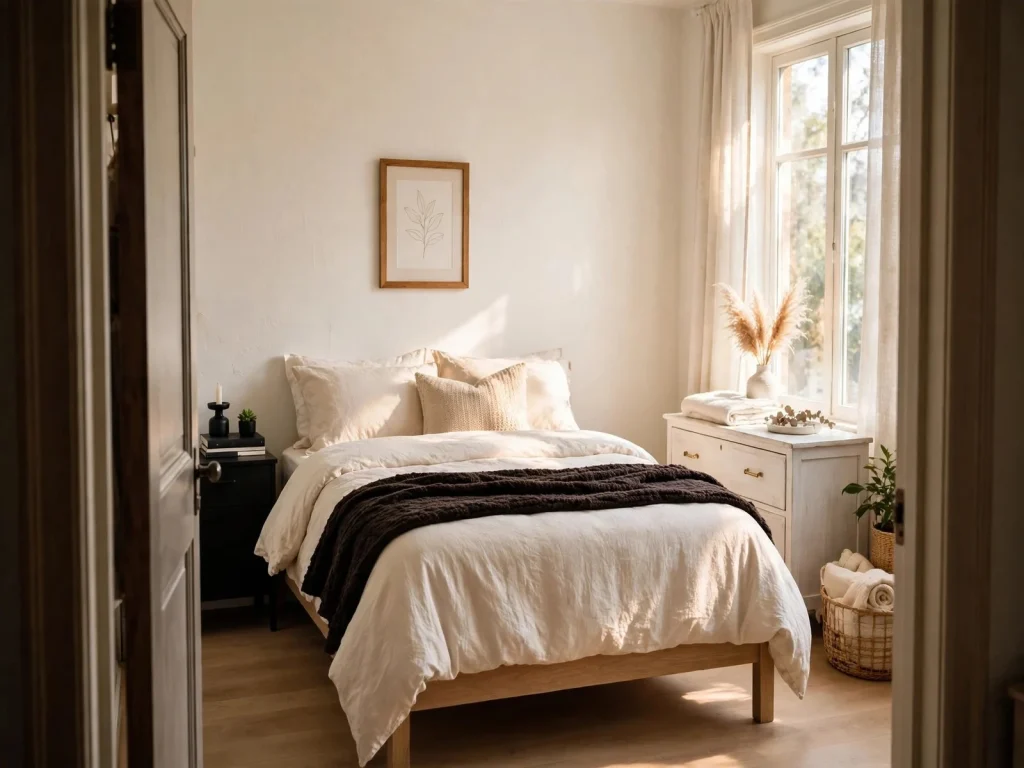
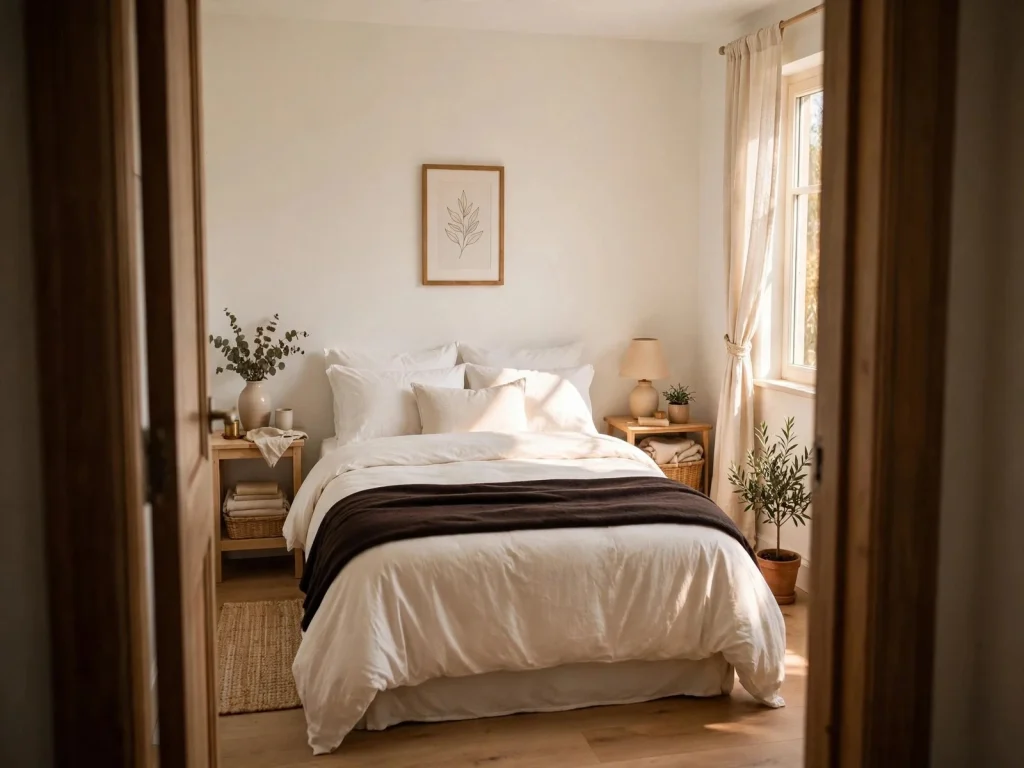
A cozy neutral bedroom needs contrast: one darkest item and one lightest item in every view of the room, so the palette has a floor and a ceiling. From the door, that can be an espresso throw against warm white bedding.
Keep the dark dose to one clear piece per view. Three small dark items read as clutter.
Measure: from each doorway view, check for one darkest item and one lightest item in the same frame.
4. Add one black edge for depth
Neutral and black bedroom ideas work when black is an edge rather than a theme. One matte black picture frame or one slim black lamp sharpens every soft tone around it.
Keep the count to one or two pieces, with a matte frame at 16 by 20 inches as the standard dose. The catch is glossy black, which bounces light and reads cold.
Budget: one matte black frame or lamp runs $20 to $60 and sharpens the whole palette.
5. Build a beige base and go deeper at the floor
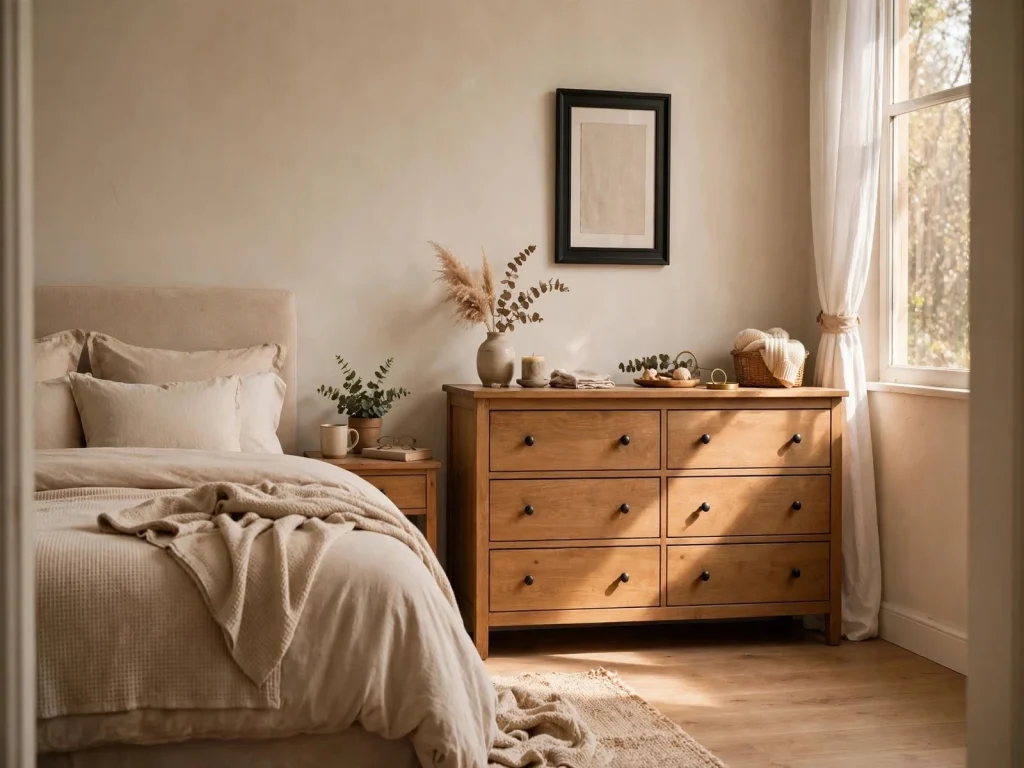
Beige neutral bedroom ideas fail when beige sits at one level everywhere. Build steps instead: pale beige on the walls, mid beige on the bedding and deeper beige or greige on the rug where feet land.
The catch is matching beige exactly, which erases every border between pieces. Aim for steps you can name.
Measure: keep at least one clear shade step between wall beige, bedding beige and floor beige.
Texture doing the work of color
6. Stack at least 3 textures on the bed itself
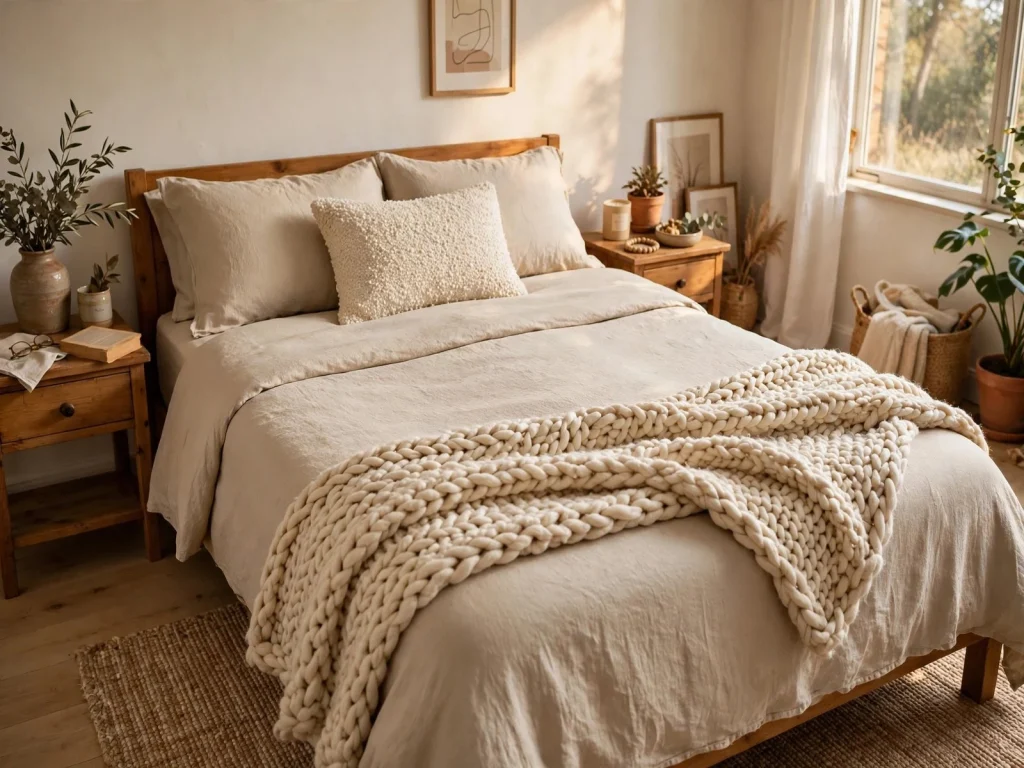
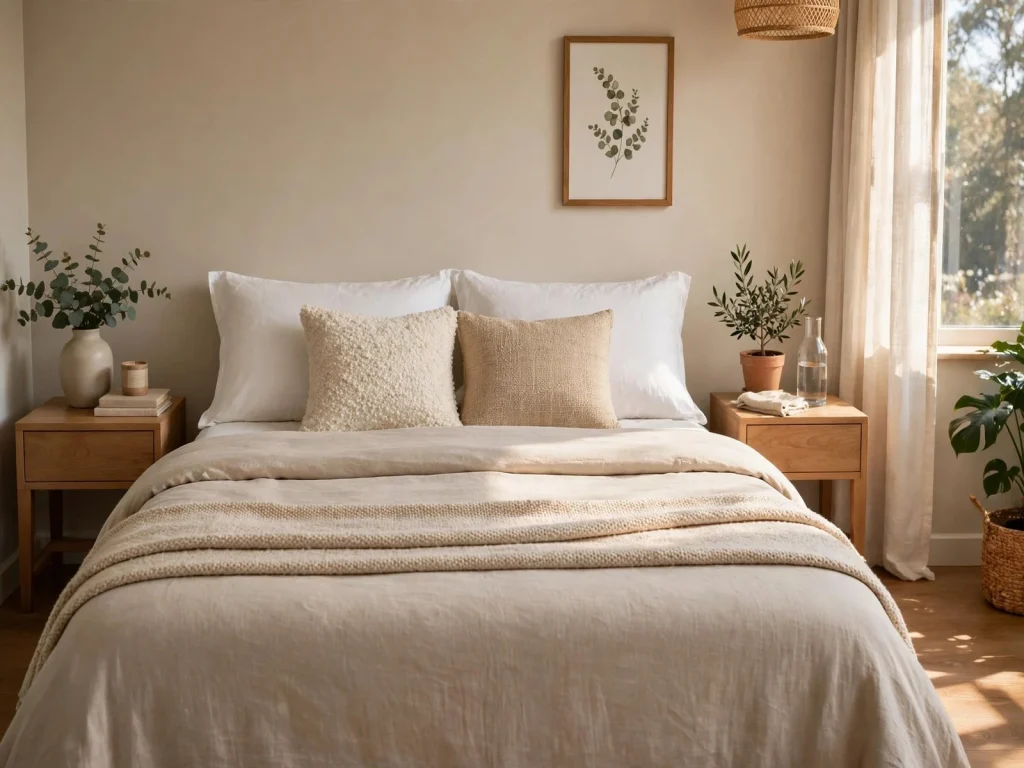
A neutral bed needs at least 3 textures on the bed itself: a smooth cotton or linen sheet, a knit or wool throw and a woven or bouclé cushion. Our bedroom bedding ideas post covers sheet fabrics for the base layer.
Build smooth first, knit second across the foot and woven or bouclé third. The catch is competing tones, so keep the stack inside your tone range.
Measure: count 3 textures on the bed, one smooth, one knit or wool and one woven or bouclé.
7. Lay a knit or wool throw across the foot third
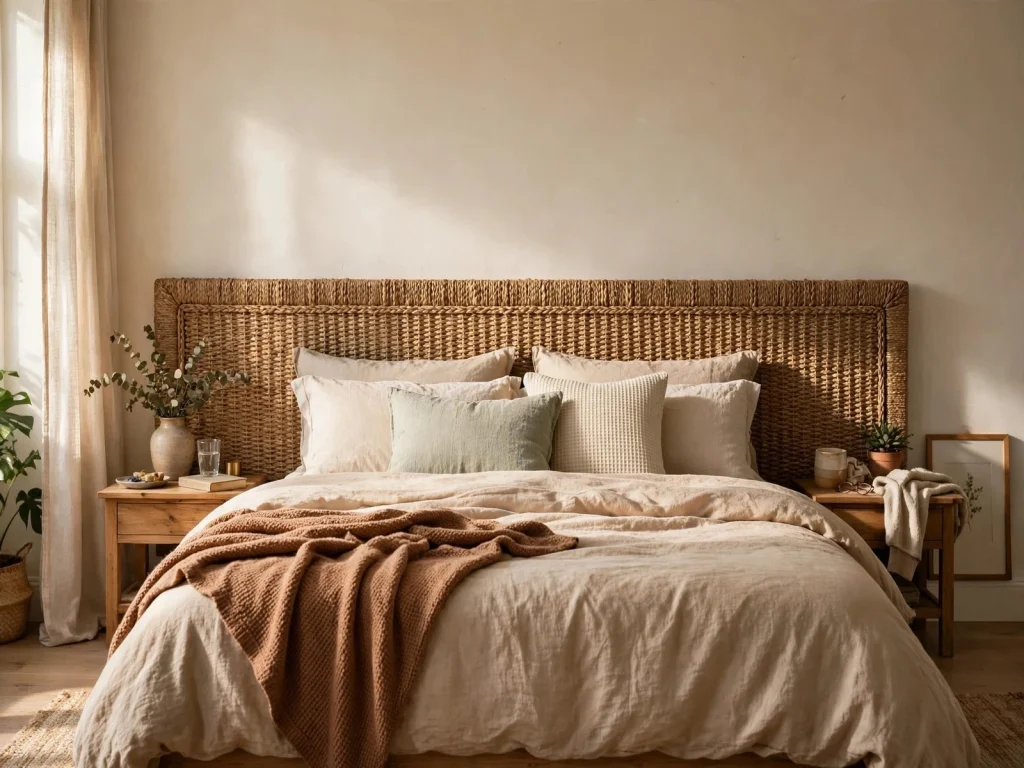
A chunky knit or wool throw across the foot third breaks the flat sheet plane. Lay it over the last 24 to 30 inches and fold it once lengthwise so the stitch reads at full width.
Pick one tone deeper than the bedding. The catch is thin throws, which add a wrinkle rather than a layer.
Budget: a knit or wool throw with real stitch depth runs $35 to $90 in queen width.
8. Pair smooth sheets with one rough weave
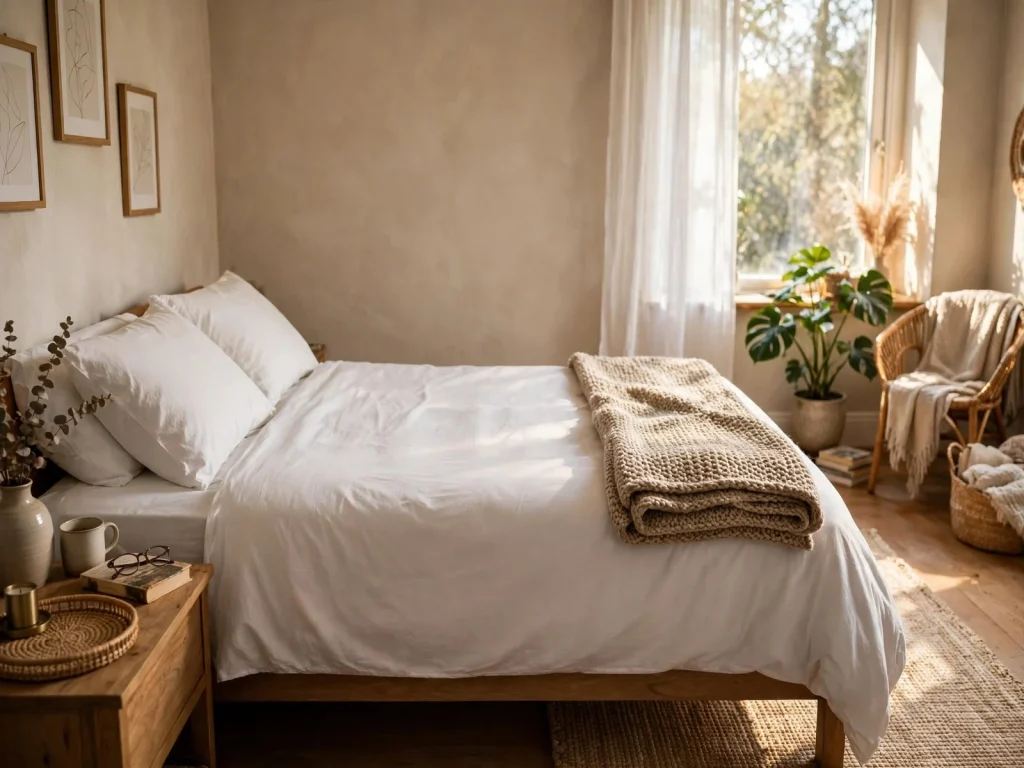
Smooth cotton or linen sheets feel cool and flat, so one rough weave over them makes the smoothness read as a choice.
Place the rough weave where hands land, across the foot or folded at the top third. The catch is roughness against skin, so keep it off the pillow zone.
Renter-friendly: a loose-weave blanket layers over any rented bedding set and leaves with you.
9. Use woven or bouclé cushions in a tight count
Cushions are where neutral bedroom decor tips into clutter. Two or three woven or bouclé cushions in front of the sleeping pillows is the working count for a queen bed.
Mix textures rather than colors: one bouclé and one flat woven cushion in neighboring tones, squares at 18 by 18 inches. The catch is cushion creep past three.
Measure: 2 to 3 cushions on a queen bed, 18 by 18 inches, sleeping pillows left clear.
10. Put texture on the headboard zone without repainting
The wall behind the bed carries half the view from the door. An upholstered headboard in a woven neutral or a woven wall hanging gives that zone a surface light can catch.
Size the piece to at least the width of the bed, its top edge clear above the pillows. The catch is dust, so pick a weave you can vacuum monthly.
Needs drilling: a woven wall hanging needs one or two wall fixings, so check your lease first.
Warm neutrals that stop a pale room feeling cold
11. Swap to 2700K bulbs before you repaint
Bulbs at 2700K keep cream and beige warm. Bulbs at 4000K are the reason pale rooms read cold and grey, because that cooler light pulls the blue undertone out of every neutral.
Swap both bedside lamps first. The catch is mixing temperatures, so change every bulb in the room together.
Budget: a full room swap to 2700K runs $15 to $30 and should happen before any paint spend.
12. Warm the largest floor surface with a deeper rug
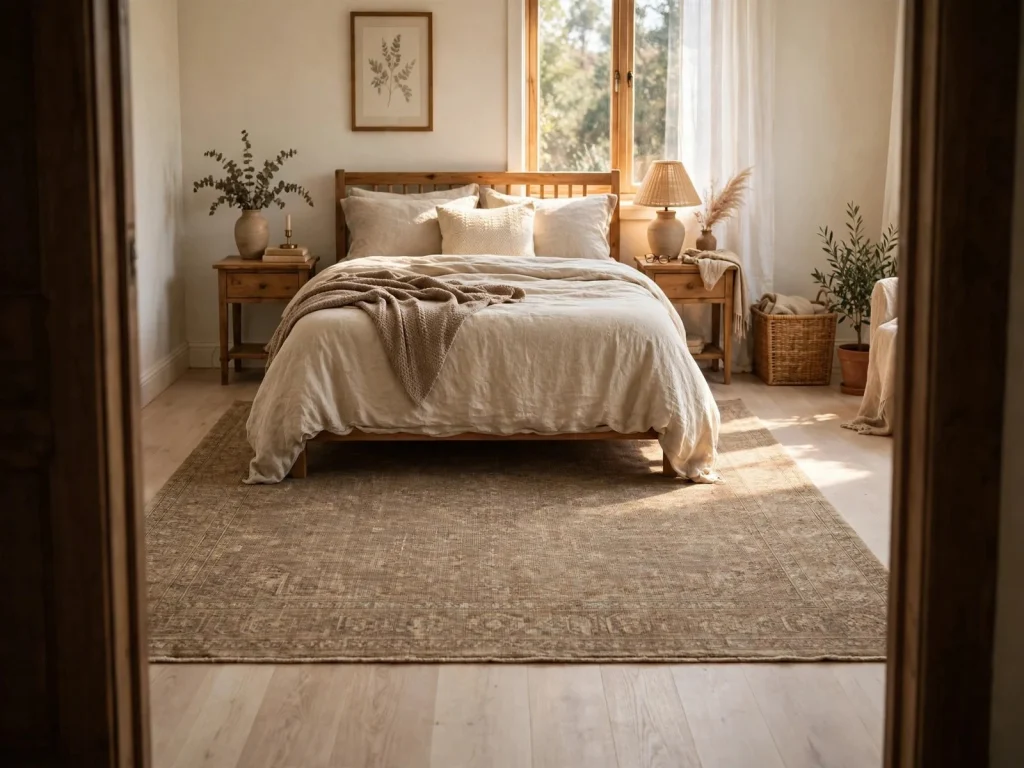
The floor is the largest surface your eye crosses to reach the bed. A rug in a deeper warm neutral like greige or warm taupe warms that crossing. An 8 by 10 under a queen covers both landing zones and the foot.
Test a sample beside the bedding in daylight and lamplight first. The catch is pile at the door, so test the swing.
Measure: an 8 by 10 rug for a queen bed, door swing tested clear over rug and pad.
13. Hang warm neutral curtains with a full drop
Linen-look curtains in oatmeal or warm white, hung so the hem touches the floor, soften the hardest lines in a pale room and add a full-height texture layer.
Hang the rod 4 to 6 inches above the frame. The catch is cool white fabric, which fights warm beige bedding. Test it against the bedding first.
Measure: rod 4 to 6 inches above the frame, curtain length rod to floor, hem touching down.
14. Layer lamplight at bed height instead of overhead light
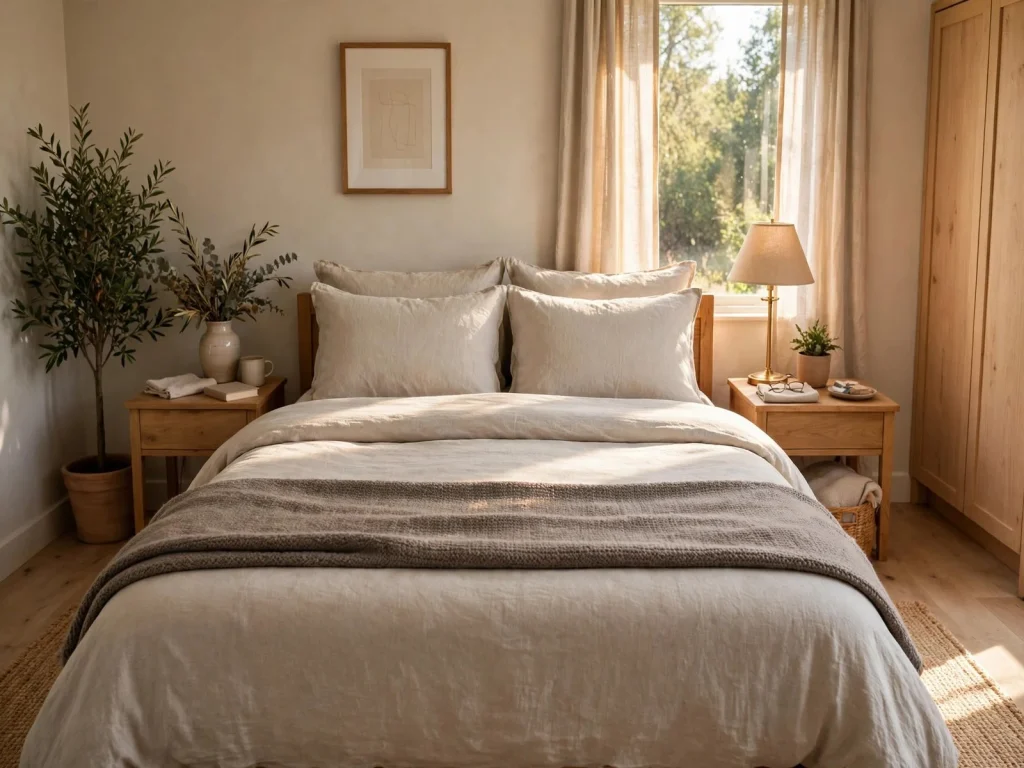
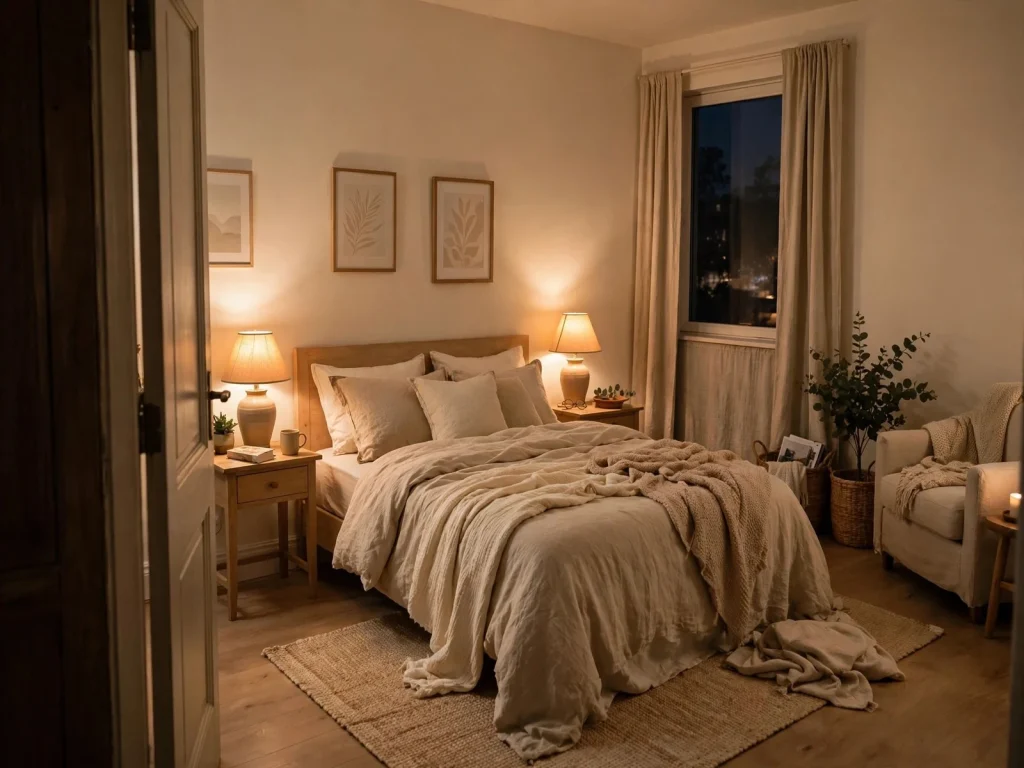
Overhead light flattens neutrals. Two lamps at bed height throw light sideways across bedding and wall texture. Sideways light creates the shadows where a neutral room finds depth at night.
Match lamp tops within 2 inches of each other. The catch is one lamp doing double duty. Our cozy bedroom ideas post shows this two-lamp logic in rooms that lead with color.
Measure: two lamps with tops within 2 inches of each other, both fitted with 2700K bulbs.
Neutral layers in small and rented rooms
15. Keep a small room to 3 tones and spend the rest on texture
A small room cannot carry five tones and stay calm. Hold the palette to 3 tones, like warm white, oatmeal and taupe, then spend variety on texture instead.
In a room under 120 square feet, one large texture beats five small ones. The catch is darkening the room, so keep the darkest tone at or below mattress height.
Measure: in rooms under 120 square feet, use 3 tones only, darkest below mattress height.
16. Build removable texture in a rental
Renters can run this whole palette without touching a wall. A rug warms the floor, a throw and cushions warm the bed and a plug-in lamp warms the light. Every layer lifts out at move-out.
The catch is buying everything in landlord white, which layers nothing. Let your pieces carry the oatmeal and taupe steps.
Renter-friendly: rug, throw, cushions and plug-in lamps build the full palette with zero fixings.
17. Let one earthy tone deepen a rented palette
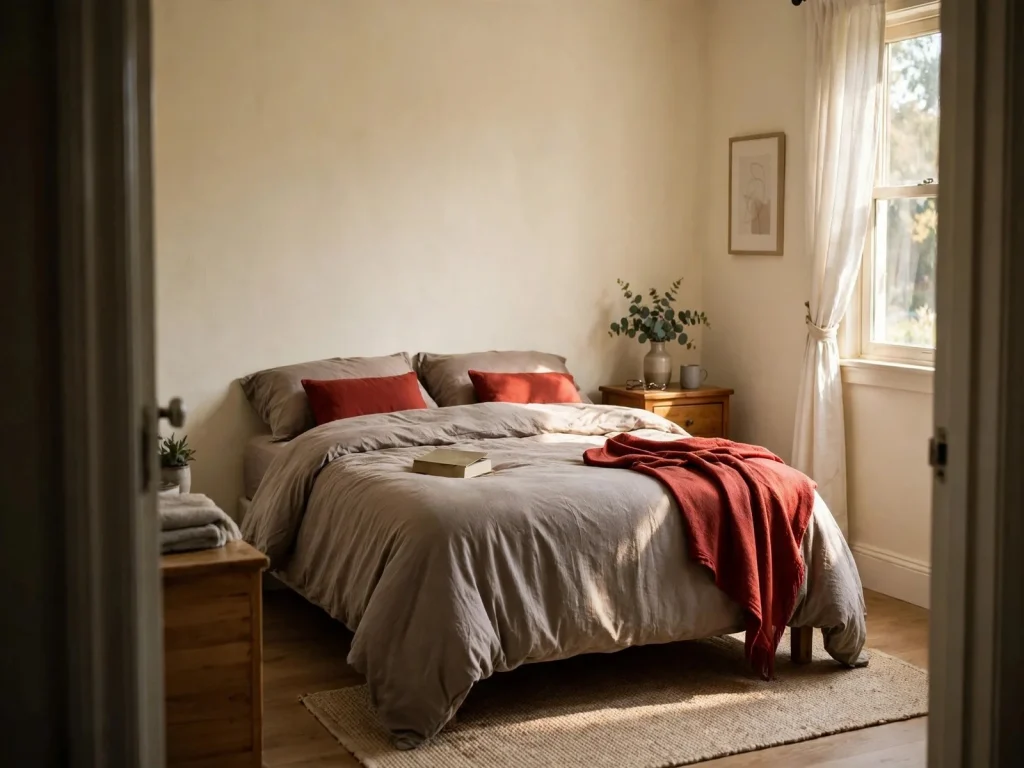
One earthy piece deepens a neutral rental. A clay-toned cushion, a warm wood stool or a seagrass basket pulls the beiges toward warmth. Earthy rooms take this further in our earthy bedroom ideas post.
Keep the dose to one or two low pieces. The catch is orange drift under 2700K light, so check the piece at night first.
Budget: one earthy cushion or basket runs $20 to $45 and counts as the darkest tone.
18. Borrow darkness in one movable piece
The dark piece in a rented room has to move with you. An espresso brown throw, a dark wood tray or a deep taupe basket sets the darkest tone from idea 3. Place it at the foot of the bed, inside the door view against warm white bedding.
Choose espresso or deep taupe rather than black here. The catch is hiding the piece away, where it does nothing for any view.
Renter-friendly: one espresso throw or basket supplies the darkest tone and packs into a box.
Cozy neutral bedroom ideas on a budget
Start with light, because light is the cheapest tone change there is. Swap every bulb to 2700K for $15 to $30 before buying a single textile. Half the rooms that feel cold are running 4000K bulbs over warm paint, so the fix sits in the lamp rather than on the wall.
Next, buy texture in touch order. The throw comes first at $35 to $90, then cushion covers at $25 to $60 for a pair over inserts you already own. A secondhand wood stool or basket at $15 to $40 can supply the darkest tone and the earthy note in one spend, covering ideas 3 and 17 together.
Save the rug for last and buy it once. Tape the outline from idea 12 on the floor and live with the tape for two days. A wrong rug is the priciest mistake on this page to return, while a right one at $120 to $300 warms the largest surface in the room for years.
Mistakes that make it fall flat
- Using one tone everywhere and calling it calm. Walls, bedding and rug in the same beige erase every border in the room. Run a counted range of 3 to 5 tones with a clear step between layers instead.
- Testing color in one light only. A swatch that passed at noon can turn blue or grey under lamplight. Test against the bedding in daylight and again under lamplight before anything covers a wall or a bed.
- Running 4000K bulbs over warm paint. Cool light pulls the warmth out of cream and beige and the room reads grey by evening. Swap the whole room to 2700K before repainting anything.
- Adding texture in competing tones. Three textures help only inside the tone range. A grey bouclé, a yellow knit and a pink cushion on one bed is a color scheme pretending to be texture.
- Skipping the dark anchor. With no darkest item, pale pieces float against each other and the palette has no floor. Add one espresso or deep taupe piece in the door view.
- Buying the rug before the tape test. Guessed sizes leave cold gaps where feet land each morning. Tape the outline and walk it for two days before ordering.
Questions people ask about this
How do I make a neutral bedroom feel cozy instead of bland? Count first. Run 3 to 5 tones from lightest to darkest, stack at least 3 textures on the bed and swap the bulbs to 2700K. Bland rooms usually fail on one of those three counts, so fix the missing count before buying anything decorative.
How many neutral tones should one room have? Use 3 to 5 tones in one room, named as a range like warm white, oatmeal, greige, taupe and espresso brown. Three is the floor for depth and five is the ceiling before the room feels busy. Small rooms sit happiest at 3 tones with texture doing the extra work.
What is the difference between warm and cool neutrals? Warm neutrals carry a yellow or pink undertone and cool neutrals carry a blue one. The undertone shows against your bedding, so test paint or fabric in daylight and again under lamplight. Warm rooms go wrong when a blue-undertone piece sneaks in and fights the rest at night.
How is a cozy neutral bedroom different from a regular neutral bedroom? A regular neutral room stops at the palette, while a cozy neutral bedroom adds counted texture, contrast and warm light. The bed carries at least 3 textures, every view holds one darkest item and one lightest item and the bulbs sit at 2700K. Same colors, more layers doing measurable work.
The bottom line
A neutral room feels boring when its tones, textures and light were never counted and it feels cozy the moment those three counts are set right. You do not need a new color. You need steps you can name, surfaces you can feel and bulbs that keep the warmth in. This week, stand at your door at night with the lamps on, count your tones out loud and swap any bulb that is not 2700K. That one check tells you which of these 18 ideas your room needs first.