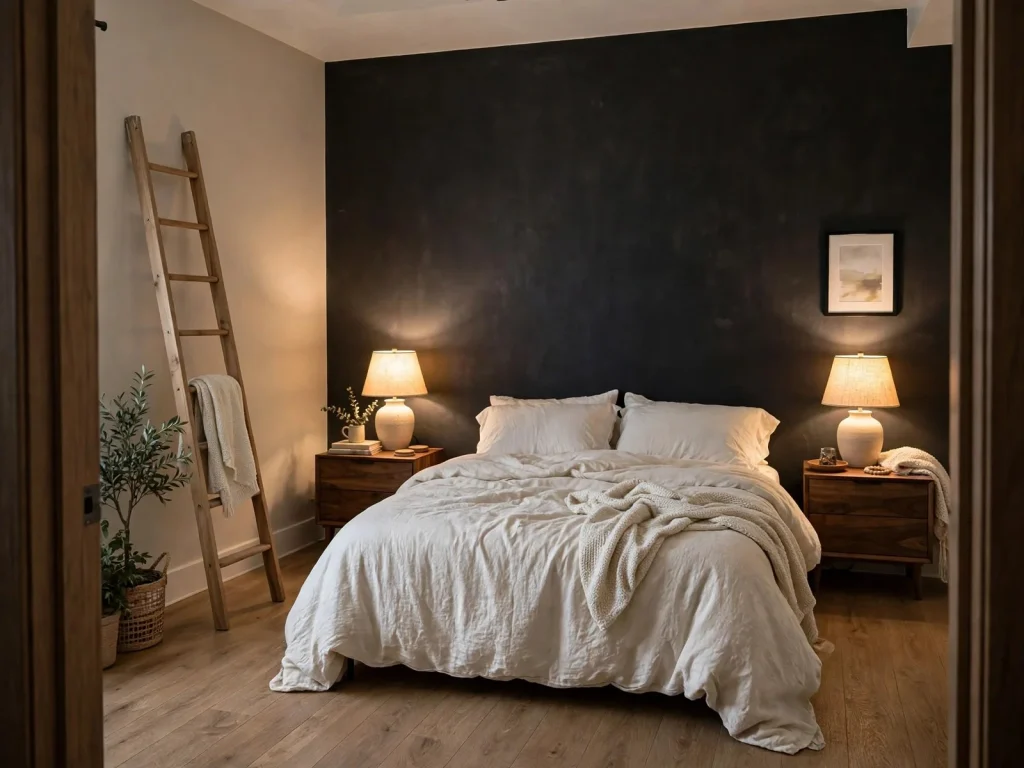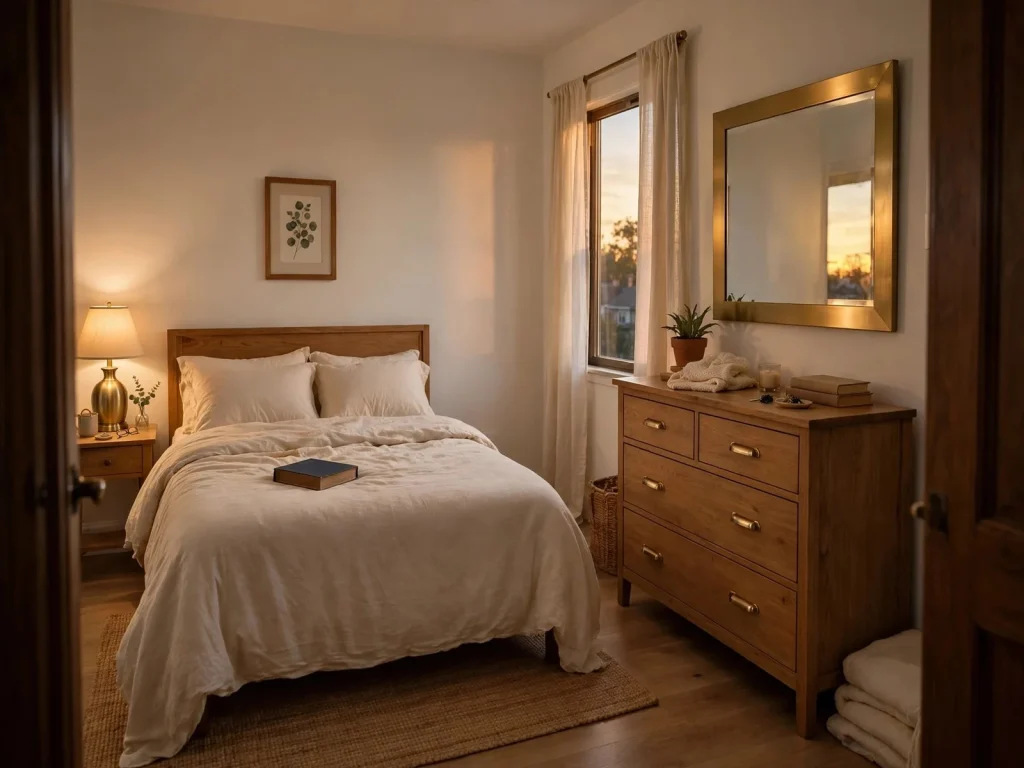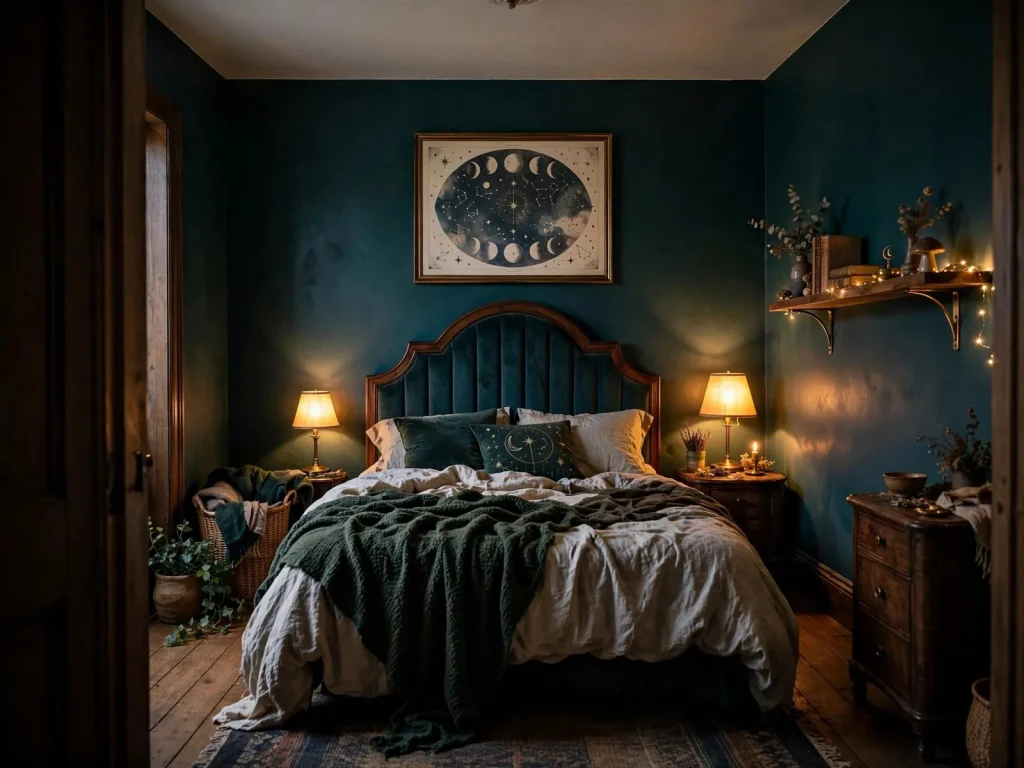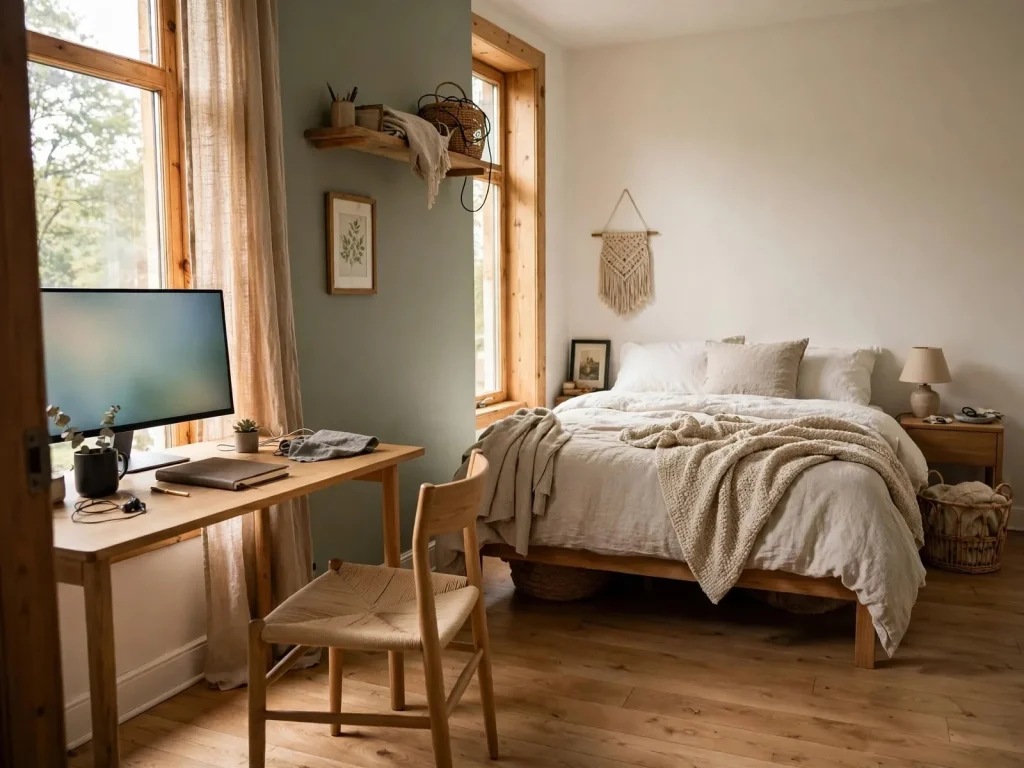
The bed fits and the layout works and the room still looks bare. The walls are empty and the bed gets made with whatever came in the set. Nothing is wrong exactly. The room just never got the styling layer that makes a small bedroom look finished instead of moved into.
This page is that layer only. These small bedroom decor ideas come with the scale for every piece, from art size to shelf depth to the pillow cap. Layout and bed placement live in our small bedroom ideas post for the room that is not settled yet. Here the floor plan stays put and the decor does the work.
Before you start: measure, rough costs, rules
Take four measurements before you buy anything: the wall above the bed, the height a frame center should sit at, the depth a shelf can take and the height of your mattress top. Mattress tops usually sit 24 to 28 inches high and that one number sets the nightstand height and the frame height for this whole page.
Rough cost notes only, since no two small rooms need the same pieces. One large print in a 24 by 36 inch frame is usually the biggest single spend on the walls. Shelves and frames cost less per piece and add up in sets, so price the full set before the first hole.
Renters, the rules are kind on this page. Most ideas hang on picture hooks or sit on surfaces. The ones that need screws say so in their practical line. Nothing here asks you to paint or move a bed.
Walls that work harder
1. Hang one anchor piece over the bed
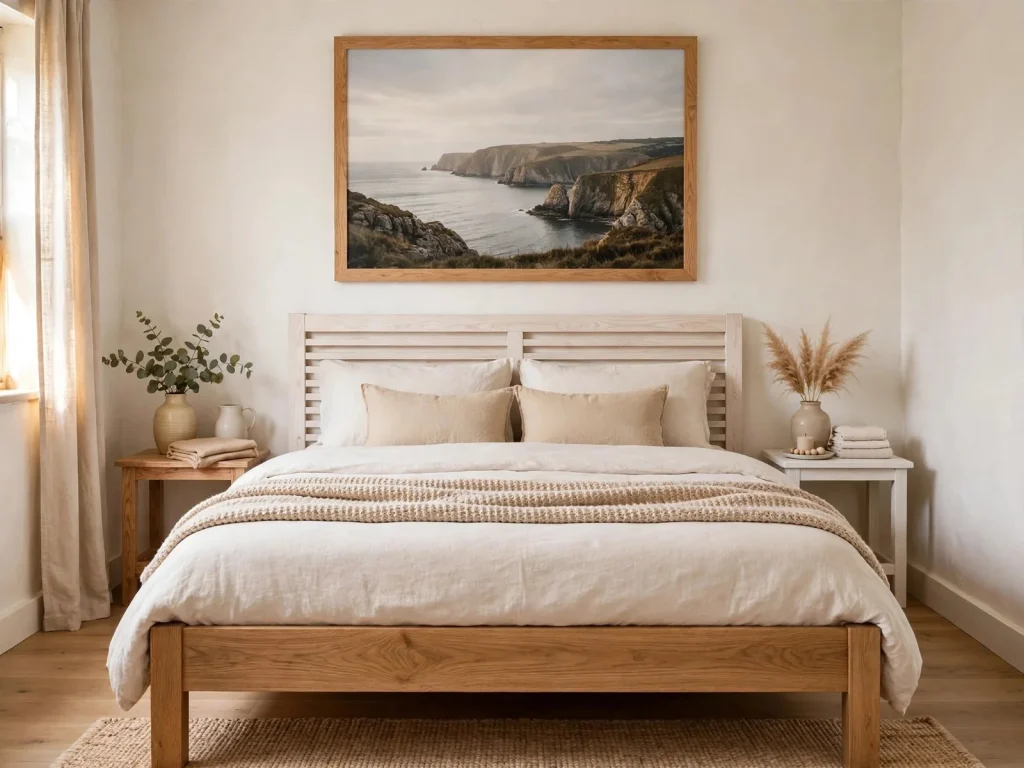
One large piece finishes a wall faster than six small ones. Hang one anchor piece 24 by 36 inches or larger on the main wall above the bed, with its bottom edge 6 to 8 inches above the headboard.
The catch is weight. A framed piece at this size needs a picture hook rated for it or two hooks sharing the load. Leaning it on the headboard is not a plan.
Measure: one anchor piece 24 by 36 inches or larger, bottom edge 6 to 8 inches above the headboard.
2. Space a small gallery tightly instead of spreading it
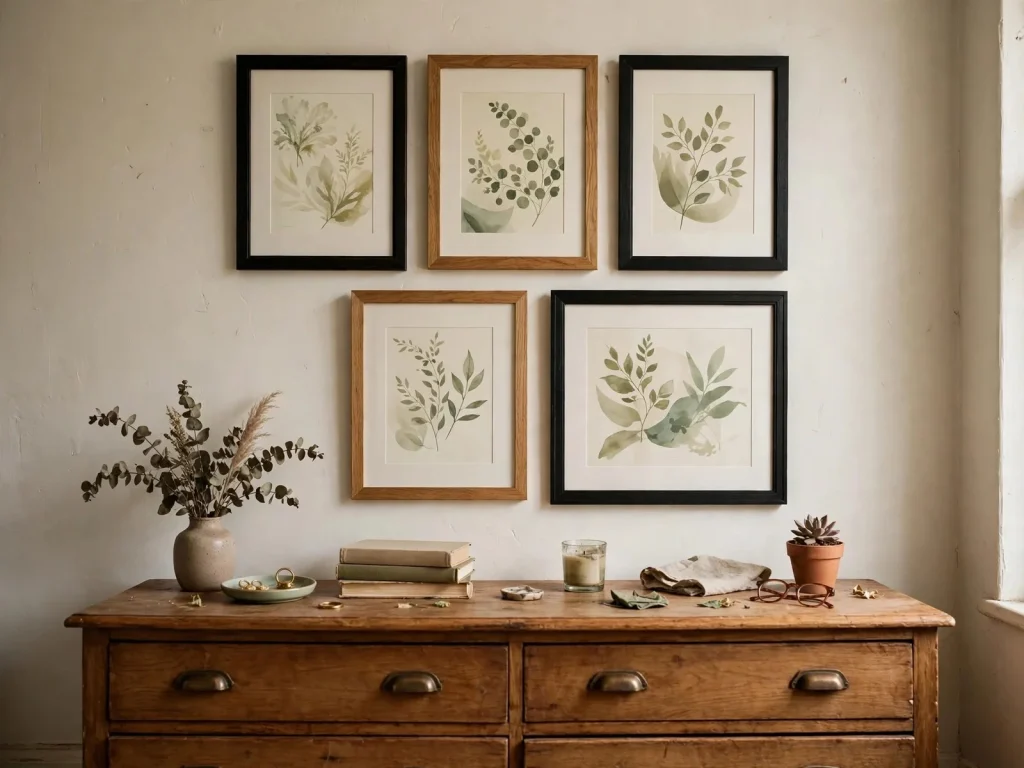
A gallery works in a small bedroom when it reads as one block of small bedroom wall decor rather than as frames hunting for space. Lay the group on the bed first and space the gallery frames 2 to 3 inches apart on every side. Hang the block so the frame centers sit at 57 inches from the floor.
The catch is patience. Tape the outline of the whole block on the wall first and live with it for a day. The full wall playbook sits in our bedroom wall decor ideas post.
Measure: gallery frames spaced 2 to 3 inches apart, frame centers at 57 inches from the floor.
3. Put one mirror where it borrows light
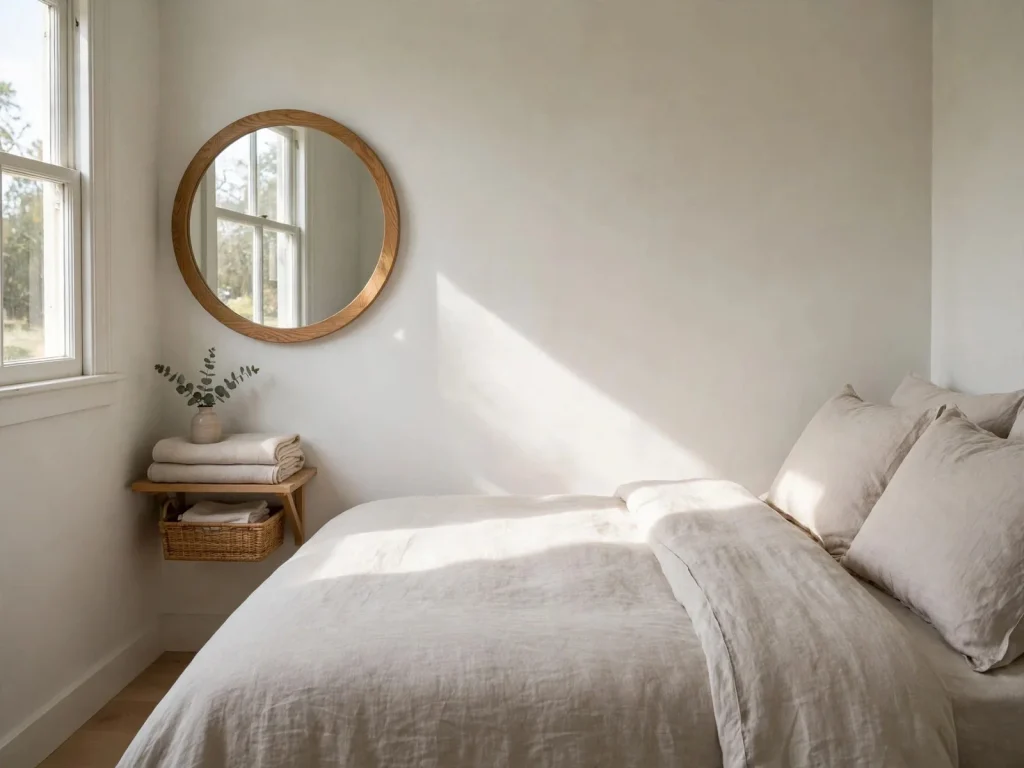
A mirror is decor that pays rent. Hung beside or opposite a window it throws daylight back into the room. Choose one mirror 24 to 30 inches across and hang its center near the same 57 inch line used for frames.
The catch is glare. Check the mirror when the room gets direct sun. A mirror that bounces sun into the bed is a mirror in the wrong spot.
Measure: one mirror 24 to 30 inches across, center hung at about 57 inches from the floor.
4. Hang curtains high and let them reach the floor
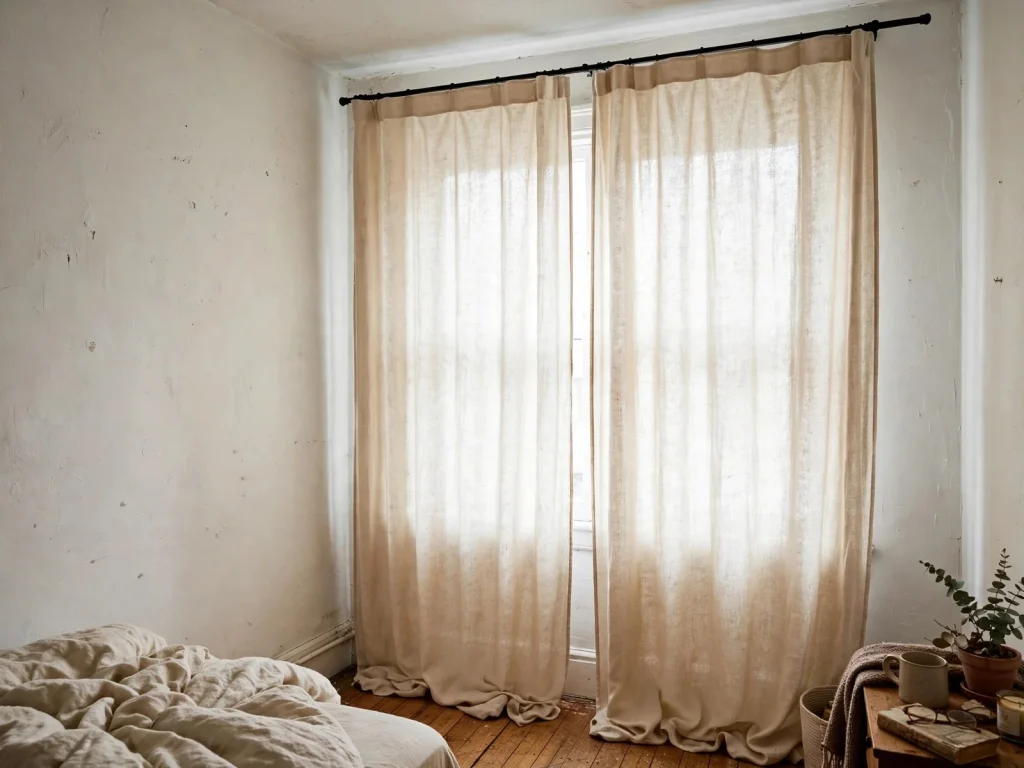
Short curtains chop a small wall into bands and make the ceiling feel lower. Panels hung near the ceiling and ending at the floor draw one long line and the wall reads taller. Mount the rod 4 to 6 inches above the window frame and choose panels that end within half an inch of the floor.
The catch is the bed wall. Panels bunch behind a headboard on the window wall, where a simple shade keeps the line clean.
Measure: rod 4 to 6 inches above the frame, panels ending within 1/2 inch of the floor.
5. Swap one frame for a woven wall hanging
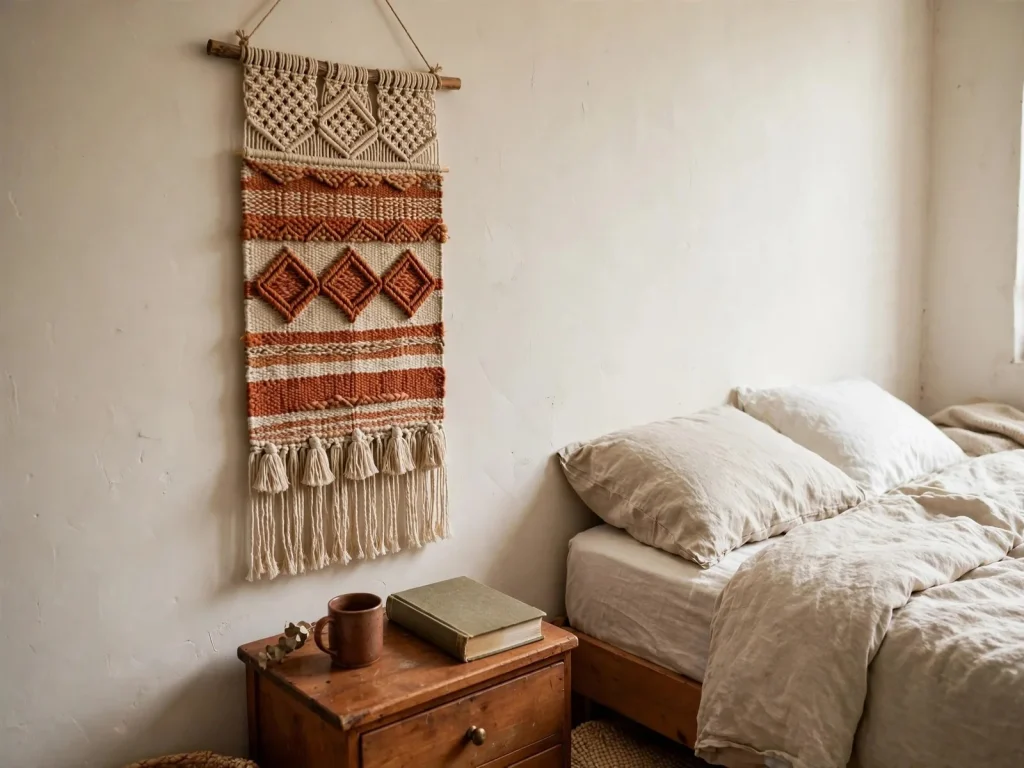
Not every wall piece has to be glass and frame. A woven hanging adds softness to a room full of hard surfaces. Keep it near anchor scale at around 24 inches wide or more and hang it on the wall beside the bed where the texture gets seen up close.
The catch is dust. A textile hanging needs a shake outside every few weeks.
Renter-friendly: a woven hanging goes up on one small hook and comes down with no patching at move-out.
Bedding and textile layers
6. Layer the bed in three pieces and stop
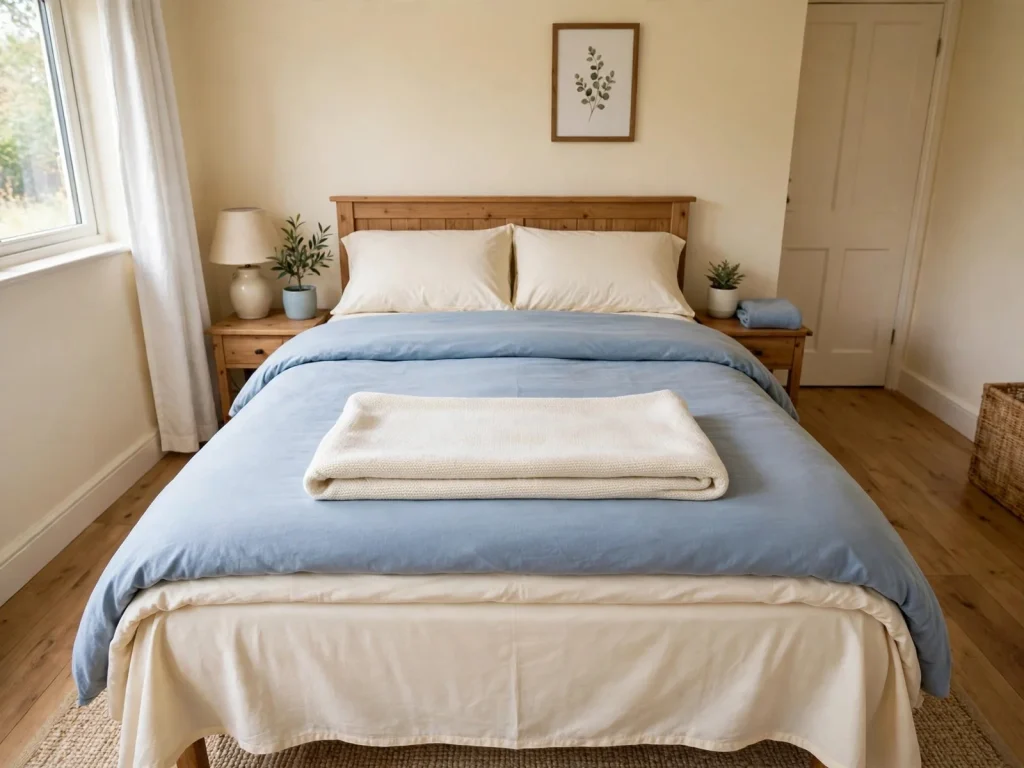
A small bed disappears under too many layers and looks flat with too few. Three pieces is the set that styles well. Build it in order: a base sheet set, one duvet or quilt and one throw 50 by 60 inches folded at the foot.
The catch is heat. In a warm room swap the duvet for the quilt alone and keep the throw. The layer count matters more than the weight of each layer.
Measure: base sheet set plus one duvet or quilt plus one throw 50 by 60 inches folded at the foot.
7. Cap the pillows at two plus two
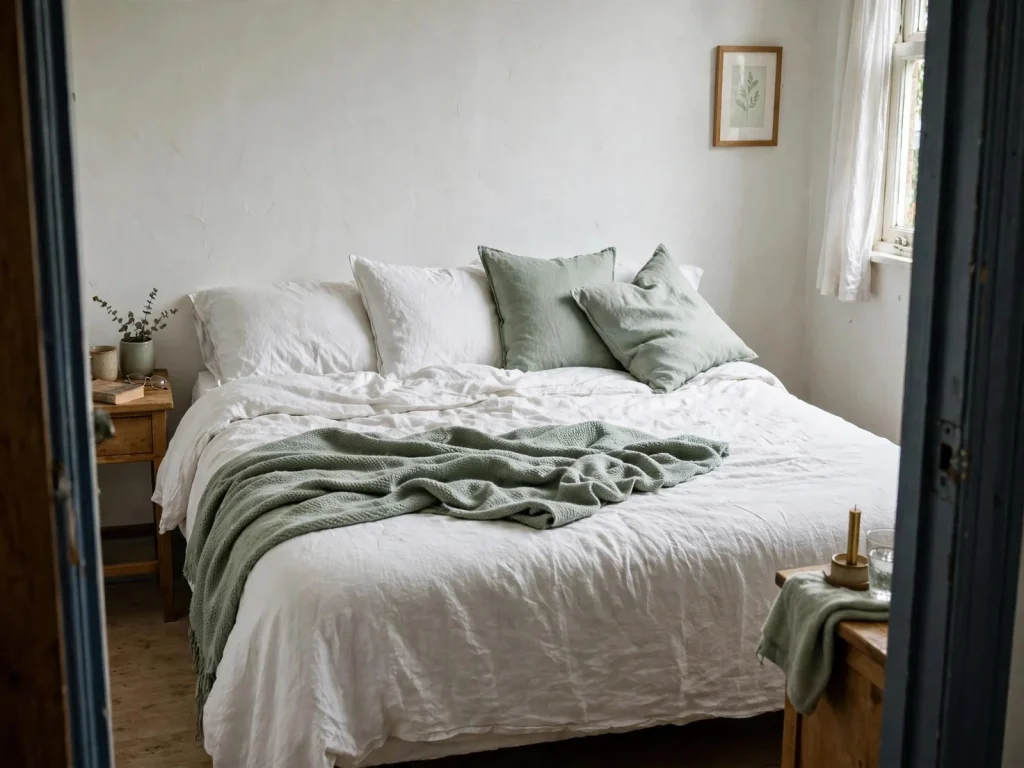
Pillows are where small beds go wrong. Six accent pillows look generous in a store photo and take half the mattress in a real room. The working set is 2 sleeping pillows plus 1 to 2 accent pillows, no more.
The catch is storage. A small bedroom has no spare closet, so a pillow you cannot store is a pillow you step over every night.
Measure: 2 sleeping pillows plus 1 to 2 accent pillows, no more, in one row in front.
8. Repeat a tight color story three times
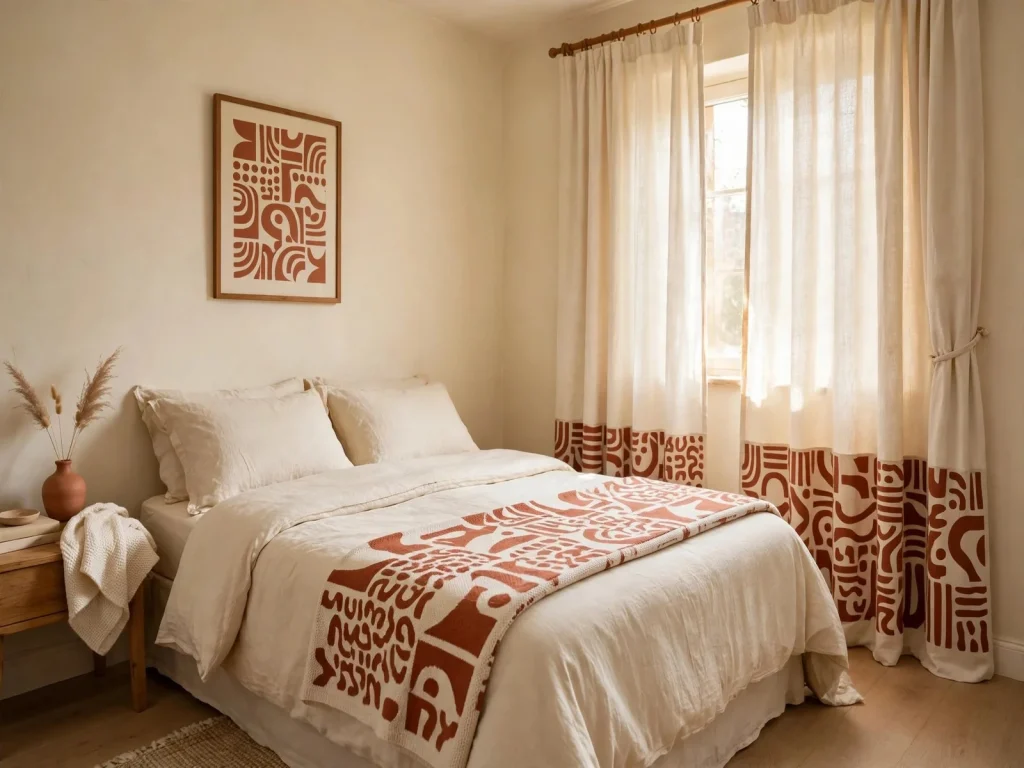
This is where creative small bedroom decor is mostly editing rather than buying. Hold the room to 2 to 3 colors only, each repeated at least three times across bedding, curtains and art so the room reads as one set.
The catch is the odd piece you love that matches nothing. Give it two companions in its color or let it live in another room.
Measure: 2 to 3 colors only, each repeated at least three times across bedding, curtains and art.
9. Let one textile carry the pattern
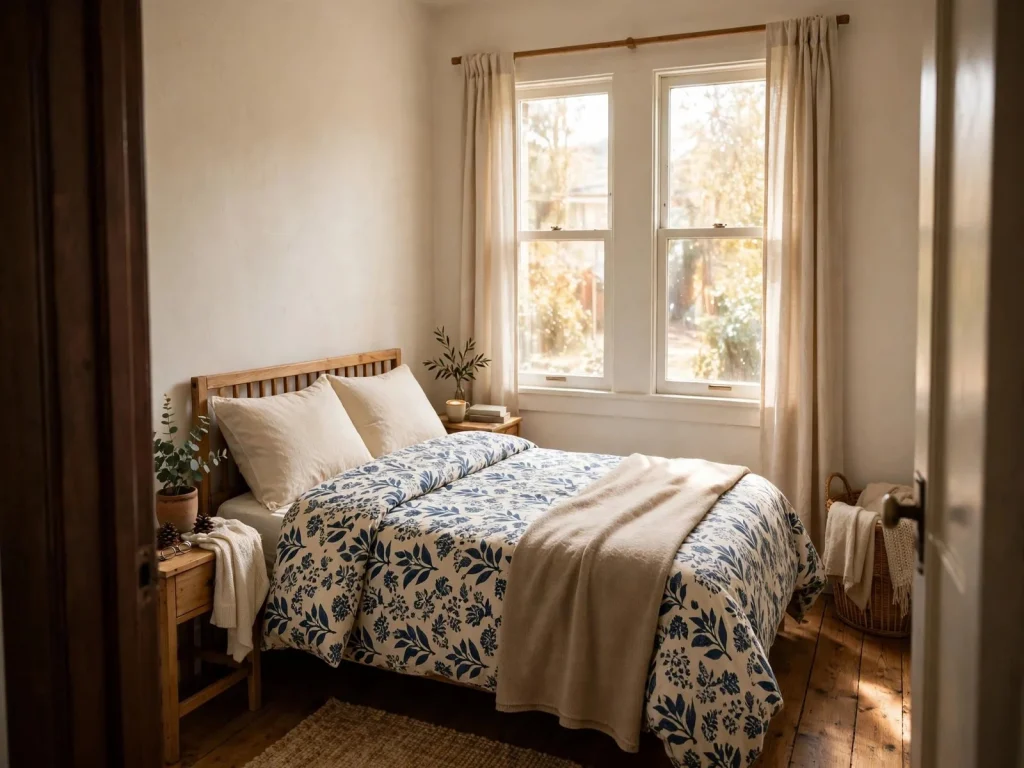
When the duvet, the curtains and the throw all carry a print, a small room hums with competing scales. One patterned textile gives the room its personality and the plain pieces give it rest. A pattern on the duvet sets the theme and everything else goes plain or textured.
The catch is scale. A tiny print on a big duvet reads as noise from the doorway. Choose a medium or large motif that still reads at six feet.
Budget: one patterned piece means the rest can be plain basics, which cost less and wash without fading a print.
Nightstand and surface styling
10. Size the nightstand to the mattress top
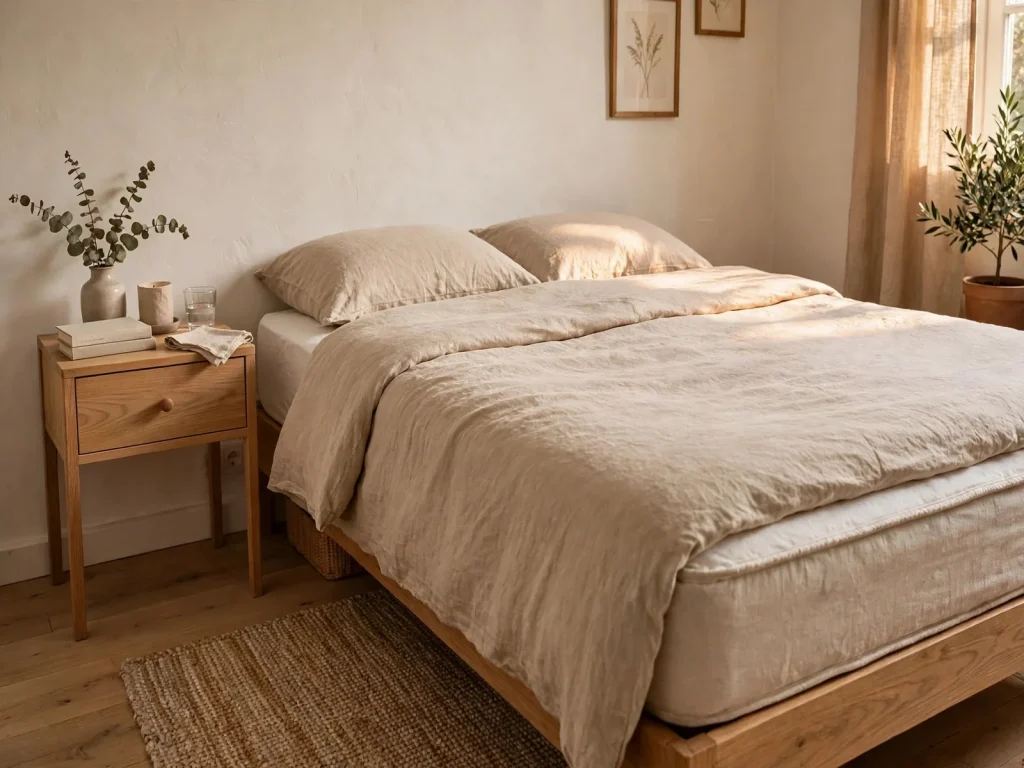
A nightstand at the wrong height makes every reach an annoyance. Choose a nightstand 16 to 24 inches wide with its top within 2 inches of the mattress top. Mattress tops usually sit 24 to 28 inches high, so the nightstand belongs in that same band.
The catch is drawers. A narrow nightstand with one drawer beats a wider open table, because the drawer hides the clutter that open shelves display.
Measure: nightstand 16 to 24 inches wide, top within 2 inches of the mattress top at 24 to 28 inches high.
11. Style the nightstand top in three zones
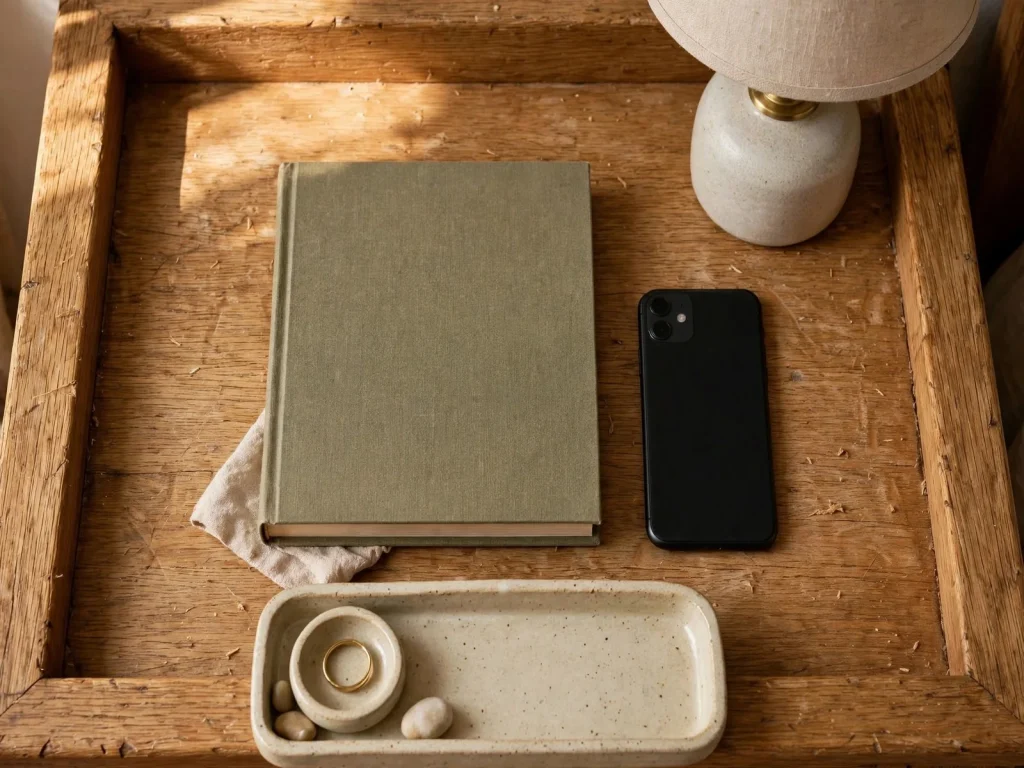
Give the top three jobs: light, a place for a book and a place for small things. Set the lamp at the back corner, the current book flat in the middle and a small tray at the front for glasses and a watch. Keep 1 inch of clear edge showing all round.
The catch is charging. Route the phone cable behind the lamp and give the phone the spot beside the book rather than fighting it nightly.
Measure: three zones on one top, lamp at the back corner and 1 inch of clear edge showing all round.
12. Pick a lamp that earns its footprint
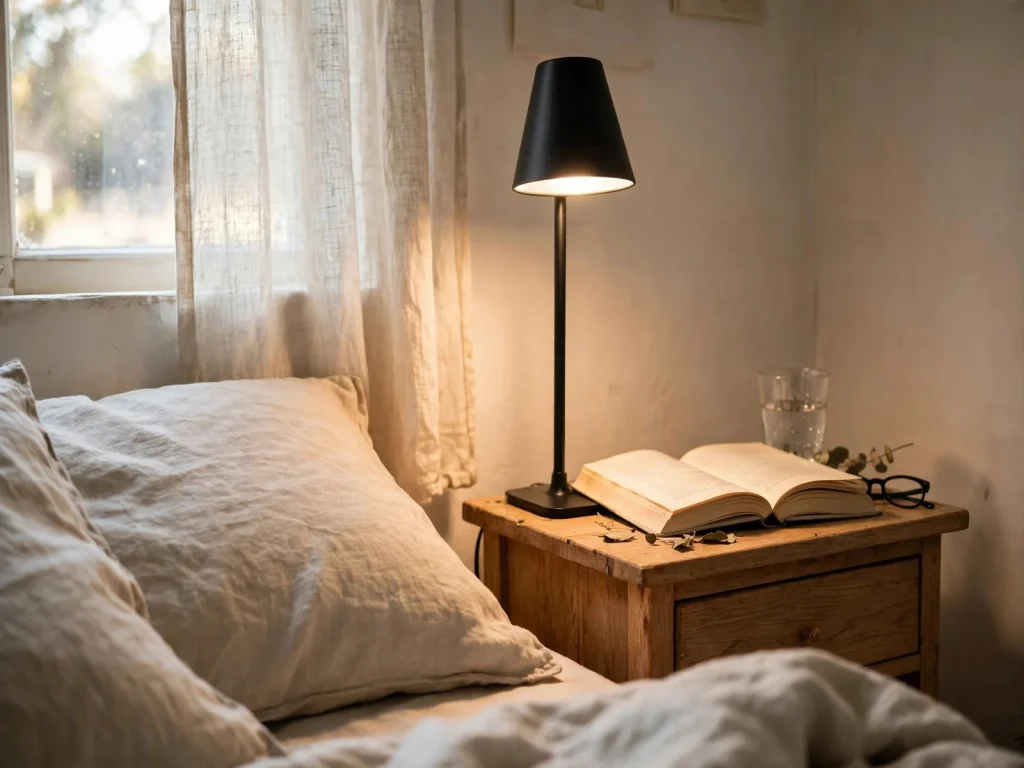
On a 16 to 24 inch nightstand the lamp is the biggest tenant. A wide shade eats the surface. Choose a lamp with a shade 8 to 10 inches across and a narrow base that leaves room for the book zone from idea 11.
The catch is glare. Sit up in bed and check that you cannot see the bare bulb from your reading spot.
Measure: shade 8 to 10 inches across, narrow base, no bare bulb visible from your reading spot.
13. Leave half the dresser top empty
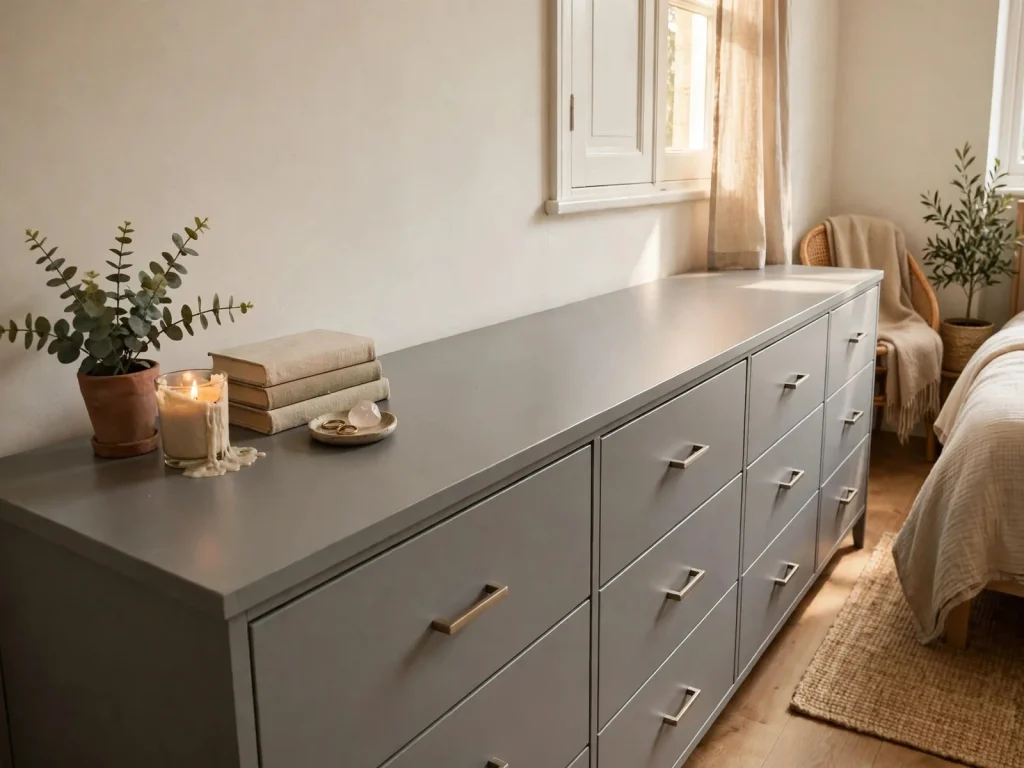
The dresser top is the surface every small bedroom overloads until it reads as storage rather than furniture. Group what stays into two clusters at most and keep at least half the top completely clear from end to end. One framed print leaned against the wall can anchor a cluster.
The catch is habit. A clear top only survives if a tray catches the daily scatter where your hand already lands.
Renter-friendly: a leaned frame and a tray style the dresser with no holes and no hardware at all.
Corners, shelves and one plant
14. Hang floating shelves at styling depth
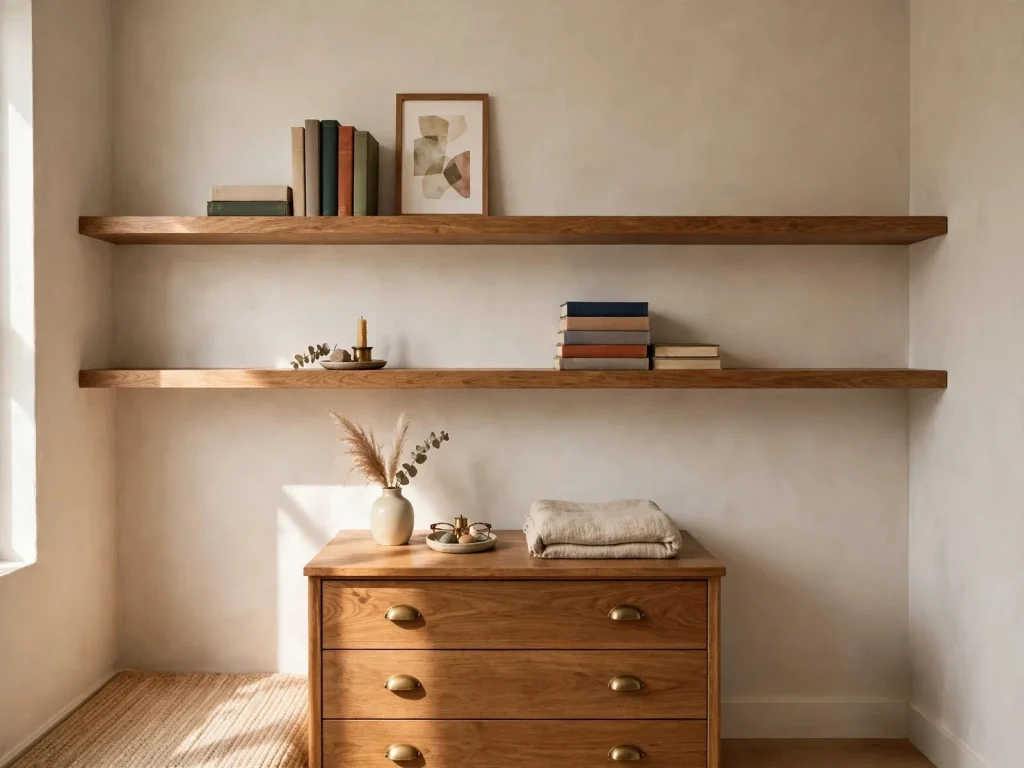
Floating shelves give a small bedroom display space that takes no floor. Too deep and they loom over the bed or the walkway. Fit floating shelves 8 to 10 inches deep and 24 to 36 inches long. That depth holds a paperback row and a small frame.
The catch is load. Fixings set the real limit, so heavy books belong on the lowest shelf and light pieces go up top.
Needs drilling: floating shelves 8 to 10 inches deep and 24 to 36 inches long, fixed into studs or proper anchors.
15. Space shelf rows so pieces can breathe
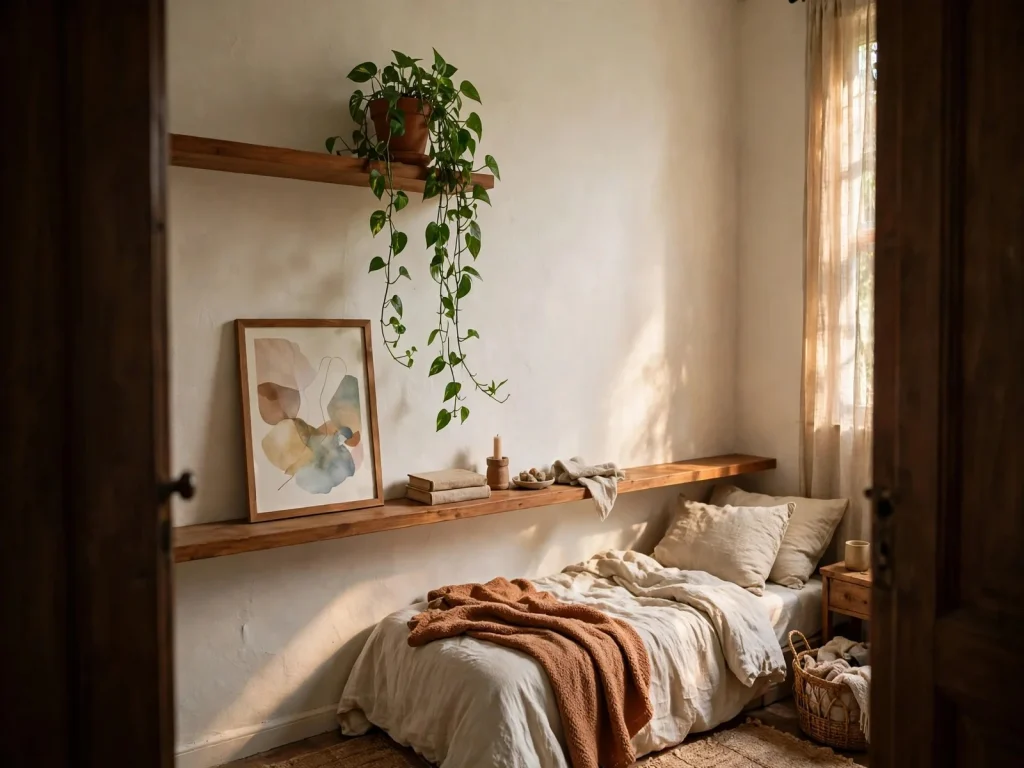
Shelves fail on spacing more than on size. Rows packed tight turn displayed pieces into stored pieces and the wall reads as a cupboard with the doors missing. Leave 12 to 18 inches of vertical space between rows. Style each shelf in small groups and leave a third of each shelf empty. Where shelves start holding real storage, our small bedroom storage ideas post takes over the plan.
The catch is symmetry. Two rows at different lengths often suit a small wall better than a matched pair, because the eye reads the group rather than the grid.
Measure: 12 to 18 inches of vertical space between shelf rows, with a third of each shelf left empty.
16. Trail one plant down a shelf
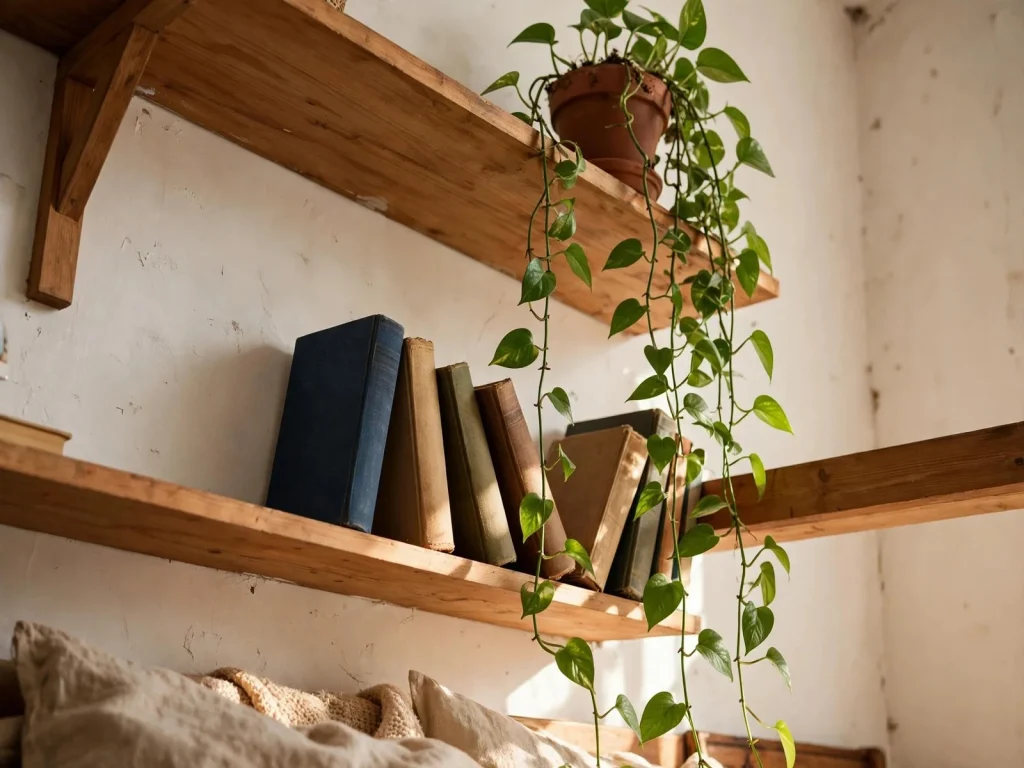
One trailing plant does what no frame can: it moves. A trail over a shelf edge softens every straight line in the room. Set one trailing plant on a shelf in the brightest light the room has and let the trail fall 12 to 18 inches clear of the pieces below it.
The catch is water. Water it at the sink and let it drain fully before it goes back over your books.
Measure: one trailing plant on a shelf, trail falling 12 to 18 inches clear of the pieces below.
17. Give the brightest corner one floor plant
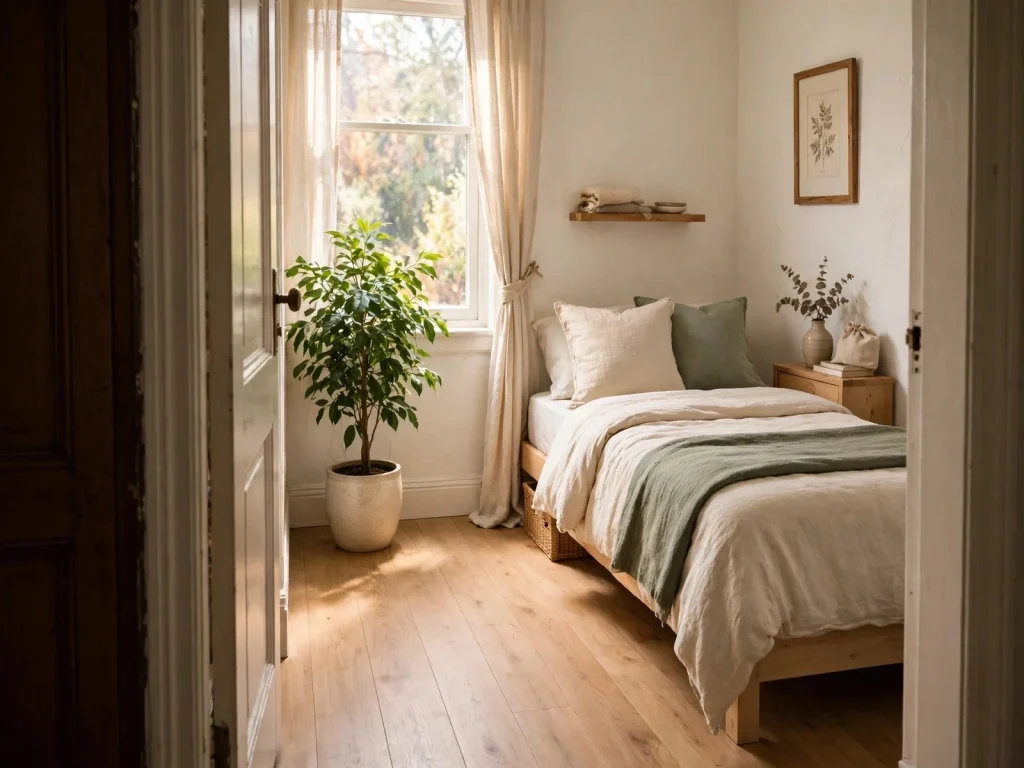
One spare corner is all a floor plant needs and the brightest corner is the spot. Choose one floor plant in a pot 10 to 12 inches across in the brightest corner and keep it off the main walkway entirely.
The catch is the door swing. Test the door and any drawers against the pot before you settle it. Leaves bend. A cracked pot does not.
Measure: one floor plant in a pot 10 to 12 inches across in the brightest corner, nothing on the main walkway.
18. Make one corner a reading spot with one chair
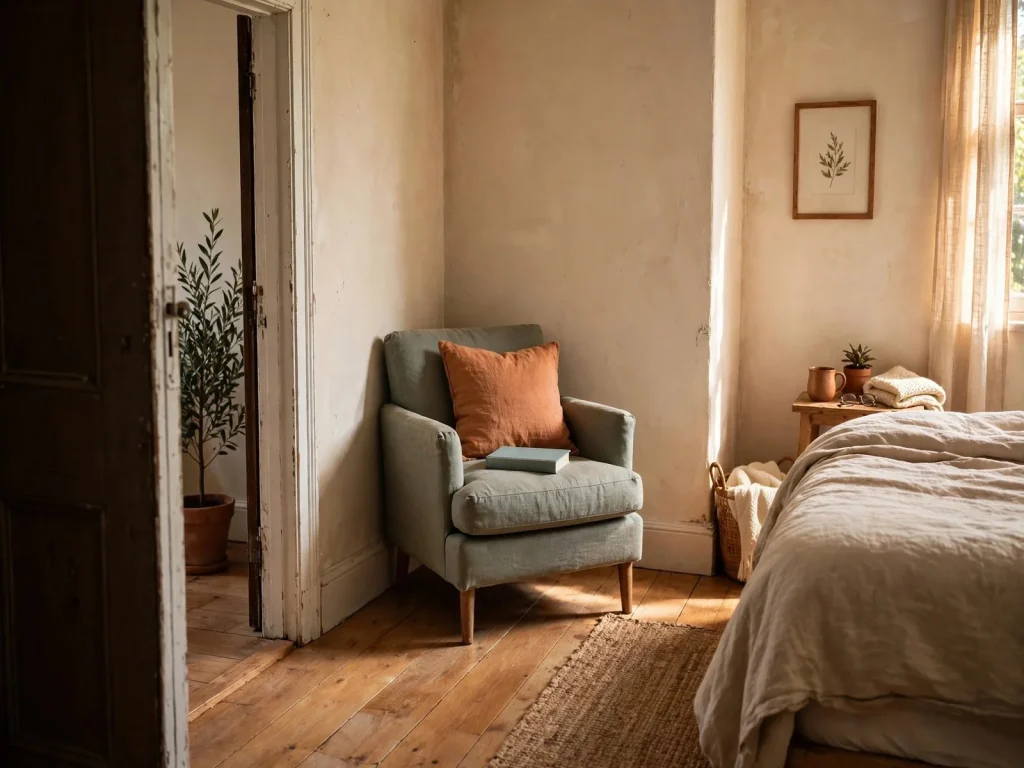
One defined corner makes a small bedroom feel planned rather than filled. Choose a chair with a footprint near 24 by 24 inches and angle it into the corner rather than flat to the wall, with the walkway beside it kept clear.
The catch is scale creep. One chair and nothing else is the rule. Add a table and a book stack and the corner becomes the clutter it replaced.
Measure: one chair near 24 by 24 inches, angled in the corner with the walkway beside it kept clear.
Small bedroom decorating ideas for one weekend
The weekend version of this page runs in a set order. Saturday morning is walls: hang the anchor piece or the tight gallery from ideas 1 and 2. Saturday afternoon is the bed: strip it to the sheet set and rebuild it with the three layers and the pillow cap from ideas 6 and 7. The room will look different by dinner.
Sunday is surfaces and corners. Restyle the nightstand into its three zones, clear half the dresser top and hang one pair of shelves at 8 to 10 inches deep if the wall is ready. Finish with the plant choice: a trailing plant on the new shelf or a floor plant in a pot 10 to 12 inches across in the brightest corner.
Keep the color story as the tiebreaker all weekend. A piece goes where its color is needed to reach three repeats. A piece that matches nothing and has no companions leaves the room rather than starting a second story.
Mistakes that make small-room decor feel cluttered
- Spreading many small frames across every wall. Each wall gets a little and no wall gets a focal point, so the room reads busy and bare at once. One anchor piece 24 by 36 inches or larger on the main wall does more.
- Piling pillows past the working set. Six accents take half the mattress and sleep on the floor nightly. Hold the line at 2 sleeping pillows plus 1 to 2 accent pillows and let the throw carry the color.
- Buying deep shelves for a small wall. Shelves deeper than 10 inches loom over the bed and catch elbows on a walkway. Fit floating shelves 8 to 10 inches deep and keep heavy pieces low.
- Letting every purchase bring a new color. A small room shows everything at once, so single appearances read as clutter. Hold 2 to 3 colors and repeat each one at least three times across bedding, curtains and art.
- Filling every surface and corner. A room with no empty surface gives the eye nowhere to rest. Leave half the dresser top clear and keep the main walkway free of plants and baskets.
Questions people ask about this
How do I decorate a small bedroom without making it feel crowded?
Work in scale and in limits. Choose one large wall piece instead of many small ones, shelves at 8 to 10 inches deep rather than 12 and a pillow cap of 2 sleeping plus 1 to 2 accents. Repeat 2 to 3 colors three times each so the pieces read as one set.
What can I put on small bedroom walls?
Start with one anchor piece 24 by 36 inches or larger on the main wall. Add a tight gallery with frames spaced 2 to 3 inches apart and centers at 57 inches, a mirror that borrows window light or a woven hanging for texture.
How many pillows should a small bed have?
Two sleeping pillows plus 1 to 2 accent pillows and no more. Extra pillows in a small room end up on the floor or on the one chair, so the cap is a storage rule as much as a style rule.
What colors work best for small bedroom decor?
The number matters more than the shade. Hold the room to 2 to 3 colors only and repeat each one at least three times across bedding, curtains and art. Light colors on the biggest surfaces keep the room bright.
The bottom line
A small bedroom looks finished when every decor piece is the right scale and part of one small color story. This week, take the art you already own, rehang the biggest piece over the bed with its center near 57 inches and count how many of your room colors repeat three times. Those two free moves will show you exactly what the room still needs.