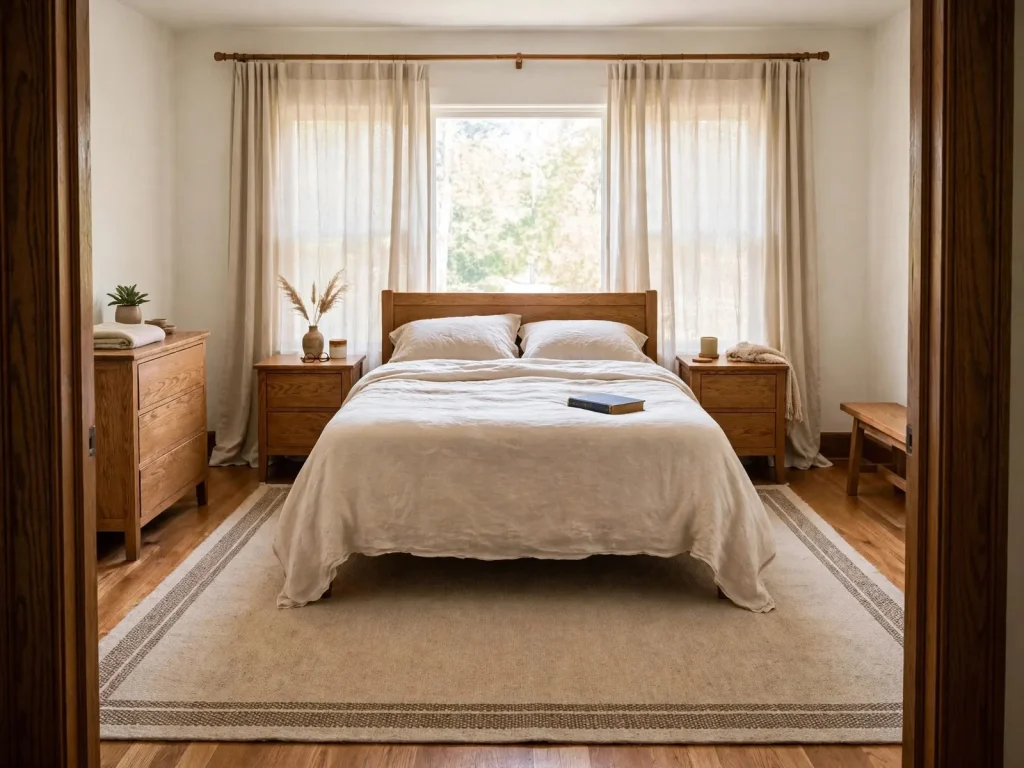
Your laptop charger is tangled in the duvet, your notebook sleeps on the pillow and your first sight every morning is an unfinished email. That is the room most bedroom office ideas have to fix. The setup has to serve four kinds of room: a master bedroom with a spare corner, a guest room that sits empty most nights, a couples room where one partner keeps office hours and a small dual-use room that does both jobs every day.
This page treats the work zone as a place with edges. Every idea separates the desk from the bed by distance, by sightline or by a cover, so one side of the room can run a real workday while the other side still switches off at night. Each idea is tagged by room size where size changes the advice. Each one carries a measurement, a budget band or a renter note. Start with the placement ideas, because no chair or lamp fixes a desk in the wrong spot. For the rest of the room beyond the work zone, the pillar collection of bedroom ideas sets the base plan.
Before you start: measure, budget, rules
Measure the room wall to wall and write down the bed footprint, the door swing and the wall the window sits on. Note which way the window faces, because it drives the first idea on this page. North light stays even all day. South light turns harsh at midday and needs a sheer or a blind. A queen bed takes 60 by 80 inches. The work zone takes the rest of your planning: a desk 24 to 30 inches deep plus 36 inches behind it for the chair and your knees, so a strip about 60 inches deep along one wall.
Size bands on this page: small means under 100 square feet, medium means 100 to 150 and large means over 150. Budget bands run in five steps: free, under $50, under $150, under $300 and over $300. Most placement ideas are free. The money on this page goes on the chair, the desk and the light, in that order.
Three rules sit under every idea. The desk never faces the bed. The screen never sits flat against the window. Work must be able to disappear at night, behind doors, under a cover or inside a closet. Renters get a flag on every idea that touches a drill or a pot of paint, with a no-damage route beside it.
Start here: the highest-impact ideas
1. Put the desk beside the window, never facing it
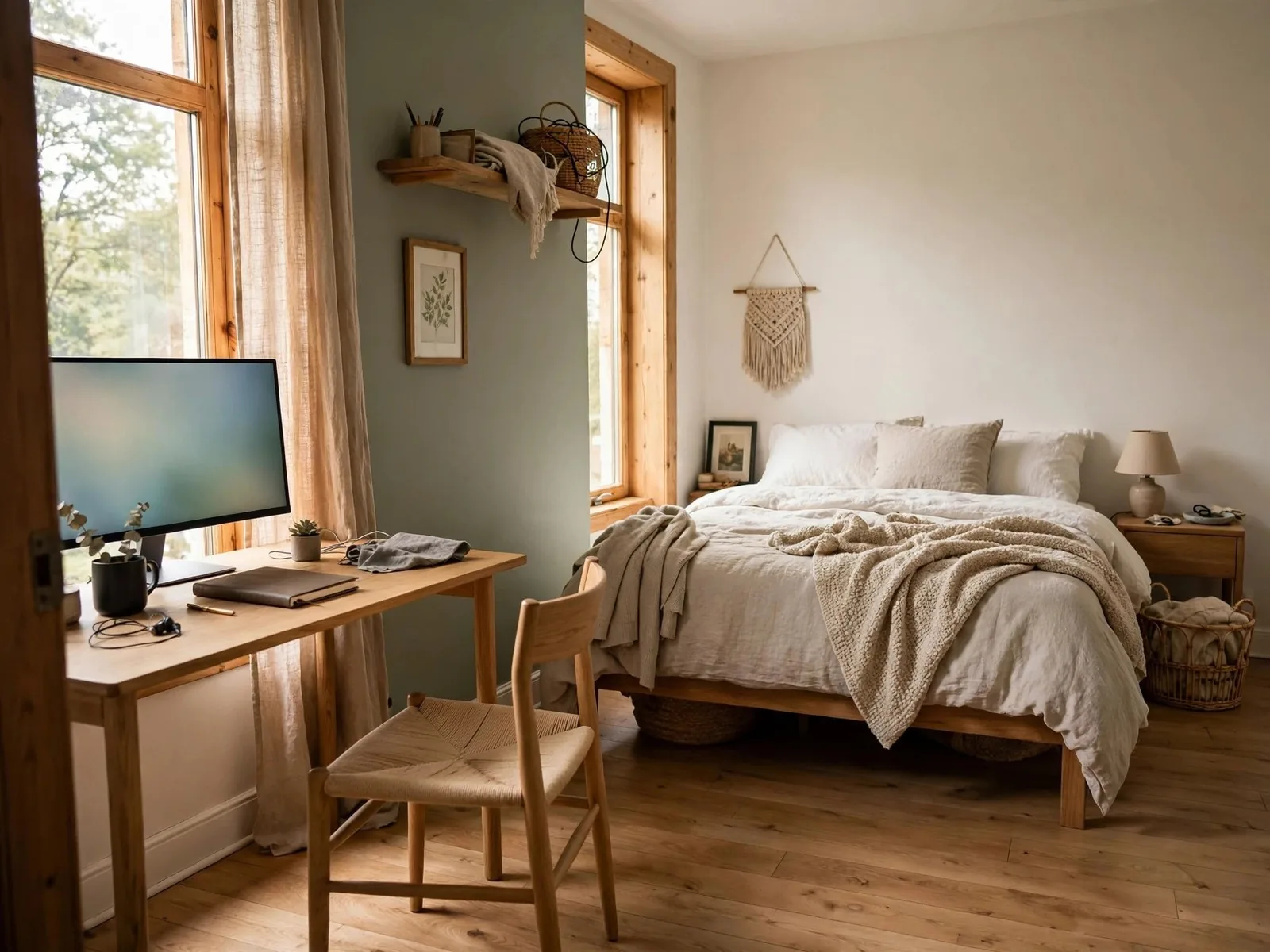
A desk facing the window looks lovely in photos and fails by ten in the morning. Sun behind the screen washes it out, your eyes work against the glare all day and every video call turns you into a dark silhouette. A desk with its back to the window is worse. The light bounces off the screen into your face.
The working position is side-on, with the window at your left or right shoulder and the screen at a right angle to the glass. A north-facing window gives the steadiest light of all, even from morning to evening. A south-facing window works side-on too, but it needs a sheer curtain or a blind you can drop for the two bright hours at midday.
Height matters as much as direction. Set the screen on a stand or a stack of books until the top edge sits at or just below eye level. Your neck stops paying for the workday by Friday.
Measure: keep the screen 20 to 28 inches from your eyes, roughly an arm’s length, with its top edge at or just below eye level.

2. Zone the room so the bed leaves your eyeline
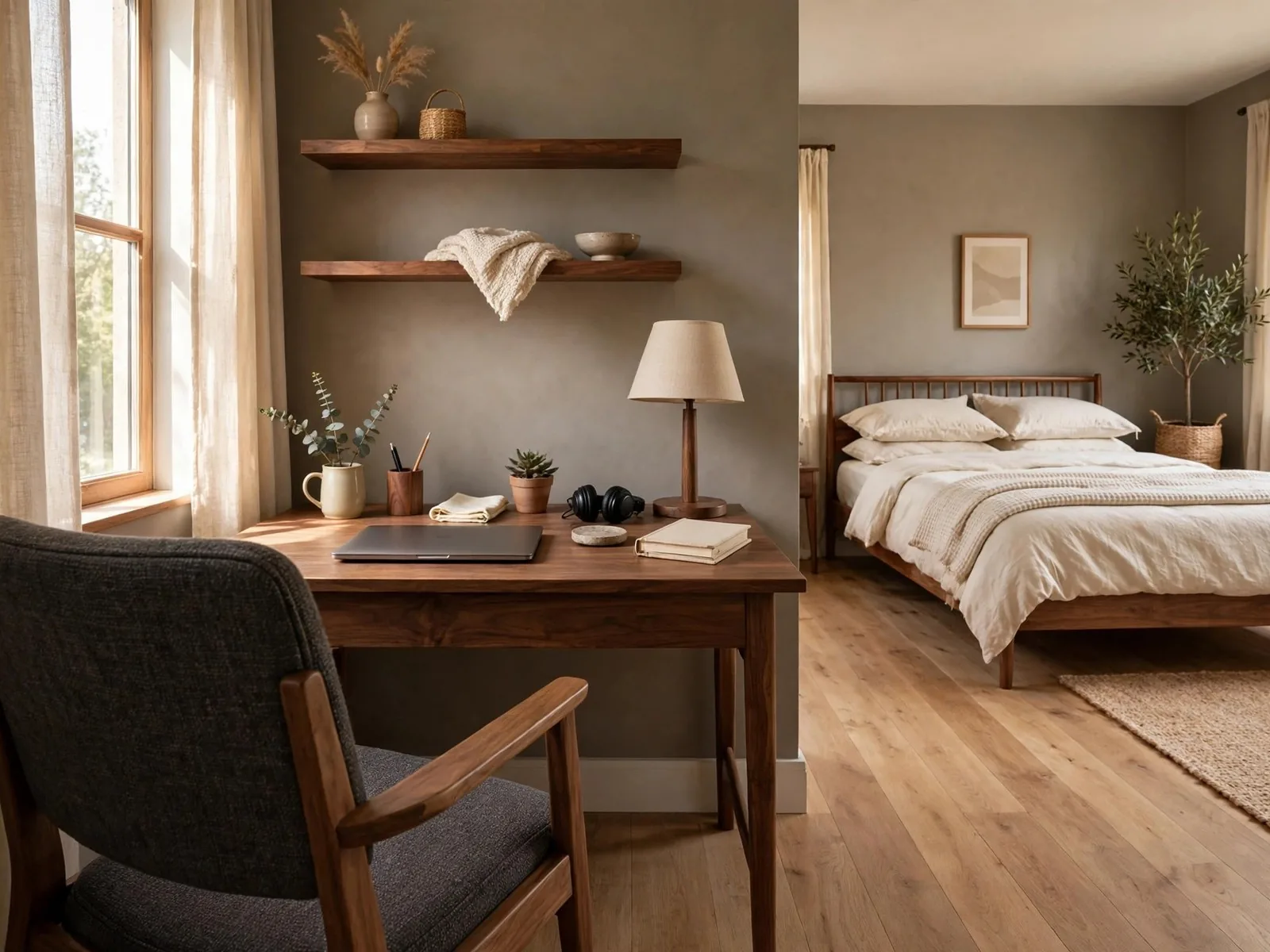
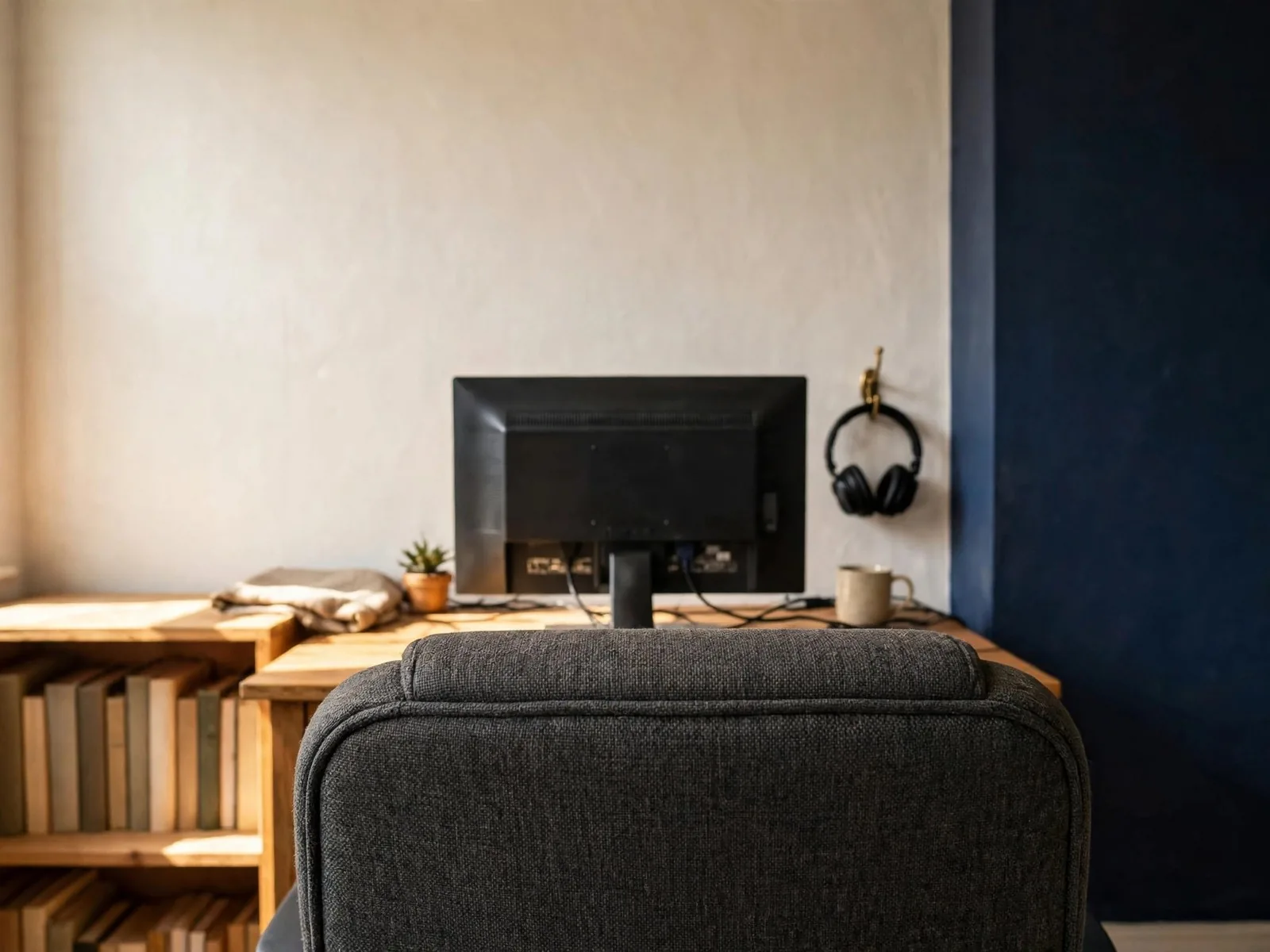
Separation in a bedroom office is mostly a sightline problem. If you can see the unmade bed from your chair, the room nags you to rest. If you can see the desk from your pillow, the room nags you to work. Both nags lose. The fix is to place the desk so it faces a wall, with the bed behind your chair and out of view in both directions.
In a medium or large room, distance helps too. Put the bed and the desk on opposite walls or at opposite ends of the same wall run. General arrangement for whole rooms gets its own page in this series. The rule here is narrower: the two zones should never share one eyeline.
The catch is the walkway. A zoned room still has to function at 7 a.m. with the chair pulled out and the bed unmade. If the chair blocks the path to the door or the closet, the zone is drawn wrong and it will annoy you daily.
Measure: leave a 30 inch walkway between the foot of the bed and the desk chair in its pulled-out position.
3. Size the desk to the zone, not to your ambitions
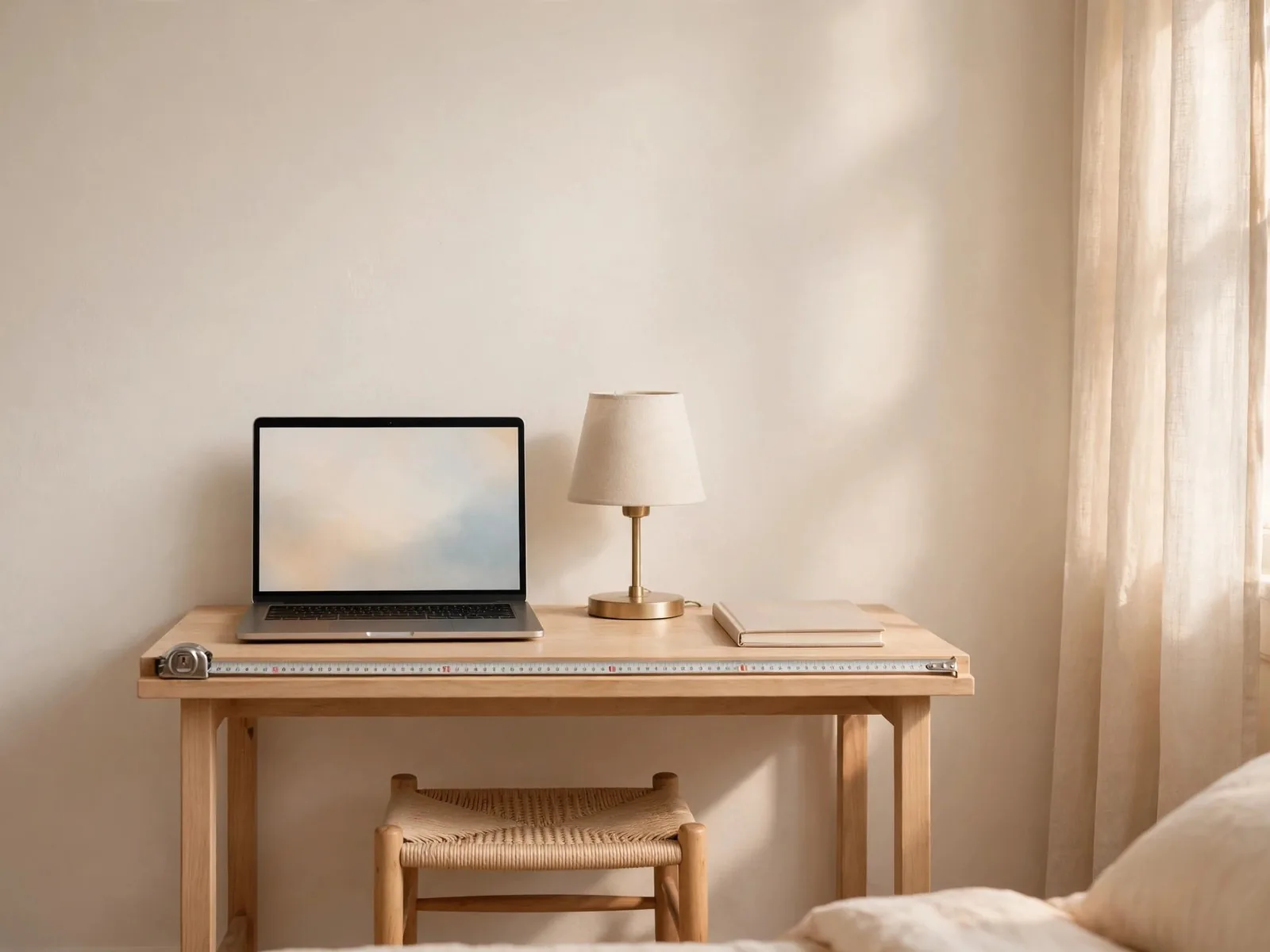
Most bedroom desks fail on depth, not width. A laptop plus a notebook needs 24 inches of depth before your forearms have anywhere to rest. A separate monitor and keyboard want 28 to 30 inches. Anything shallower pulls the screen closer than the 20 inch minimum from idea 1 and your eyes pay for it.
Width follows the gear. Forty inches holds a laptop, a lamp and one notebook in a row. Forty-eight inches holds a monitor, a keyboard and a paper tray without stacking. Anything wider invites the desk to become a storage surface, which is how the work zone quietly doubles in size.
Buy the plainest version that fits the numbers: a flat top and clean legs. Drawers under a bedroom desk mostly collect the clutter you were trying to keep out of the sleep zone.
Budget: a plain desk at 44 by 24 inches runs $80 to $180. Spend on the right footprint before you spend on finish.
4. Give video calls a backdrop that is not your bed
On a call, your background does half your talking. An unmade bed behind you reads as a day off. A plain wall, a bookcase or one framed print reads as a workplace. This is the cheapest professional upgrade in the whole post and it costs nothing but placement.
The desk-against-a-wall setup from idea 2 already solves it: the wall sits behind your chair and the bed stays behind the camera. If your only workable wall faces the bed, hang a plain curtain panel behind the chair or set a low bookcase there instead. Keep the backdrop 3 to 6 feet behind you so it reads soft rather than stark.
Skip virtual backgrounds as the main plan. They flicker at the edges of your hair and shoulders and they hide a problem that one furniture move fixes for good.
Renter-friendly: a tension rod with one plain curtain panel behind the chair makes a clean call backdrop with no screws and no permission.
Ideas by room problem
5. Turn a spare closet into a cloffice
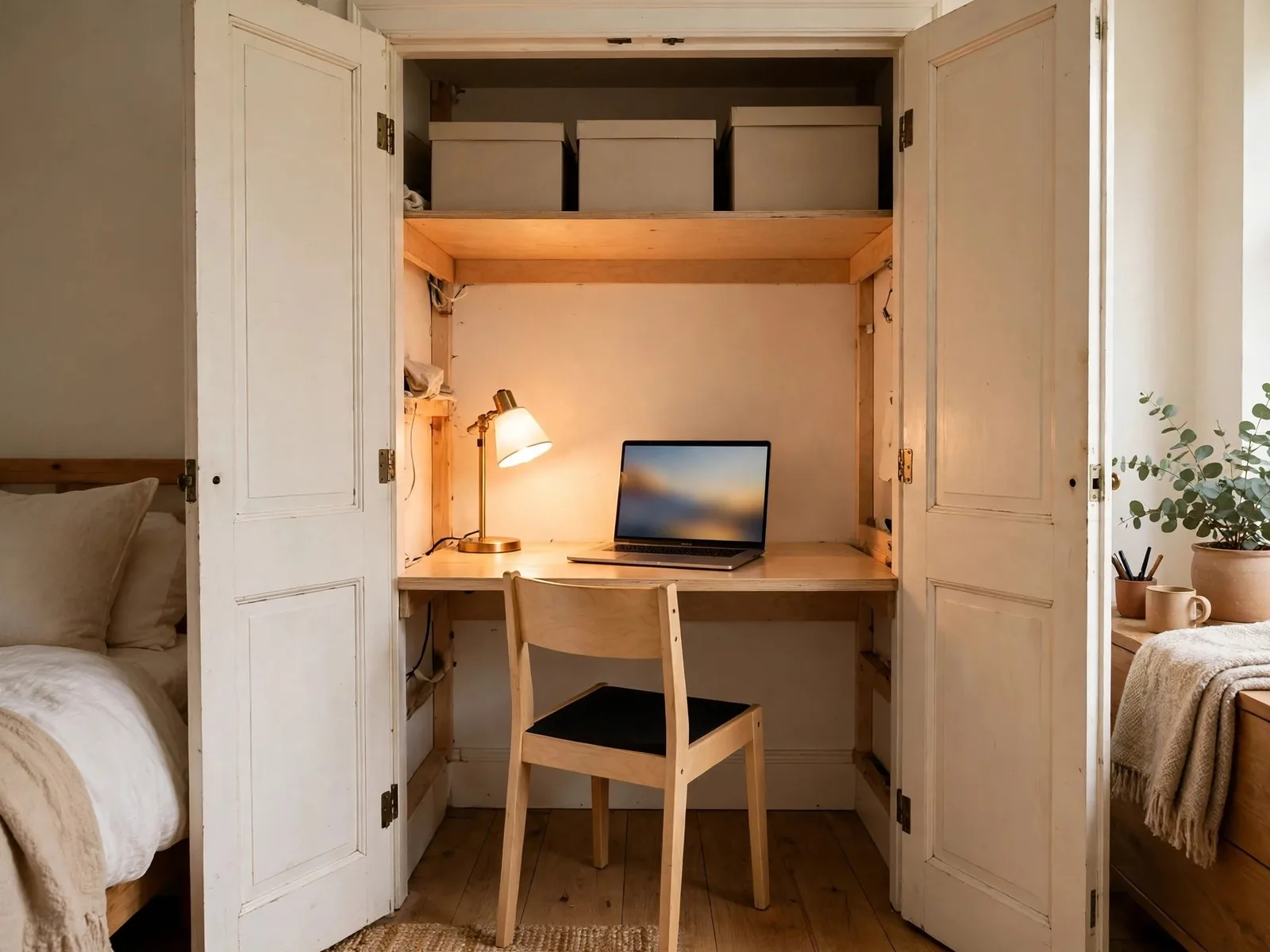
A reach-in closet is a work zone that already has edges. Slide a desk inside, add a task light and the whole office closes away at night behind the doors or a curtain. Pinterest saves this setup under bedroom closet ideas with desk and 2nd bedroom office closet ideas for a reason: it is the only version where work fully leaves the room without leaving the room. It suits small rooms best, where no wall strip is spare.
The numbers are forgiving. A reach-in closet runs 48 to 72 inches wide and about 24 inches deep, which fits a 40 to 48 inch desk or a shelf board cut to the width. Set the desk surface at 28 to 29 inches high, standard desk height. There is no window light in a closet, so a plug-in task lamp is not optional. Run one power strip inside so the door or curtain closes over a single cable.
Chair storage is the catch. The chair lives in front of the closet when the doors are open and needs a parking spot nearby at night. A folding chair that hangs on the closet wall solves it in the smallest rooms.
Needs drilling: a shelf-board desk fixes to the closet side walls on two brackets. Renters can stand a 40 inch desk inside instead and lose nothing but a few inches of depth.
6. Make the guest room earn its keep with a daybed and a slim desk
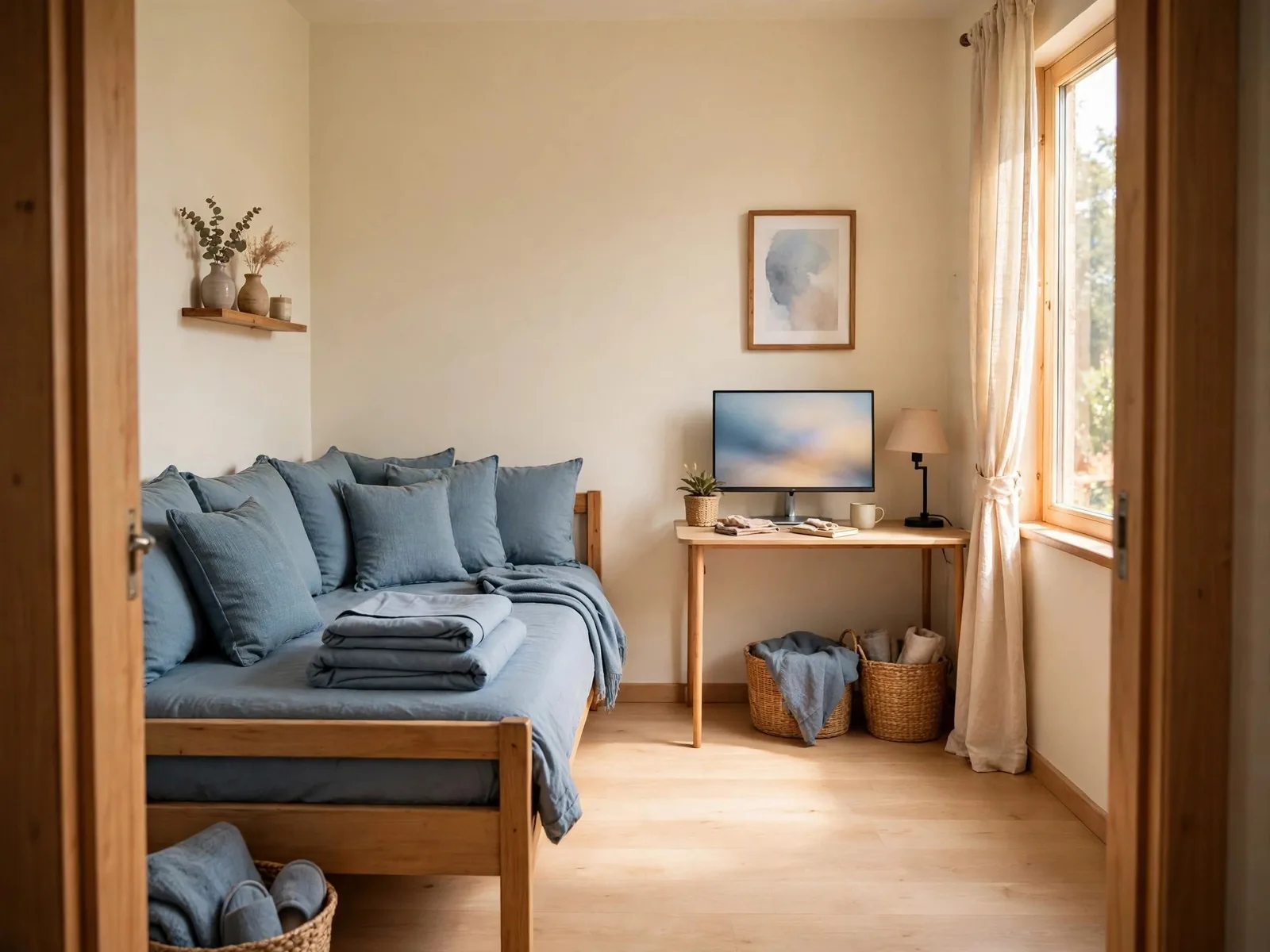
A guest bedroom that hosts guests twelve nights a year and sits empty the rest is the most wasted room in the house. The guest bedroom office combo fixes the ratio: a daybed works as a sofa by day and a twin bed by night, while a slim desk on the short wall makes the room a full-time office. This is the medium-room version of the dual-use problem.
A daybed is a standard twin at 38 by 75 inches. Dressed with two firm cushions along the wall side, it reads as a deep sofa during the workday. Keep the desk at 40 to 44 inches wide so the room still turns into a bedroom in ten minutes: laptop into a tray, chair tucked under, bedding out of the closet.
Warn guests with your feet, not your words. If the walkway between the daybed edge and the desk chair drops below 24 inches, the room feels like storage with a bed in it. Move the desk to the window wall before you shrink the daybed.
Budget: a daybed frame runs $200 to $400 and replaces both a guest bed and a sofa the room never had floor space for.
7. Share a master bedroom office combo without waking your partner
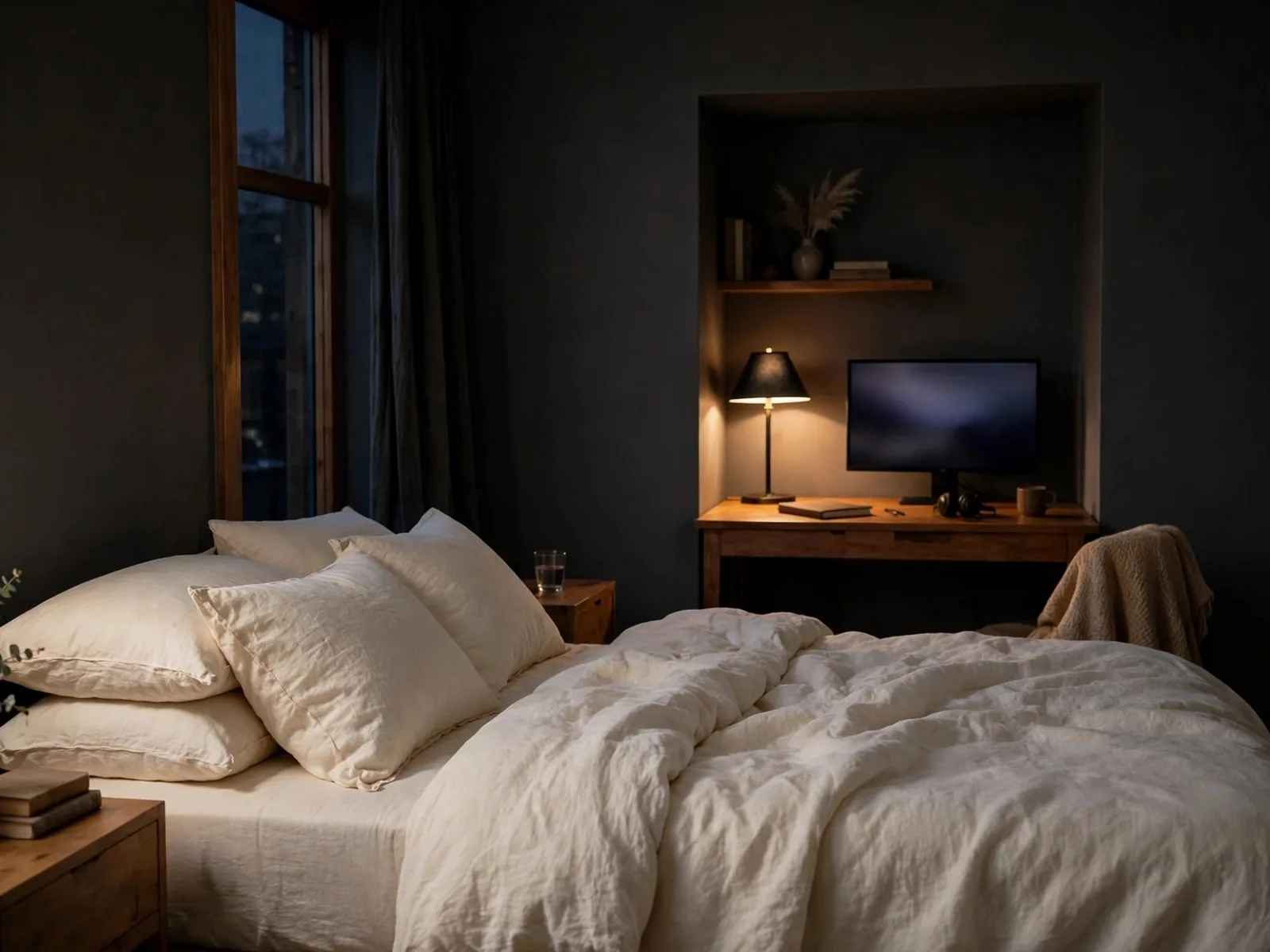
The large-room version has a different problem: two sleep schedules in one room. The desk goes in the alcove, the bay or the corner furthest from the bed head, with the screen angled so its glow never crosses the pillows. The master bedroom page plans the suite as a whole. This idea handles only the corner where work happens.
Light discipline does the rest. A shaded task lamp aimed at the desk lights your work and nothing else. Calls after your partner sleeps move to headphones with the microphone close to your mouth, so your voice stays low without whispering. Brightness on the screen drops at night for the same reason the lamp stays shaded.
Agree the boundary out loud once. Work ends at an agreed hour and the desk closes down like idea 15 says. Couples rooms fail on unspoken schedules far more often than on square feet.
Measure: put at least 8 feet between the desk and the head of the bed in a master bedroom. Angle the screen away from the pillows.
8. Split a small bedroom office combo with one divider
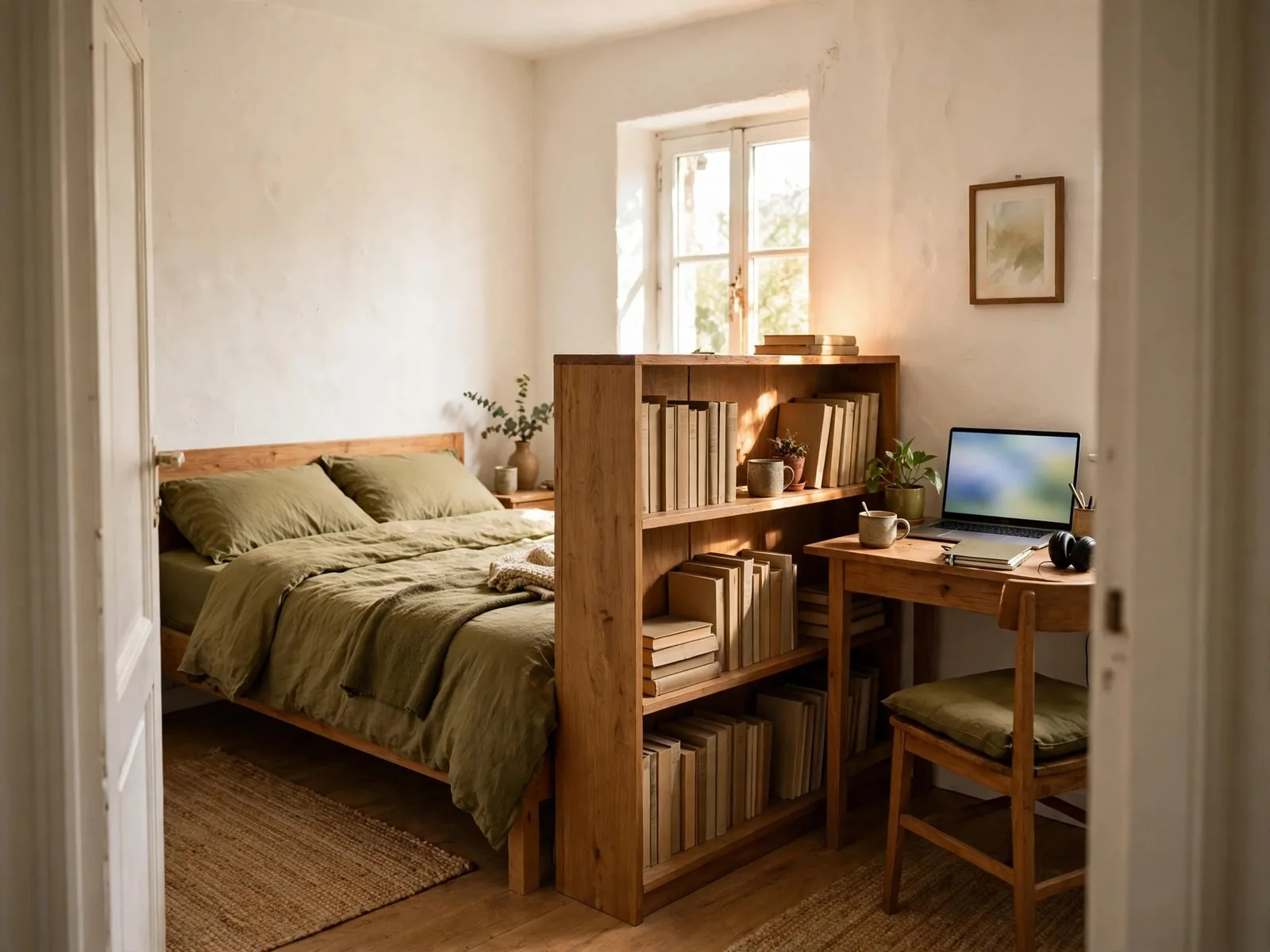
In a small room under 100 square feet, distance cannot separate the zones, so a divider has to. A low bookcase set at a right angle to the wall makes two rooms out of one: bed on one side, desk on the other, storage in the divider itself. The searches call this small office bedroom combo ideas and it is the layout small rooms save most.
Keep the divider low and narrow. A bookcase 12 inches deep and about 48 inches tall splits the sightlines while light still passes over the top. The desk side gets the shelves for work gear. The bed side gets the plain back panel, because the sleep zone should face the calmest surface in the room. The small bedroom page works the tightest floor plans in more detail.
Renters can swap the bookcase for a curtain on a tension rod or a folding screen. The sightline split is what matters. The furniture is just one way to hold it up.
Renter-friendly: a curtain on a tension rod divides a small room for under $40, with no holes in the walls and no paint to undo.
Ideas by budget
9. Start with the free version: rearrange before you buy
Before any money moves, run the one-hour test. Turn the desk to face a wall. Move it beside the window instead of against it. Push the chair in and look at the room from the pillow. Half the problems on this page are placement problems wearing a shopping list as a disguise.
Work in the rearranged room for a full week. The glare that remains, the chair that still hurts and the cables that still cross the floor are your real shopping list. Everything else was furniture placement.
This is also the honest way to test the closet idea. Spend one day working at a card table inside the open closet doorway before you cut a shelf board to size.
Budget: free. One hour of rearranging tells you which paid ideas on this page your room actually needs.
10. Spend the first $150 on the chair
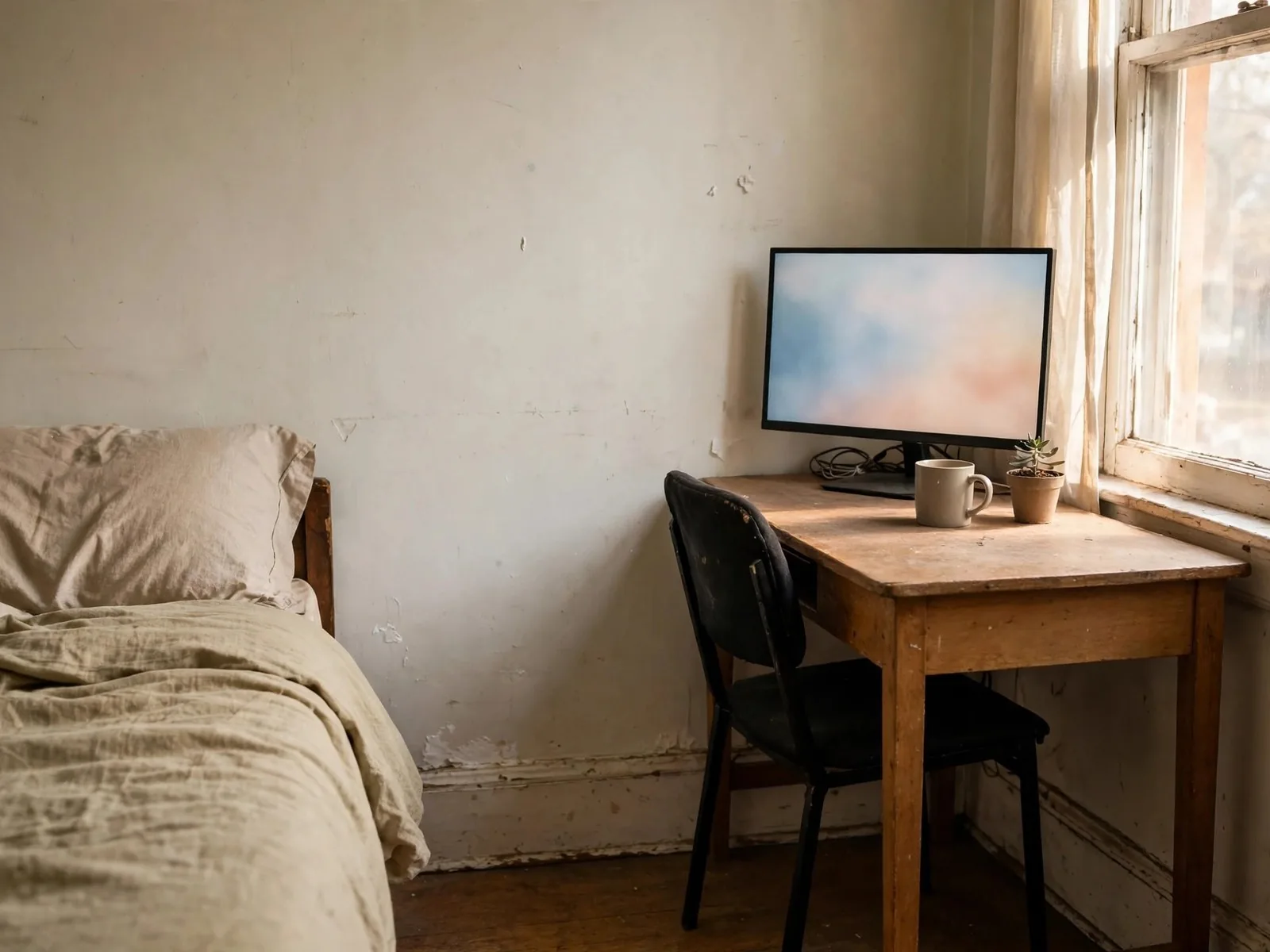
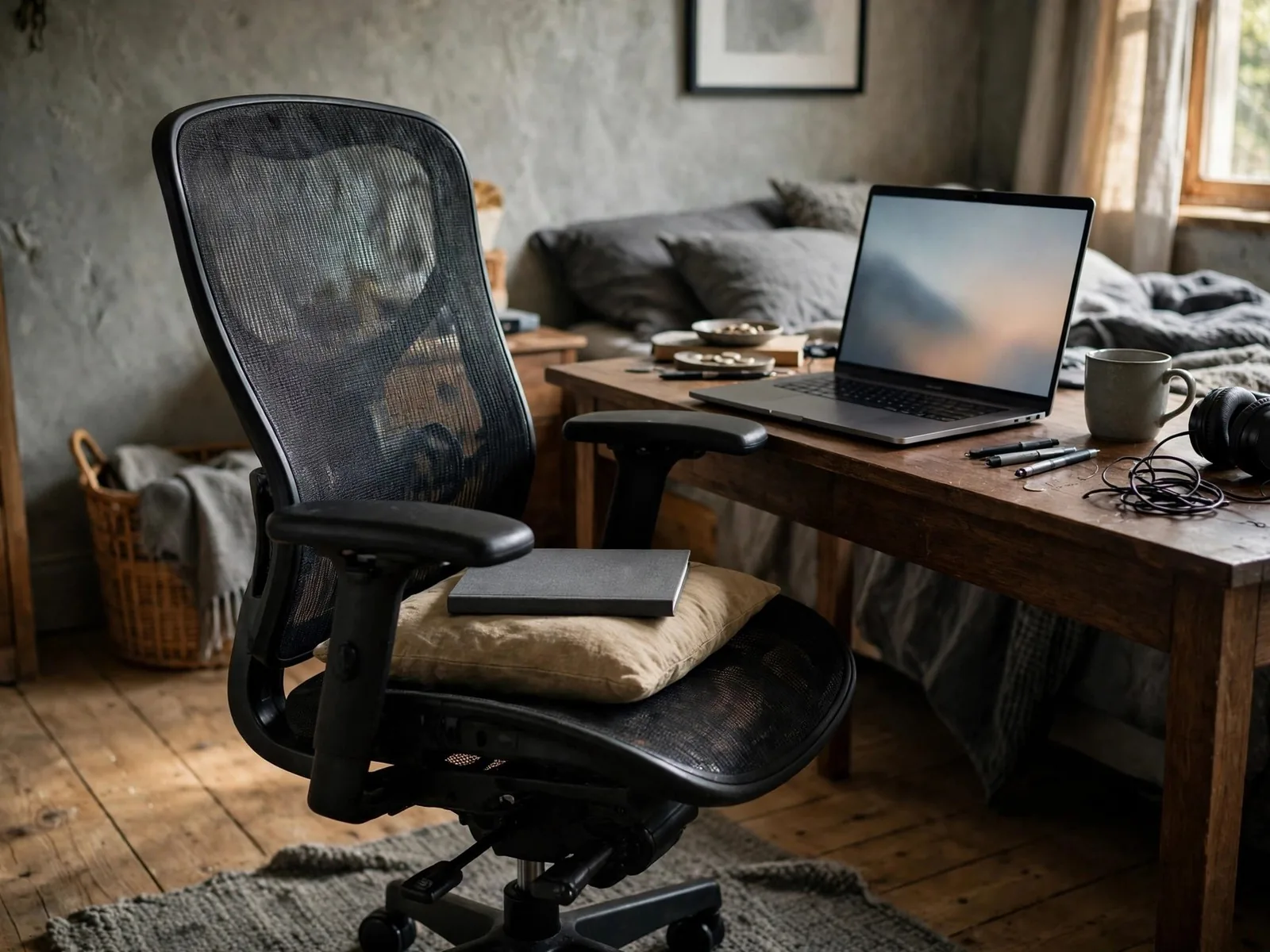
Eight hours exposes a bad chair the way one night exposes a bad mattress. A dining chair or a kitchen stool holds your posture together with willpower until about Thursday, when your back files its complaint and the bed starts looking like an office again.
The numbers to shop by: a seat height that adjusts between 16 and 21 inches, so your feet rest flat with your knees near a right angle. A seat back that supports the curve of your lower back. Armrests are optional in a bedroom, where a chair with arms may not slide under a 24 inch deep desk.
Office clearance chairs are the budget secret of this whole page. Businesses replace chairs in batches, so a supportive ergonomic chair with years left in it sells used for the price of a flimsy new one.
Budget: $50 to $150 buys a used ergonomic chair from an office clearance. It is the most comfort per dollar anywhere on this page.
11. Choose a fold-down wall desk when floor space is the real budget
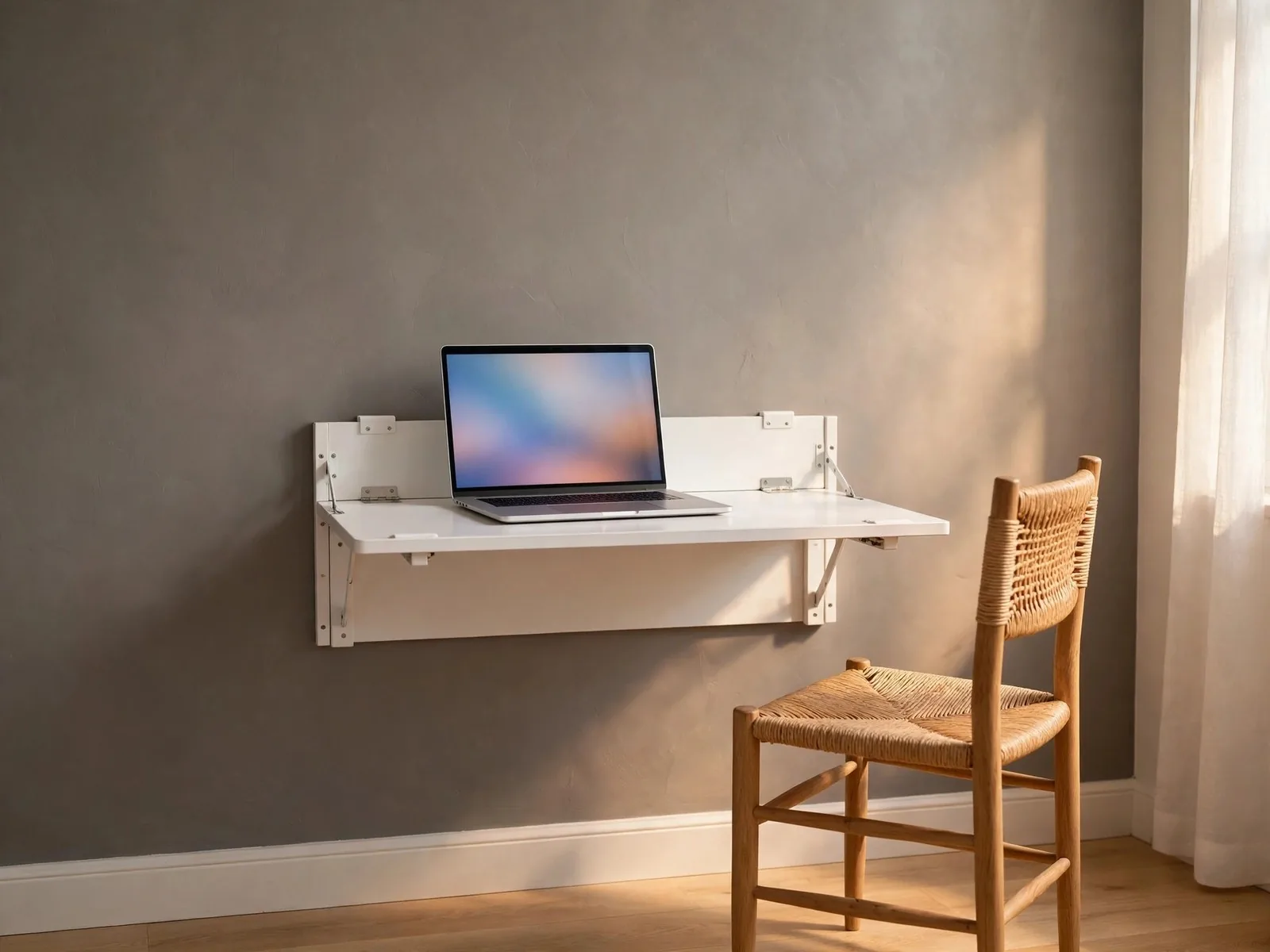
Some rooms have the wall but not the floor. A fold-down desk mounts flat to the wall, opens to a work surface for the day and folds back to 4 or 5 inches deep at night. The bed keeps its floor, the walkway stays clear and the office still closes down completely.
Size it for a laptop life. A top at 32 to 36 inches wide holds a laptop and a notebook side by side. It will not hold a monitor setup, so this idea pairs with laptop-only work or a monitor arm fixed beside it. The chair parks under the folded desk or folds flat itself.
The mount is the whole job. The brackets must hit studs, because a folding desk loaded with a laptop and your forearms is a lever pulling on the wall all day.
Needs drilling: a fold-down desk anchors into two studs. Renters should use the divider in idea 8 with a small standard desk instead.
12. Upgrade the light before you upgrade the gear
Eye strain in a bedroom office usually comes from contrast, not darkness. A bright screen in a dim room tires your eyes by lunch. The fix is a shaded task lamp that lifts the light level around the desk to match the screen, not a bigger monitor.
Aim for 400 to 800 lumens at the desk surface for reading and paperwork. Bulb color is a schedule choice: 3000K to 4000K reads alert during the day, while a 2700K warm bulb in the evening tells your body the workday is ending. The lighting page sizes lamps and layers for the whole room if you want the full plan.
Place the lamp on the opposite side from your writing hand so your hand never shadows the page. In a side-on window setup, the lamp fills the hours after the daylight goes.
Budget: $30 to $70 buys a shaded task lamp and the right bulb. It fixes eye strain faster than any screen upgrade.

Finishing touches
13. Hide the cables once and keep chargers off the nightstand
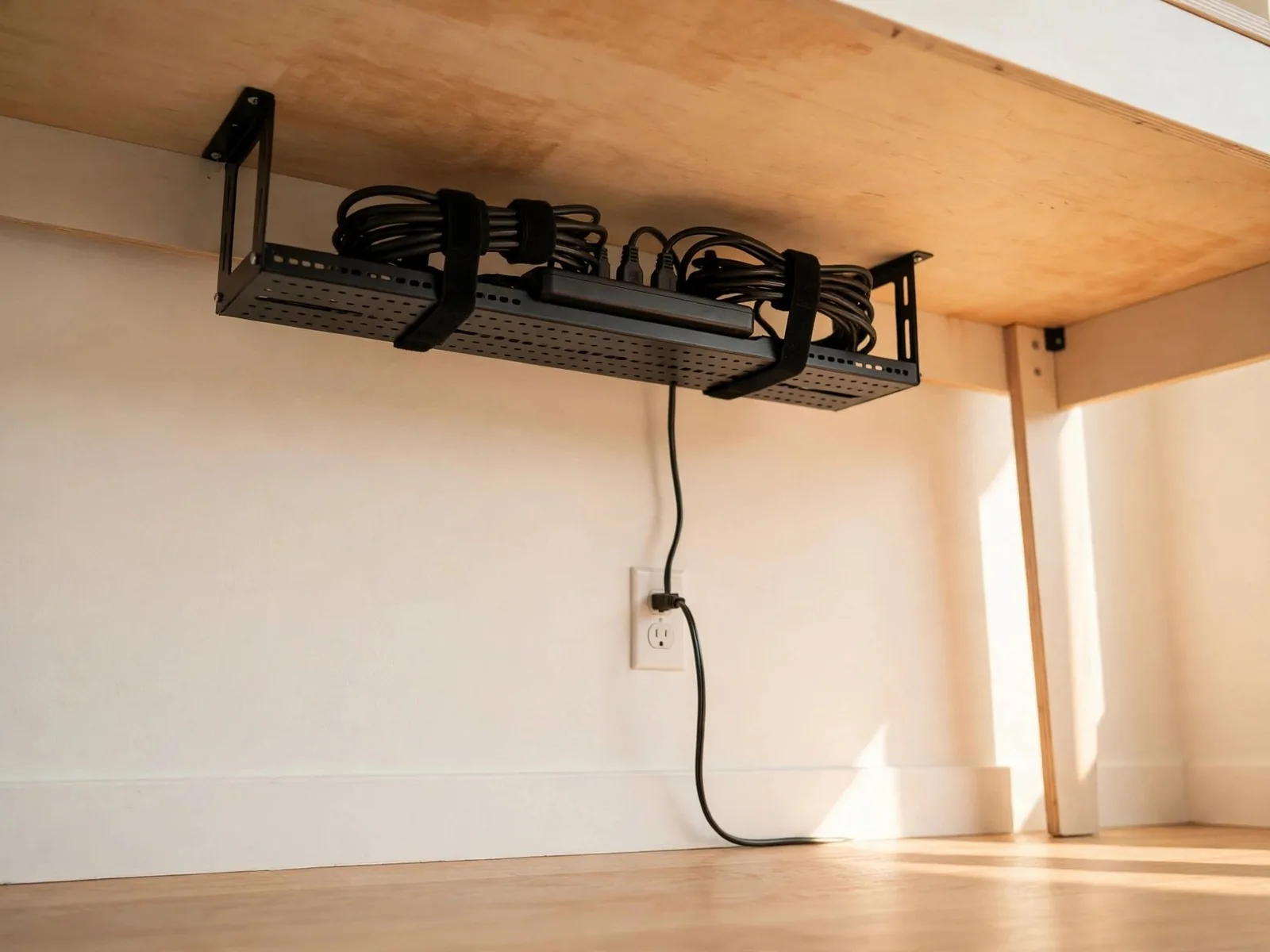
Cable creep is how the office annexes the sleep zone one cord at a time. The phone charger migrates to the nightstand, the laptop cable crosses the floor and the power strip ends up glowing beside the bed. One cable tray under the back edge of the desk ends the migration in twenty minutes.
Mount one power strip in the tray and route every desk cable into it, so a single cord runs to the wall outlet. The phone charges on the desk overnight, which is better for sleep than a lit screen beside the pillow anyway. The small bedroom storage page keeps the rest of the room’s overflow in closed boxes with the same discipline.
Use Velcro ties rather than zip ties. Desks change, gear changes and a cable you can free in five seconds gets tidied again instead of abandoned.
Budget: a cable tray, one power strip and a pack of Velcro ties run under $25 in total.
14. Mark the work zone with one color signal
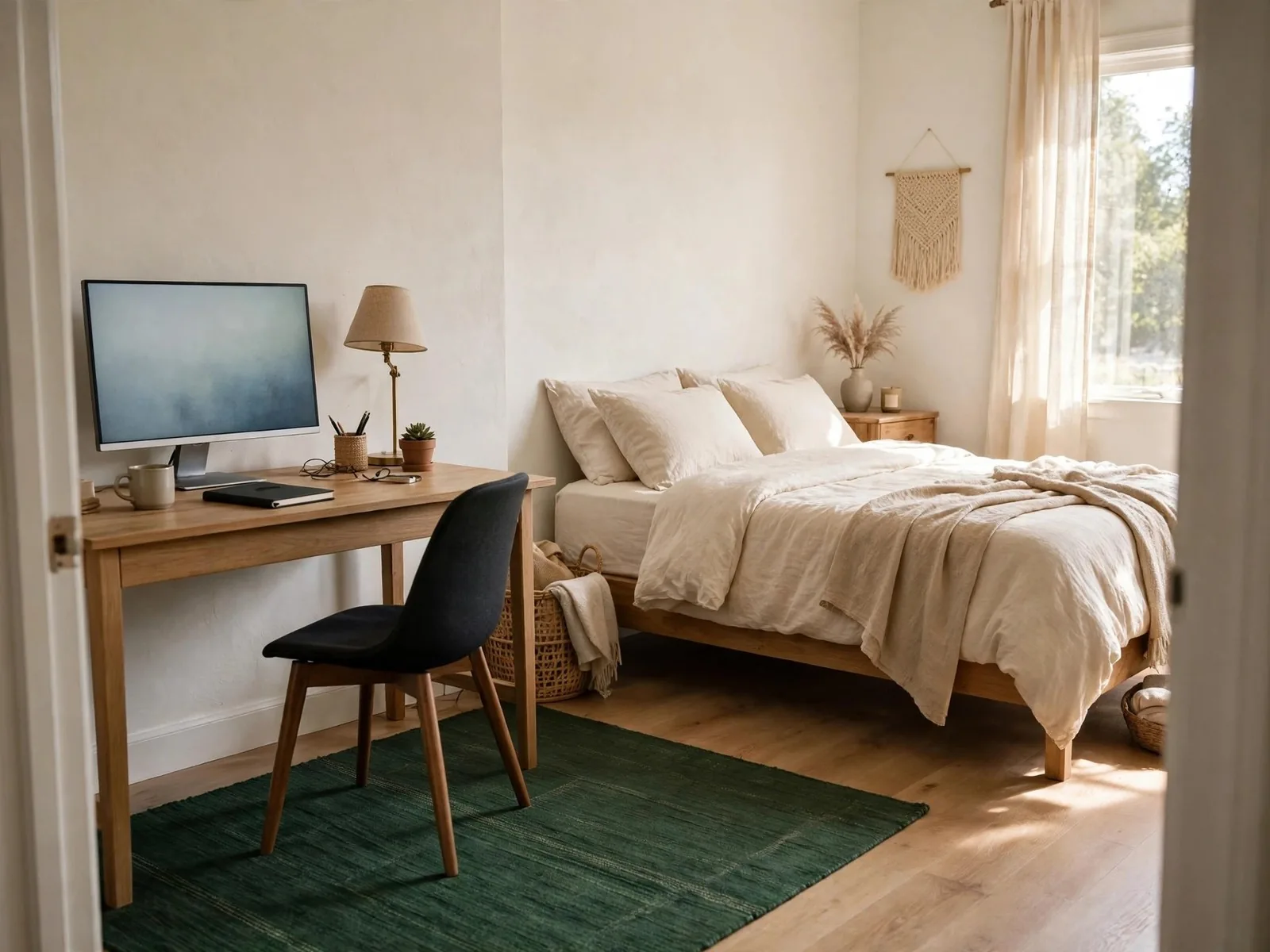
Zones read faster in color than in furniture. A flat-weave rug under the desk chair, a chair mat in a deep tone or one painted wall behind the desk tells your brain which room you are in before you sit down. The sleep side stays soft. The work side gets the one strong note.
Paint is the boldest version: one wall behind the desk in a deep green, a navy or a warm charcoal, finished where the bed zone begins. The accent wall page covers paint methods and edges if you take that route. Keep the color behind the desk only, never behind the bed, so the strong wall is the one you face at work and never see from the pillow.
The rug version is nearly as clear and fully reversible. A 4 by 6 foot rug under the desk and chair marks the territory, quiets the chair wheels and warms the floor at the spot where your feet land first.
Renter-friendly: the rug version marks the zone with no paint, no permission and nothing to undo at move-out.
15. Close the office down every night
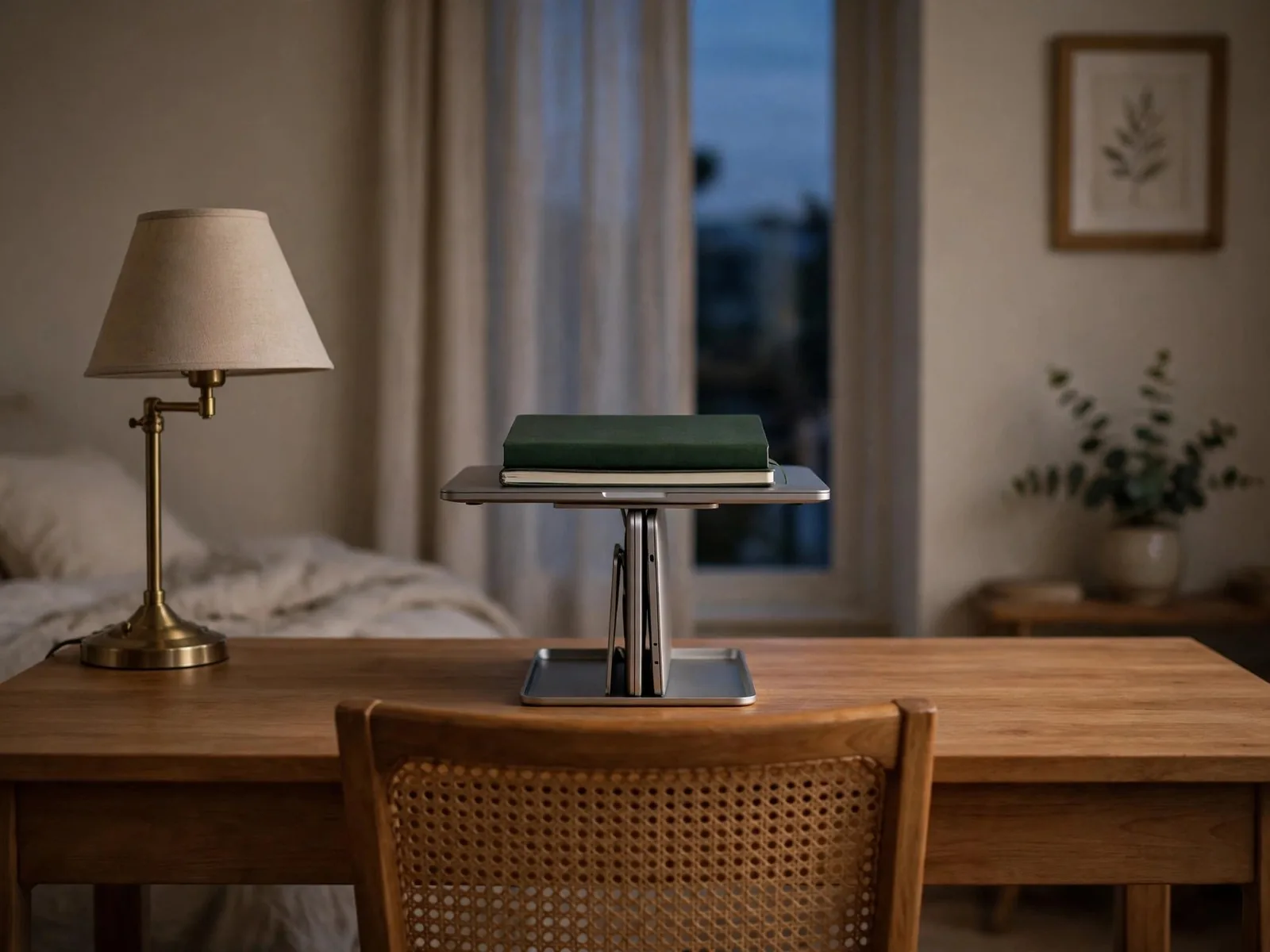
The last idea is the one the title promises. Work leaves the room when you do one two-minute shutdown: laptop closed and into a vertical stand or tray, notebook stacked on top, chair pushed in, lamp off. If your office is the closet from idea 5, the doors close. If it is the divider setup, the tray carries everything behind the bookcase.
What matters is that no work object stays visible from the bed. A closed laptop on the desk still reads as tomorrow’s first task. A covered or stored one reads as furniture. A plain cloth cover over the desk does the same job for under $10 if a tray is not in the budget this month.
Build the habit before you buy the gear. A week of shutdowns with a cardboard box as the tray will tell you whether you need the stand, the cover or the closet after all.
Budget: a laptop tray or vertical stand runs $15 to $40. The shutdown habit itself is free and it is the part that works.
Bedroom Office Ideas on a budget
The budget version of this page is an order of operations. Start with the free moves from idea 9: desk beside the window, chair turned to a wall, bed out of the eyeline. Live with it for a week. The problems that survive the rearrangement are the only ones worth money.
Spend the first money on the chair, used, from idea 10. Spend the next money on the lamp from idea 12, because light fixes both the workday and the evening. After that, the divider decides by room: a tension-rod curtain in a small rental, a low bookcase where you own the walls. Dorm rooms run this exact dual-use problem at 100 square feet and the dorm room page squeezes work and sleep into one room with the same rules.
Hold the desk purchase for last and buy it by the measurements in idea 3, not by a photograph. A desk that fits the zone beats a beautiful desk that eats the walkway, every time. Our bedroom makeover page runs the same spend-in-order discipline on whole rooms.
The one thing never to buy cheap is the closing layer. A cover, a tray or a pair of closet doors is what makes the room a bedroom again at night. If the budget forces a choice between a prettier desk and a way to hide the ordinary one, hide the ordinary one.
Mistakes that make it fall flat
What makes a bedroom office look cheap is rarely the furniture. It is the blur: work gear on the bed, sleep gear on the desk and no edge anywhere. These are the five blurs that undo the room fastest, worst first.
- The desk at the foot of the bed, facing it. Work becomes the first sight of the morning and the last sight at night. Your brain never fully clocks out or fully rests. Turn the desk to a wall and let the bed leave your eyeline instead.
- The screen backed against the window. Glare washes the screen out all day and every call shows a silhouette. Side-on placement from idea 1 fixes both in one move.
- Working from the bed itself. The duvet desk destroys posture by noon and teaches your body that the bed is a workplace, which is how sleep problems start. A $60 folding table beats the bed as an office.
- A dining chair for an eight-hour day. No height adjustment and no back support means pain by Thursday and the desk abandoned by the weekend. The used ergonomic chair in idea 10 costs less than the physio bill.
- Chargers living on the nightstand. Work sleeps beside your head, lit screen and all. One tray on the desk keeps every charger in the work zone where it belongs.
Questions people ask about this
Where do I start when decorating a bedroom that also has to hold a desk?
Start with the two fixed points: the bed and the desk. Place the bed first, then give the desk the leftover wall with the best light, beside a window rather than against one. Measure both footprints before buying anything else. Once those two zones hold, storage, light and decor fill the gaps in that order.
What order should I buy bedroom office items in?
Buy in the order your body notices them. Desk first, sized to the wall you measured. Chair second, because eight hours exposes a bad seat in a week. Task light third. Storage and the closing cover fourth. Wall color, a rug and art come last, once the zones work and the cables are hidden.
How do I make a bedroom office feel finished?
Finished means both zones read as deliberate. The bed is dressed in layers rather than a bare duvet. The desk clears at night behind a cover or inside a tray. One color or rug marks the work corner, the cables are hidden and the light pools warm at both stations instead of glaring from the ceiling.
The bottom line
A bedroom office works when the room holds two honest zones and a door, real or invented, between them. Placement first, a chair your back trusts, light that matches the hour and a shutdown that clears the desk from view: those four moves do more than any single purchase. This week, run the free test. Turn the desk to face a wall, set the screen an arm’s length away and close the laptop into a tray tonight. Live with the zones for seven days before you spend a dollar.