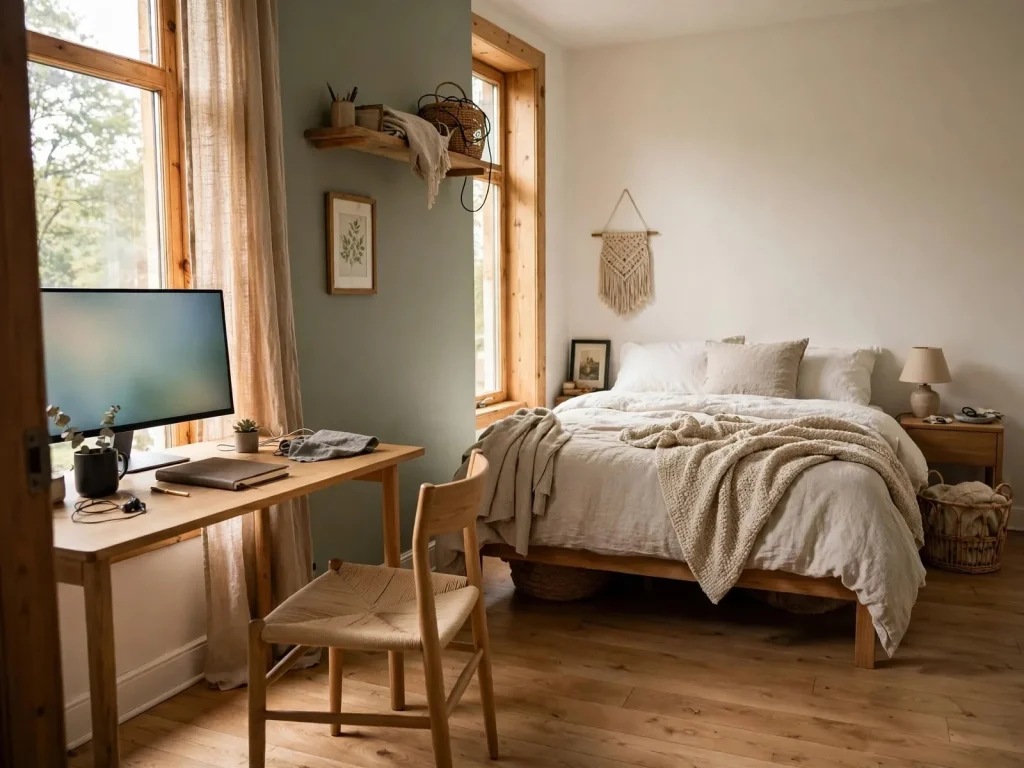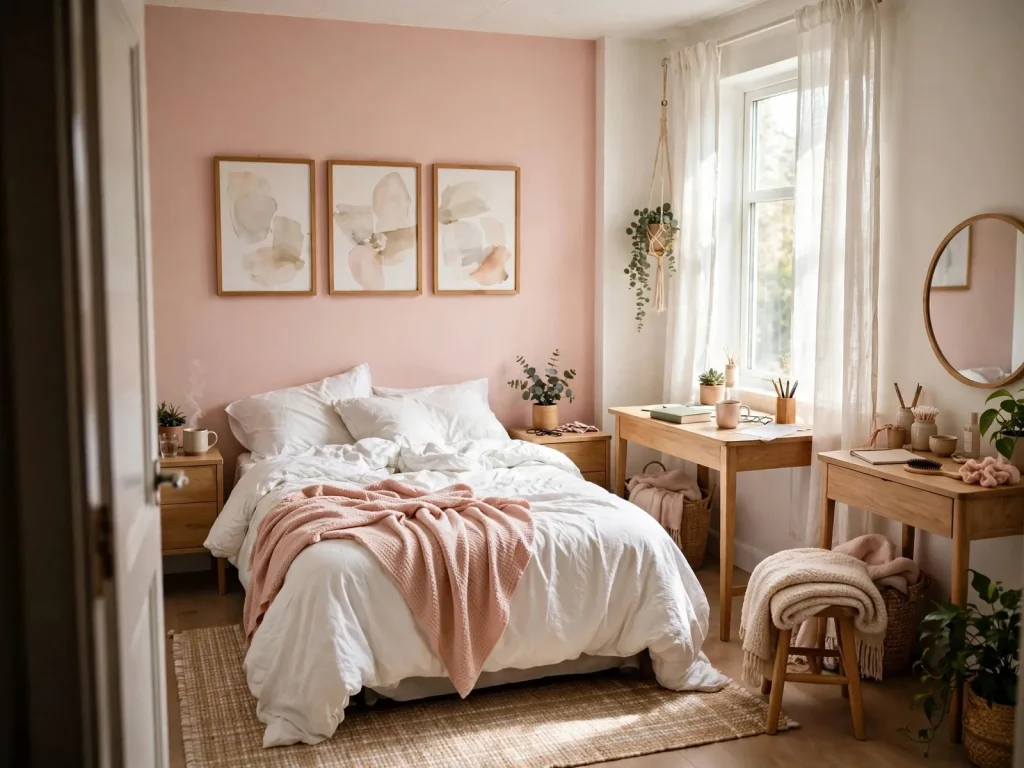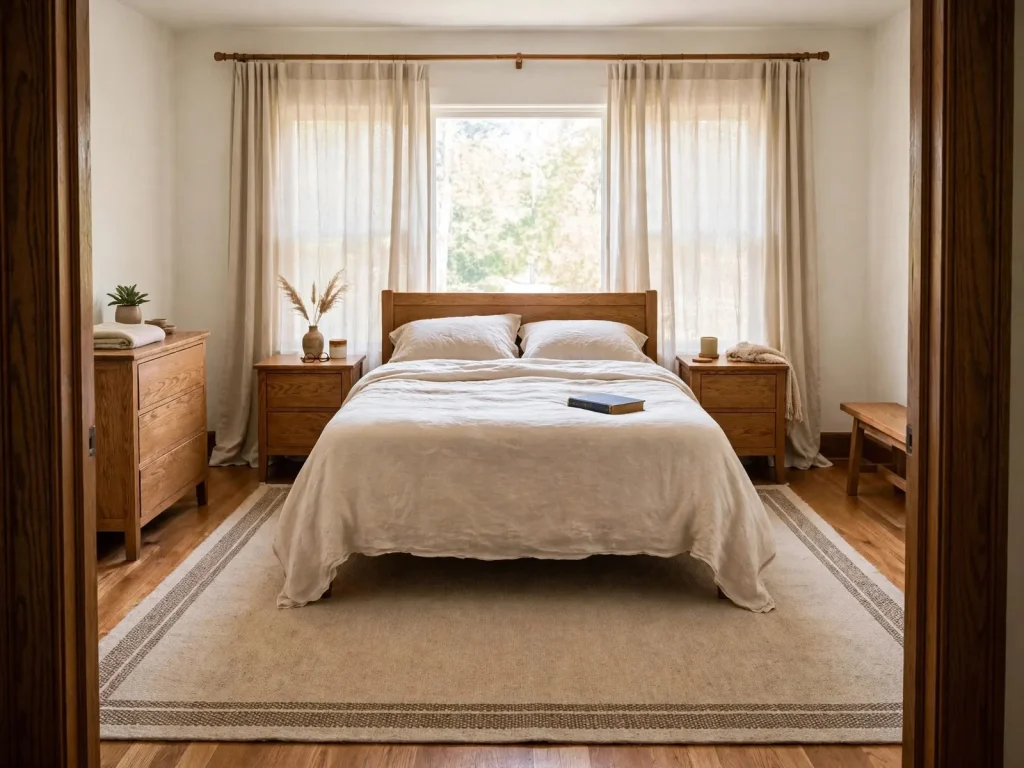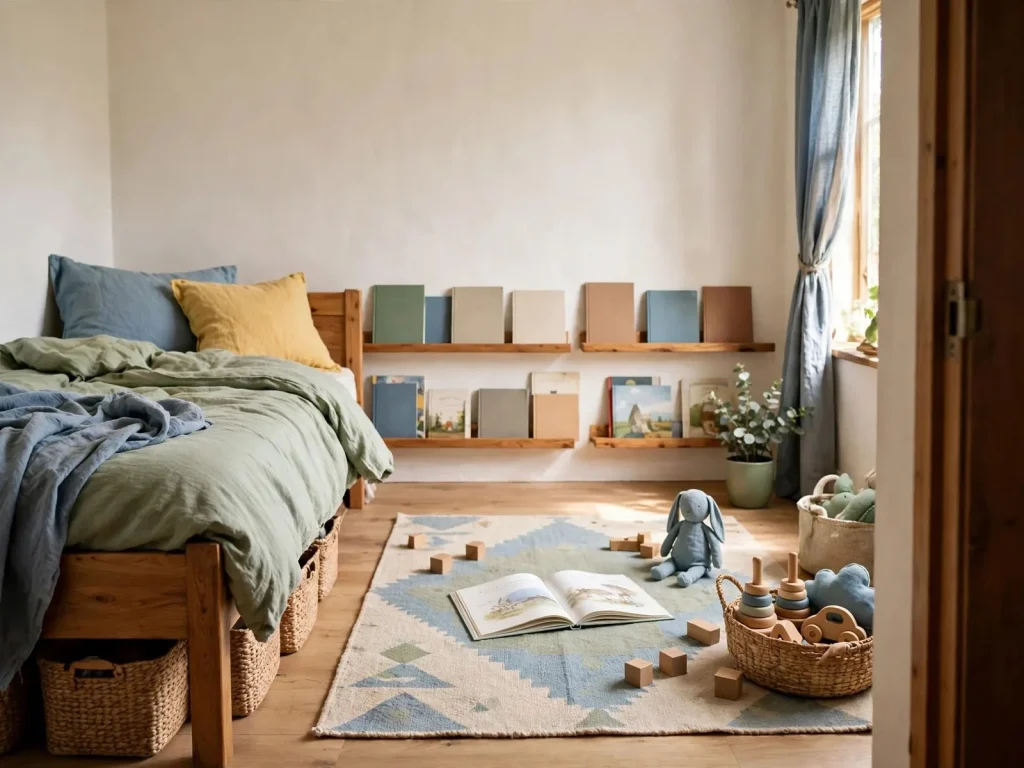
Your bedroom is not small and the closet is not tiny. The room still does not work. Spare bedding lives on the chair, out-of-season clothes colonize the guest bed and the dresser top has become a landing strip for everything that has no home. The problem is not square feet. It is that most of the furniture in the room holds nothing at all.
This page fixes that with bedroom storage ideas built on the furniture itself. The storage types are named plainly: under-bed storage, vertical storage on walls and in tall pieces, hidden storage inside furniture and the dresser system that does the heavy lifting. Every idea states its capacity in plain units, folded sweaters, pairs of shoes and linear feet where rails appear. The order starts with a free reorganization and ends with the buy list. For the inside of the closet itself there is a separate page in this series and the pointer sits below. The wider set of bedroom ideas lives on the pillar page when the rest of the room needs planning.
Before you start: measure, budget, rules
Measure the room the way storage sees it. Start under the bed: frame height from floor to the underside of the rails, because that one number decides every under-bed idea on this page. Most frames give 6 to 12 inches. Then measure the wall runs the dresser and armoire could take, the depth of the corner nobody uses and the clear floor in front of each piece, since a drawer needs its own depth again to open.
Sort by what things are, not by where they currently sit. The piles that matter are seasonal clothes, spare bedding and blankets, shoes and bags, books and paperwork and the daily layer of chargers and glasses and half-read books. Count roughly as you sort. A dresser drawer holds about 8 to 10 folded sweaters; a queen duvet folded takes the space of about 6 sweaters. Those two numbers size almost every idea below.
The visibility rule runs through the whole page. Closed storage is the default, because a room reads calm when the storage has fronts on it. Open storage is allowed only on the styled surfaces in the last group, where what shows has been chosen on purpose. If an idea tempts you to store daily clutter in the open, it belongs in a drawer instead.
Set the budget order now and hold it. The free reorganization comes first: rezone the drawers you own and move things to the storage the room already hides. Then come the under $50 fixes, dividers and bins and hooks. The $50 to $250 band buys the bench and the shelving. Real furniture money, the armoire and the storage bed, is spent last and only on the pile the free steps could not place. Renters: every idea that wants a screw has a freestanding or tension version flagged in its practical line.
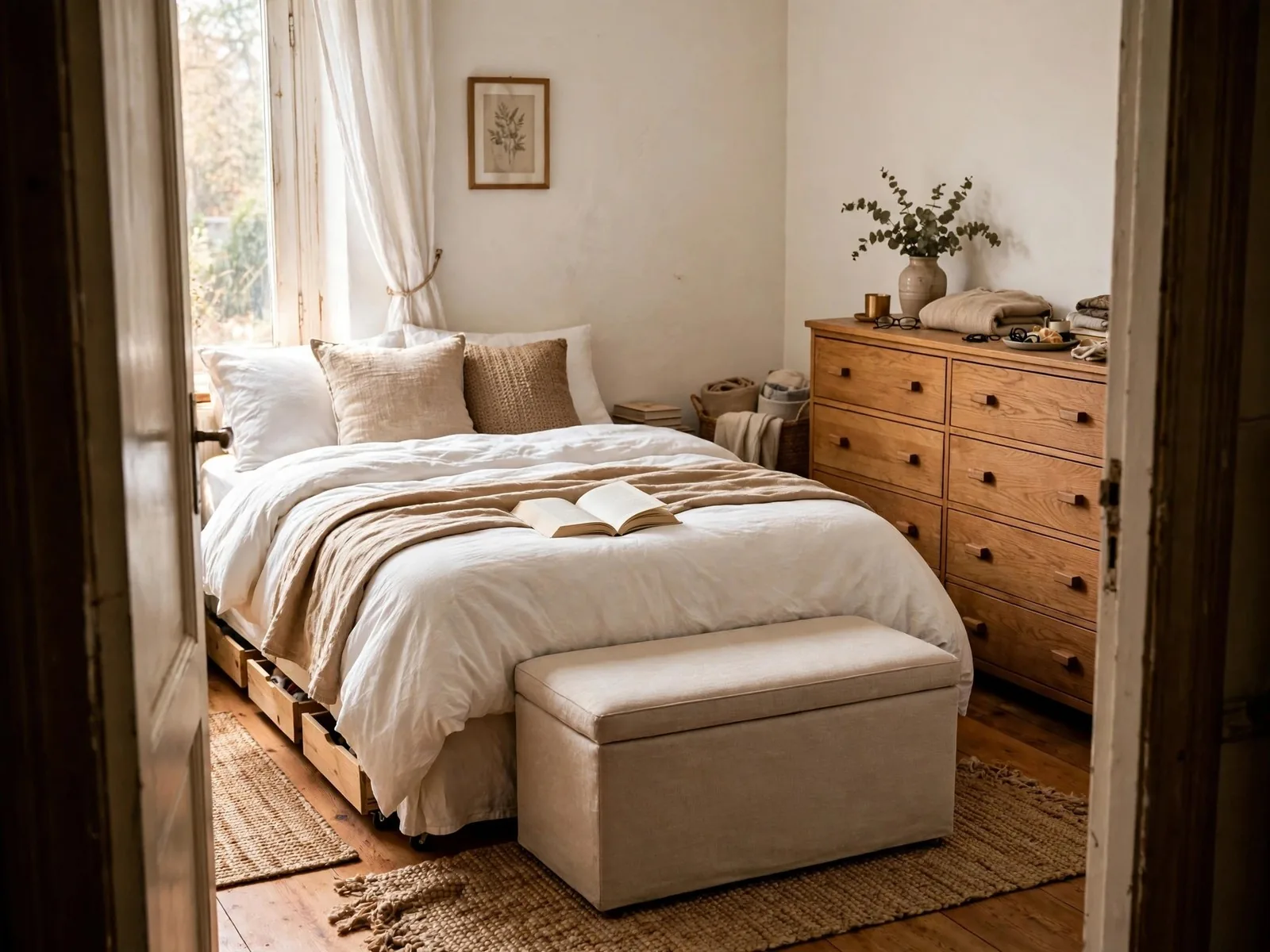
First, the closet: a short pointer
This page deliberately keeps the closet short. Closet interiors and systems, rails and shelf towers and door choices, are a whole subject with their own measurements and they live on the bedroom closet ideas page in this series. What follows here assumes the closet does its basic job and fixes everything outside its doors.
One closet habit still belongs in this page, because it decides how much furniture storage you need. The closet holds what you wear this season. The moment out-of-season clothes and spare bedding move out of it and into the under-bed and armoire storage below, the rail and shelves inside start working again without a single new fitting.
The furniture that does the heavy lifting
1. Run one wide dresser and zone its drawers by category
Two narrow chests waste the wall between them and split one wardrobe across two pieces, so nothing is ever where you look for it. One wide dresser, 54 to 60 inches, puts the whole folded wardrobe on one wall with drawers that can each take a category. It is the single hardest-working storage piece a bedroom owns.
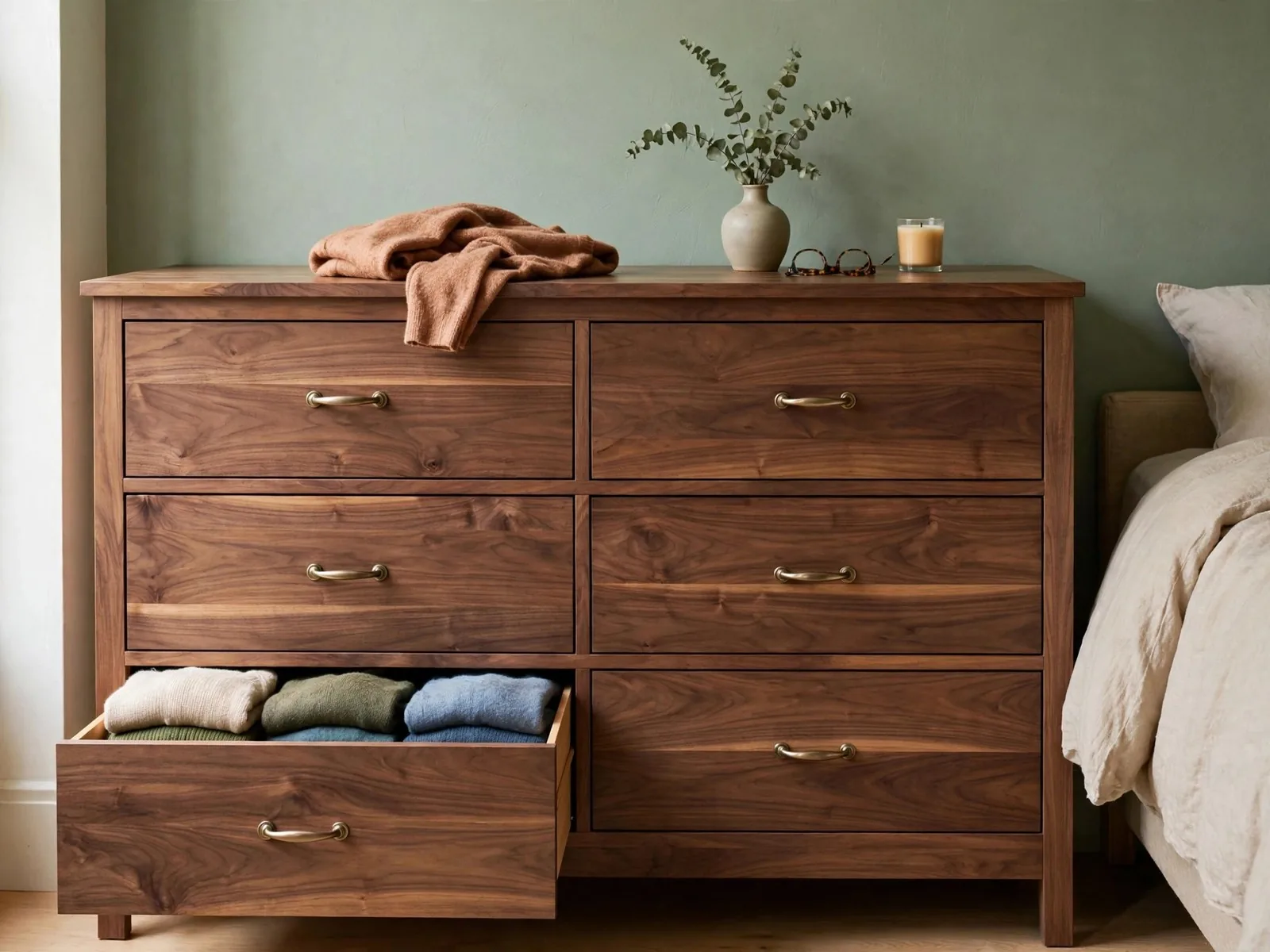
Zone the drawers before anything goes in. Six drawers plan out as two for tops, one for bottoms, one for sweaters, one for underwear and socks and one flex drawer for the current overflow. A drawer 5 to 6 inches deep holds tees and underwear; sweaters want a drawer 8 to 10 inches deep and hold 8 to 10 folded pieces each. Keep the flex drawer honestly flex. The season it fills with permanent residents, the system is telling you a pile has outgrown the room.
The catch is drawer quality. A wide dresser with drawers that stick under load fails at the exact weight this plan puts in it. Open and close every drawer in the store with one hand and walk away from any that rack sideways. The grown-up primary suite version of this planning runs on the master bedroom ideas page.
Measure: a six-drawer dresser at 54 to 60 inches wide holds roughly 45 to 55 folded pieces across its drawers.
2. Choose nightstands with real drawers, not just a top
The standard nightstand is a table pretending to be furniture: a top for the lamp and a shelf that displays your clutter at pillow height. Swap it for a small chest and the bedside becomes storage. Two drawers and a shelf hold the book stack, the charger tangle and the medicines that otherwise migrate to the dresser top.

Size it by the drawer, not the silhouette. A nightstand 22 to 28 inches wide with drawers about 4 and 8 inches deep covers the bedside list of most sleepers: the top drawer for glasses and chargers and lip balm, the deep drawer for books and the sleep layer of socks or a spare blanket in a shared room. In a couples room the two nightstands do not need to match in style, but their drawer counts should match too. Otherwise one side of the bed becomes the household overflow by default.
Height matters more than finish. The top should land within 2 inches of the mattress top, so the lamp and the water glass work at pillow level. A nightstand that stores plenty but stands 6 inches too low is a box you reach down to in the dark.
Budget: a two-drawer nightstand chest runs $80 to $250 and replaces both a table and a bedside basket.
3. Park a storage bench at the foot of the bed for spare bedding
Spare bedding is the pile with no home in most bedrooms. It is too bulky for a drawer and too clean for the closet floor, so it rotates between the chair and the guest bed. A storage bench at the foot of the bed is sized for exactly this problem: one long cavity that swallows the bulky and soft.
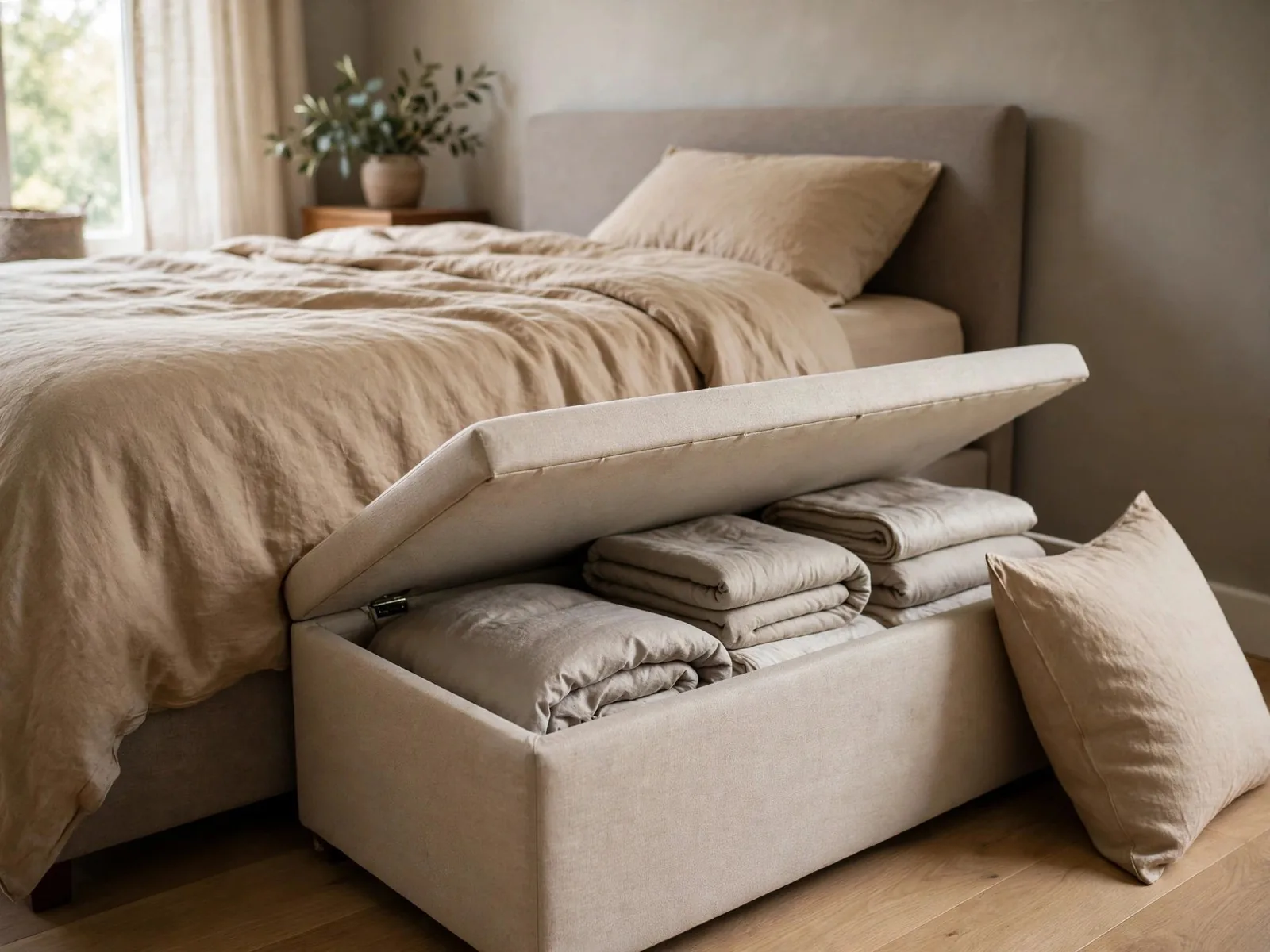
A bench 48 to 54 inches long and about 18 inches deep holds two folded duvets or a full spare bedding set with two spare pillows and a folded throw. That is the whole guest kit in one place, grabbed in one trip when visitors land. A hinged top with a soft close or a lift-off lid both work; a hinged top wins in rooms where the bench doubles as the place you sit to put shoes on.
Keep the bench for the bulky and infrequent only. The day it starts holding daily clothes it becomes a horizontal drawer you dig through standing up and the bedding gets evicted back to the chair. If the bench must earn a second job, give it the winter blanket rotation and nothing else.
Measure: leave 24 inches of clear floor between the bench and the wall or dresser opposite, so the lid opens and you can still walk past.
4. Stand an armoire where the closet overflow actually lives
Some wardrobes outgrow their closet honestly: the coat collection, the formal wear or the second person’s full wardrobe in a house with one small closet. An armoire is the furniture answer, a closet that stands in the room. It earns its large footprint only when it replaces a real overflow, not when it becomes a handsome junk cupboard.
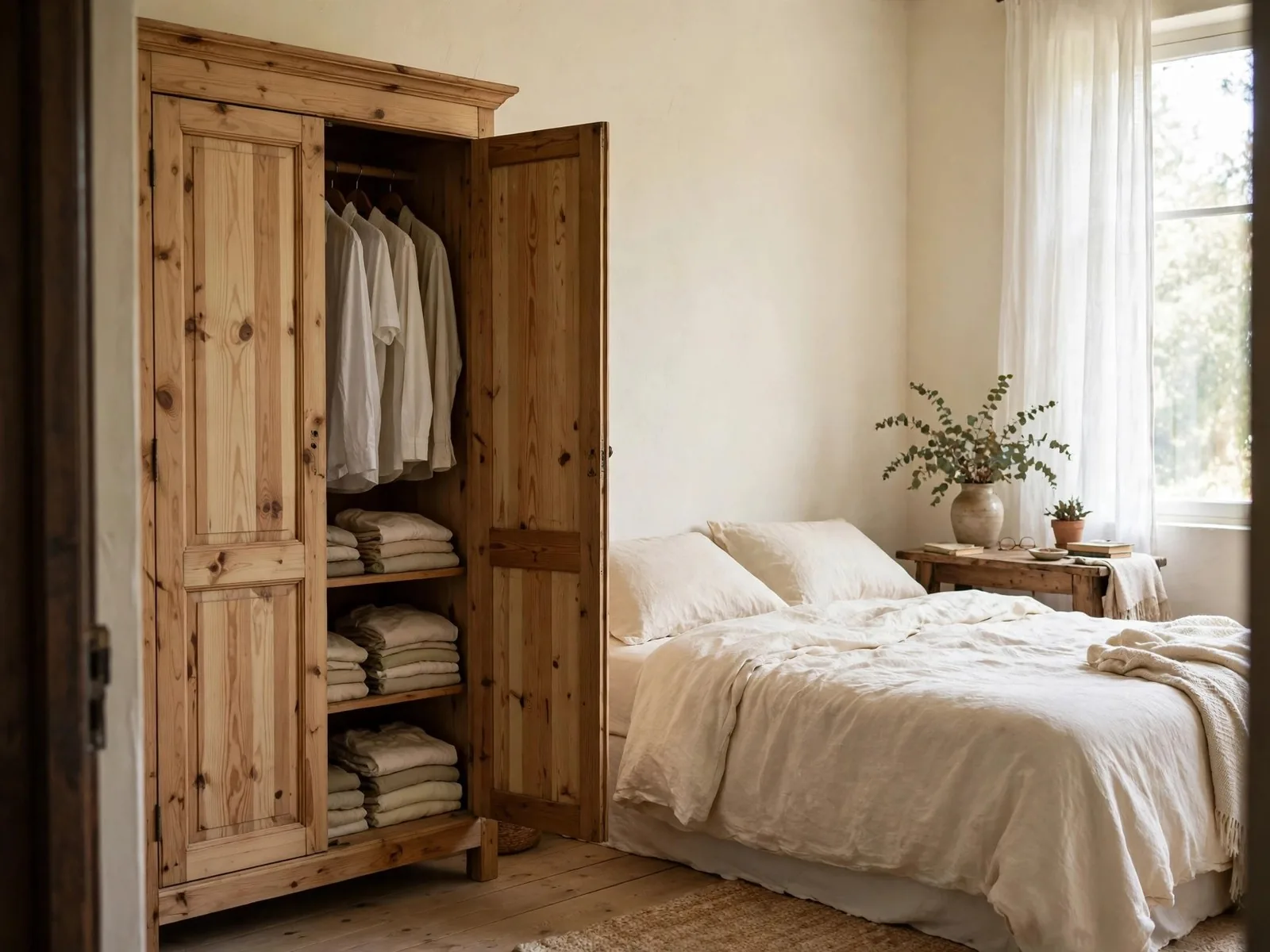
Plan the inside before the outside. A useful armoire interior splits into a hanging section with about 36 to 42 inches of rail, which holds roughly 30 hangers of shirts and dresses, plus two or three shelves for folded stacks and a drawer or two at the base. Depth is the decision: a hanging armoire needs about 24 inches inside depth or hangers sit at an angle and sleeves crush against the doors.
Place it on the wall the eye lands on last, usually the wall beside the door rather than the wall facing the bed. A 40 inch wide armoire facing the bed turns its doors into the room’s main view. Renters should treat an armoire as the big alternative to any built-in: it stores like a closet system and it leaves with you.
Budget: a solid armoire runs $300 to $900 and a flat-pack wardrobe frame does the same job from about $200.
Under-bed and hidden storage
5. Roll low drawers under the bed for out-of-season clothes
The floor under a queen bed hides about 20 square feet of storage in a room that claims to have none. Flat drawers on casters turn that void into the out-of-season archive: the sweaters in July, the light dresses in January. Under-bed storage works because the things stored there are needed twice a year, so the slower access costs nothing.
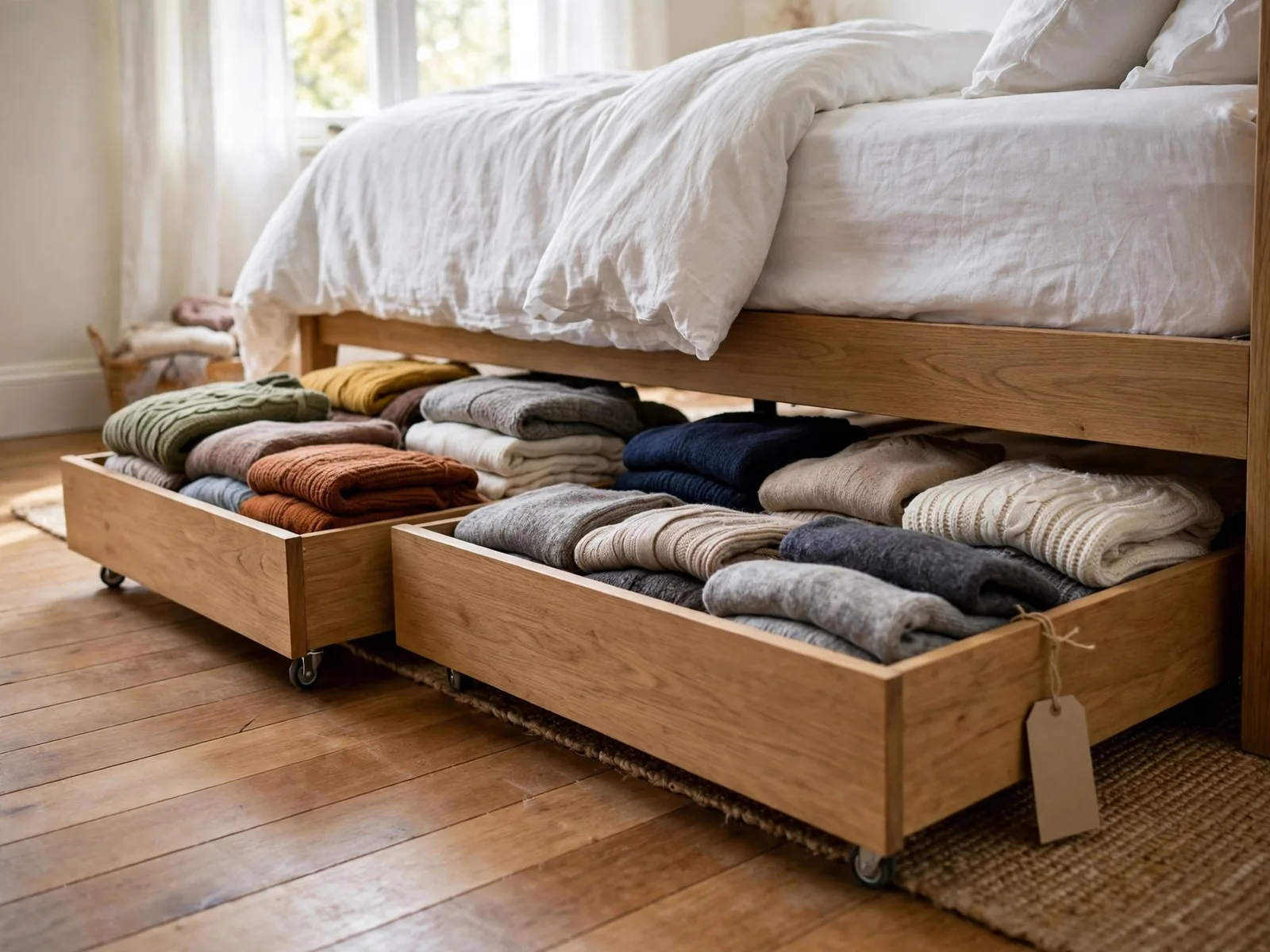
Match the drawer to the clearance you measured. Bins and drawers come at 6, 8 and 12 inch heights and the drawer plus its wheels must sit at least half an inch under the frame rail. Two long drawers per side beat four small boxes: each long drawer holds 10 to 12 folded sweaters or a full set of seasonal tops and you pull one drawer instead of excavating three lids.
Solid fronts beat clear boxes here. A drawer with a real front reads as furniture from the doorway and keeps the dust off the contents; open bins under a bed collect a grey film on everything inside them within a season. Label the end of each drawer with a blank tag you write on, summer or winter, so the swap takes minutes.
Measure: buy drawers at least half an inch shorter than the under-bed clearance, wheels included in the height.
6. Choose a lift-up base or bed drawers for the bulky bedding
When the spare bedding pile outgrows the bench, the bed itself is the next cavity. A lift-up ottoman base opens the full footprint of the bed as one deep store. Bed frames with built-in drawers split the same space into two or four sorted compartments. Either version hides the bulkiest things a bedroom owns in the one place they fit.
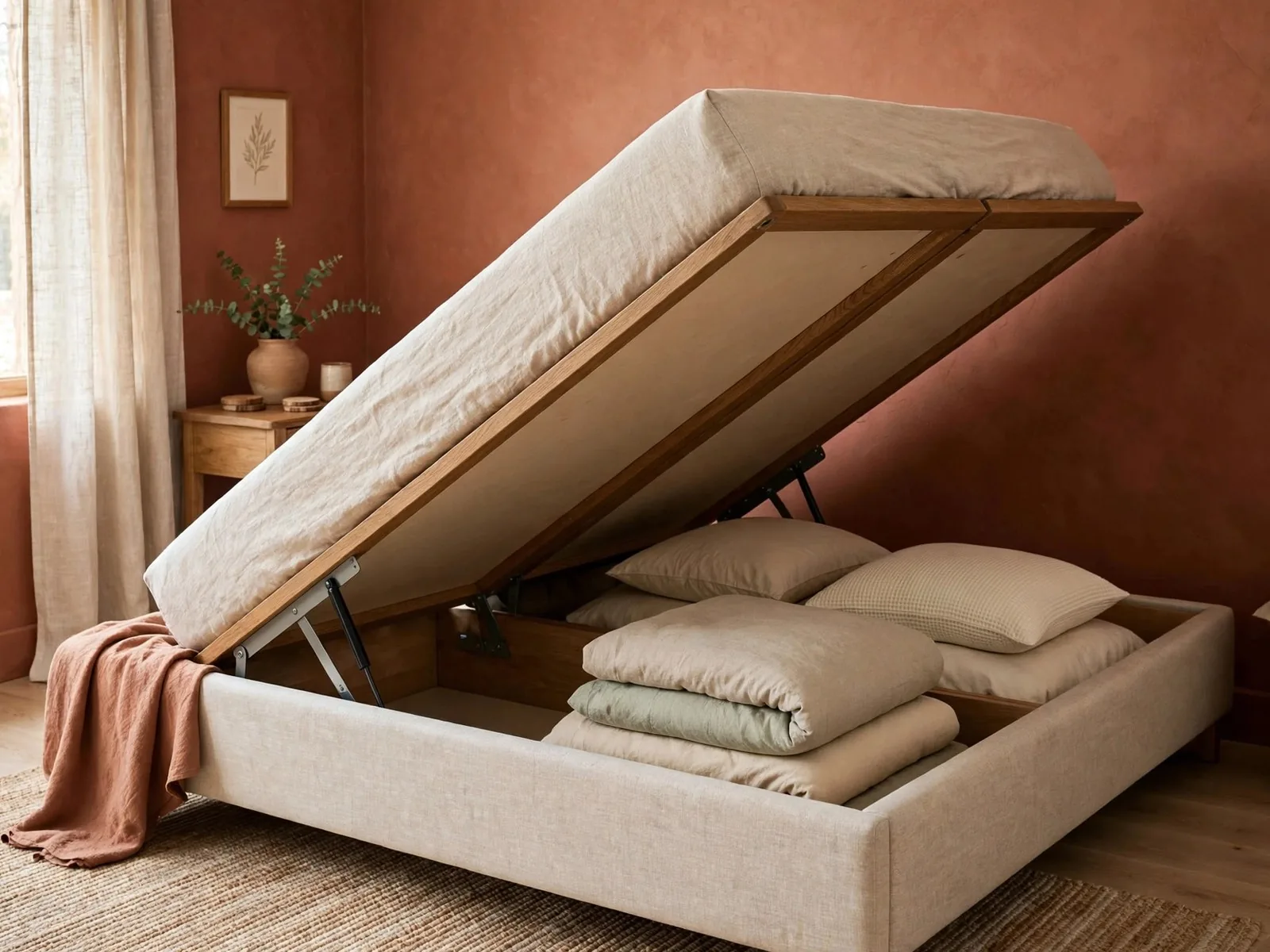
The lift-up base holds the most: roughly the volume of a large wardrobe shelf run, enough for two duvets, four pillows and the blanket stack with room left over. The trade is access. You lift the mattress to reach anything, so this space takes the truly seasonal: the heavy winter duvet, the guest bedding and the mattress topper in its off months. Drawers in the base suit things you reach monthly instead, spare sheet sets and the extra pillows for reading.
Check the room before you commit to a lift-up base. The mattress lifts toward the foot or the side and needs that side clear of benches and radiators. In a room where the bed sits tight against two walls, base drawers on the open side are the honest version of the same idea.
Budget: a lift-up storage base runs $250 to $600 over a plain base and bed frames with drawers run $400 to $900.
7. Let the headboard hold the small stuff
A storage headboard trades a few inches of room length for shelves and cubbies exactly where small things land: the book, the glasses, the phone and the water glass. In a room where nightstands do not fit either side of the bed, it is not a compromise. It is the only bedside storage the room can have.
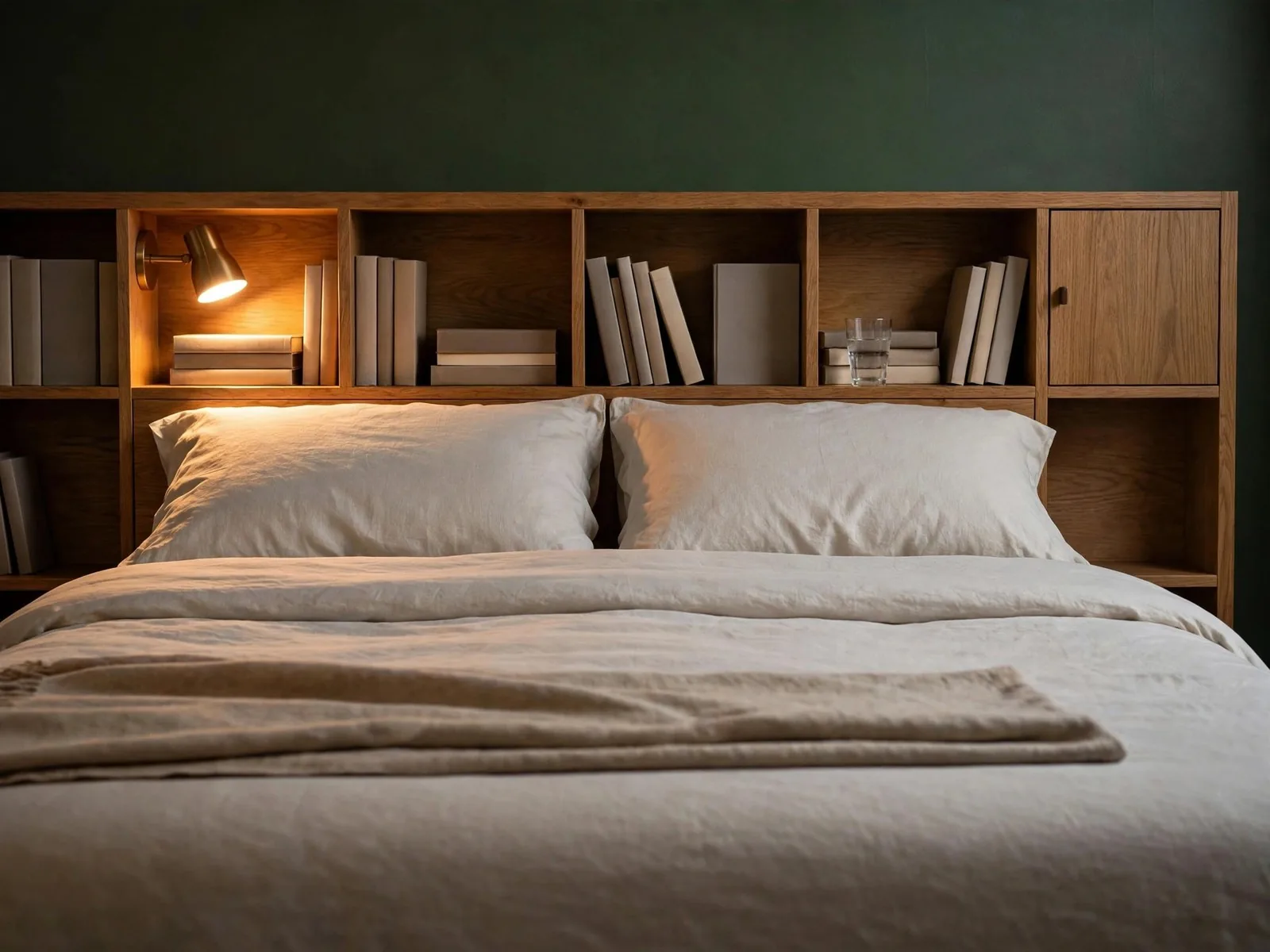
Look for a headboard with two or three cubbies per side plus one shelf at pillow height, in a depth of 8 to 10 inches. That holds the nightly layer for two people without a single surface at mattress level collecting cups. Closed cubby doors on at least one section keep the visual calm rule intact; fully open headboard shelves turn pillow height into a display of clutter you face at 6 inches. The shapes and heights that work behind pillows are covered on the headboard ideas page.
The catch is the wall behind it. A storage headboard is furniture, but it reads as part of the bed, so it needs the bed centered on the wall with an inch or two to spare each side. Measure the wall run before you fall for a king size version in a queen size room.
Measure: allow 8 to 10 inches of extra room length for a storage headboard and keep the top shelf clear of anything that can fall.
8. Hide the archive inside a trunk or a hollow ottoman
Every bedroom holds an archive: the keepsake box, the paperwork folder, the sewing kit and the board games that come out twice a year. Loose, these things colonize the closet top shelf and the corner behind the door. A trunk or a hollow ottoman gives the archive one closed home that reads as furniture.
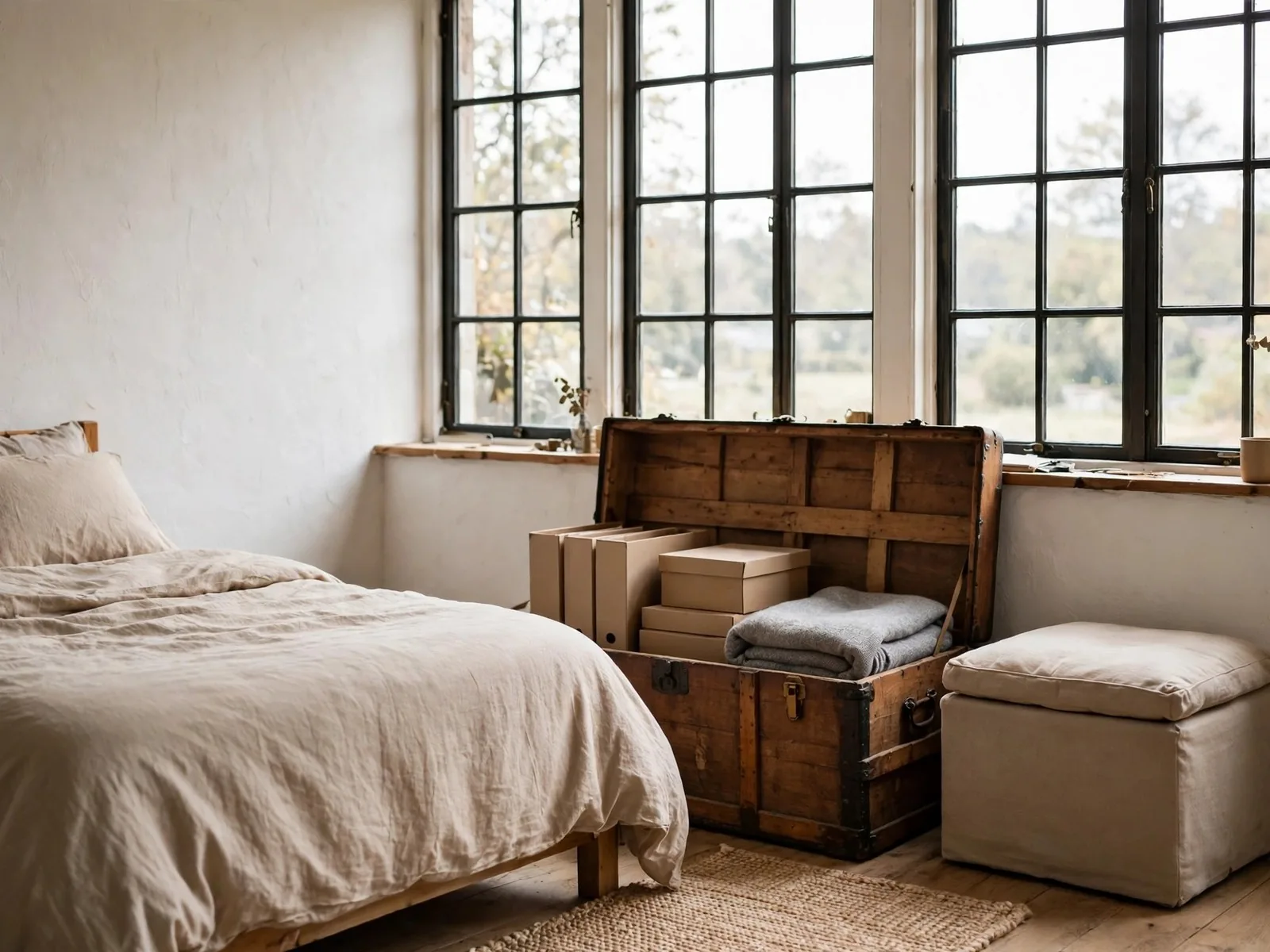
A trunk about 36 inches long holds roughly 3 cubic feet: the keepsake box, two file boxes of paperwork and the blanket that is too good to give away. Park it under the window or at the side of the dresser where a dead gap usually sits. A pair of hollow ottomans or storage cubes does the same job in smaller rooms, one for the craft kit and one for the guest towels. They double as the seat at a dressing table.
Heavy things go at floor level and light things go high, so the trunk takes the paperwork and the books while the duvets stay in the bench or the lift-up base. A trunk full of bedding is fine. A top shelf full of file boxes is a lifting injury waiting for a date.
Budget: a lidded trunk runs $80 to $250 and hollow storage ottomans run $40 to $90 each.
Vertical and wall storage
9. Hang floating shelves where the floor has run out
When every piece of floor furniture is placed, the walls are the remaining storage. Floating shelves and wall shelves, the bedroom shelving ideas all over Pinterest, hold the books, the folded overflow baskets and the plant that makes the room feel finished. Vertical storage works because it spends height the room was wasting from picture rail to ceiling.
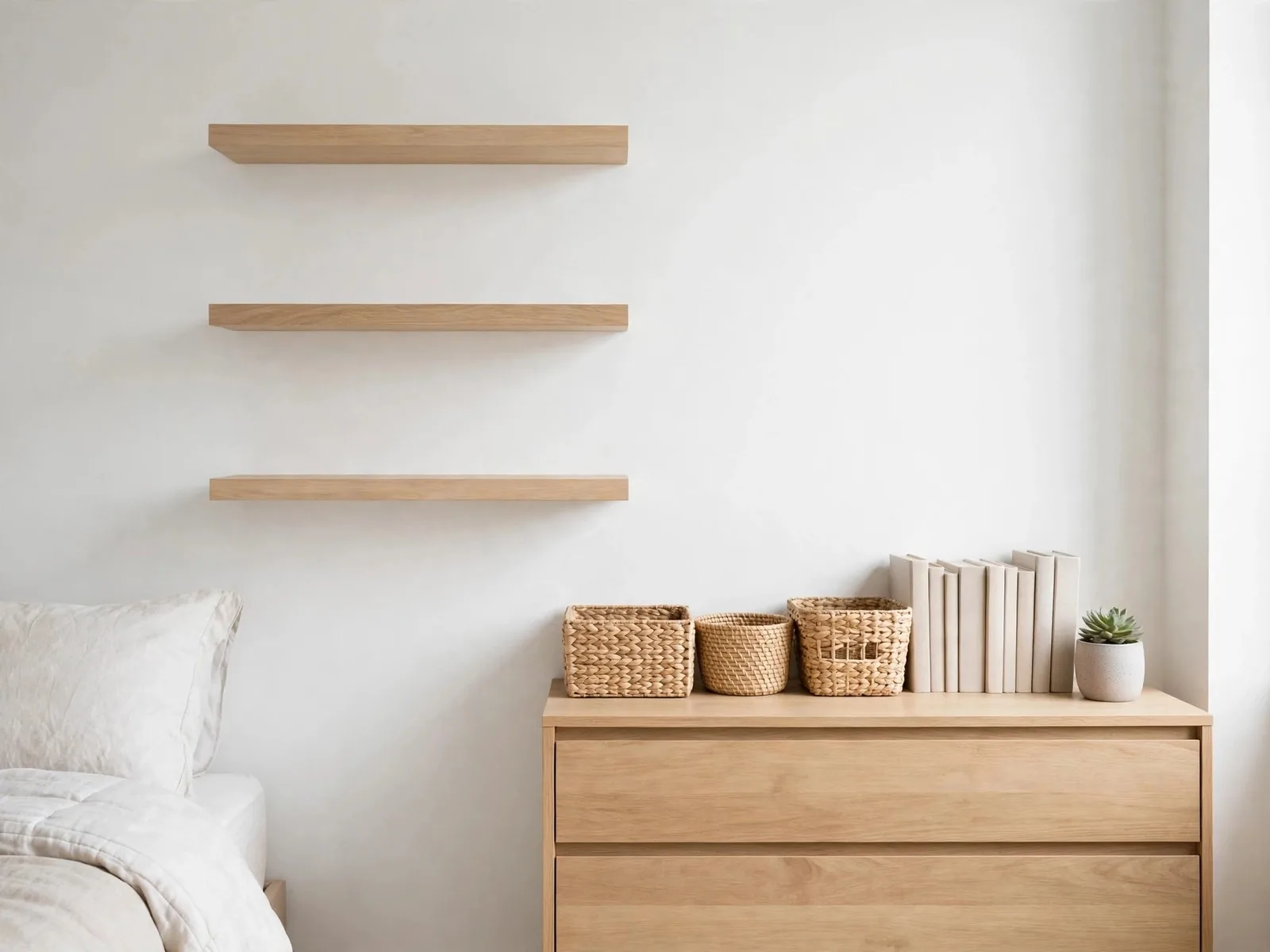
Keep shelf depth honest. A shelf 10 to 12 inches deep holds paperbacks, small baskets and folded linens; shelves deeper than that invite double rows that hide their own back half. Run two or three shelves with 14 to 16 inches between them on the wall beside the dresser, where they extend the dresser system upward instead of competing with the bed wall. Rated brackets or fixings into studs matter: a loaded 36 inch shelf of books carries 25 to 35 pounds.
Shelves over the bed are the exception to argue with yourself about. Nothing heavy belongs above pillows. Keep over-bed shelves for a lightweight print and a plant in a plastic pot or skip them entirely and let the wall rest.
Needs drilling: floating shelves fix into studs or rated wall anchors and a 36 inch shelf should be rated for at least 40 pounds loaded.
10. Fill a dead corner with a tall narrow bookcase
Most bedrooms have one corner that fits nothing: too narrow for the dresser and too deep for a plant stand. A tall narrow bookcase, 16 to 20 inches wide and 72 inches tall, turns that dead column into five or six shelves of storage that take almost no floor.
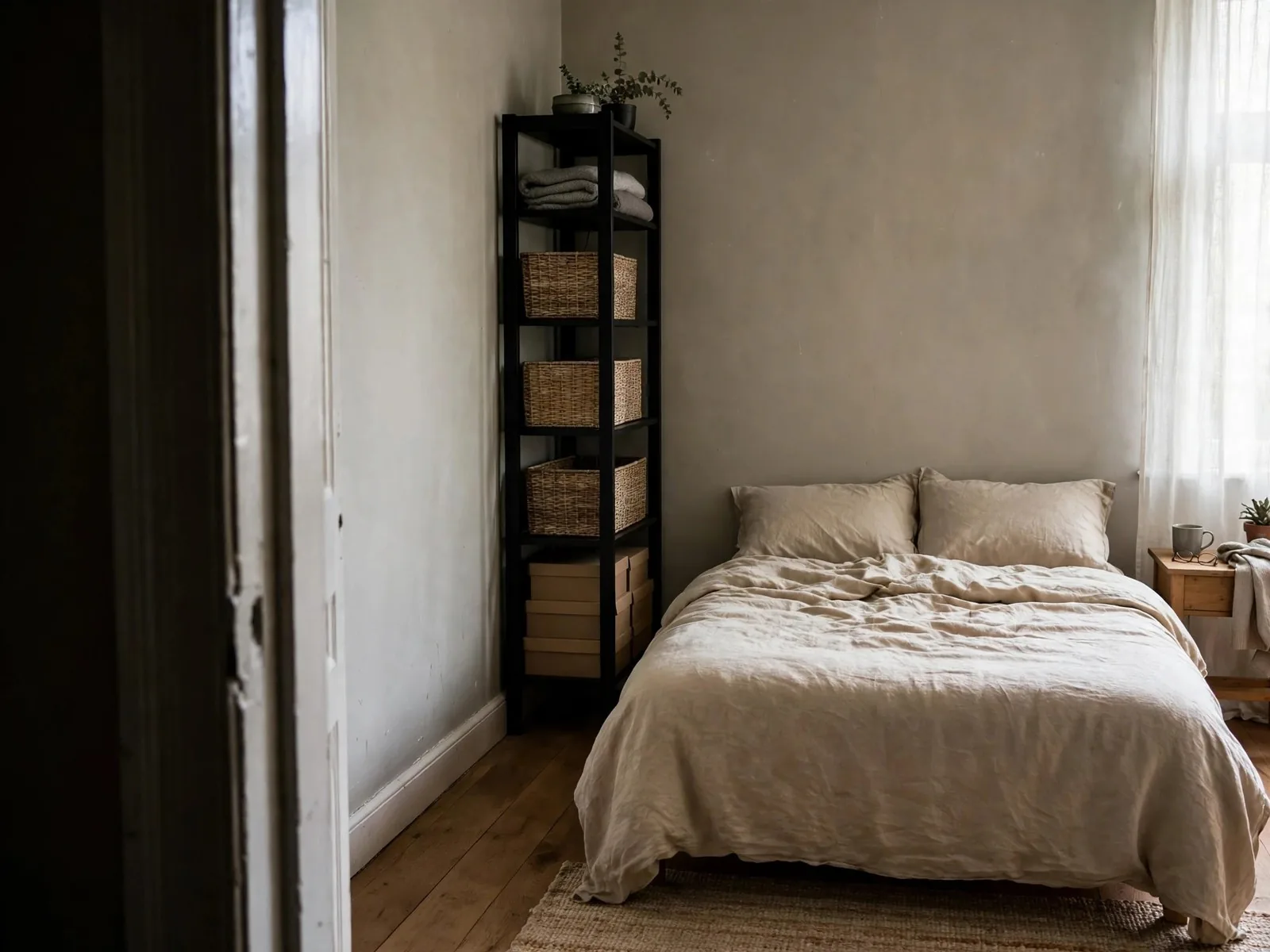
Load it by weight and frequency. The bottom shelves take the heavy and daily: the shoe boxes and the book stack. Middle shelves at eye level take the folded overflow in baskets. The top takes the light archive, hats and the boxes you open twice a year. Five shelves in a 18 inch wide case hold roughly 40 to 50 books or the basket equivalent of two dresser drawers, which is real capacity from a footprint smaller than a laundry basket.
Anchor it. A tall narrow case loaded at the top is the most tip-prone piece in the bedroom and the strap takes ten minutes. In a rental, the same column works as a ladder shelf that leans and loads low, with nothing heavier than baskets above shoulder height.
Measure: a bookcase 16 to 20 inches wide and 72 inches tall turns one dead corner into five or six shelves of storage.
11. Use the back of the door for the daily grab layer
The back of the bedroom door and the back of the closet door are storage surfaces most rooms ignore. An over-door rack holds the daily grab layer at the exact point you leave the room: the bag, the hat, the robe and the shoes you wear four days a week. It is the cheapest vertical storage on this page and it asks for no tools at all.
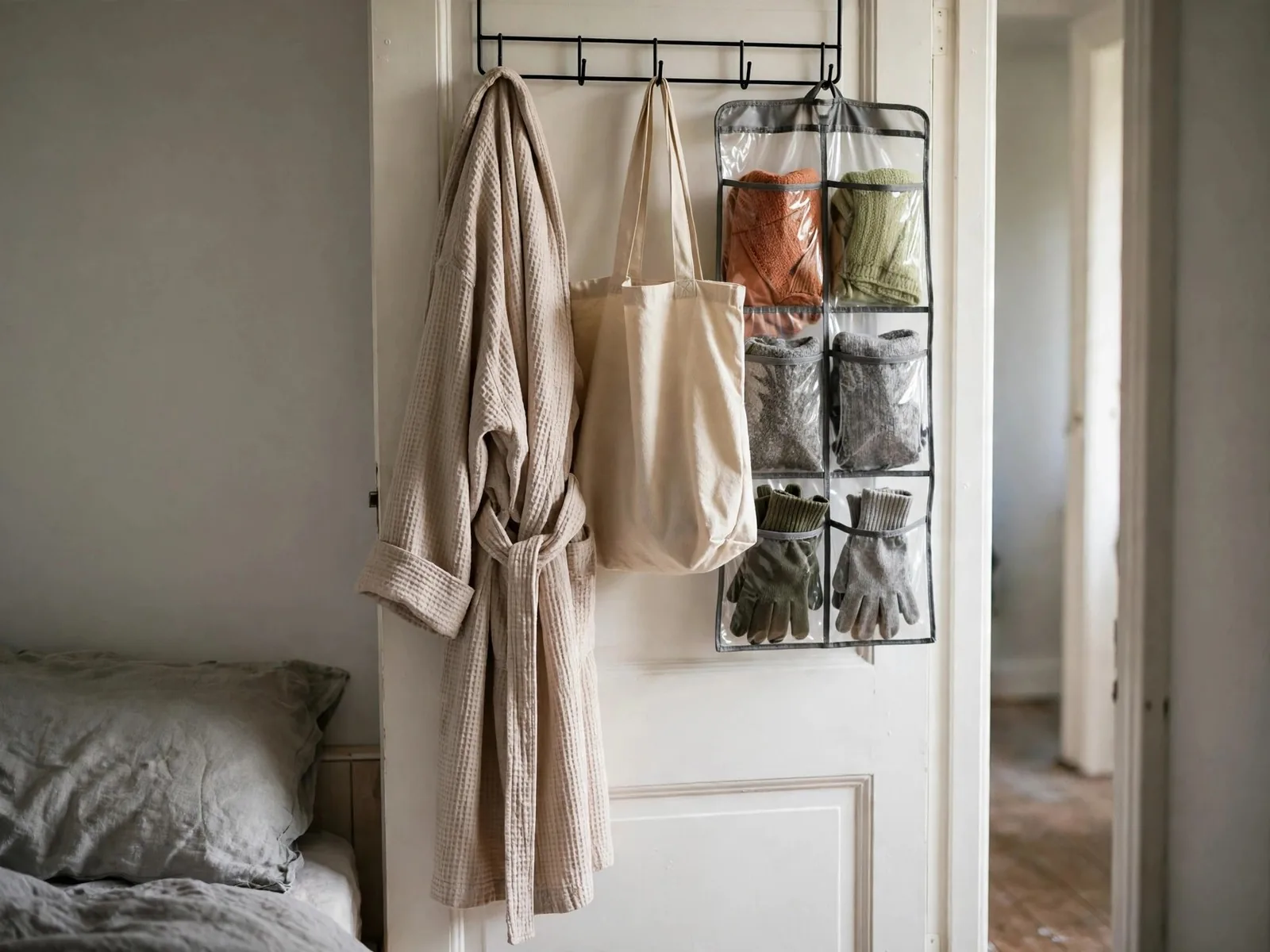
Choose the rack by what it carries. A hook rail holds robes and bags. A clear pocket organizer holds 12 to 16 pairs of small things, scarves and gloves and chargers, in pockets you can see into. A shoe rack version holds 10 to 12 pairs over the door height, which sounds generous until you remember the closet shoe count; give the door the daily 4 pairs and store the rest properly. Small rooms run this layer better than anyone, as the small bedroom ideas page shows on whole-room scale.
Doors need to close. A loaded rack adds half an inch to the door thickness and some frames will not forgive it. Test the close with the rack empty before you load it and add felt pads where the organizer swings against the door face.
Renter-friendly: over-door racks hang from the door top with no screws and no marks and run $15 to $35.
12. Run one high shelf for the archive boxes
Above the door or along the top of the longest wall, one high shelf at 78 to 84 inches takes the archive out of daily sight. Matching lidded boxes up there hold the out-of-season overflow that did not fit under the bed, the spare curtains and the occasion shoes. High storage works because the archive is light, bulky and rarely opened.
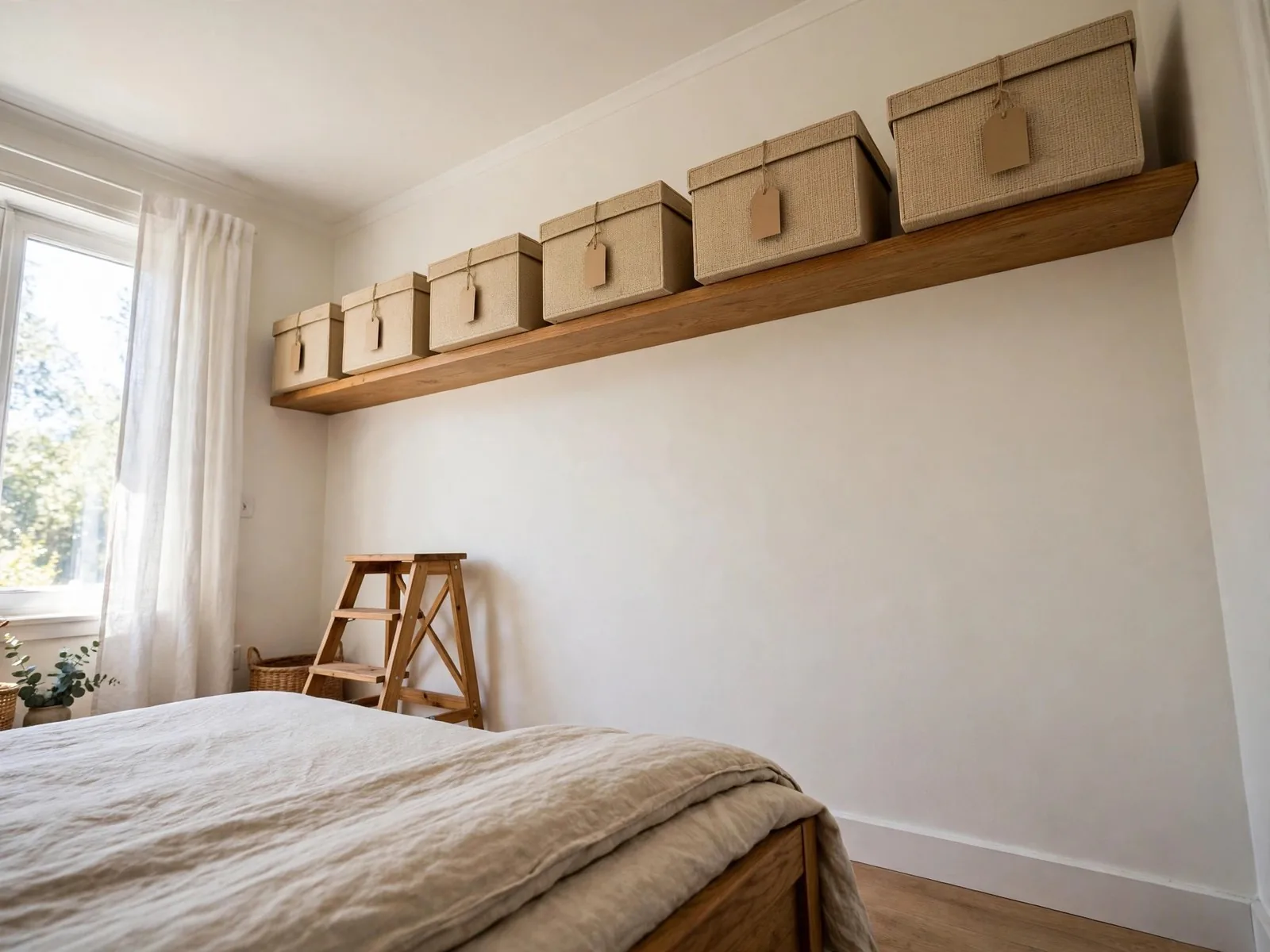
Keep the shelf at 12 inches deep and the boxes at about 13 inches wide, so each box lifts down with one hand on the ladder and one on the box. Five or six boxes run a full wall width and hold roughly 25 to 30 folded items each, which is a whole season of clothes for one person. Label the end of every box with a plain blank tag you write on; an unlabeled archive is just clutter with altitude.
Weight discipline is the whole idea. Duvets, sweaters and hats go up. Books, files and anything with real heft stay at floor level in the trunk from idea 8. The high shelf is also the one place a step stool must live nearby, so park it in the dead corner from idea 10 when the bookcase is not there.
Measure: mount the high shelf at 78 to 84 inches with boxes no heavier than you can lift down one-handed from a step stool.
The styled surfaces: only what earns open storage
13. Style open shelves in closed thirds
Open shelves fail when they store everything in the open. They work when two thirds of what they hold sits inside closed boxes and baskets and only one third is display. That ratio is the difference between a styled shelf and a visible junk drawer at eye level.
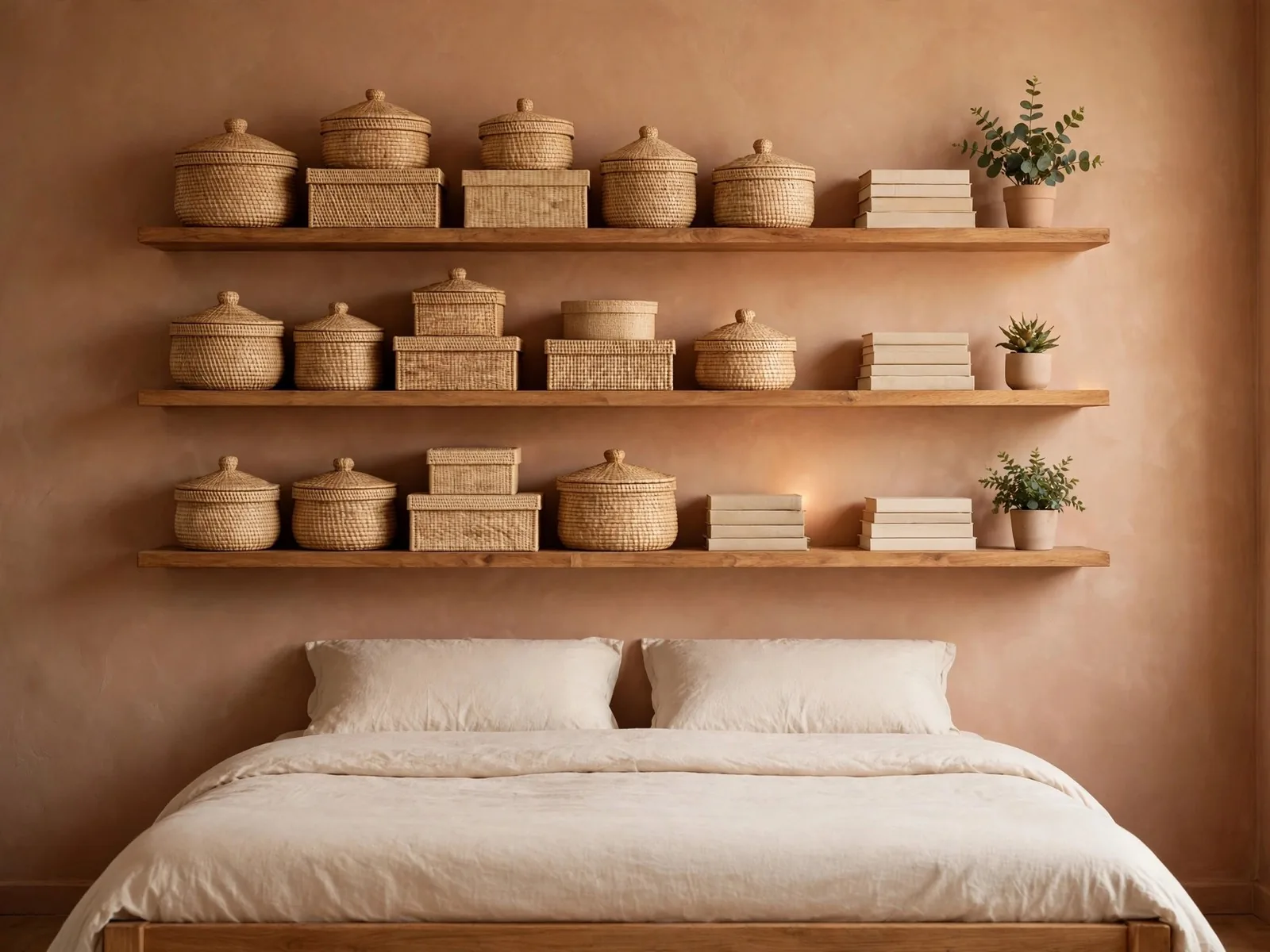
Build each shelf the same way. A lidded box or a basket with a lid takes the real storage: the chargers, the paperwork overflow and the craft supplies. A short run of books stands beside it, spines out. One object with air around it finishes the shelf: a plant, a framed print or a ceramic bowl that holds the keys. Repeat the rhythm shelf to shelf and the whole wall reads calm even though it is holding two drawers worth of actual stuff. The refresh of these surfaces belongs to the same rhythm as the bedroom makeover ideas page, one surface at a time.
The test is the doorway view. Stand in the door and squint. If your eye lands on piles, the ratio is wrong; move one pile into a box and look again. Open storage earns its place one shelf at a time and loses it the same way.
Budget: lidded baskets and boxes for a three-shelf run cost $30 to $70 and do more for the room than any styling object.
14. Give the dresser top a tray and a strict landing rule
The dresser top is the surface that decides whether the room looks stored or spilled. It fails by accumulation: the post, the receipts, the jewellery dish and the three things that were going to be put away later. A tray draws a border around the allowed landing zone and everything outside the tray has to be dealt with the day it lands.
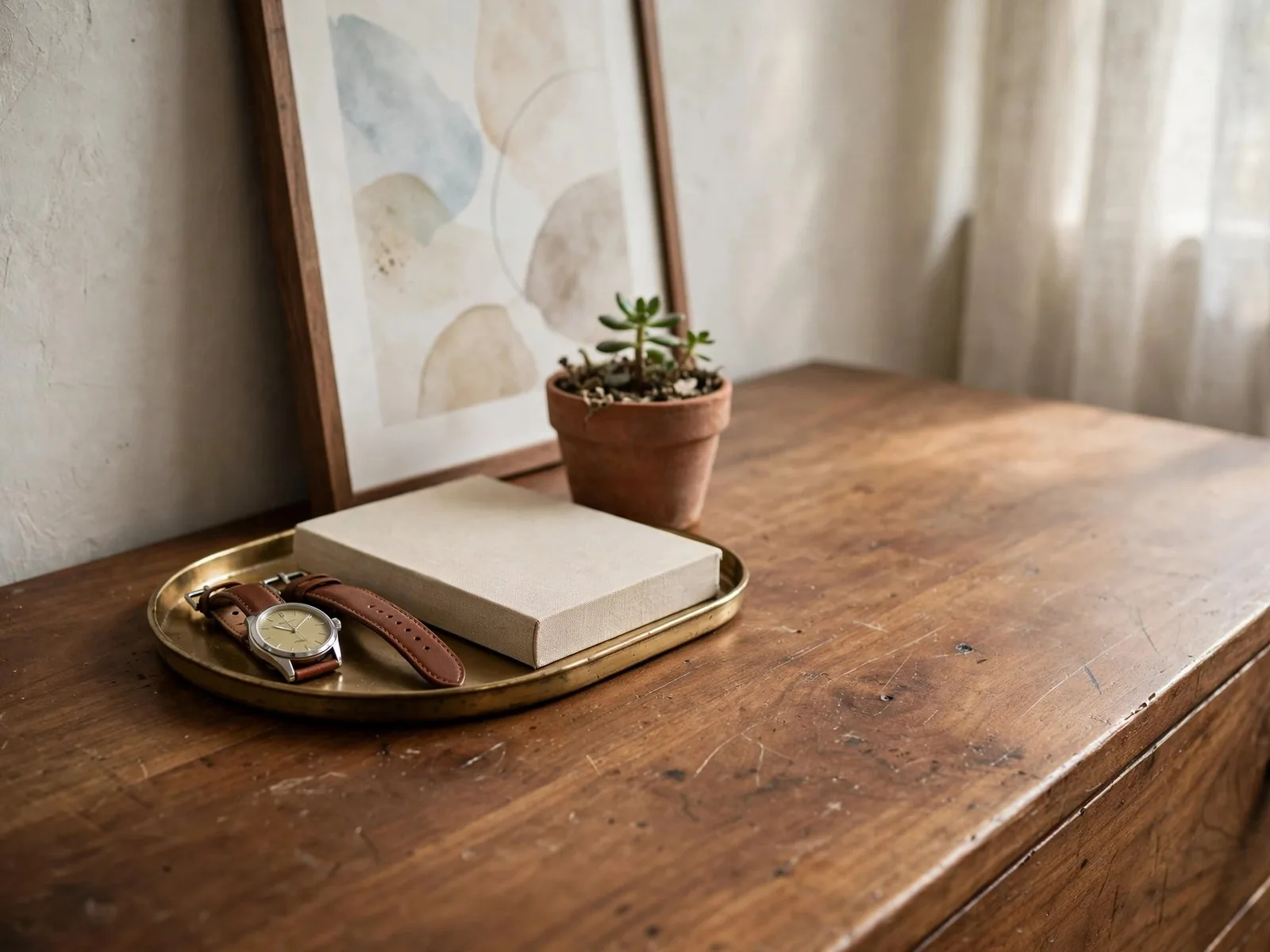
Choose a tray about 16 by 10 inches and give it the daily list: watch, jewellery, the book in progress and the hand cream. Perfume and the styled layer, a small plant or a framed photo, stand behind the tray where they are display on purpose. The rest of the top stays empty on purpose too. An empty dresser top is not wasted space; it is the folding surface for laundry and the visual rest that makes the closed drawers below read as a system.
Enforce the rule weekly, not daily. A Friday five-minute sweep returns escapes to drawers and boxes. A rule with no sweep becomes a tray surrounded by the same clutter it was meant to exile.
Budget: a simple tray runs $12 to $30 and the rule itself is free.
15. Keep the daily layer in lidded baskets, not loose piles
The daily layer is small and specific: chargers, the current craft project, the gym kit that lives in the bedroom and the children’s books that migrate in at bedtime. Loose, each one forms a pile with its own gravity. In lidded baskets, one per category, the same things become a system you can carry room to room.
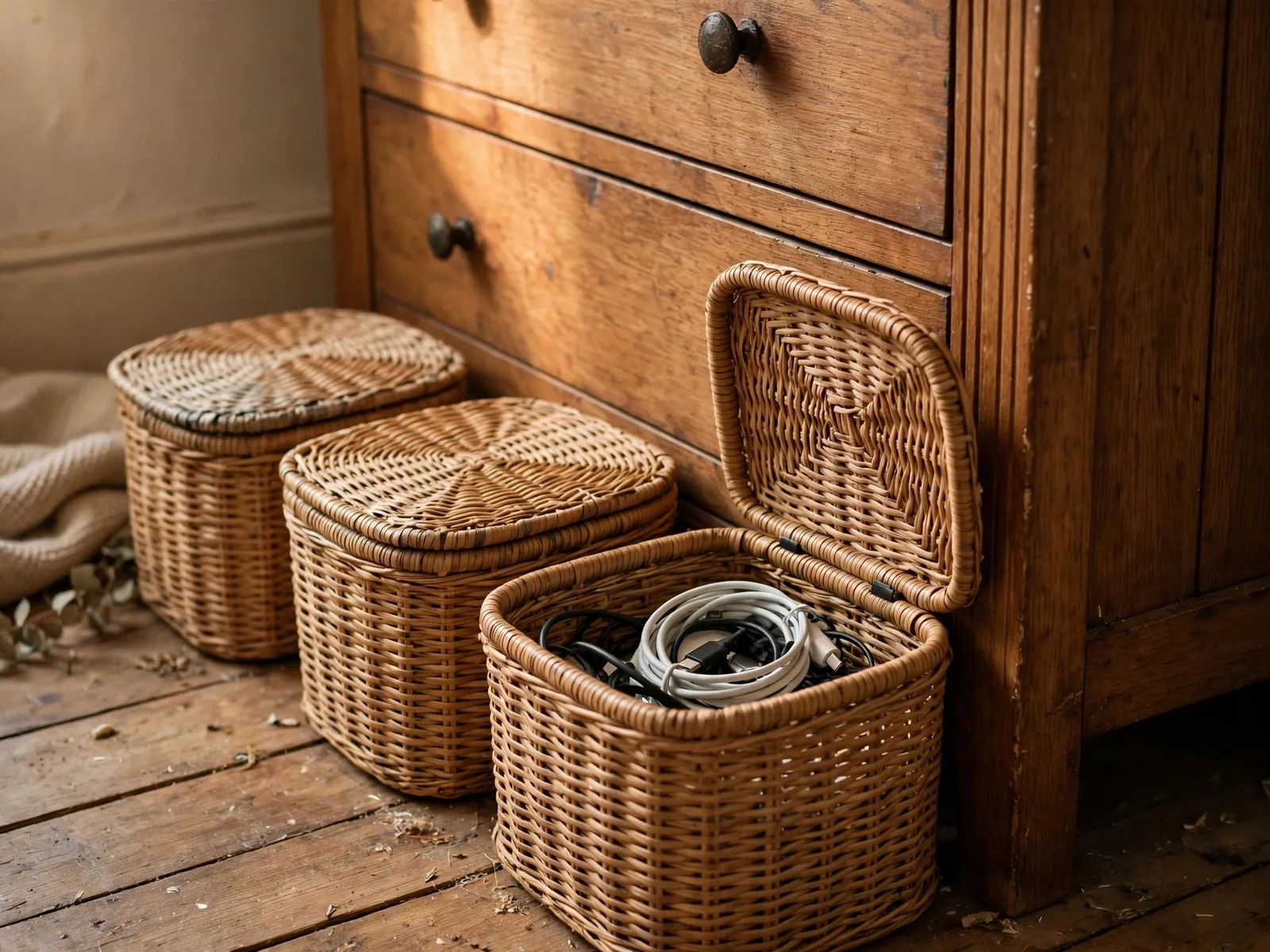
Size the baskets to the category, not to the shelf. A basket about 12 by 8 inches holds the charger and cable tangle of a whole household’s bedside needs. A larger one at 16 by 12 inches takes the craft project with its materials, so the project leaves the dresser top and returns to its basket in one lift. Park the baskets where the pile used to form, on the dresser end, the bookcase shelf or the floor beside the chair, because a system that fights the habit loses to the habit.
Labels stay blank tags you write on or nothing at all. In a couples room, one basket each in the same style ends the negotiation about whose pile is whose. When a basket overflows twice in a month, the category has outgrown the basket and the answer is a drawer, not a bigger basket.
Budget: lidded baskets run $10 to $25 each and three cover the daily layer of most bedrooms.
16. Move what the bedroom should not hold somewhere else
The last storage idea is subtraction. Some things are stored in the bedroom by default rather than by decision: the suitcases, the off-season coats of the whole family, the paperwork archive and the sports kit. Each one evicts a category the bedroom actually needs. Moving them out is storage you gain without buying a single piece.
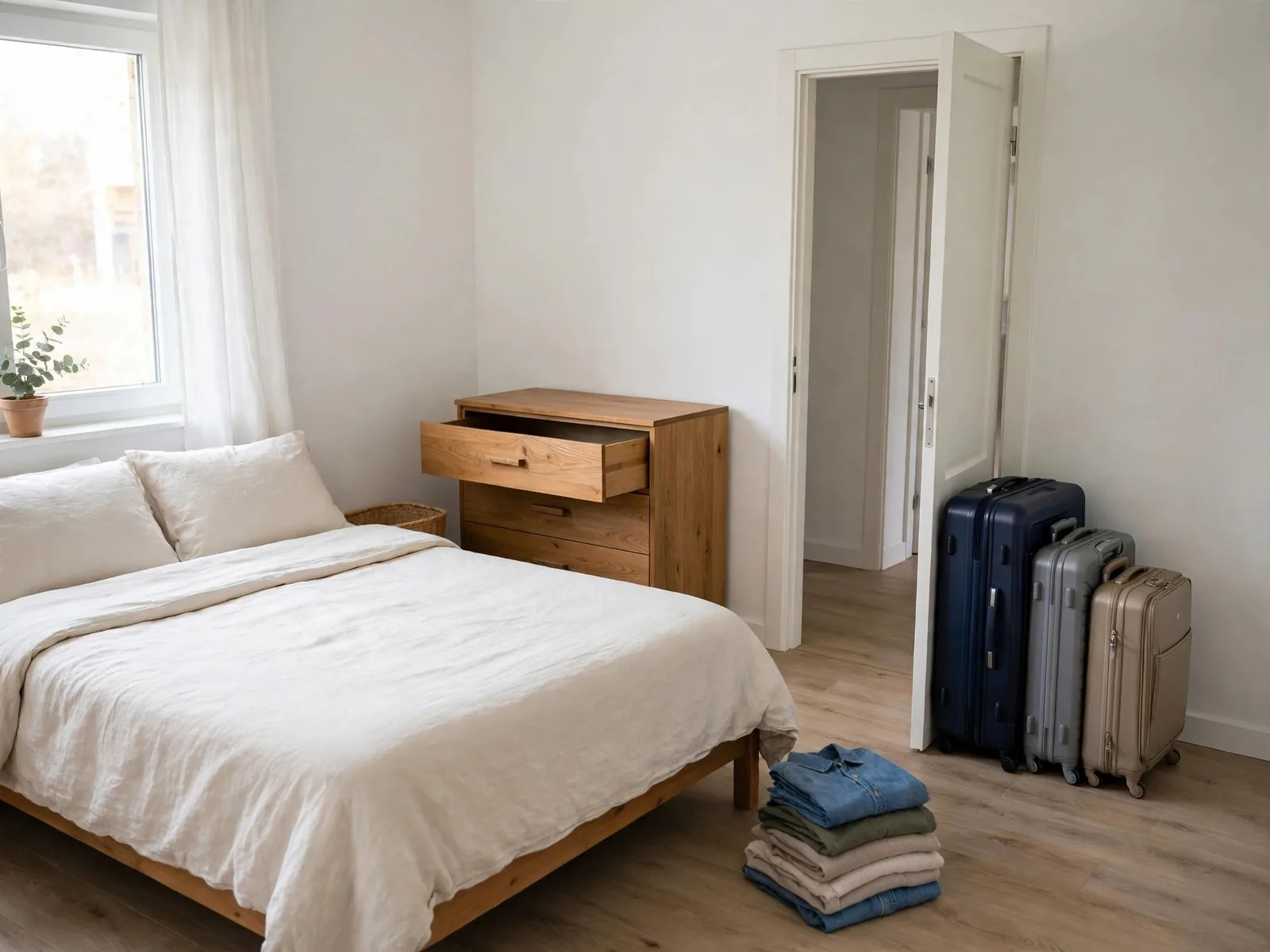
Work the list in order of bulk. Suitcases nest inside each other and belong in the attic, the garage or the top of a hall closet. Out-of-season family coats belong with the coats, near the door they leave by. The paperwork archive goes to one file box wherever paperwork lives in your house. What stays in the bedroom is what the bedroom uses: this season’s clothes, the bedding for this bed and the daily layer.
The freed space is bigger than it sounds. In most rooms this move empties one full drawer and the top of the armoire in a single afternoon. Resist refilling it for a month. Empty storage is not a gap in the system; it is the margin that stops the next season change from starting a new pile. Rooms tight enough that even this margin is hard won are the small bedroom storage ideas page‘s whole subject.
Budget: free. The move usually returns the equivalent of one drawer and one shelf to the room.
Bedroom Storage Ideas on a budget
The budget version of this page is a sequence, not a shopping list. Night one is free: empty the dresser, rezone the drawers per idea 1 and move the seasonal clothes into whatever already rolls or slides under your bed. Most rooms find a drawer they did not know they had in that single pass.
The first $50 goes on the friction points. Drawer dividers for the two busiest drawers run about $15. An over-door rack from idea 11 runs $15 to $35. Blank tags and a marker for the boxes and drawers cost almost nothing and end the open-every-box hunt that makes storage feel broken.
The next band buys capacity. Lidded baskets for the styled shelves and the daily layer run $30 to $70 as a set. Flat bins sized to your measured under-bed clearance run $12 to $25 each and two cover a season of clothes. Stop there for a season and live with the system. The furniture money, the bench, the armoire and the storage bed, should be spent only on the pile that survives a season of the cheap system still homeless. That pile is real. The rest was organization wearing a price tag.
Mistakes that make it fall flat
- Buying furniture before the sort. A bench or an armoire bought for the pile you imagine arrives and meets the pile you actually own and fits neither. Sort and count first; every capacity on this page is written in units you can count at home before spending anything.
- Open storage for daily clutter. Shelves full of loose chargers, paperwork and half-finished projects read as clutter at eye level, however nice the shelves are. Closed storage is the default for a calm room; open shelves hold boxes and one styled layer only.
- Under-bed bins bought by guess. A 12 inch bin under a frame with 8 inches of clearance is a return trip, not storage. The clearance measurement takes one minute with a tape and it decides the whole under-bed group.
- Two small pieces where one wide one works. A pair of narrow chests or nightstand tables split categories and waste the gaps between them. One wide dresser with zoned drawers holds more and reads calmer than any pair of small pieces.
- Storing heavy things high. File boxes and book stacks on high shelves are hard to lift down and risky while you do it. Heavy lives at floor level in the trunk; high shelves and top shelves take the light and bulky only.
- Letting the dresser top become the system. When the top of the dresser holds the overflow of every drawer beneath it, the room has not gained storage, it has gained a shelf at waist height. The tray rule and the weekly sweep keep the top a surface, not a store.
Questions people ask about this
How do I organize a bedroom closet with too many clothes? Start outside the closet. Move out-of-season clothes into under-bed drawers and spare bedding into a bench or the bed base, so the closet holds only this season. Then sort what remains by category, keep daily clothes at the front and give the closet system itself the full plan on the bedroom closet ideas page.
What is the best under-bed storage? Low drawers on casters with solid fronts beat lidded bins for most bedrooms. They pull out in one motion, keep dust off the contents and read as furniture from the doorway. Match the height to your frame clearance with half an inch to spare and choose two long drawers per side over four small boxes.
How do I add storage without making the room look cluttered? Choose closed storage first: drawers, lidded baskets and furniture with doors. Keep open shelves to the styled rule of two thirds closed boxes and one third display. Match boxes and baskets in one material or color per wall, leave the dresser top mostly empty and let one surface per room stay deliberately bare.
The bottom line
A bedroom with enough storage is rarely a bigger bedroom. It is the same room where the furniture works: drawers zoned by category, the bed hiding a season of clothes underneath it and the walls carrying the archive up high. The closet gets easier too, the moment it stops storing the whole house. This week, do the free night-one job: empty one dresser, rezone its drawers with the categories in idea 1 and write the drawer map on a card taped inside the top drawer.