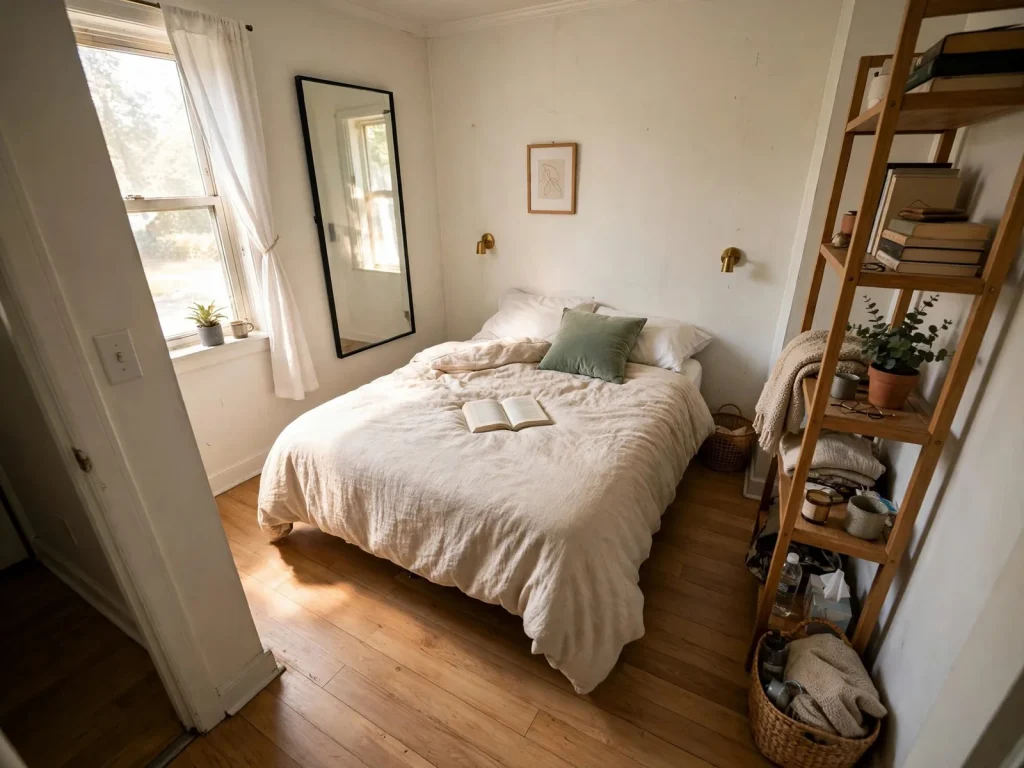
You have saved forty minimalist bedrooms and your own room still looks like a storage unit that happens to contain a bed. The saved rooms are not calm because their owners live with almost nothing. They are calm because everything in them has a closed door to disappear behind and every surface was cleared on purpose, not by accident. Minimalist bedroom ideas fail in real rooms for one plain reason: people remove the furniture and keep the clutter.
This page hands you the formula the photo roundups skip: the four materials that define the style, the palette in named colors and the two signature pieces to buy before anything decorative. Then come 13 ideas in the order you would actually tackle them, each with a measurement, a budget band or a renter note attached. The angle matters: minimalism is a storage strategy as much as a style, which is why it works hardest in small rooms. For the whole idea bank across every style, the bedroom ideas pillar is the map.
Before you start: measure, budget, rules
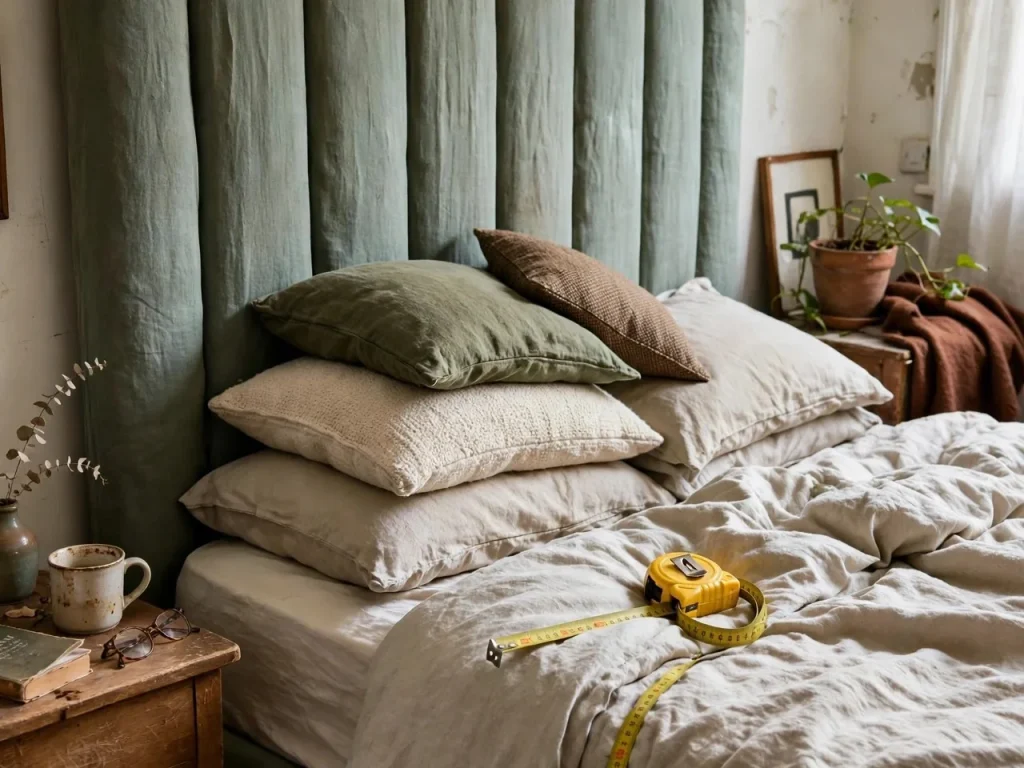
Three measurements run this style. The width of the bed wall, because art and headboard sizing both come off it. The walkway on each side of the bed, which needs 24 to 30 inches to feel calm instead of squeezed. And the height of your mattress top, because a nightstand more than 2 inches above or below it looks wrong and works worse. Take all three before you buy anything.
The budget bands on this page are simple. Free means an edit or a swap with another room. Under $60 means textiles and small pieces. $60 to $300 means one furniture piece bought patiently. Over $300 means the bed frame, bought once. Every idea below carries one of those bands or a measurement instead.
The household rules are the style itself. Nothing lives on a surface without a job to do. If an object is visible, it is either used daily or it is the one large decorative gesture in its zone. Renters lose nothing here: the frame is freestanding, the storage is furniture and the one art piece can lean instead of hang.
Measure: bed wall width, side walkways at 24 to 30 inches and mattress top height. Three numbers, taken once, run every decision on this page.
The formula: what makes this style
1. Build the palette on warm white, oatmeal and one wood tone
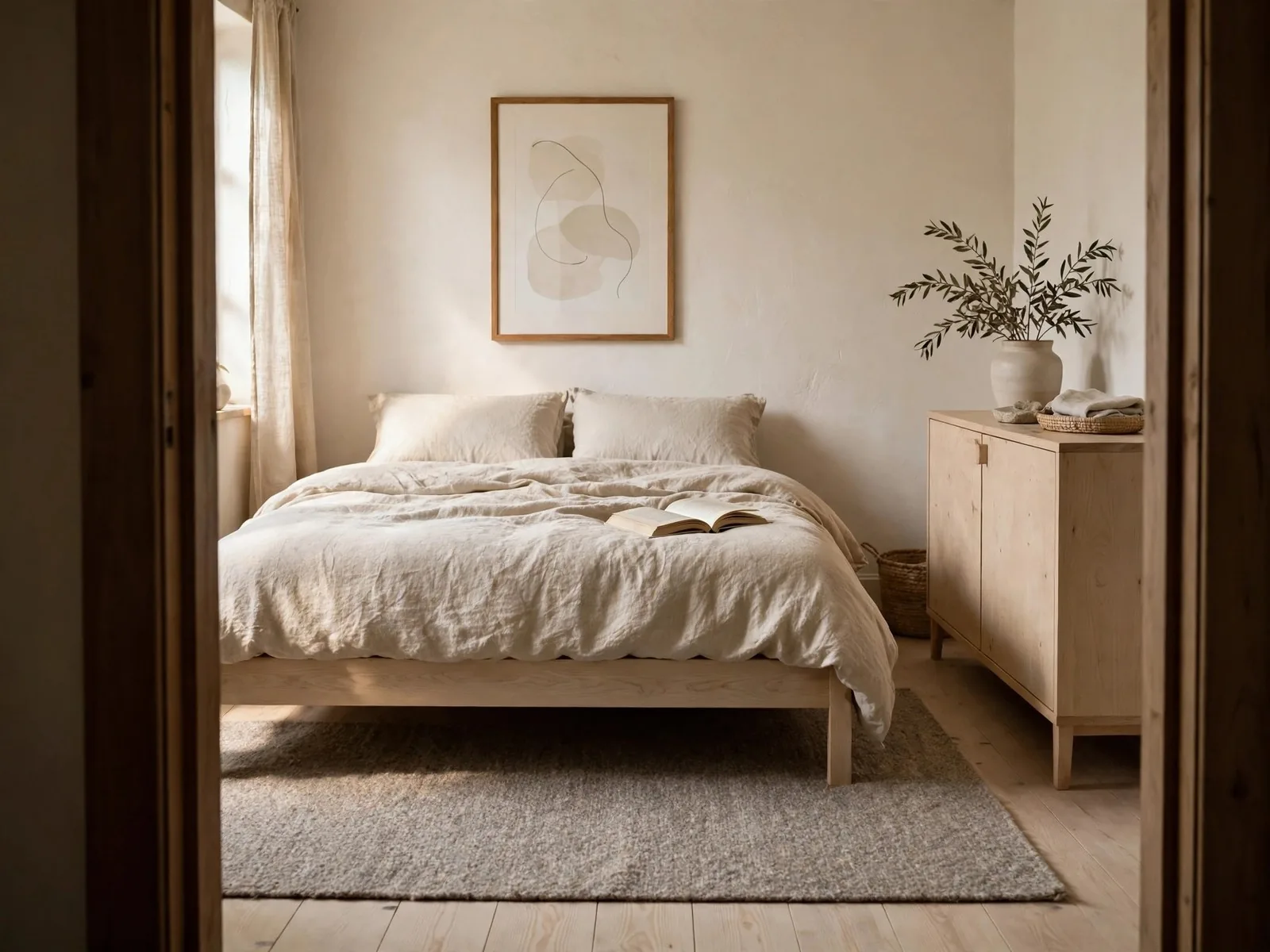
Minimalism has the shortest ingredient list of any style on this site, so here it is in full. The defining materials are four: washed linen, pale wood, wool and matte ceramic, with matte black metal used in tiny doses as punctuation. The palette is warm white, oatmeal, soft greige and one muted accent at a time. The signature pieces are two: a low platform bed frame in pale wood and one closed storage piece with doors or drawers. Buy those two first, in that order. The room already reads minimalist before a single decorative object arrives. The four ideas below install the formula piece by piece.
Three colors plus wood is the whole allowance. Warm white on the walls and in the bedding base, oatmeal or soft greige in the second textile layer and one wood tone, pale oak or birch, repeated across the frame and the dresser and the nightstands. A single accent color may visit in one place, sage in the throw or clay in one cushion. It stays under a tenth of what you see.
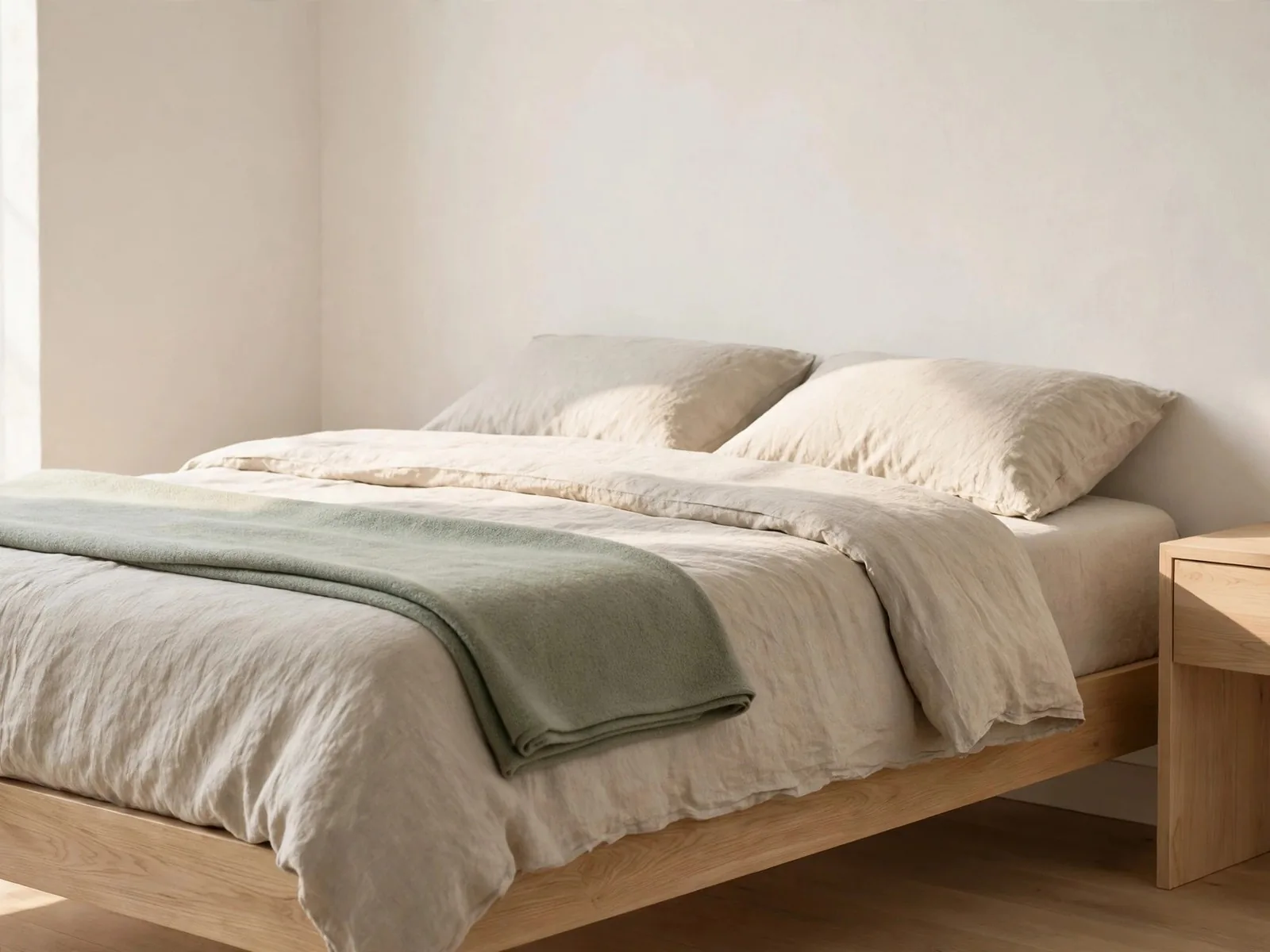
The named colors matter because the wrong white ruins this faster than any clutter. Blue-white paint reads cold and clinical under bedroom light. Warm white has a drop of yellow in it and it is the difference between a sanctuary and a clinic. Our bedroom color ideas page lists the warm whites and greiges that behave in north and south light.
Measure: test paint swatches against the bedding twice, at noon and under the bedside lamp. Warm white shifts a full shade between daylight and lamplight.
2. Let four materials do all the decorating
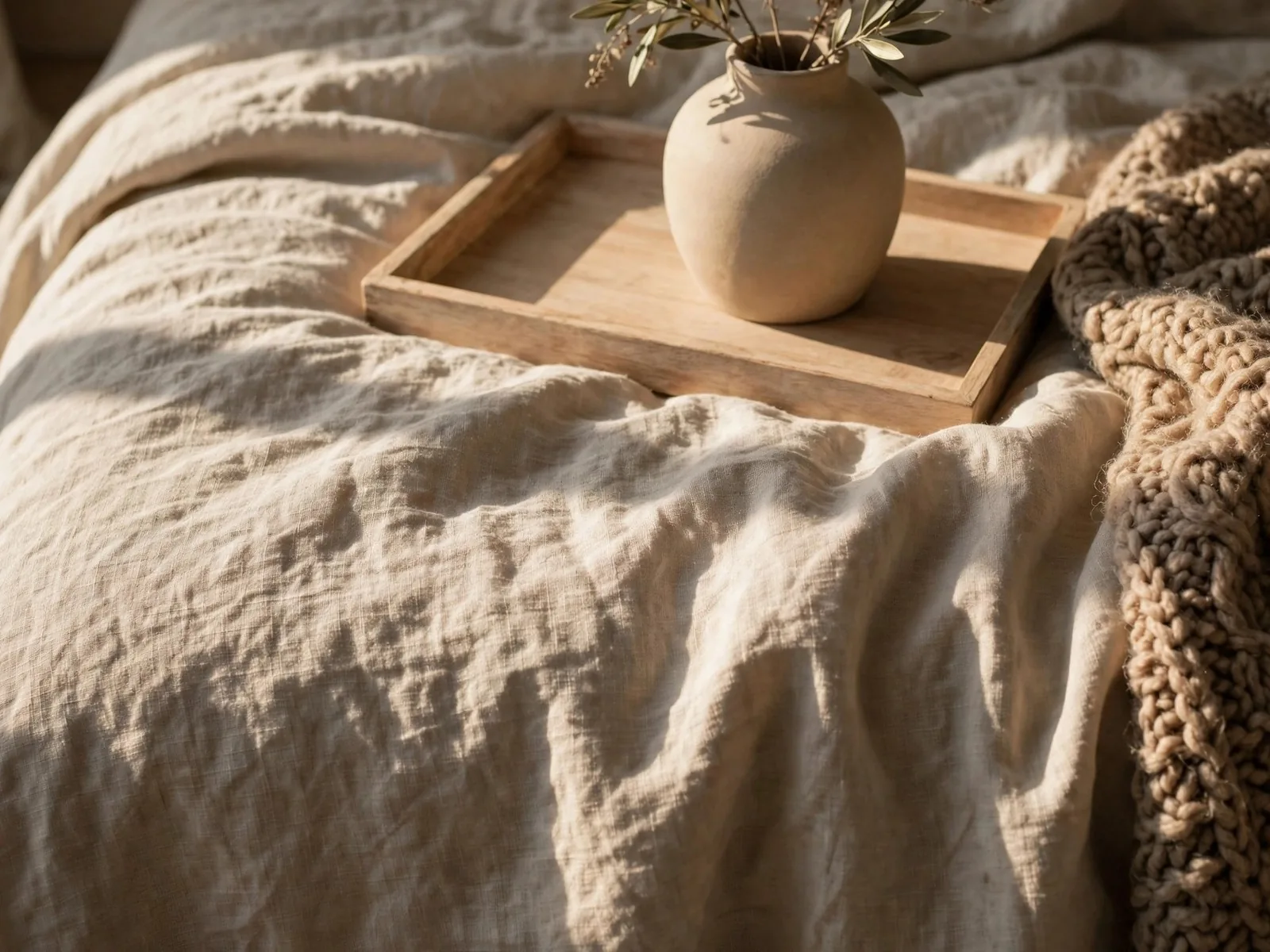
Where other styles use pattern, this one uses touch. Linen on the bed with its visible weave, pale wood with the grain showing, wool in the rug or the single throw and matte ceramic for the lamp base or the one vase. Hold a hand over any surface in a good minimalist room and it feels different from the last one. That contrast is the decoration. The boho bedroom ideas page runs on a cousin of this list and layers it three deep for the opposite effect. Here one layer is the whole idea.
The catch is the fifth material. The moment chrome, glass or gloss plastic joins the list, the room stops reading calm and starts reading showroom. Metal survives only as matte black punctuation: a lamp stem, a frame edge, a drawer pull. Everything else that shines gets edited out or hidden behind a door.
Budget: the four materials are the inexpensive ones by nature. A linen or linen-blend bedding set runs $60 to $120 and outlasts three trend sets.
3. Buy the low platform bed first
This is signature piece one and the room’s anchor. A platform frame in pale wood, sitting low, with a low headboard or none at all and no footboard. The low line keeps the bed from looming, makes the ceiling feel higher and leaves the wall above it free for the one large gesture this style allows. Nothing else you buy will change the room’s reading as much as this frame does.
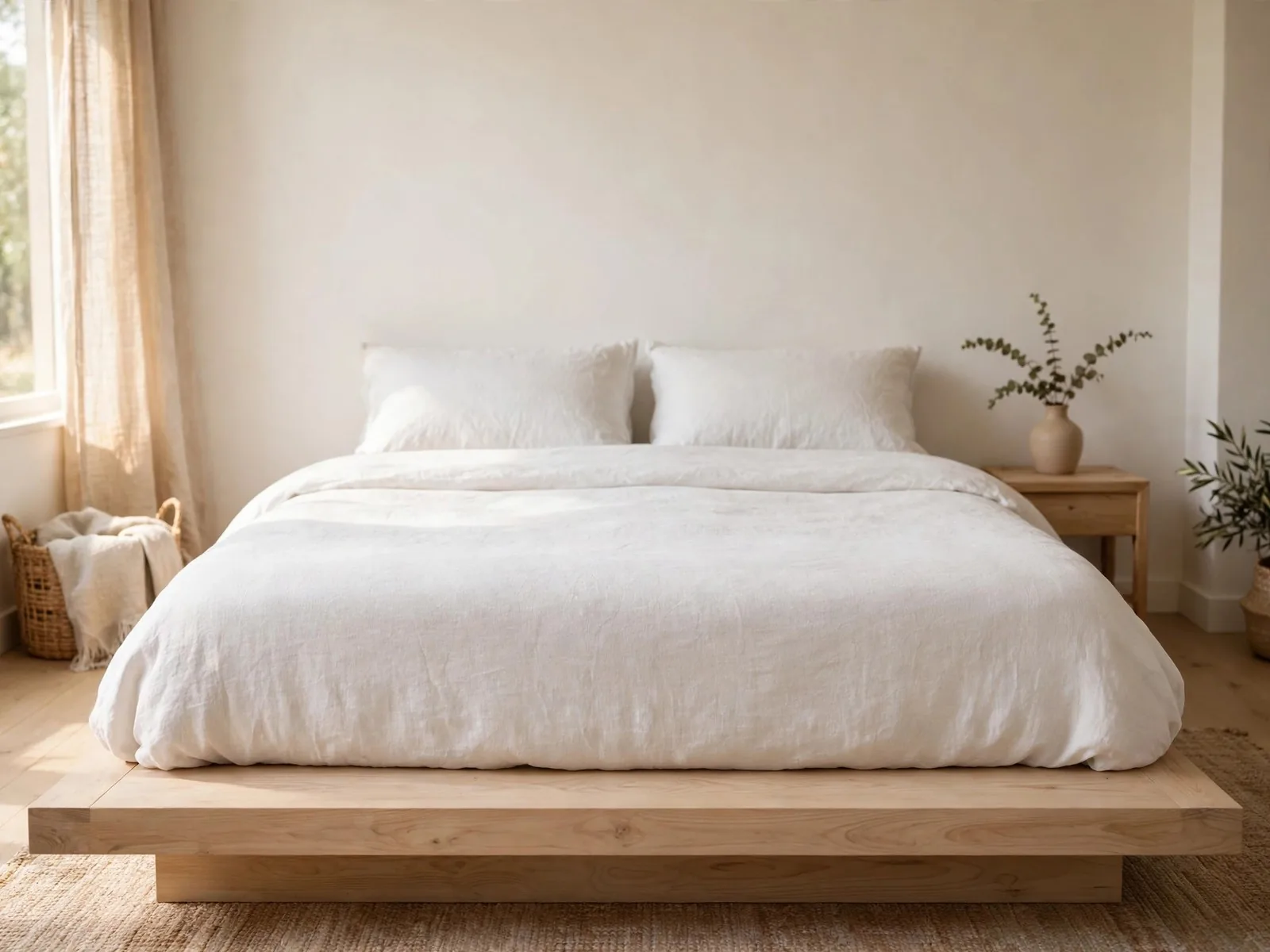
The honest catch: a low platform gives up most under-bed storage, because the clearance underneath is often 4 to 6 inches rather than the 12 a box spring allows. That storage has to live somewhere, which is exactly why the next idea outranks every decorative purchase. If under-bed boxes are non-negotiable in your room, choose a 12-inch frame and accept the slightly taller line.
Measure: platform frames sit 10 to 14 inches high before the mattress. Add your mattress depth and aim for a finished sleeping surface around 22 to 24 inches.
4. Buy closed storage second, before any decor
Signature piece two is a dresser with drawers, a wardrobe with doors or nightstands with a drawer each. Its material can match the frame or simply sit inside the same tone family. Its job is absolute: everything that used to live on surfaces goes behind a door or into a drawer. A minimalist room is not a room with less stuff. It is a room where the stuff has somewhere to go.
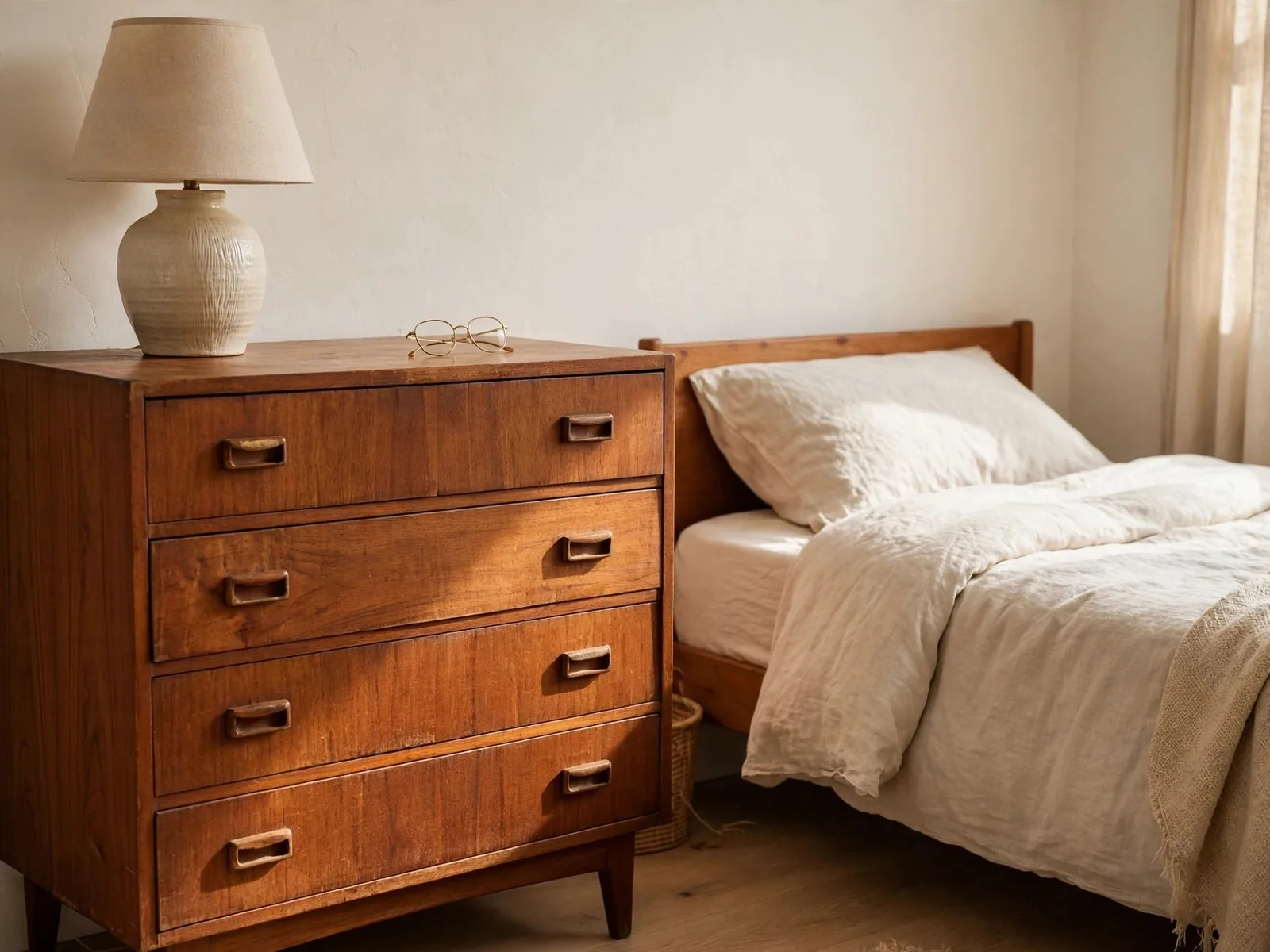
This is also the idea that makes the style a small-room strategy rather than a sacrifice. Closed storage lets a 100-square-foot room hold a full life without showing it. The small bedroom storage ideas page works through drawer counts and sizes for tight rooms in more detail.
Budget: $150 to $400 buys a solid six-drawer dresser secondhand. This piece carries the whole style, so it outranks every decorative buy on the page.
The ideas, room zone by room zone
With the formula installed, the zones are quick. Each one gets a single decision, made once. The discipline is mostly about stopping.
5. Dress the bed in one textile family and stop at two pillow sizes
The bed fills more than half of what you see from the doorway, so its discipline decides the room. One textile family only: the linen set from idea 2, in the palette, with nothing competing on top of it. Sleeping pillows at the back, two square cushions or one long lumbar in front and one throw folded once across the foot. That is the finished bed. A fourth layer is where minimal beds start their slide back into ordinary ones.
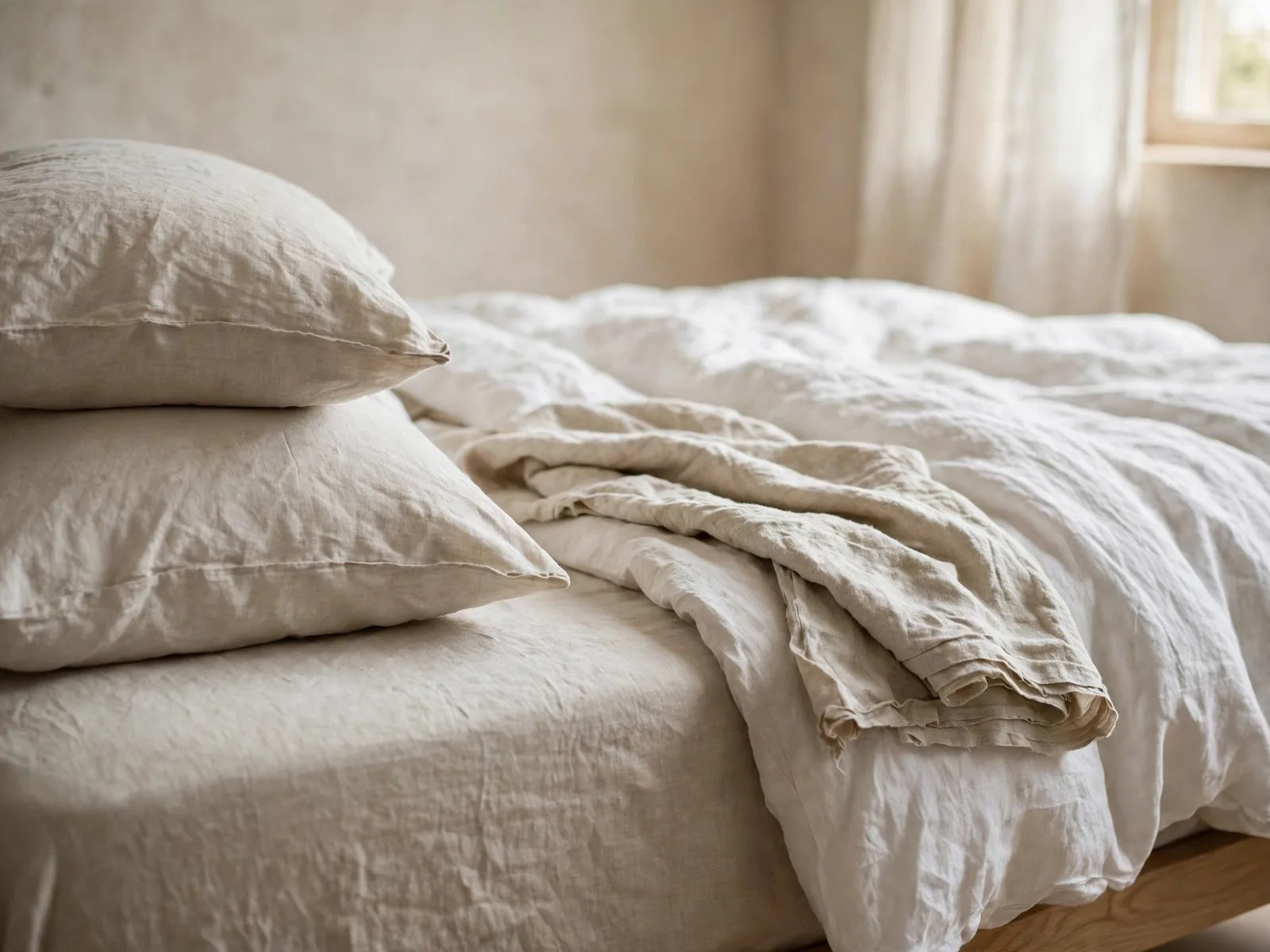
The headboard question resolves the same way. Low and plain wins: an upholstered panel or a wood headboard that stops 24 to 36 inches above the mattress. Tall and tufted belongs to other styles. The headboard ideas page shows the low profiles that work and the heights to order them at.
Measure: two pillow sizes maximum, one throw, one textile family. Count them from the doorway; the doorway view is the one that has to read calm.
6. Hang one large piece on the bed wall or hang nothing
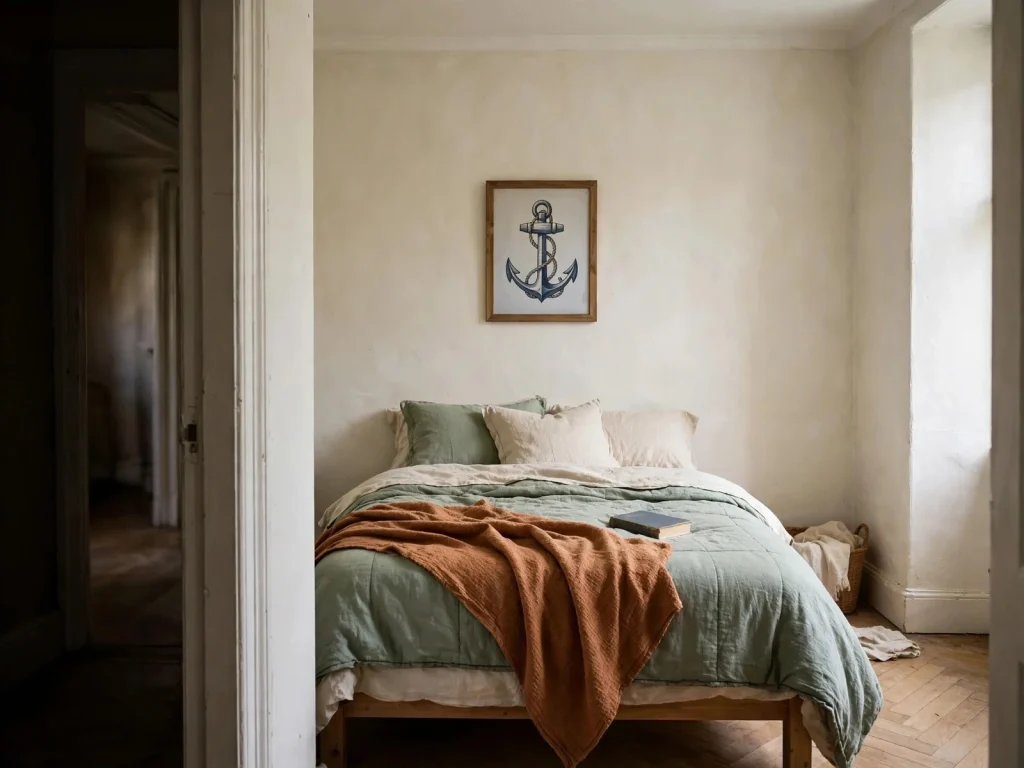
One wall gets one gesture. A single large print, a woven hanging or a shallow relief panel, sized to at least two-thirds of the bed’s width and hung so its center sits at eye level from the doorway. Every other wall stays bare. Ten small frames is the fastest way to break this style, because the eye reads each small object as a separate decision and the room fills with noise at picture height.
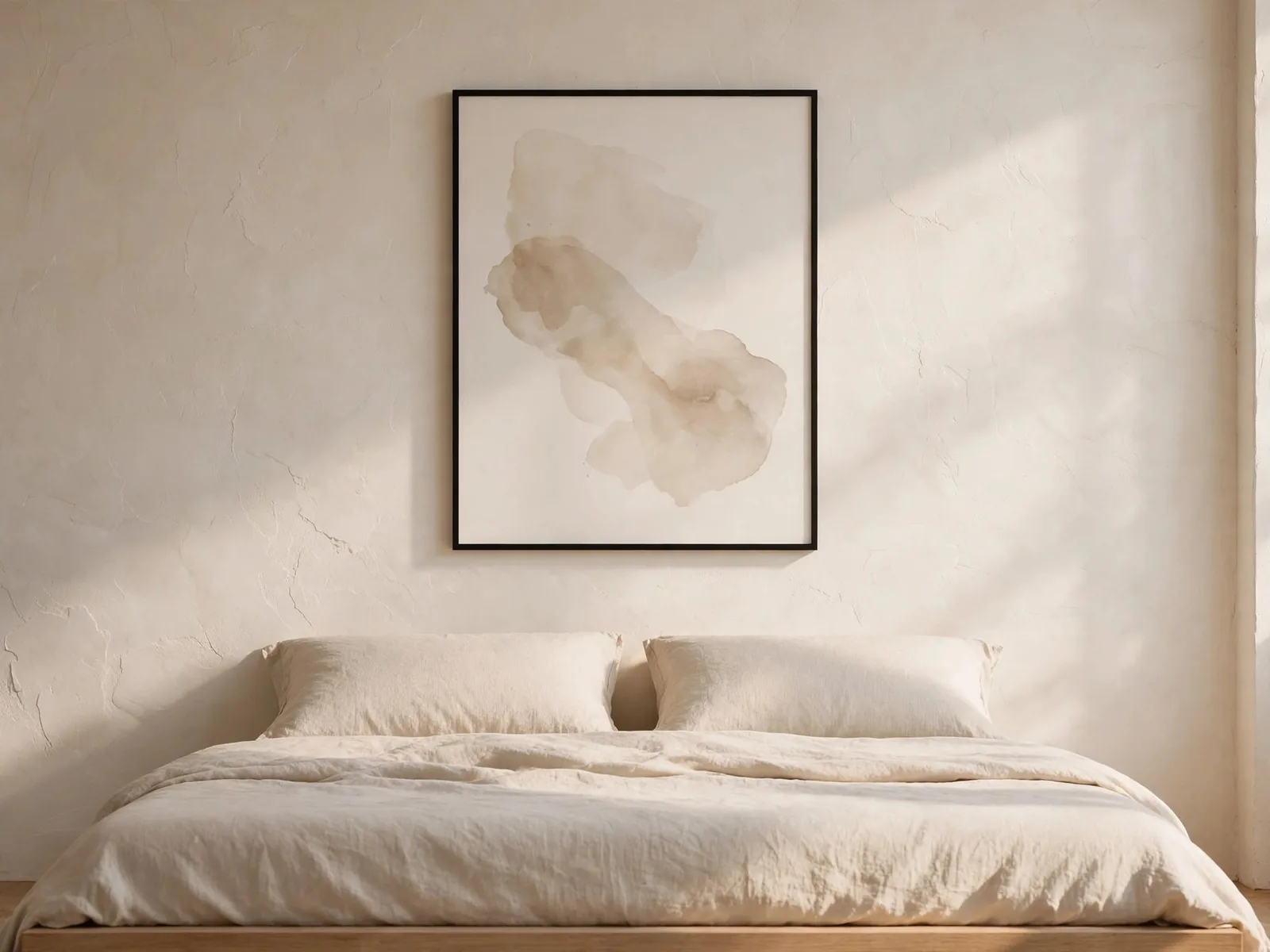
If one gesture is not enough for you, the only other version this style allows is treating the whole bed wall as the gesture: a limewash finish or slim wood slats, wall to wall, with nothing hung on it at all. The bedroom accent wall ideas page covers both finishes and their real costs.
Renter-friendly: lean the large piece on the dresser or hang it from one removable hook rated for its weight. The style needs one hole at most and usually none.
7. Use one rug sized to the bed or leave the floor bare
One rug, flat in weave, in a heathered natural wool tone. It goes under the bed and out on both sides, so bare feet land on it at the exact two places feet land. A small rug floating at the foot of the bed is surface clutter that happens to be horizontal. If the budget will not stretch to the right size, bare wood or laminate with clean lines beats a too-small rug every time.
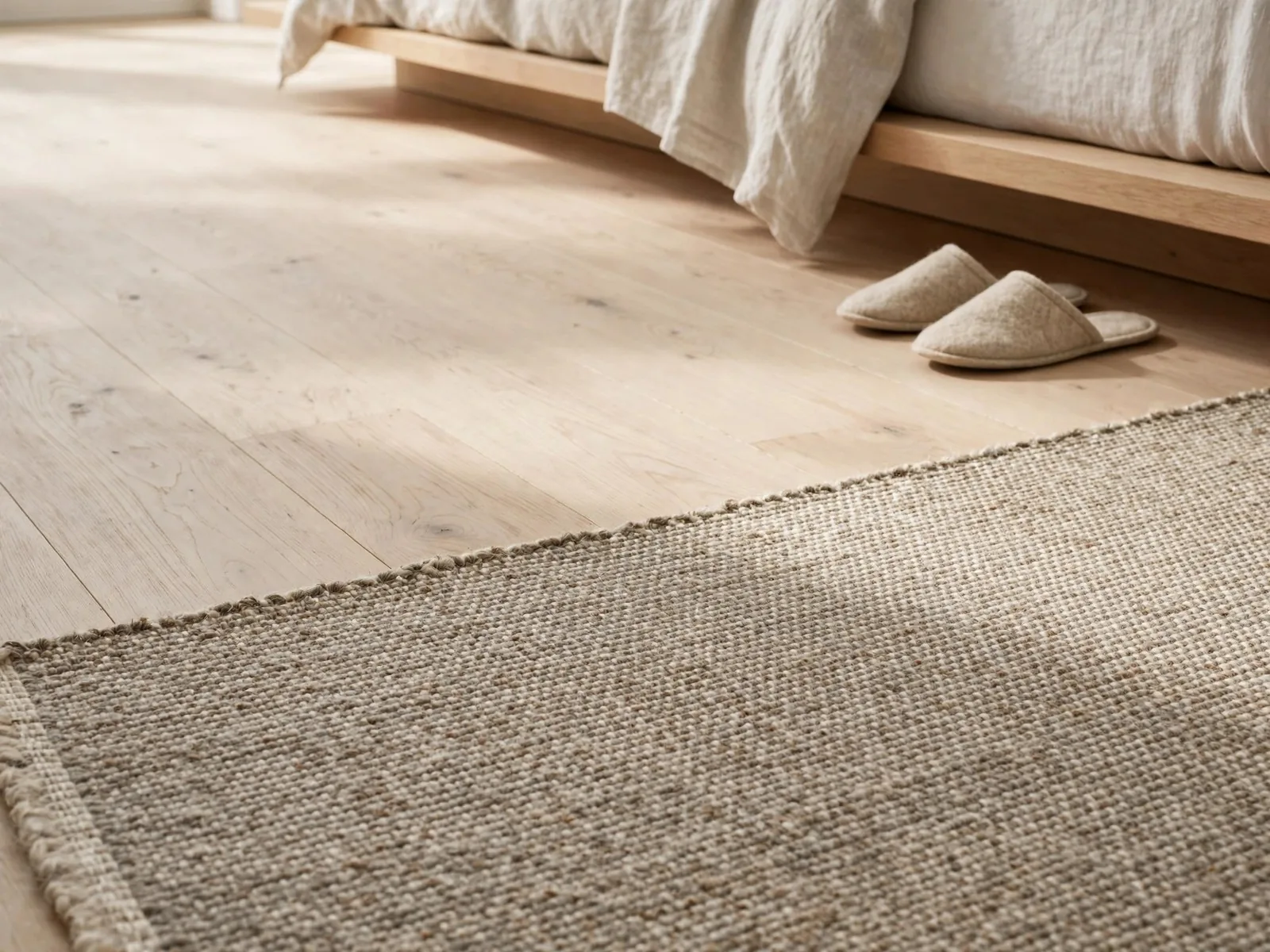
Sizing is the whole idea. A queen bed is 60 by 80 inches. An 8 by 10 rug under it leaves roughly 24 inches of border on each side and at the foot, which is the proportion in every saved photo you have pinned. Go down to a 5 by 7 and the border vanishes on one side, which is why small rugs look apologetic.
Measure: 24 inches of rug border on both sides of the bed is the target. Measure the room before the rug, not after it arrives.
8. Light it low, warm and from two places
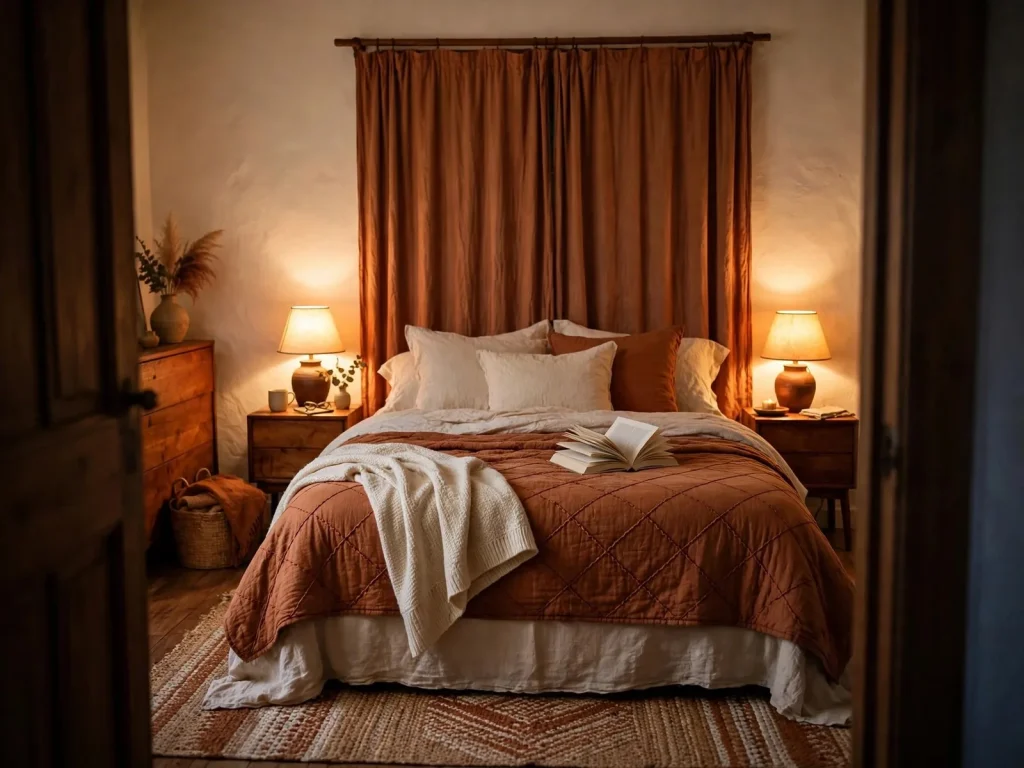
Two light sources, both low, both warm. Bedside lamps with linen or paper shades, bulbs at 2700K, placed so the light pools beside the bed instead of flooding the ceiling. The ceiling light is this style’s enemy after dark; a bright overhead source flattens every texture the room depends on and turns warm white paint faintly blue. One dimmer or one smart bulb in the main fitting is the compromise for rooms that need overhead light for cleaning.
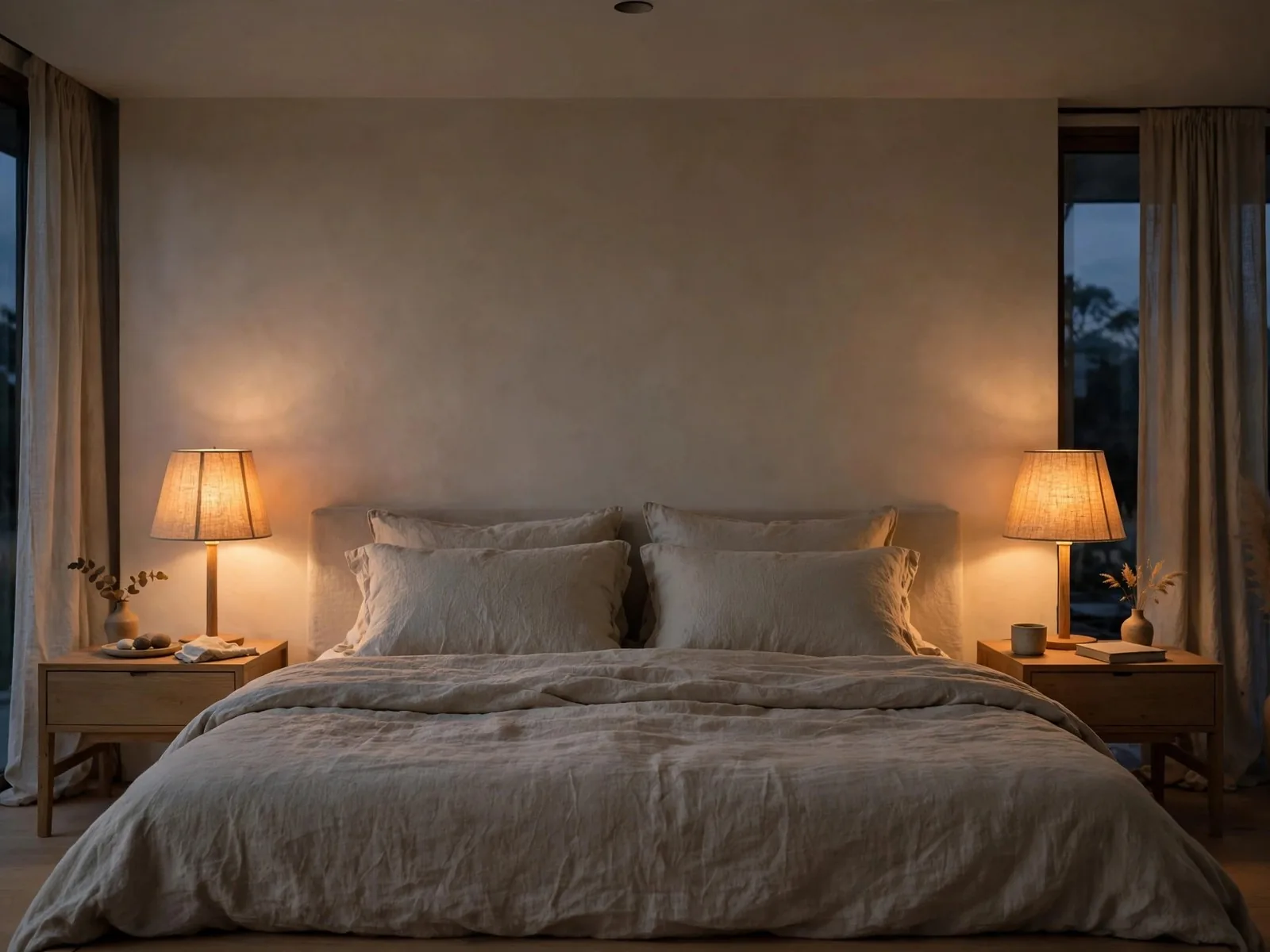
Matching lamps matter more here than in any other style, because in a room with this little in it, a visible pair becomes part of the decor whether you planned it or not. The bedroom lighting ideas page works through lamp heights and shade sizes for bedsides in detail.
Budget: a matching lamp pair runs $40 to $90 secondhand or on sale. In this style the pair is furniture, so price it like furniture.
Color and textile combinations that hold the style
Three combinations cover nearly every minimalist bedroom worth saving. Each one is the formula from idea 1 with a different accent decision. Each one also fails in a specific way worth knowing before you commit.
9. Warm white, pale oak and oatmeal: the base combination
This is the default and the one to choose when you cannot decide. Warm white walls, pale oak frame and dresser, oatmeal linen with a white sheet layer and a heathered natural wool rug under everything. It works in north light and south light because its warmth lives in the textiles rather than the paint. It is also the combination in most of the photos behind the minimalist tags on Pinterest boards, usually captioned as neutral or beige.
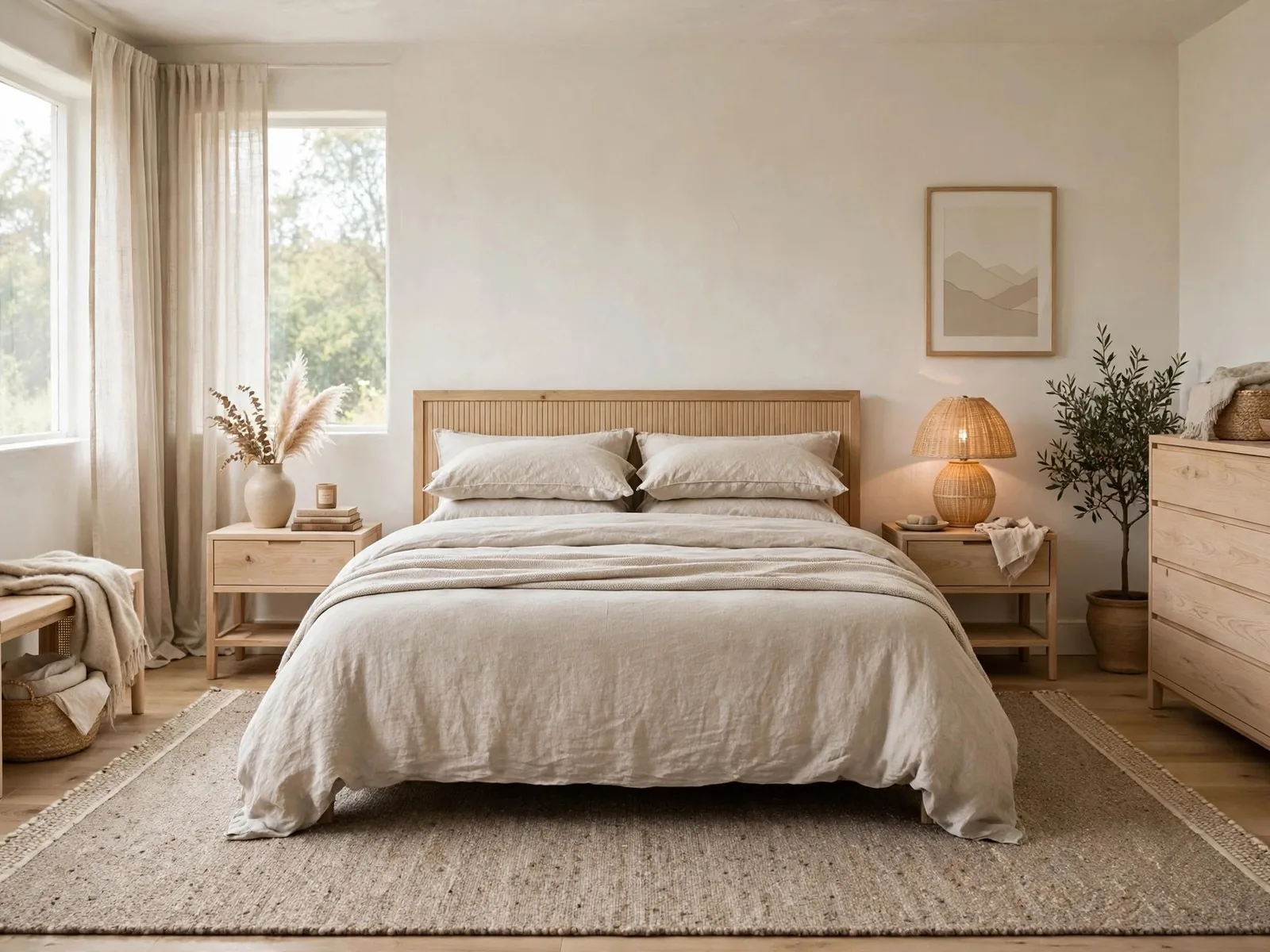
Its failure mode is politeness. If every tone sits within one shade of the next, the room goes flat and reads unfinished instead of calm. The fix is texture contrast, not more color: the nubby wool against the smooth linen against the wood grain. Keep the tones and separate the touches.
Measure: hold the bedding, the rug sample and a wood offcut together in the room’s own light. If you cannot tell where one ends and the next begins at arm’s length, one of them needs to go a shade deeper.
10. Greige, white and one clay accent: the rental rescue
Built for the room you cannot paint, the one with greige walls or beige carpet that the landlord considers a feature. White bedding does the lifting against the greige, because white beside greige makes the greige read as a deliberate warm neutral instead of a compromise. Then one clay or terracotta textile, a throw or a single cushion, placed at the foot of the bed where the eye lands first. Matte black appears only in the lamp stems and the picture frame.
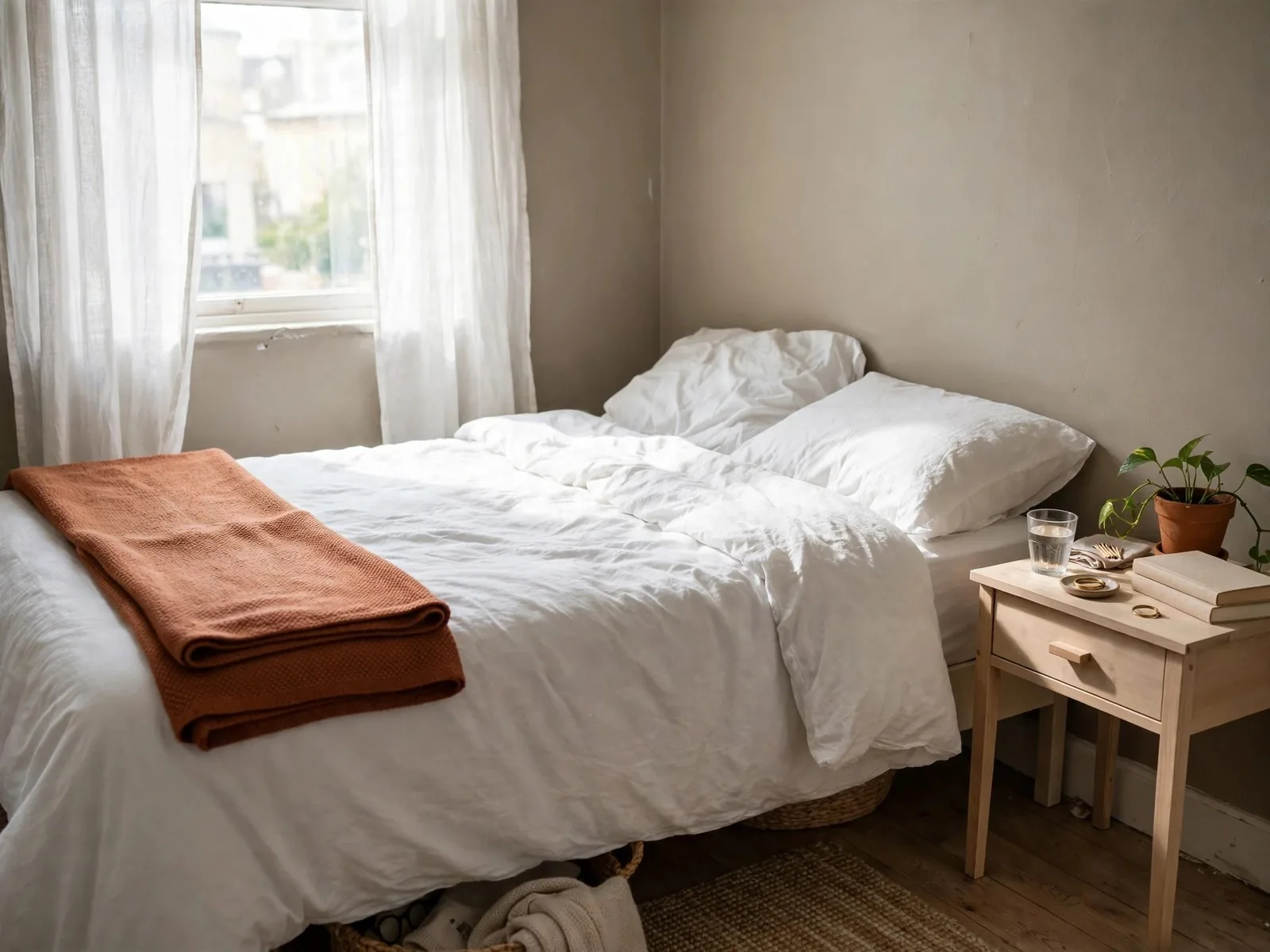
This is the combination that proves the style does not need white walls. It needs contrast in the right order: lightest at the bed, mid-tone at the walls and the single warm accent where the bed ends. Renters get the whole style with zero paint and zero holes beyond idea 6.
Renter-friendly: no paint, no drilling and nothing the landlord can object to. The white bedding set is the entire renovation.
11. Soft sage, white and birch: the version with a pulse
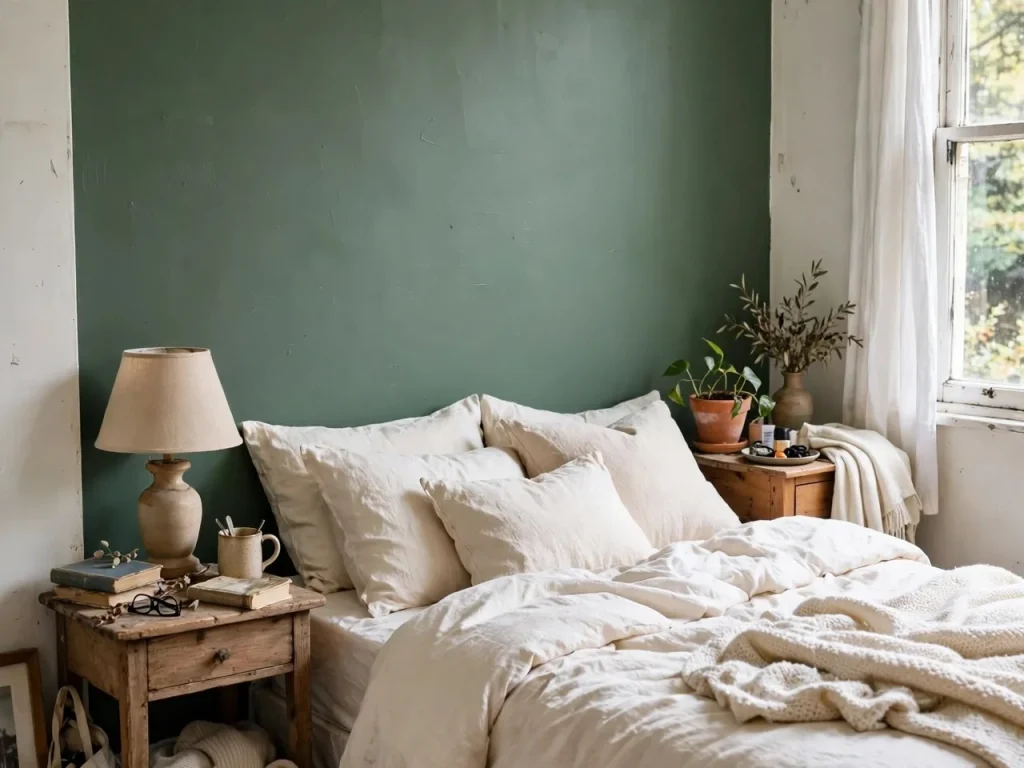
For readers who find the base combination too quiet, sage is the accent this style absorbs best. One sage layer only, the duvet cover or the wall behind the bed, with everything else held at white and pale birch. Sage counts as a neutral in this company because it behaves like one: it recedes, it pairs with wood and it photographs calm. The cozy bedroom ideas minimalist pins lean on exactly this build, pale green against white linen and light wood.
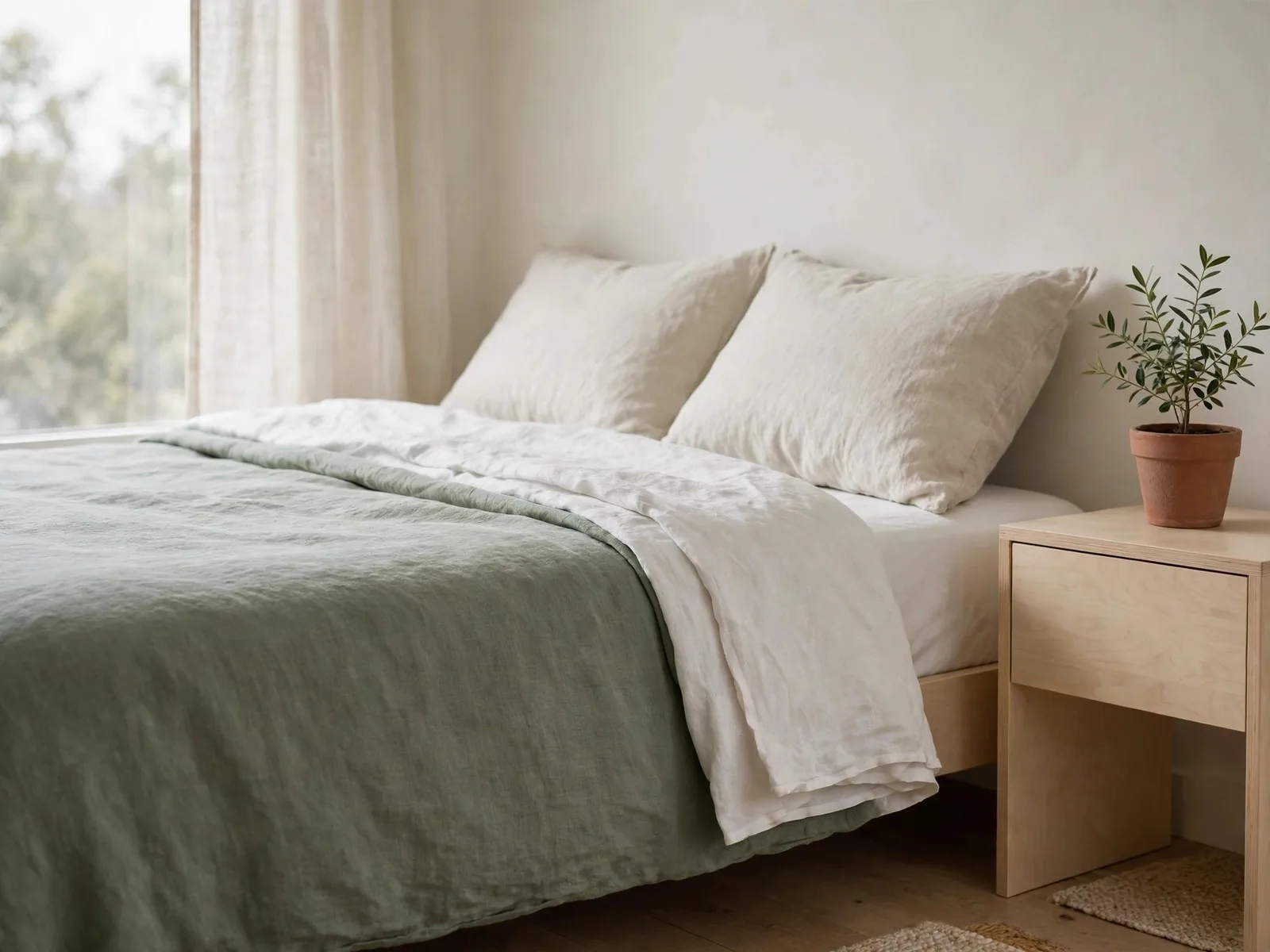
Test before committing, because sage turns grey in a north-facing room and grey sage is just grey. A duvet cover is the cheap test. Live with it through one full day of light before any paint decision gets made.
Budget: one sage duvet cover set at $35 to $60 tests the entire combination. Paint only after the textile version has survived a week.
Getting the look for less
12. Thrift the signature bed or strip the frame you own
The budget entry to this style is its most expensive piece, because solid wood platform frames are exactly what secondhand shops are full of. A thrifted frame in oak, pine or teak, checked for tight joints and unbroken slats, then sanded and sealed with a matte clear coat, lands within a shade of the $400 retail version for a tenth of the commitment. The orange pine frames from the nineties are the best hunting: the wood is solid and the color is only skin deep.
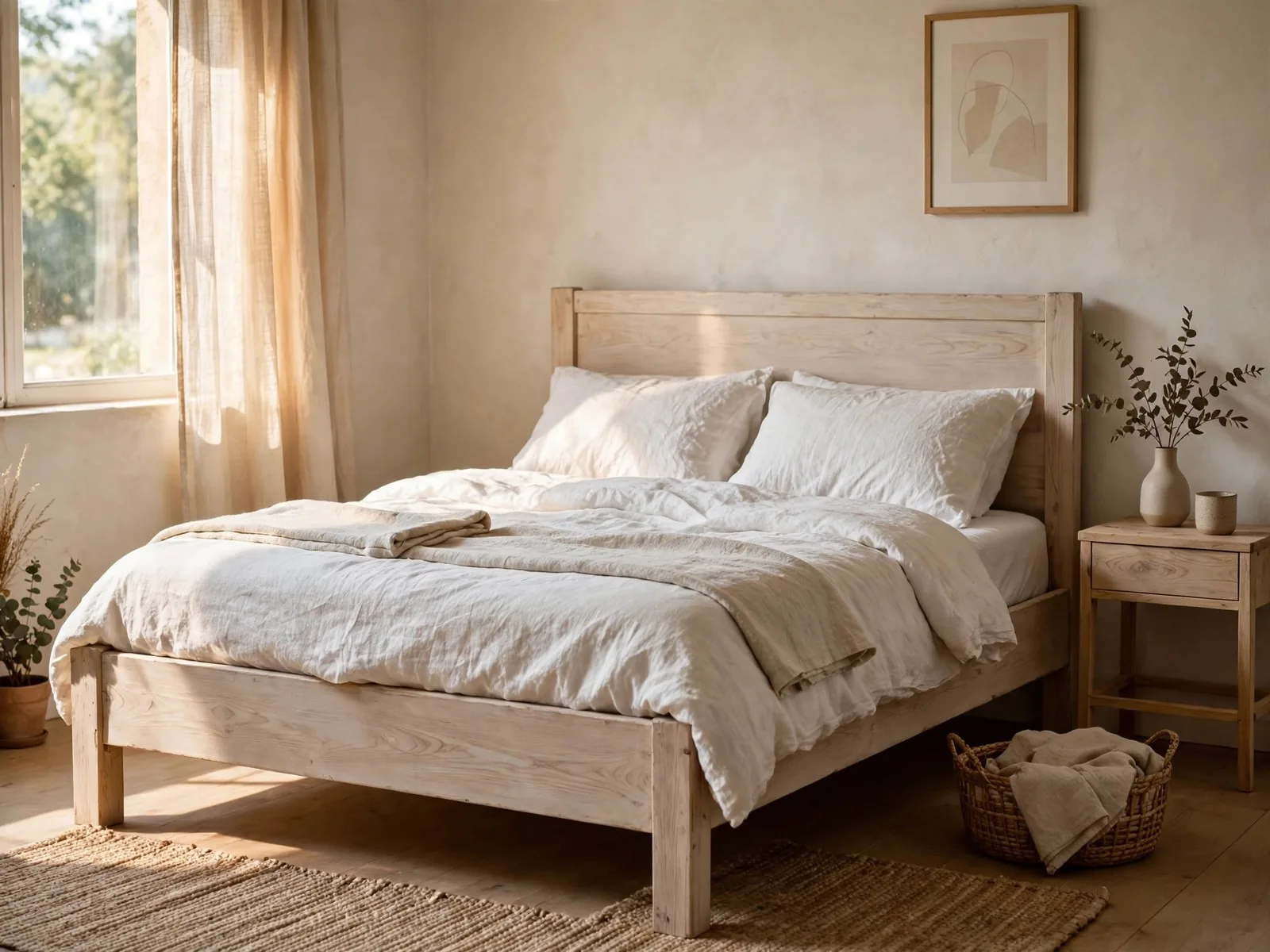
Already own a frame with good bones and a bad finish? The same treatment works in place. Sand the visible rails, lose the footboard if it unbolts and seal everything matte. A Saturday of sanding is the difference between a frame that fights the style and one that anchors it. Vintage bedroom ideas and minimalist ones shake hands here: the oldest piece in the room is often the most convincing one.
Budget: $40 to $150 buys a solid wood frame secondhand in most markets. Check joints and slats before you pay; both are fixable, neither is free.
13. Subtract first: run the box test before any purchase
The cheapest idea on this page is the one the whole style stands on. Take every object off every surface, the dresser top, the nightstands, the chair that holds clothes. Put all of it in one box in another room. Live with the cleared room for seven days. Whatever you walk to the box to fetch has earned its place back. Everything still in the box after a week is clutter with good PR.
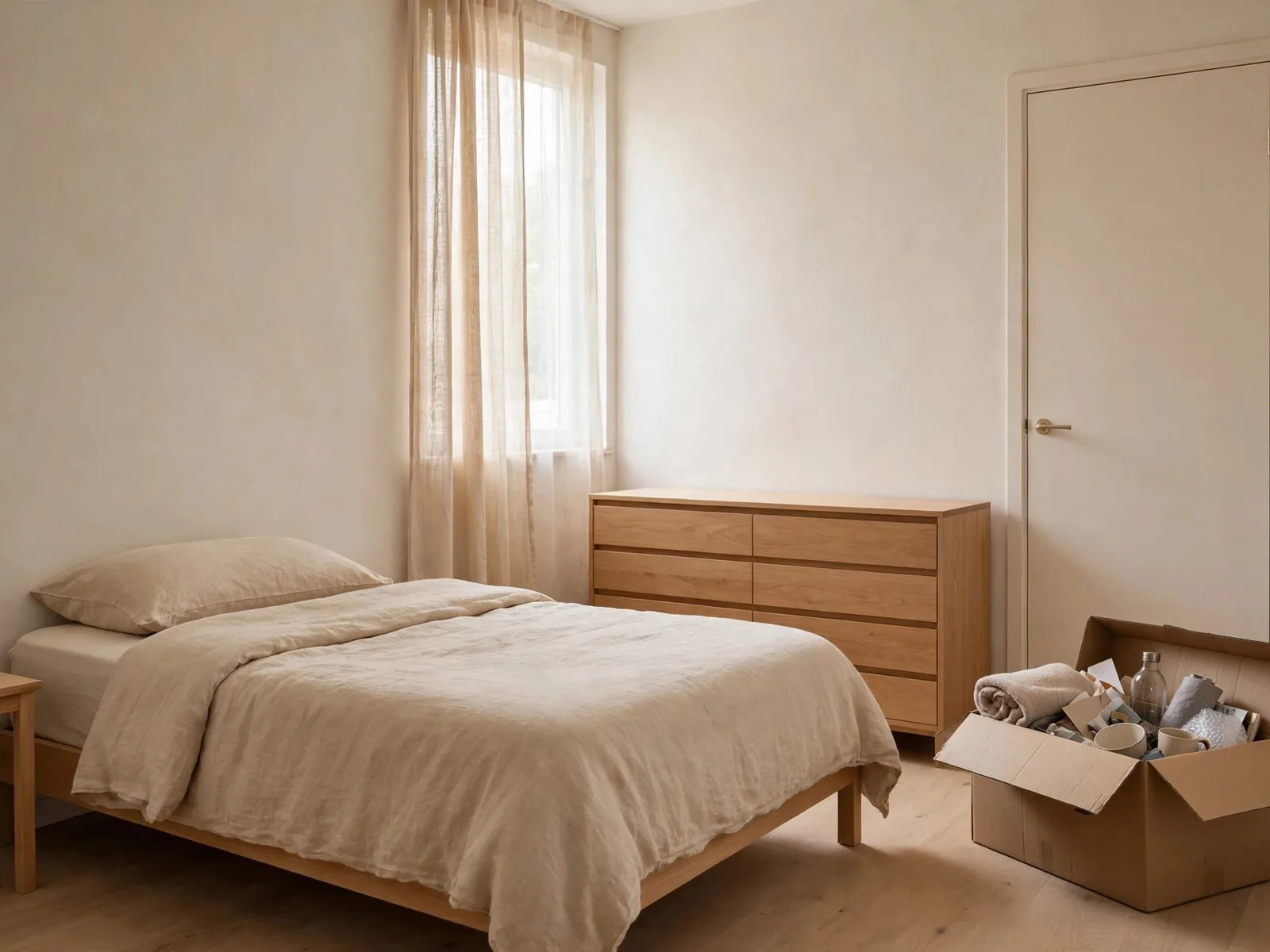
Sell or donate the box’s remains and the style starts paying for itself, because that money is the dresser fund from idea 4. This is also the honest test of whether you want minimalism or just want your room to feel different. Our bedroom makeover ideas page runs the same subtract-first logic across a full room redo.
Budget: $0. The edit cannot be skipped at any price; every later purchase gets smaller after it.
Minimalist bedroom ideas on a budget
The order of spend matters more than the amount. Spend nothing first: the box test from idea 13, the surfaces cleared and the closet audited. The first real money goes on the bedding base, a white or oatmeal linen set at $60 to $120, because the bed is most of the room and this one purchase carries the palette. The next money goes on closed storage, the secondhand dresser, before a single decorative object is allowed through the door. After that, the thrifted frame when the right one appears, then the rug at the right size and the matching lamps last, because light is the layer you judge best once everything else is in place. Run in that order, a convincing minimalist bedroom lands between $300 and $600 spread over a season. Reverse the order and the same money buys a room that looks tidy for exactly one photograph. The same order scales up, too: the master bedroom ideas page applies it to a room with two of everything.
Mistakes that make it fall flat
- Open storage and visible clutter. This is the element that breaks the style, named plainly: if your things are on display, you do not have a minimalist room, you have a tidy one with good intentions. Open shelves, clear boxes and surface rows of bottles all argue against the formula every hour of the day. Give everything a door or a drawer. Anything that cannot get one belongs to a different style.
- The empty white box. Subtracting furniture and texture along with the clutter leaves a room that reads unfinished rather than calm. Smooth bedding, no rug and flat white on every wall is a waiting room. Texture is not decoration in this style; it is the structure that replaces it.
- The cold palette. Blue-white paint, grey textiles and chrome details turn minimalism into a hotel corridor. The style’s calm is warm: warm white, natural wood and 2700K light. If a showroom photo looks chilly, its palette is the reason, not its emptiness.
- Ten small accessories instead of one large piece. A row of small objects reads as ten decisions and ten dusting jobs. One large print, one ceramic vase or one woven hanging reads as a single calm statement. Scale up or leave the wall bare.
- The matching furniture set. A bed, two nightstands and a dresser bought as one suite reads staged, like a furniture showroom at closing time. Pieces inside one wood tone family, gathered separately, read as a room someone lives in. Suites are how minimalism gets mistaken for a hotel package.
- Cool white bulbs. A 4000K bulb overhead undoes the palette every single evening, pushing warm whites toward blue and flattening wool and linen into grey. Match every bulb in the room at 2700K. It is the smallest purchase on this page and the one with the largest nightly effect.
Questions people ask about this
What defines this style in a bedroom? A minimalist bedroom is defined by closed storage and four natural materials: linen, wood, wool and matte ceramic. The palette is warm white, oatmeal and pale wood. Every surface is edited, the bed sits low and one large piece replaces many small ones. Nothing is on display without a job.
How can I get this look on a budget? Subtract before you spend. Box everything on the surfaces for a week and keep only what you reach for, then thrift the signature pieces: a solid wood bed frame runs $40 to $150 secondhand and closed dressers are everywhere. Spend first on storage, last on decor.
What colors go with this style? Warm white on the walls, oatmeal and soft greige in the textiles and pale oak or birch for the wood. Add one muted accent at a time, sage green, clay or dusty blue. Keep it under a tenth of what you see. Blue-white paint and cool grey read cold here.
The bottom line
Minimalism is not a purge and it is not a purchase. It is a short list of decisions, closed storage, three colors plus wood, four materials and one large gesture per wall, held until the room goes quiet. The rooms you saved are not owned by people with fewer things. They are owned by people whose things have doors. This week, run the box test from idea 13: clear every surface into one box, live with the room for seven days and write down what you actually fetch back. That short list is your style. The rest of the box is your dresser fund.