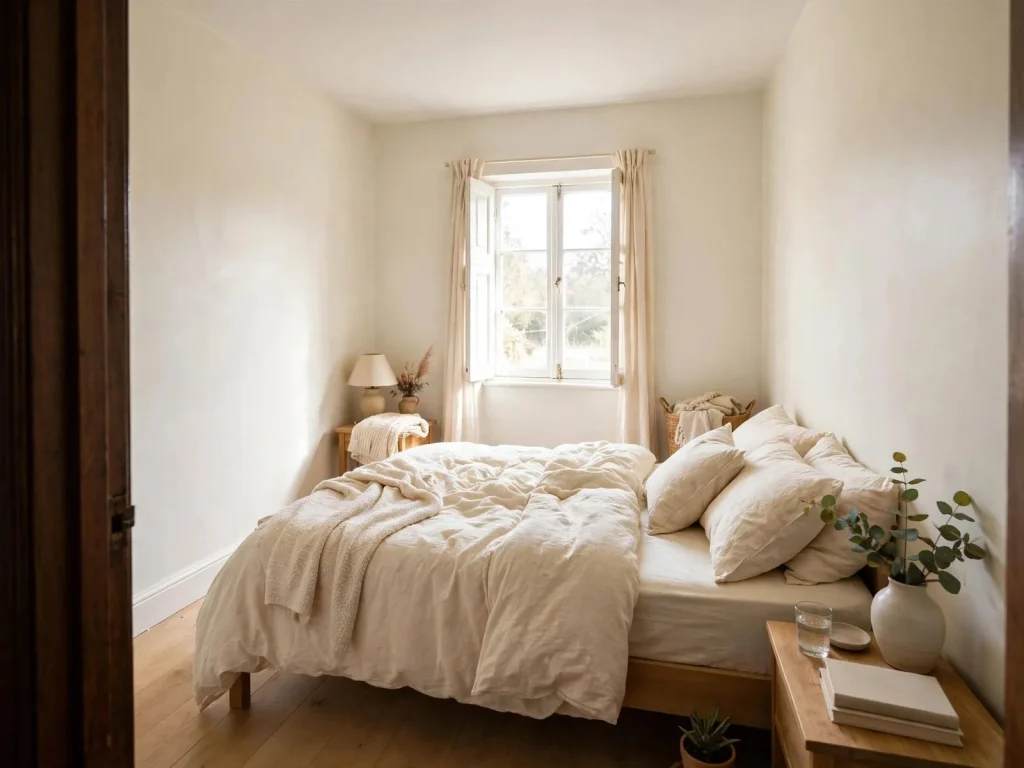
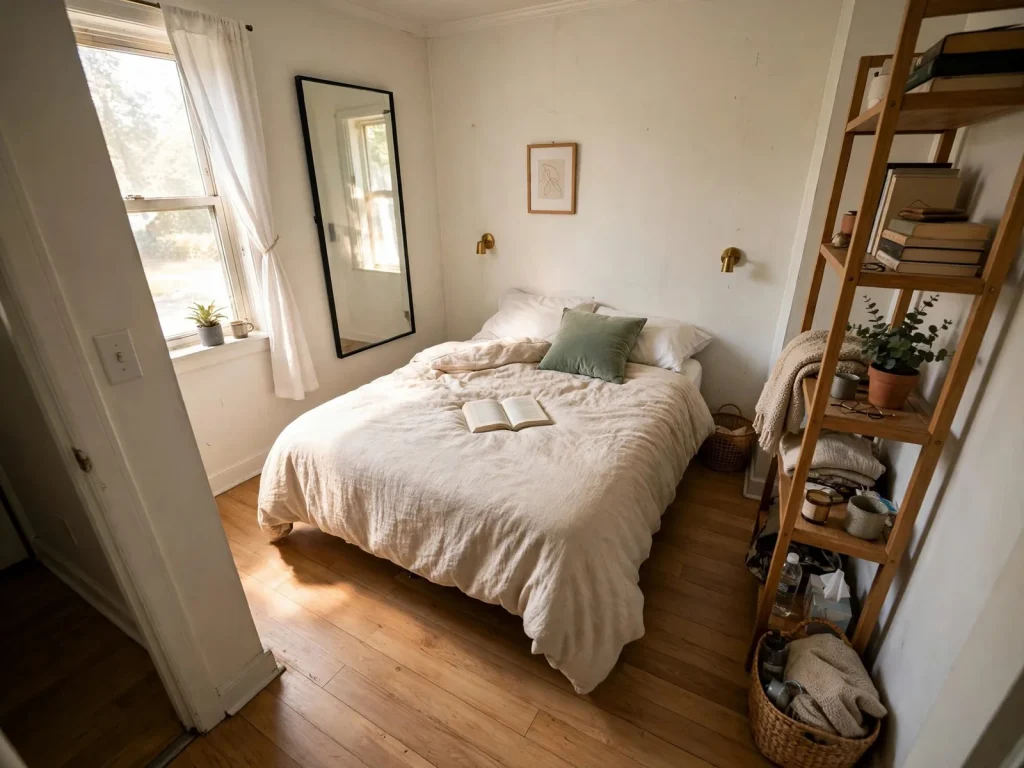
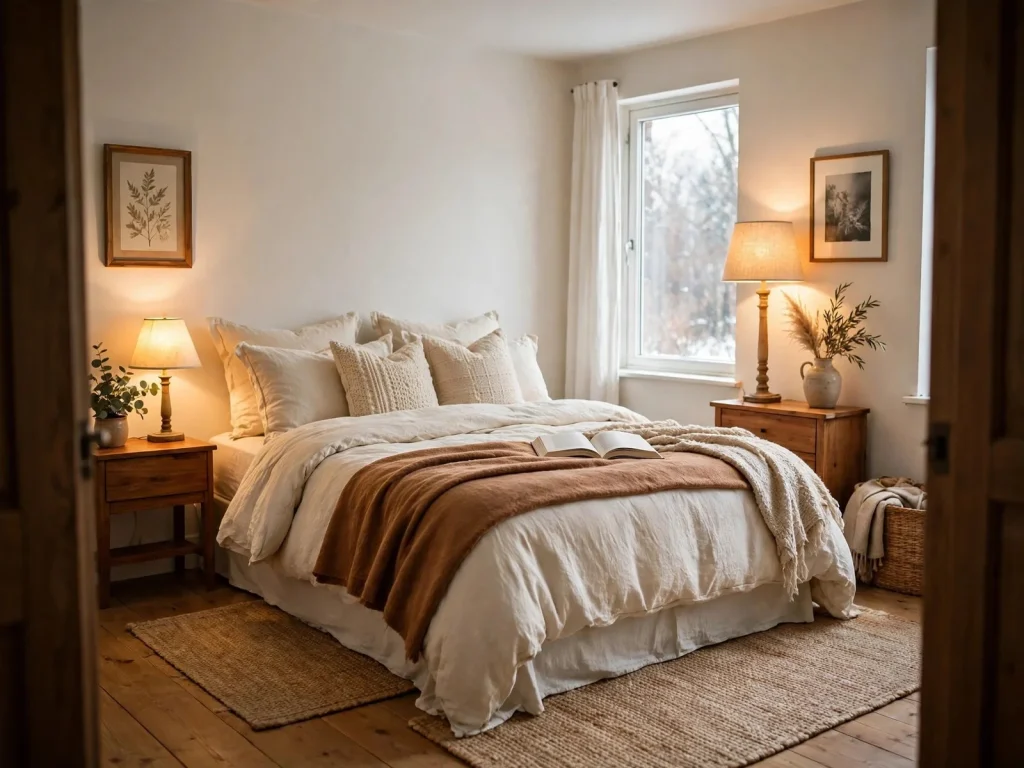
Your bedroom measures fine on paper. The tape says the bed fits with floor to spare on both sides. Then you stand in the doorway at night and the room closes in anyway. The walls feel close. The window wall looks dark. The bed seems to eat the whole floor. That gap between the measurements and the feeling is a sightline problem. Sightlines can be fixed without moving a single wall.
This page works on the feeling directly. Every trick here changes how big the room reads and every trick carries the size or height that makes it work. A mirror in the wrong spot does nothing. A curtain rod at the wrong height does nothing. The order matters too: light first, then mirrors, then curtains, then furniture. Follow that order and you can make your small bedroom look bigger one surface at a time. If the layout itself needs work first, start with our small bedroom ideas post.
Before you start: measure, rough costs, rules
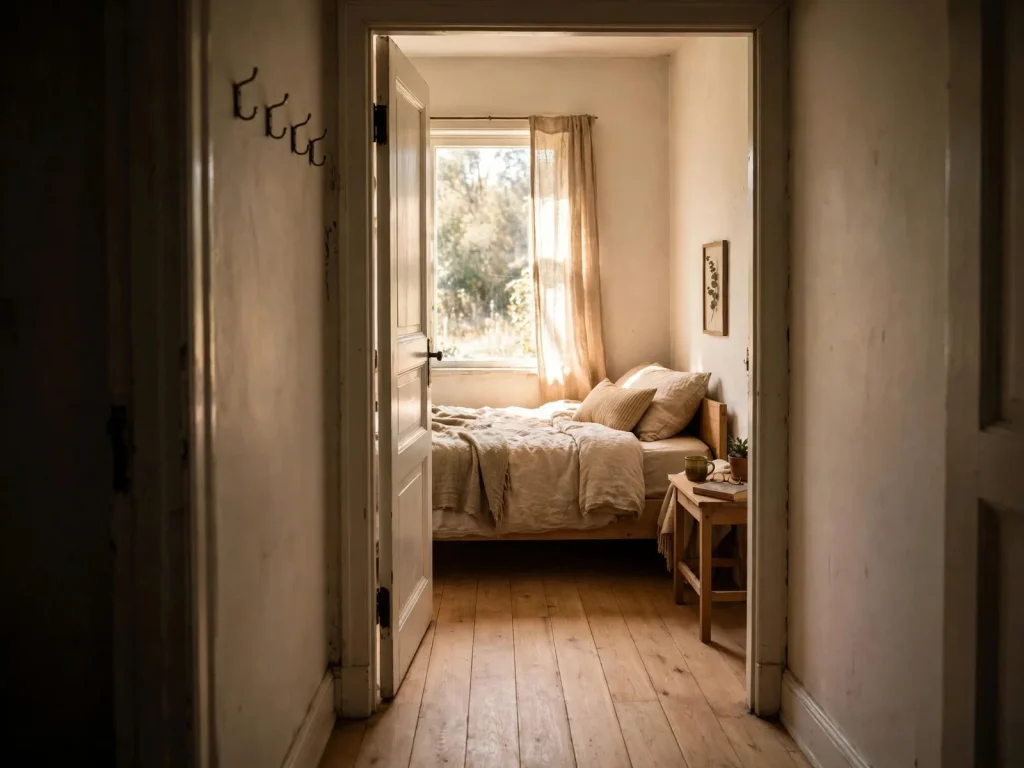
Take three measurements before you buy anything. Measure the ceiling height at the bed wall. Note where the window sits and which wall gets its light because the mirror ideas on this page are placed against that light. Then stand in the doorway and study the first view the room gives you. That doorway sightline is the view every trick here tries to deepen. Note what blocks it now.
The rough cost notes on this page run in a simple order. Paint is the cheapest change here and it does the most work per dollar. Mirrors and curtain rods come next and both turn up secondhand in the sizes this page names. New furniture costs the most and changes the read the least per dollar so it comes last and only when the legs are wrong. No fixed prices are promised anywhere on this page because sizes and finishes move the cost too much to quote honestly.
Renters, two rules before you start. Check your lease before paint touches a wall and keep every other trick to hooks and leaning pieces and tension rods where you can. Nothing here needs built-ins or wall removal. The rental section near the end adapts the strongest ideas to a no-drill version. Read the main ideas for the numbers and the rental section for the method.
Light and color first
1. Paint the walls a color with an LRV of 60 or higher
Light walls bounce daylight back into the room instead of absorbing it. From the doorway the walls are most of what you see.
Choose wall colors with a light reflectance value (LRV) of 60 or higher, the range warm whites and pale warm greys fill.
The catch is north light, where cool whites read grey, so test the color on two walls first.
Measure: LRV of 60 or higher, checked on the swatch card before the paint is mixed.
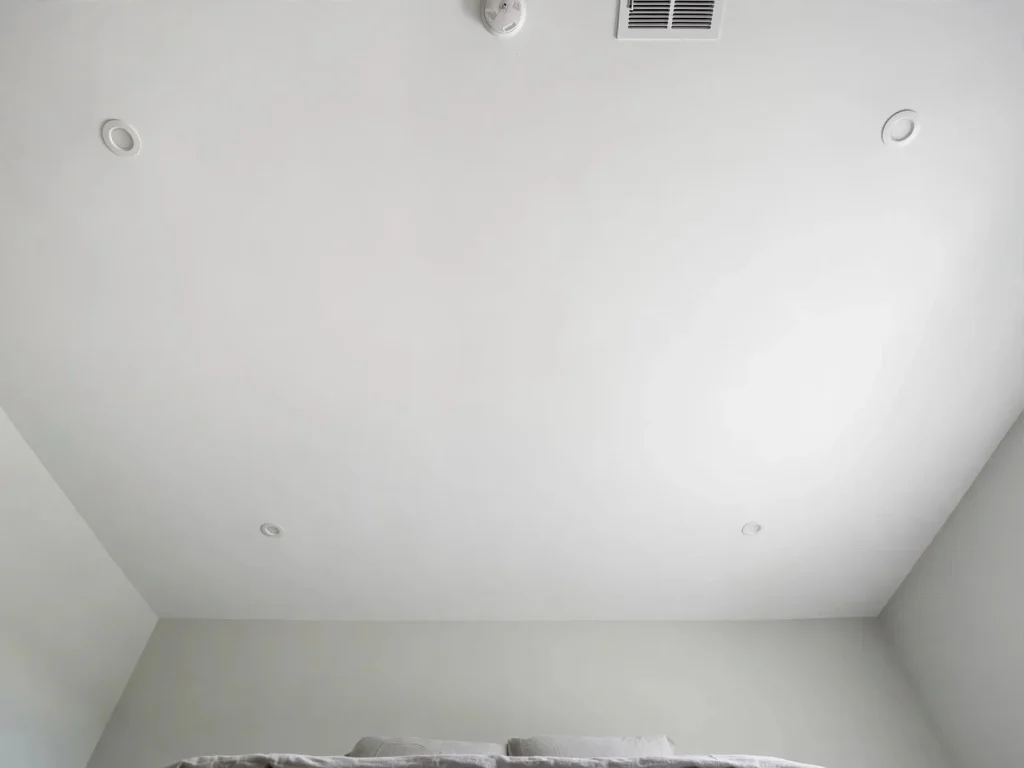
2. Paint the ceiling flat white so the eye reads height
The eye judges height from the ceiling. A tinted ceiling pulls that judgement down. Flat white blurs the wall line so the room reads taller.
Paint the ceiling in flat white with no tint added, over walls at an LRV of 60 or higher so the corner contrast stays soft.
The catch is finish: gloss shows every tape line under lamplight and flat hides them.
Budget: flat white ceiling paint is the cheapest height trick here and one gallon covers most small rooms.
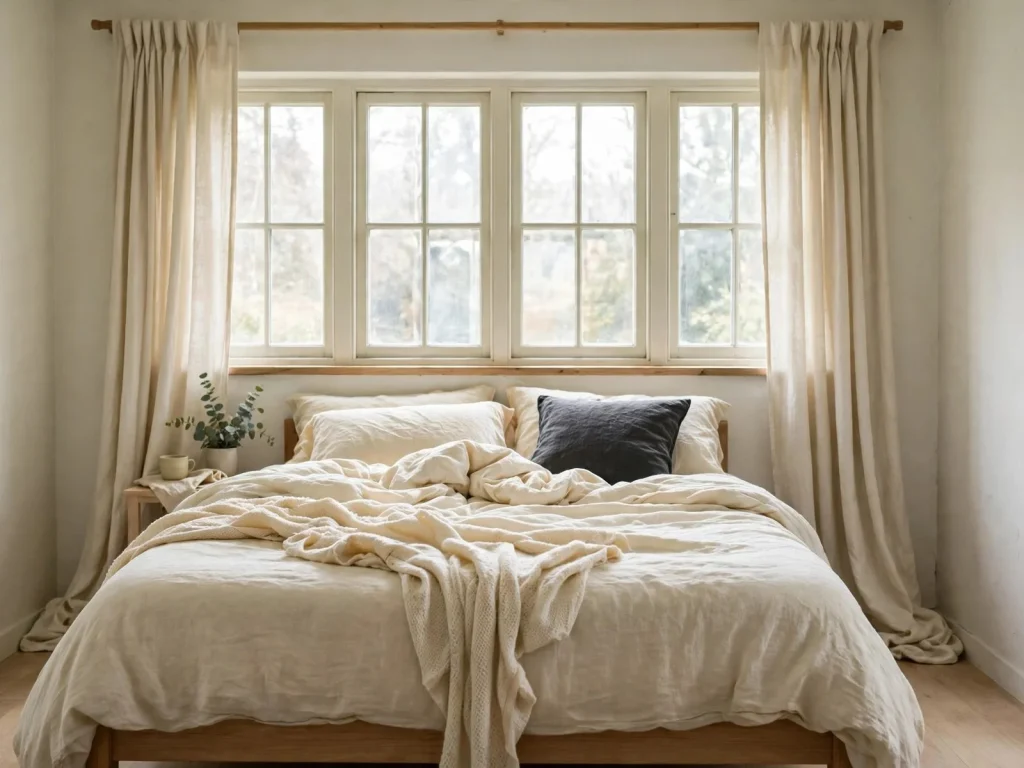
3. Carry light colors across the bedding and curtains
The bed fills the room center and the curtains cover the window wall. Dark tones on either chop the room into blocks even over pale paint.
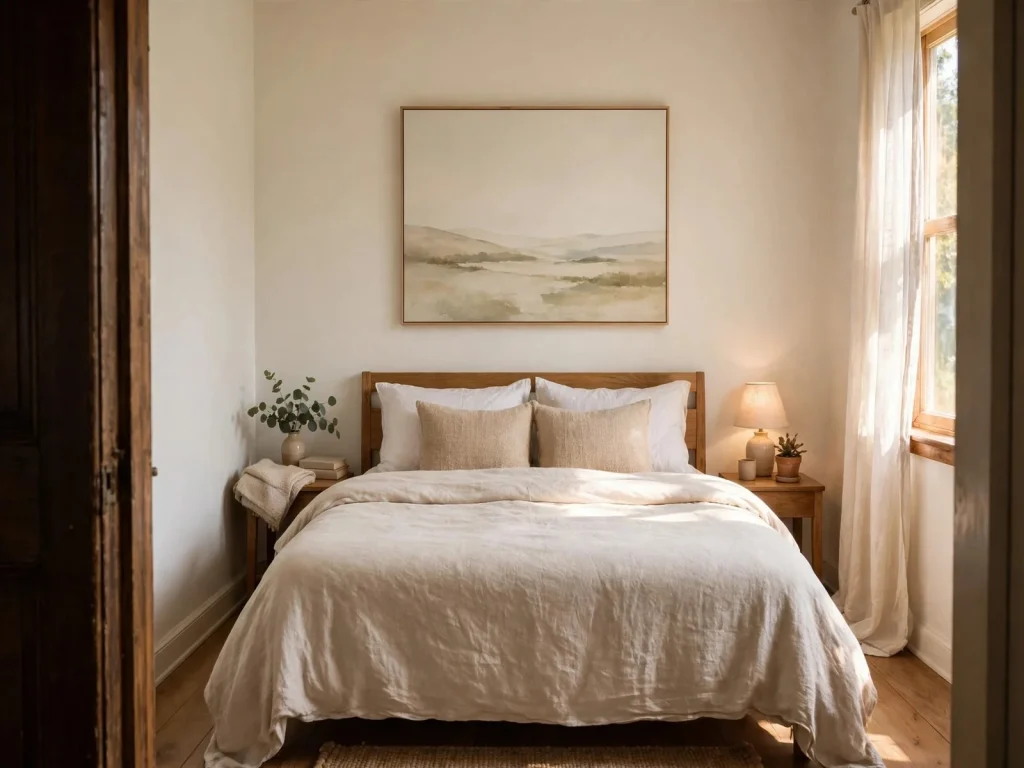
Keep bedding in white or cream or a pale warm neutral and curtains in the same family. Close pale tones let the eye travel.
One dark cushion is fine. A dark duvet makes the biggest surface in the room the darkest.
Measure: bedding and curtains in pale tones close to the wall color, with dark accents smaller than a pillow.
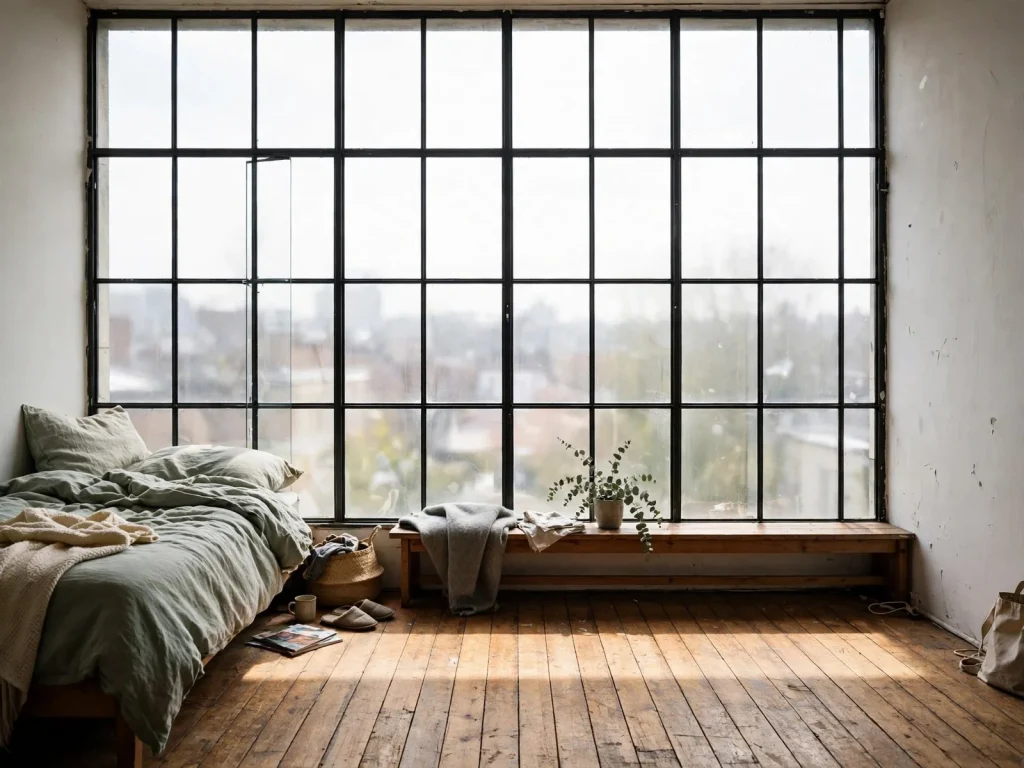
4. Keep the window wall clear so daylight reaches the room
A bright window makes a room read deep. A blocked window reads shallow because the light stops at the blockage.
Keep tall furniture off the window wall and pieces below the sill. Leave the floor in front of the glass open for at least 24 inches.
The catch is wall shortage. If the dresser must stay, shift it to one side of the window.
Renter-friendly: move tall pieces off the window wall and keep the glass clear. It costs nothing and needs no permission.
Mirrors and reflective surfaces
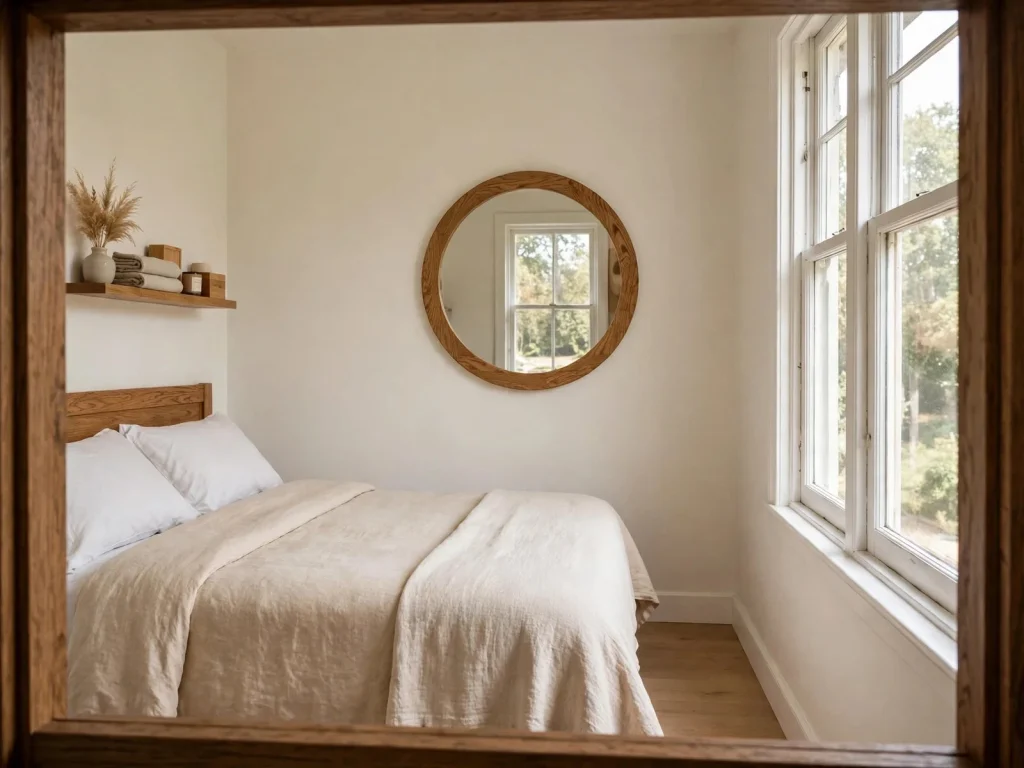
5. Hang a round mirror opposite the window
Opposite the window a mirror throws daylight back into the room and doubles the view. The doorway opens up at once.
Choose a round mirror 24 to 36 in across and hang it opposite the window or beside it. Round softens the straight lines of the bed and dresser.
The catch is aim. Too low it reflects the bed. At eye level it reflects light and the far wall.
Measure: a round mirror 24 to 36 in across, opposite or beside the window, centered near standing eye level.
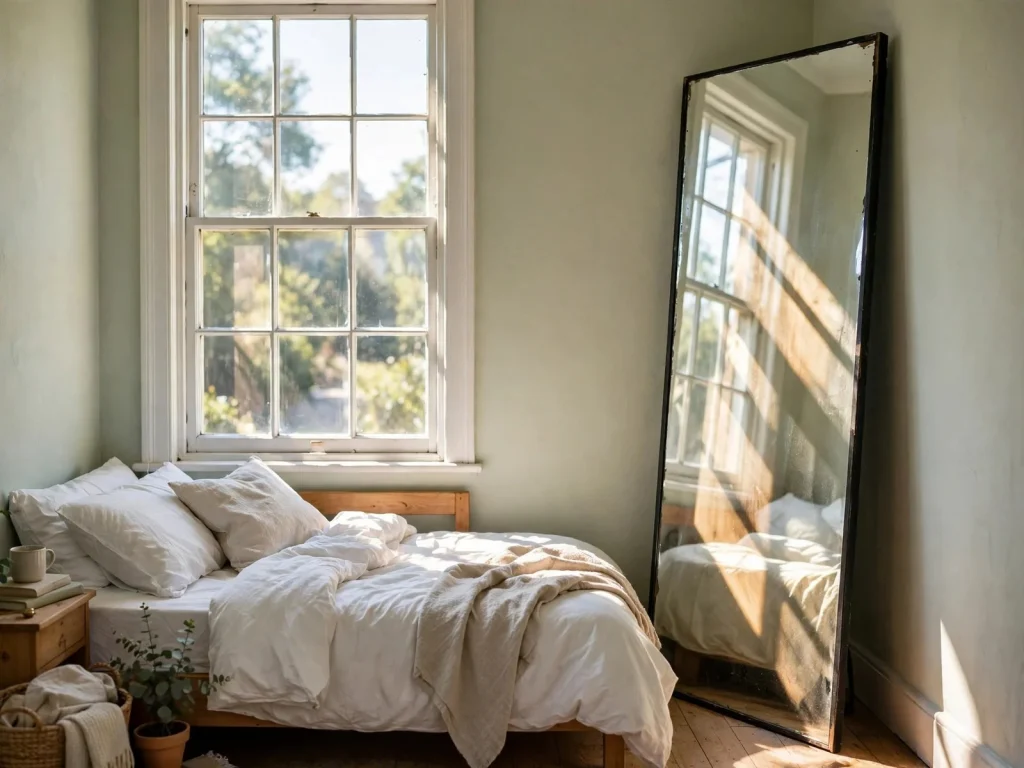
6. Stand a full length mirror beside the window
A tall mirror beside the window bounces daylight sideways and stretches its wall, because the eye reads its height as more wall.
Use a full-length mirror 16 to 20 in wide and 55 to 65 in tall, placed beside the window to catch light at an angle. This is the full length mirror in bedroom idea readers save most.
Facing the bed it reflects lamplight at night, so use the bed head wall if that bothers you.
Renter-friendly: lean a full-length mirror 16 to 20 in wide and 55 to 65 in tall beside the window. No drilling.
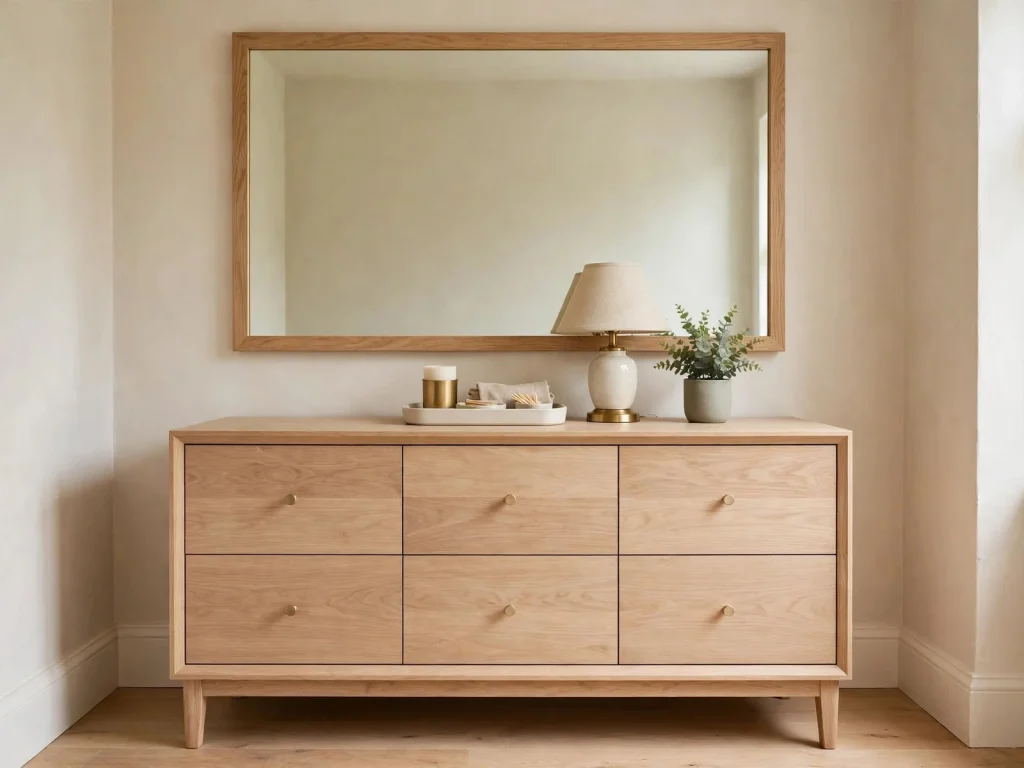
7. Use the dresser mirror as wall decor that earns its place
A small mirror in a heavy frame above the dresser reflects a patch of ceiling and adds weight instead of space. One wide mirror turns that wall into light and depth.
As mirror wall decor it has to earn its place. Pick a mirror at least two-thirds of the dresser width, so 32 in or wider over a 48-inch dresser.
The mirror doubles the dresser top, so keep it to a tray and a lamp and one plant.
Measure: a dresser mirror at least two-thirds the dresser width, hung 4 to 6 in above the top.
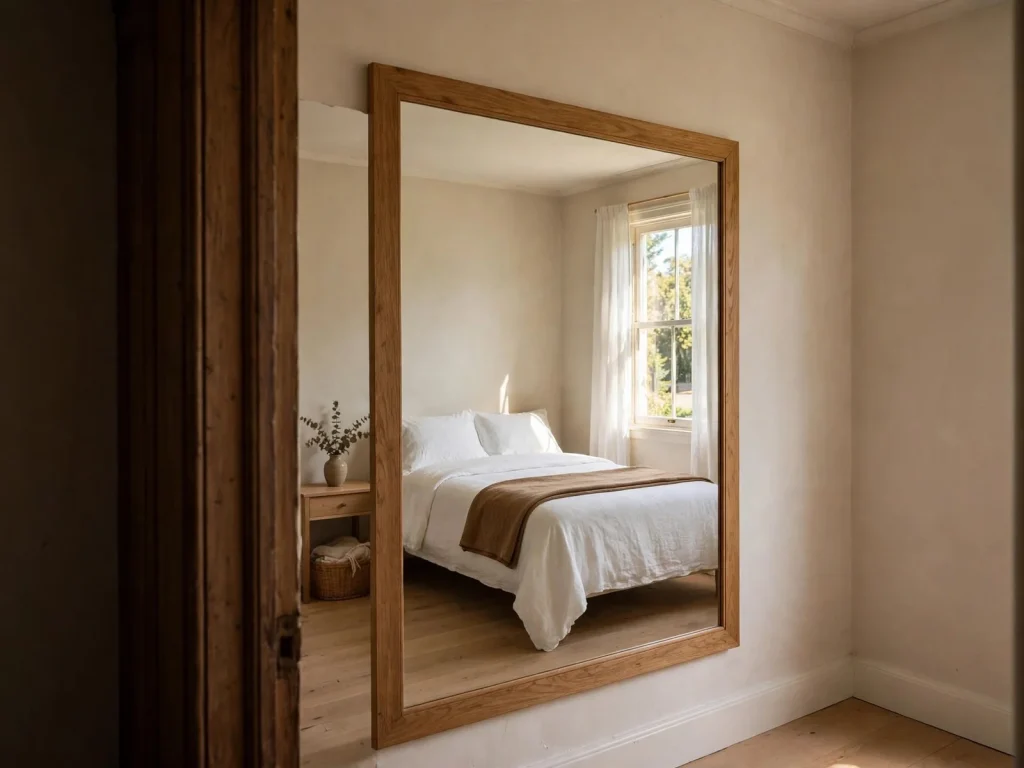
8. Angle one mirror to reflect the best view in the room
Every mirror reflects something. Glass showing a made bed and a window doubles the best of the room. Glass showing a laundry chair doubles the worst.
Walk the room with a hand mirror and check each planned spot from the doorway and from the bed. Right size with the wrong view still shrinks the room.
Glossy frames and nightstand tops add a little bounce but none replace one placed mirror.
Measure: check the reflected view from the doorway and the bed before any mirror is fixed.
Curtains and vertical lines
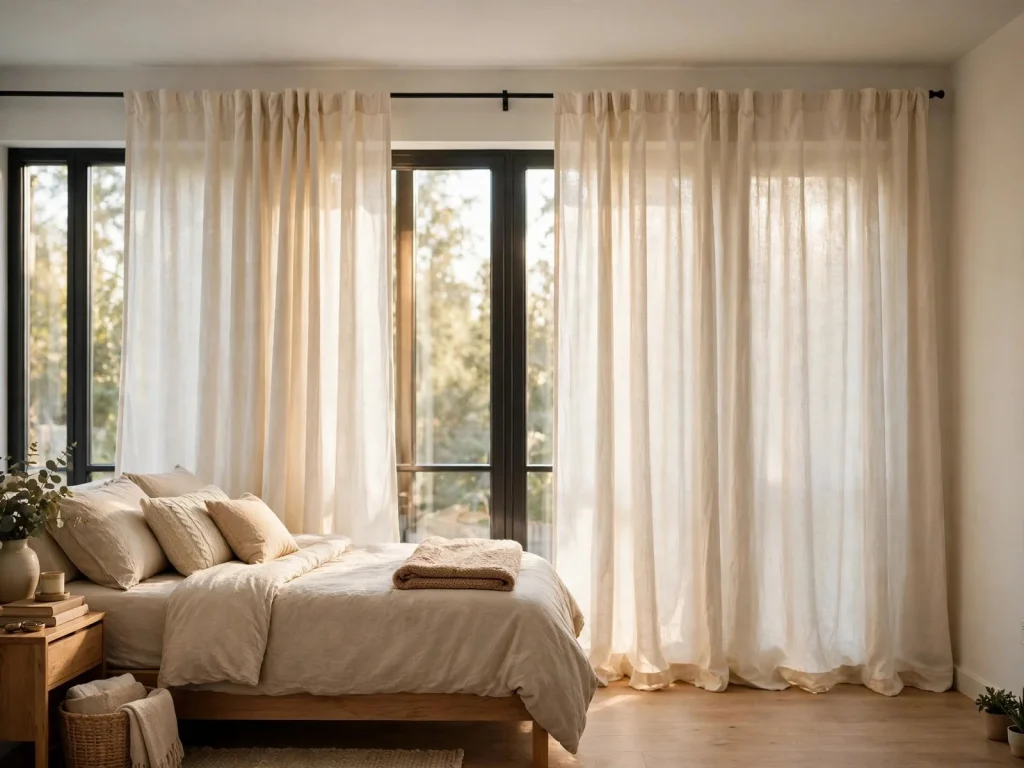
9. Mount the curtain rod just below the ceiling
Curtains lie about where the window starts. A rod at the frame top tells the eye the window and the ceiling are low. A rod near the ceiling makes the same window read tall.
Mount the rod 2 to 4 in below the ceiling and measure from the ceiling down. The ceiling is the line you borrow height from and the gap still fits finials and hardware.
Popcorn ceilings and crown molding can tilt brackets, so drop to 4 in below the ceiling in those rooms.
Measure: rod 2 to 4 in below the ceiling, set from the ceiling line down and never from the frame up.
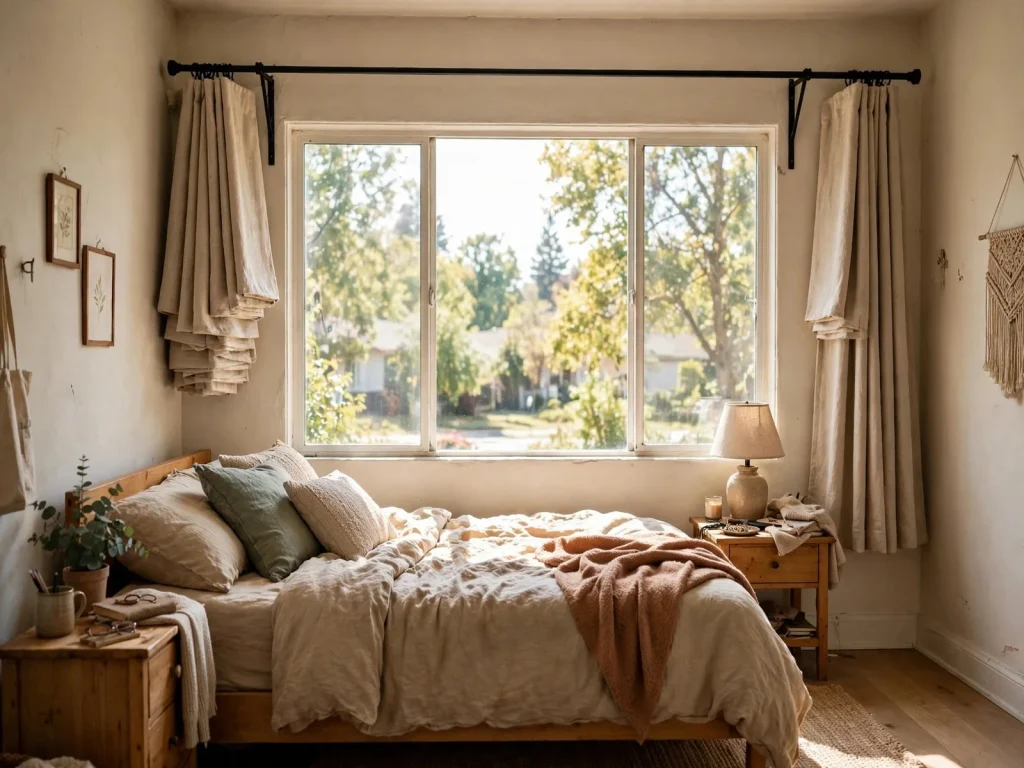
10. Run the rod wider than the window frame
Panels parked on the glass cut daylight at both edges. A wide rod stacks panels on the wall and the full glass shows.
Extend the rod 8 to 12 in wider than the frame on each side. Buy panel width for the full rod span and measure the rod before the fabric.
The catch is wall space. Take 12 in where the wall allows and less near a corner. Panel styles and lengths for this mount sit in our bedroom curtain ideas post.
Measure: rod 8 to 12 in wider than the frame on each side and panels bought to the full span.
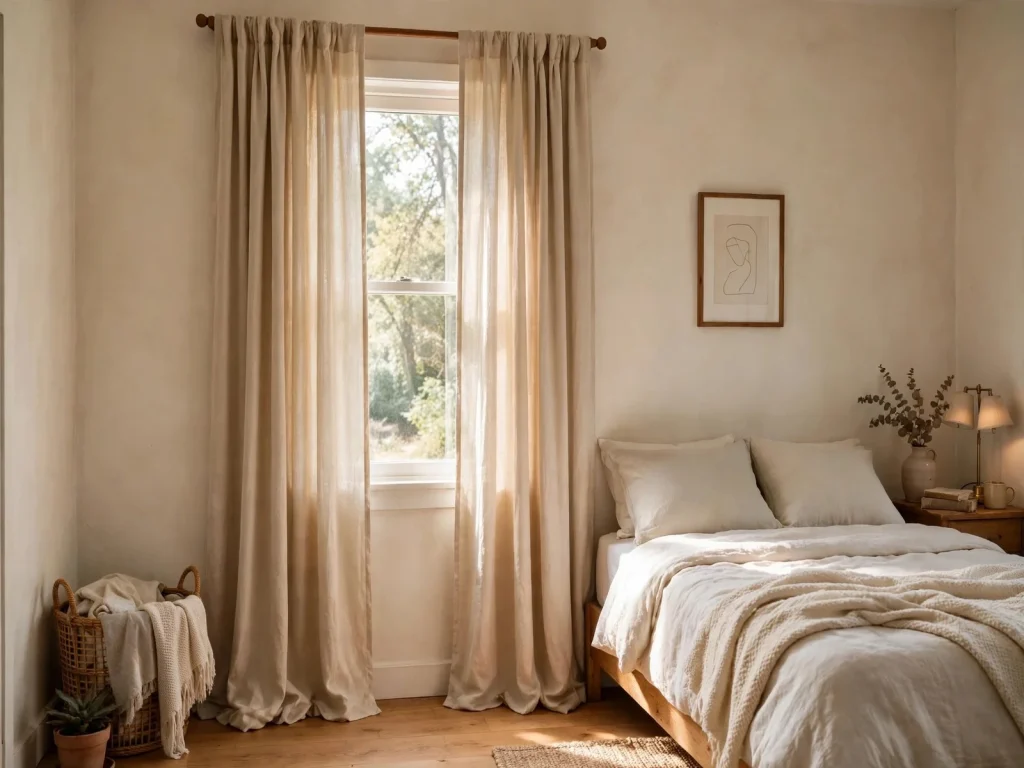
11. Choose full length panels that end just above the floor
Short curtains cut the wall at knee height and mark exactly how low the window is. Full length panels run ceiling to floor in one line and that vertical line stretches the room.
Use panels 84 in or 96 in long, ending just above the floor. Just above means the hem clears the floor by about half an inch.
The catch is heat. Panels over a baseboard heater are a safety problem, so end them at the sill and let a tall headboard carry the line instead.
Needs drilling: 84 in or 96 in panels on a high wide rod need brackets in studs or solid anchors.
Furniture scale and visible floor
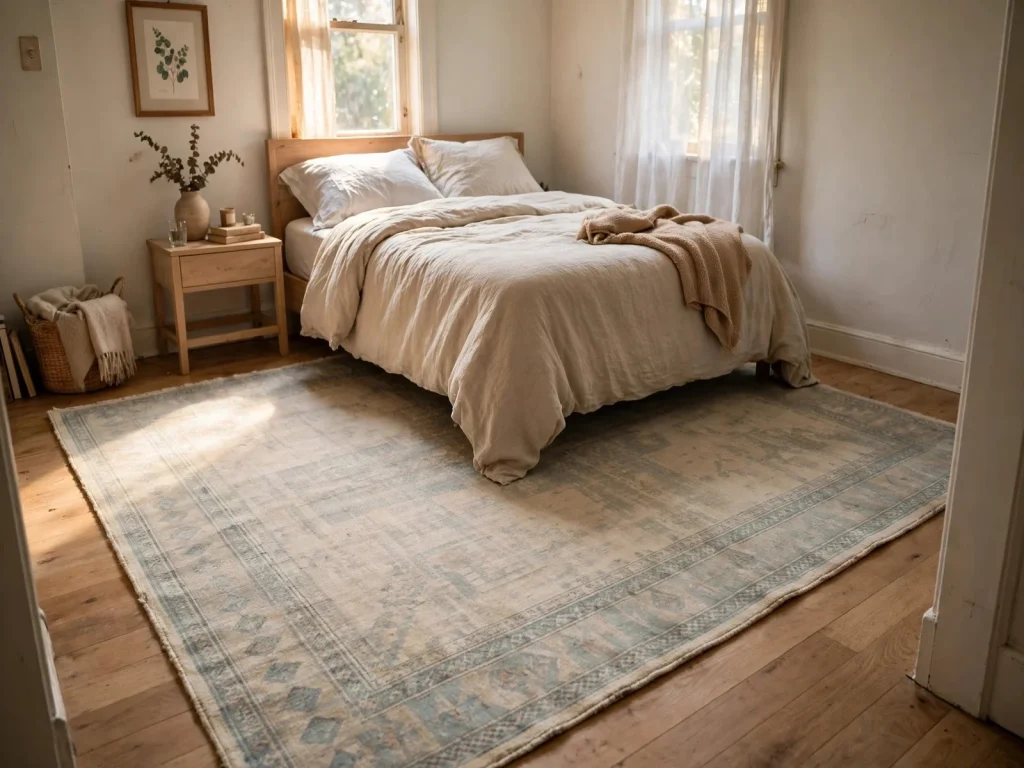
12. Lay one large rug under the bed
Small mats chop the floor into islands and the eye counts every edge. One large rug makes the floor read as one surface.
Choose one large rug, 5×8 ft or 6×9 ft, under the bed and past both sides and the foot. More sizes sit in our bedroom rug ideas post.
The catch is swing and storage. Thick pile can catch the door and block under-bed drawers, so check both first.
Measure: one rug at 5×8 ft or 6×9 ft under the bed, past both sides and the foot, no extra mats.
13. Choose furniture raised on visible legs
Furniture flat on the floor reads heavy. Raised pieces read lighter at the same size because floor showing underneath stretches the visible floor.
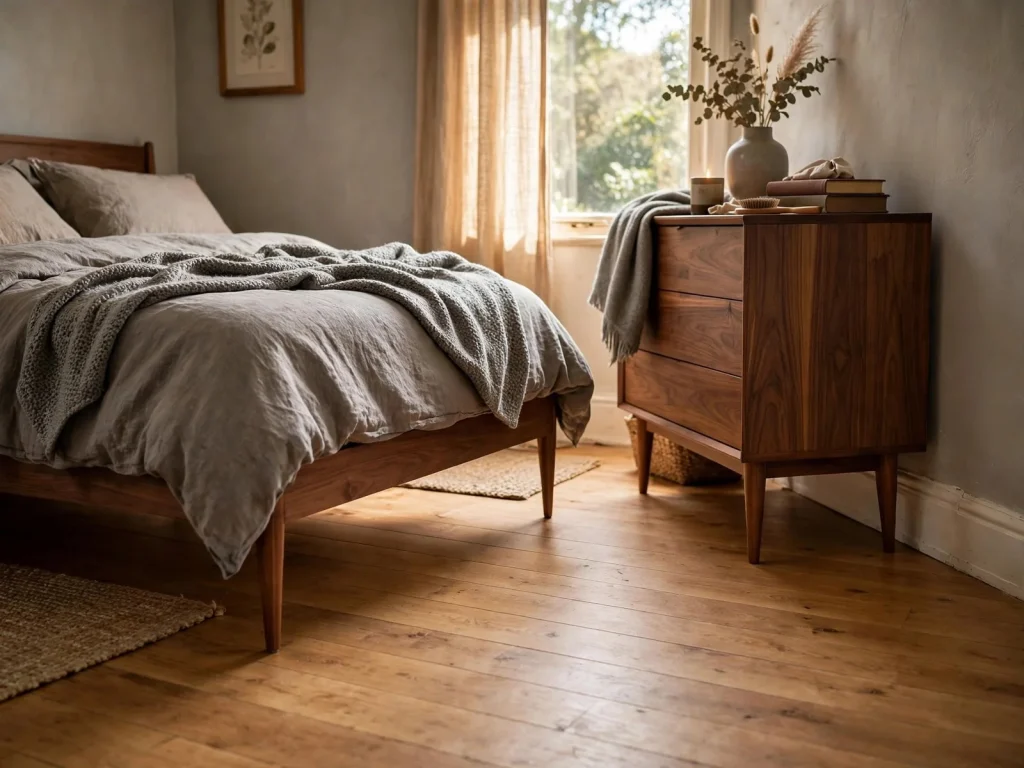
Choose beds and dressers and nightstands raised on visible legs 4 to 6 in high so floor shows underneath.
Leggy beds lose the hidden under-bed box, so store in low bins that stay out of sight.
Measure: legs 4 to 6 in high on bed and dresser and nightstands, with the gap visible from the doorway.
14. Hang one large art piece instead of a cluster of small frames
Small frames break a wall into fragments and every edge stops the eye. One large piece lets the wall read as one long surface.
Hang one large art piece with its center at 57 in, in the doorway sightline and scaled to the furniture below.
Over a bed, use a rated anchor or pick a canvas at a fraction of the frame weight.
Measure: one large piece, center at 57 in, scaled to the furniture below and fixed with a rated anchor.
15. Keep the first 36 inches inside the door clear
The doorway view judges the room in one second. A clear entry lands it deep, on the bed and the window.
Keep the first 36 in inside the door clear of furniture and storage. Swap any piece there for a narrower one from deeper in the room.
Give shoes and bags a home behind the door or in the closet or the zone refills within a week.
Measure: the first 36 in inside the door kept clear so the entry view lands on the far wall.
Make your small bedroom look bigger in a rental
Rentals rule out paint for many readers and drilling for most, so the rental version of this page runs on lean and tension and swap. Start with the mirror. A full-length mirror 16 to 20 in wide and 55 to 65 in tall leans beside the window with no fixing at all and it does the same light work as the hung version. If your lease allows picture hooks, the round mirror opposite the window at 24 to 36 in across is the one fixing worth asking about.
Curtains carry the height trick without a drill. Hang panels from a high adhesive hook row rated for the weight where the lease allows hooks. Panels at 84 in ending just above the floor still give the vertical line. Where hooks are banned too, a tall leaning mirror and a pale duvet cover carry the room on their own.
The floor and furniture tricks need no permission at all. One large rug at 5×8 ft or 6×9 ft under the bed lifts out at move-out. Leggy furniture with 4 to 6 in of leg height is a buying choice rather than a change to the room. Keep the first 36 in inside the door clear and tall pieces off the window wall and a rental bedroom reads bigger with zero marks on any wall.
Mistakes that shrink the room
- Hanging the curtain rod at the top of the window frame. It announces the true window height and the ceiling feels lower at once. Mount the rod 2 to 4 in below the ceiling instead and let the panels claim the full wall.
- Scattering small rugs around the bed. Mats and a runner chop the floor into islands and every edge shrinks the read. Lay one large rug at 5×8 ft or 6×9 ft under the bed so the floor reads as one surface.
- Choosing dark paint to make the room feel cozy. Dark walls absorb light a small room cannot spare and the walls close in at night. Keep wall colors at an LRV of 60 or higher and get the cozy feeling from bedding texture instead.
- Filling the entry with furniture. A dresser or rack in the first 36 in inside the door makes the first view a close-up of clutter. Clear the entry zone and let the first view land on the far wall.
- Hanging a gallery of small frames over the bed. Small edges stop the eye again and again and the wall reads fragmented and short. One large piece with its center at 57 in gives the wall back its length.
Questions people ask about this
What color makes a small bedroom look bigger?
A pale color with a light reflectance value of 60 or higher. Warm whites and pale warm greys and soft creams sit in that range and bounce daylight back into the room. Paint the ceiling flat white as well.
Where should a mirror go in a small bedroom?
Opposite the window or beside it, so the glass bounces window light back into the room. A round mirror 24 to 36 in across works opposite the window and a full-length mirror 16 to 20 in wide and 55 to 65 in tall works beside it. Check the reflection from the doorway first because a mirror reflecting clutter doubles the clutter.
Do curtains make a small bedroom look bigger?
Yes, when they are hung for height. Mount the rod 2 to 4 in below the ceiling and 8 to 12 in wider than the frame on each side and use panels 84 in or 96 in long ending just above the floor. Hung at the frame with short panels, the same curtains mark exactly how small the window is.
Does a big rug make a small room look bigger or smaller?
Bigger, when it is one rug sized to the bed. A single rug at 5×8 ft or 6×9 ft under the bed lets the floor read as one surface while small mats chop it into pieces. Keep the pile low if the door swings over the corner.
The bottom line
A small bedroom reads bigger when the eye travels far and stops rarely: light walls, one mirror with light to give back, curtains claiming the full wall and floor showing under the furniture. None of it needs a remodel. This week, clear the first 36 inches inside your door and stand in the doorway at night to see what one clear sightline does. It costs nothing and it takes ten minutes and it tells you exactly which trick on this page your room needs next.