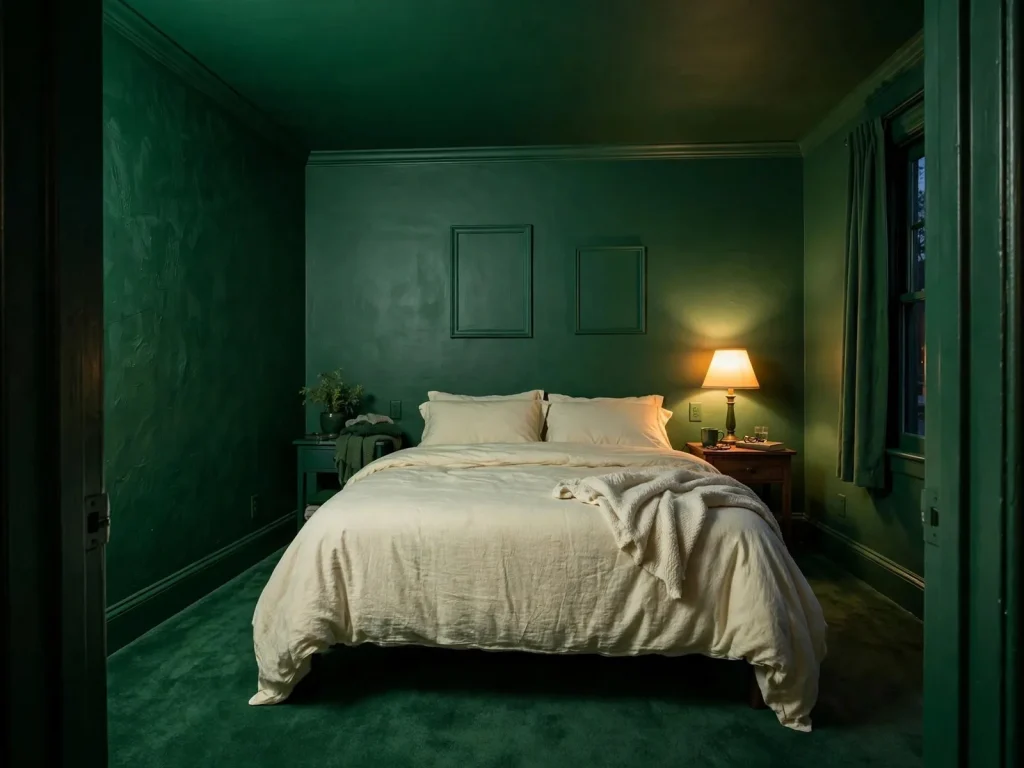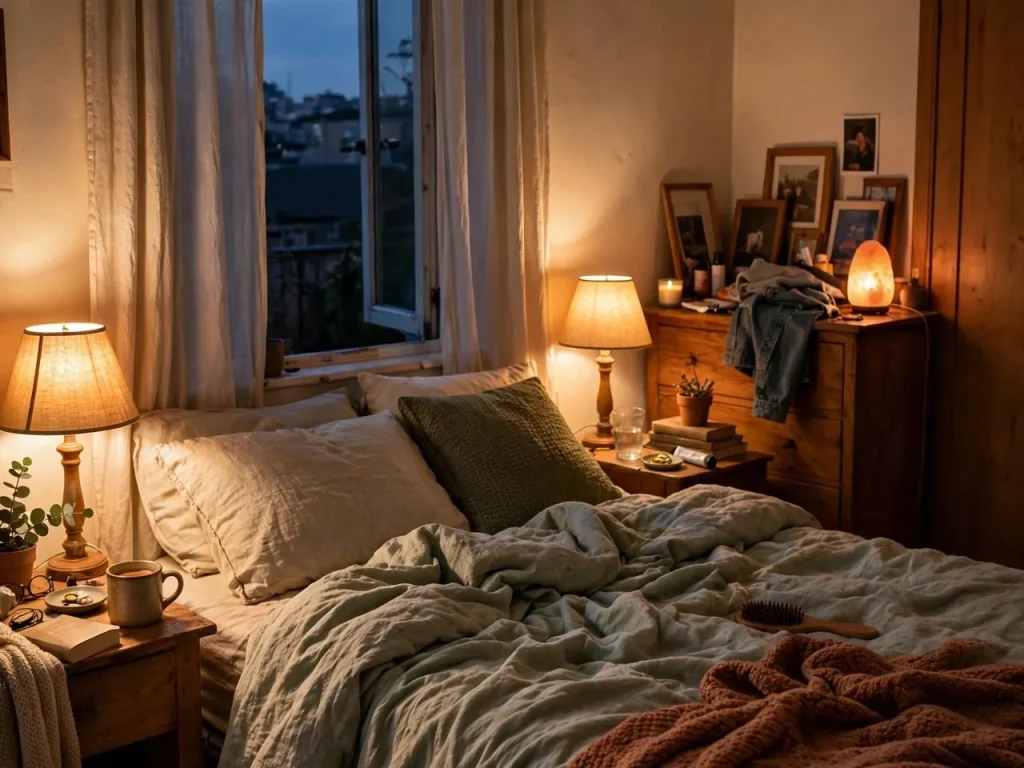
You love the boho look but the white and beige versions feel washed out in your room. You want the deep wall color and the layered texture, yet every dark room you save looks like a cave by bedtime. The worry is fair: dark boho done by feel alone tips heavy fast and paint is an expensive way to learn that.
This page works by dosage instead. Dark boho bedroom ideas here come with the share of the room each shade should cover, a texture count for every bed setup and bulb temperatures that keep deep color warm after dark. The broad light and neutral version of the style lives in our boho bedroom ideas post. This page takes the dark slice only and measures it.
Before you start: the measurements, cost notes and rules
Measure the room first. Dark color is dosed by floor area on this page, so note the room size in square feet, the length of the bed wall and the direction the window faces. A north facing window cools every shade you put beside it. A south facing one warms the same shade by a full step.
Costs follow the dosage. One deep wall takes a single gallon of paint in most rooms, while four walls plus textiles plus lighting is where the real money goes. Textiles carry the texture count and they are the pieces you can buy one at a time. Bulbs are the cheapest fix on the page and they change dark walls more than any cushion does.
Renters, the rules are simple. Where paint is not allowed, the color has to arrive on fabric, paper or furniture instead of the wall. Nothing in the renter section near the end needs drilling and the strongest no-paint move on this page is a large dark textile hung as a wall panel.
The dark palette, wall by wall
1. Paint the bed wall deep and stop there in a small room
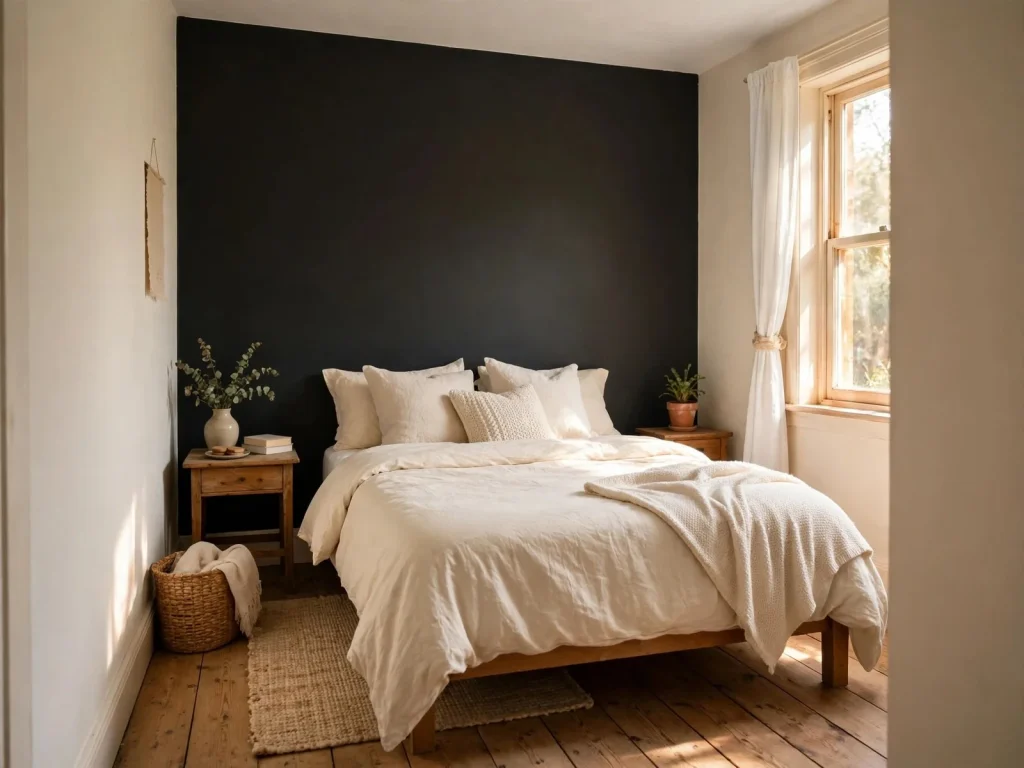
Deep color earns its keep fastest on the wall behind the bed, because that wall is the backdrop in every view of the room. In a room under 120 square feet, dark color belongs on 1 or 2 walls only. The bed wall plus the window wall is the usual pair, with the remaining walls in a warm off-white that bounces light back into the shade.
Choose the family before the exact shade. Charcoal and blackened green read cool and calm. Deep teal sits in the middle. Aubergine and espresso brown read warm. Naming the family first stops the classic mistake of picking a paint chip that fights the bedding you already own.
The catch is the ceiling. A white ceiling over one dark wall reads as a deliberate frame. A dark ceiling over one dark wall in a small room reads as a lid, so keep the fifth wall light until the room passes 150 square feet.
Measure: dark color on 1 or 2 walls in rooms under 120 square feet, on the bed wall first.
2. Go all four walls only when the room is big enough
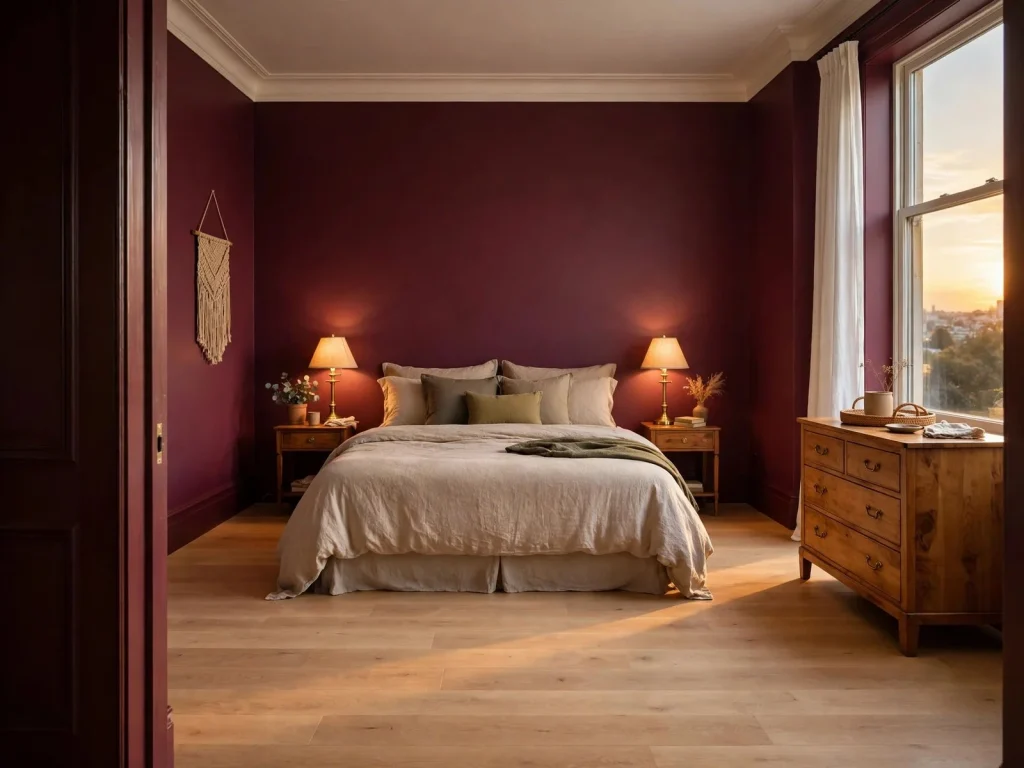
Full-room dark color is the moody boho bedroom look at its strongest and it has a floor size condition. Above 150 square feet, deep shades on all walls settle into richness because the bed and the dresser no longer crowd the color. Below that size the same paint closes in, which is why the small-room version above stops at two walls.
Light does the rescue work here. A big dark room needs light at three heights and bulbs at 2700K or warmer, both covered in the light section below. Without them, four dark walls photograph well at noon and sulk all evening.
If you want mood without the boho layering at all, our moody bedroom ideas post takes the same deep palettes in a cleaner direction. Come back here for the texture count that keeps the mood warm.
Measure: all four walls in deep color only in rooms above 150 square feet, with layered light planned before the paint.
3. Pick charcoal when you want the cool version
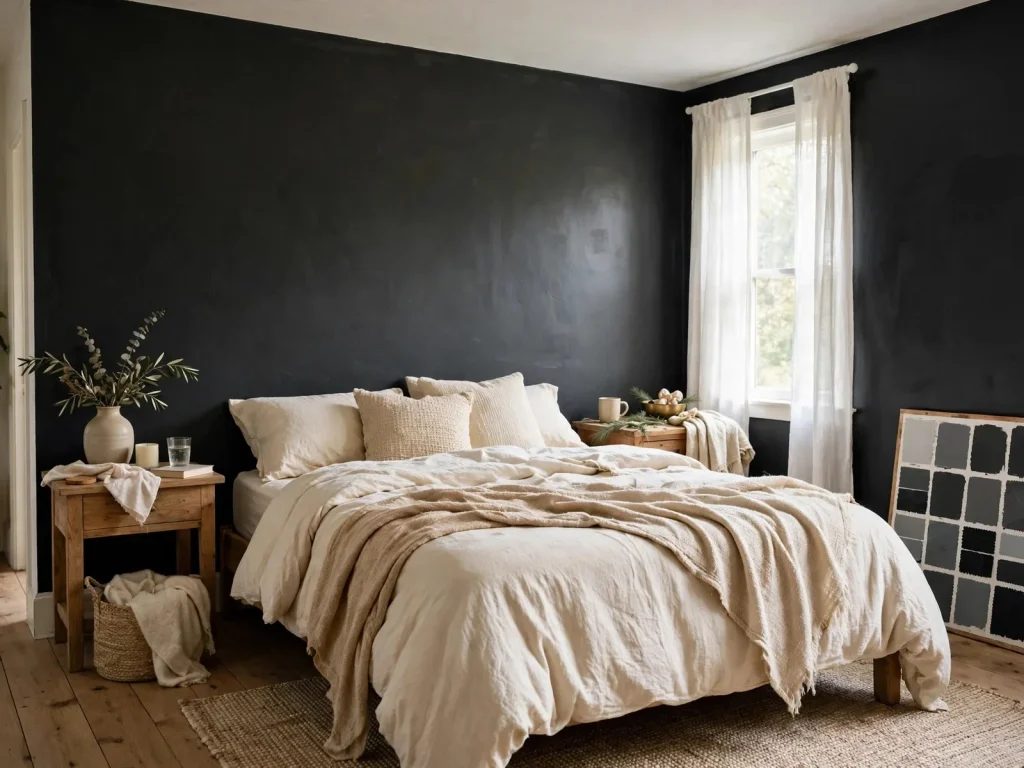
Charcoal is the safest deep family for a first dark boho bedroom, because it sits behind pattern without fighting it. It pairs with natural linen and pale jute the way a frame pairs with a picture. Blackened green is its warmer cousin, deep enough to read as color in daylight and as near black at night.
Run the family test on the biggest textile you own. Hold the paint chip against the bedcover in the room’s real light at morning and again at lamp light. Charcoal that looks blue-grey at noon can look flat black by 9 pm and that shift is the version you will live with most.
Cool families want warm textiles to balance them. Woven cotton in cream, a wool throw in rust and rattan with a honey tone all push charcoal back toward cozy boho bedroom ideas territory instead of a grey box.
Budget: test the family with one sample pot on a board at least 24 inches square before buying the gallon.
4. Choose aubergine or espresso when you want the warm version
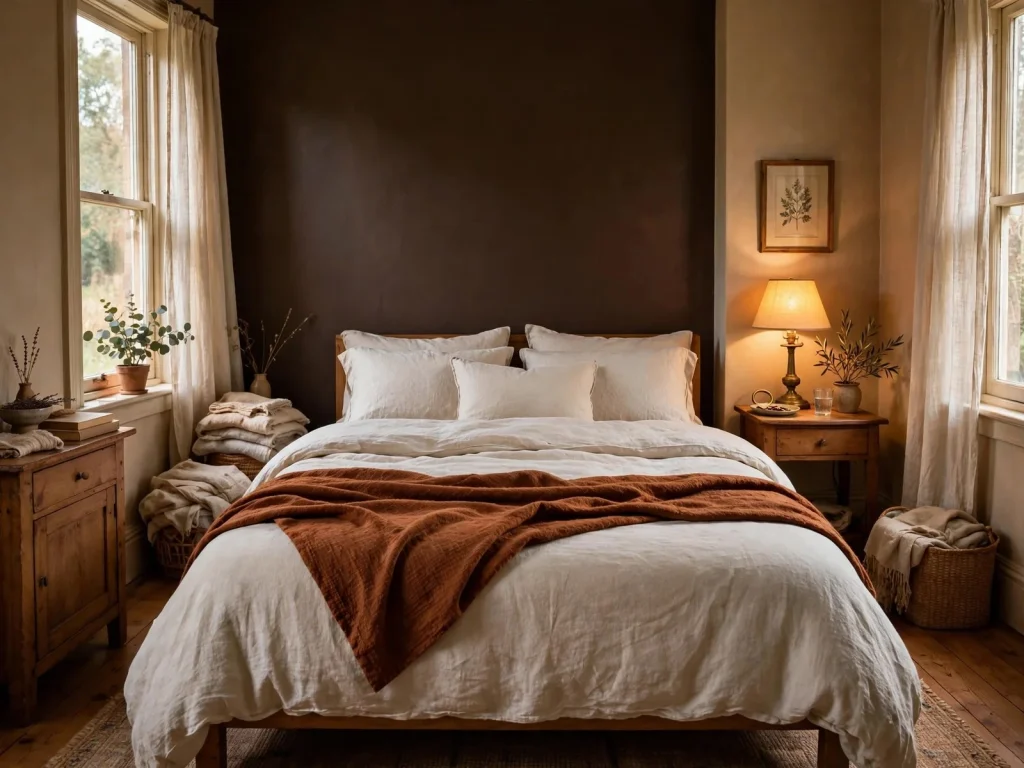
Aubergine and espresso brown carry warmth inside the darkness itself, so the room feels rich before a single texture is added. Aubergine sits beside burgundy in the same family and our burgundy bedroom ideas post works that depth of red in a more tailored way. Espresso is the quieter route, reading almost like dark wood at a glance.
Warm families pair with aged brass better than with any other metal on this page. They also forgive mid tone woods, so an existing walnut or acacia bed looks intentional instead of mismatched.
The catch is saturation creep. Warm darks plus rust textiles plus terracotta cushions can stack into one red-brown note. Break the stack with one pale piece, usually the bedding base in natural linen and let the deep tones layer around it.
Measure: keep one pale textile in the bed setup whenever the wall family is warm, so the deep tones stay separate.
Texture layers that keep dark rooms warm
5. Count three texture families on every bed setup
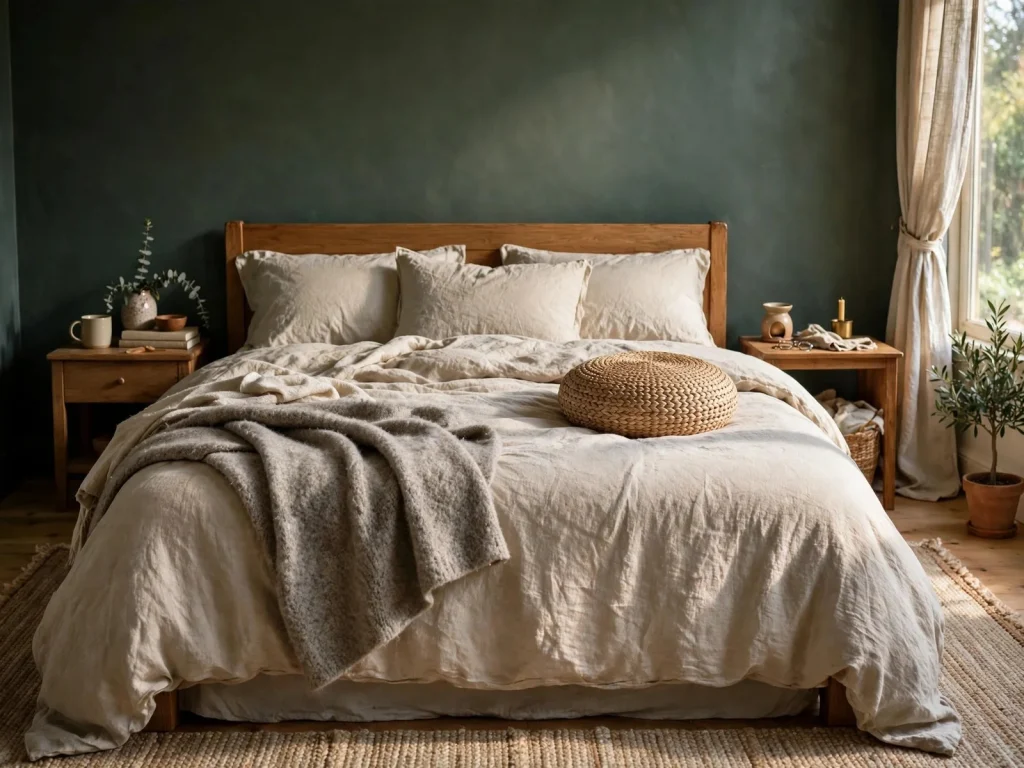
Texture is what separates dark and rich from dark and flat. Every bed setup on this page carries at least 3 texture families: woven cotton or linen bedding, a wool or jute rug and one woven or carved piece such as rattan, cane, carved wood or a macrame wall hanging. Count them in any photo you save. The rooms that feel warm always pass the count.
Build the count from the bed outward. Linen or woven cotton is layer one because it covers the largest area. A wool throw or a wool cushion is layer two. The third layer sits on the wall or the floor, where the eye lands after the bed.
Skipping the count is how dark rooms go heavy. One flat cotton duvet on a dark wall gives the eye nothing to do and the brain reads that plainness as gloom rather than calm.
Measure: at least 3 texture families per bed setup, counted before you buy anything new.
6. Ground the bed with a boho bedroom rug in wool or jute
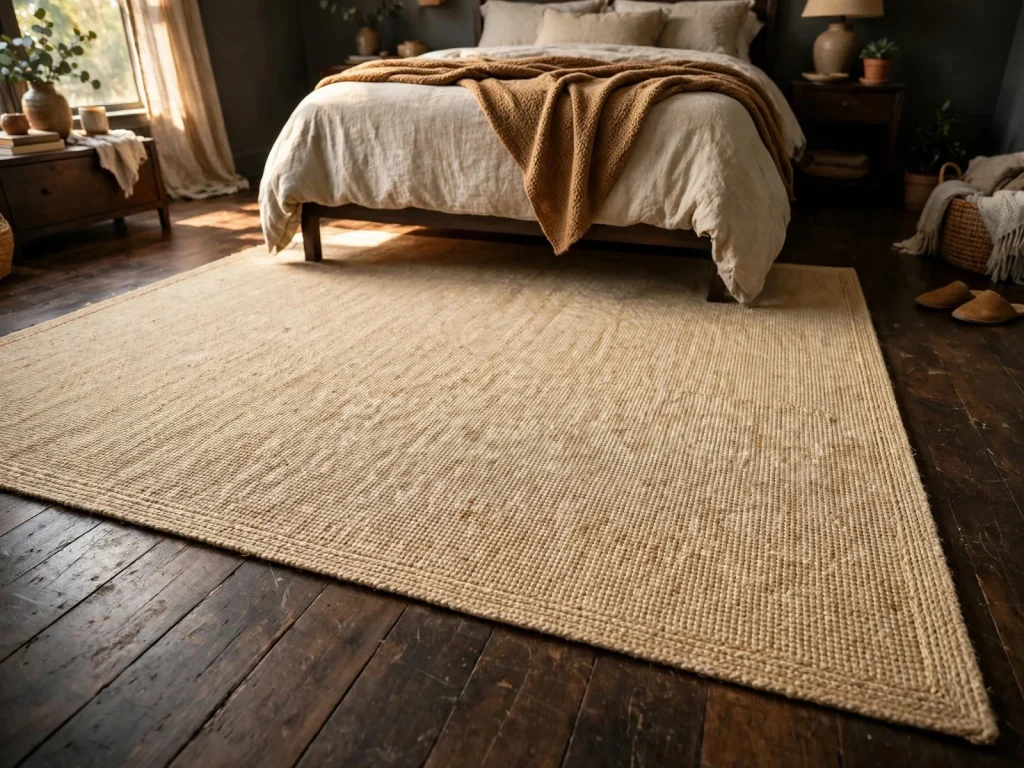
A boho bedroom rug does two jobs in a dark room. It lightens the floor plane so the walls carry the depth alone and it adds the woven texture family at the largest scale in the room. Jute reads pale and rough. Wool reads softer and takes dye well, so a faded vintage-look wool rug brings pattern and warmth in one piece.
Size it to the bed you have. The rug should slide under the lower two-thirds of the bed and still show on both sides, so your feet land on fiber and not on bare floor at the edge of a dark room at night.
Flat dark floors are the catch. A dark stained floor under dark walls leaves no light plane in the room at all and the rug is the cheapest way to put one back without touching the floor itself.
Renter-friendly: a rug changes the floor color with no permission and no damage and it lifts out in minutes at move-out.
7. Hang a macrame or woven panel where paint cannot go
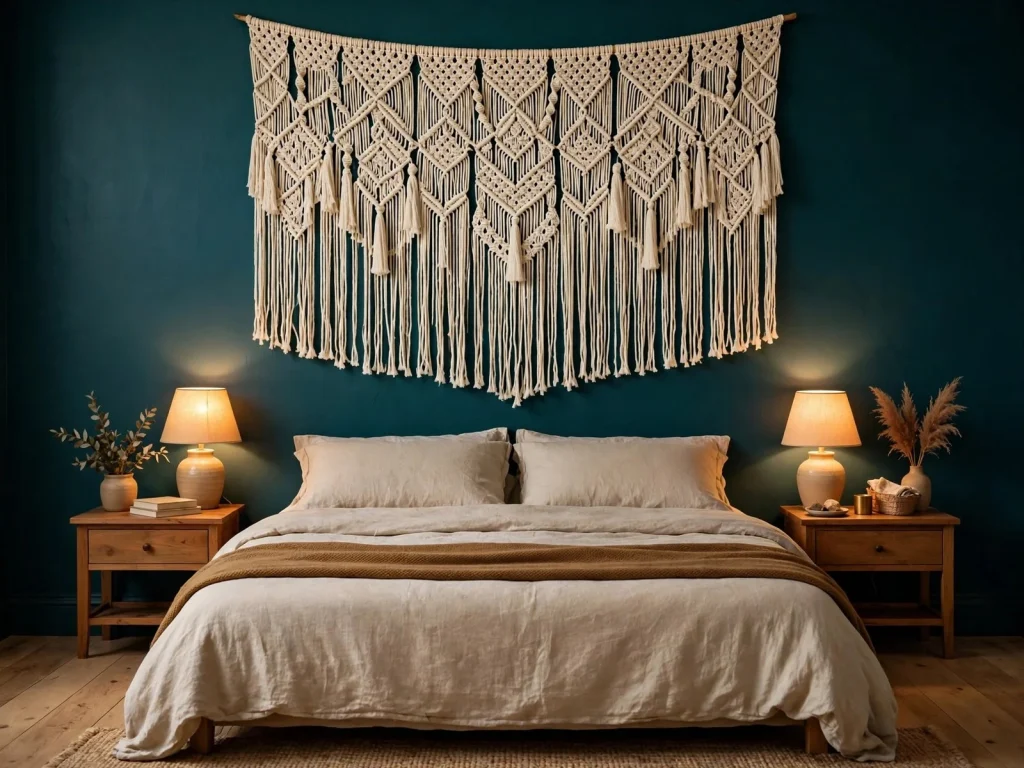
Boho bedroom wall decor earns its place in a dark room because woven pieces catch lamplight in their knots and ridges. A macrame hanging or a woven wall panel over the bed gives the dark wall a lit surface to play against. Flat prints in glass frames go dull on deep colors by comparison.
Hang the piece wide. A panel that spans at least half the width of the bed holds its own against a dark wall. A small hanging centered over a queen bed reads as a postage stamp, no matter how pretty the knots are.
In a rental this piece does double duty, because a large dark woven panel hung on the bed wall gives the deep color effect with no paint at all. That swap returns in the renter section below.
Measure: woven wall piece at least half the bed width, hung with its center at eye level from the foot of the bed.
8. Bring in rattan, cane and carved wood for the third texture
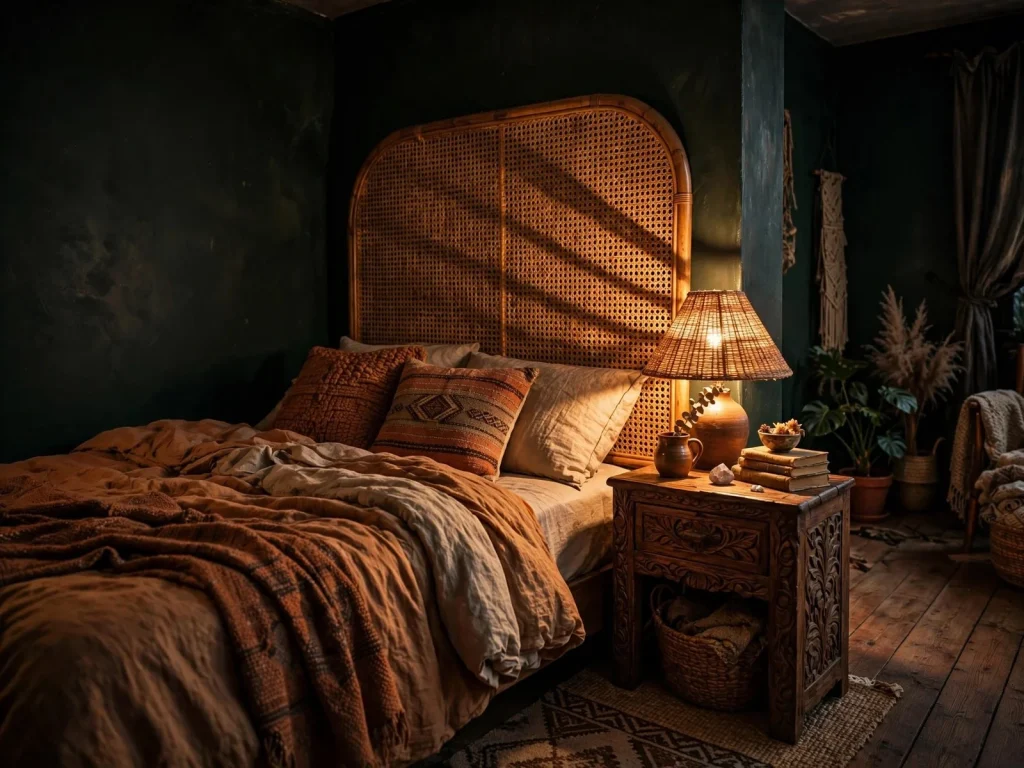
Woven wood pieces keep dark boho from sliding into dark modern. Rattan and cane webbing let light pass through their pattern, so a headboard or a nightstand in cane reads light even in a deep toned room. Carved or unfinished wood adds the hand-made edge that flat furniture cannot fake.
Place one woven piece where lamp light crosses it. The shadow pattern it throws is half the effect and it costs nothing extra once the piece is in the right spot.
The catch is tone. Pale raw rattan against a charcoal wall can look stranded. Mid tone and honey finishes sit closer to the walnut and mango wood family this style runs on, so choose the finish with the wall color in the room, not under shop lights.
Budget: one cane or rattan piece per room is enough to set the texture; a second one only if the room is above 150 square feet.
Light against dark walls
9. Swap every bulb to 2700K or warmer
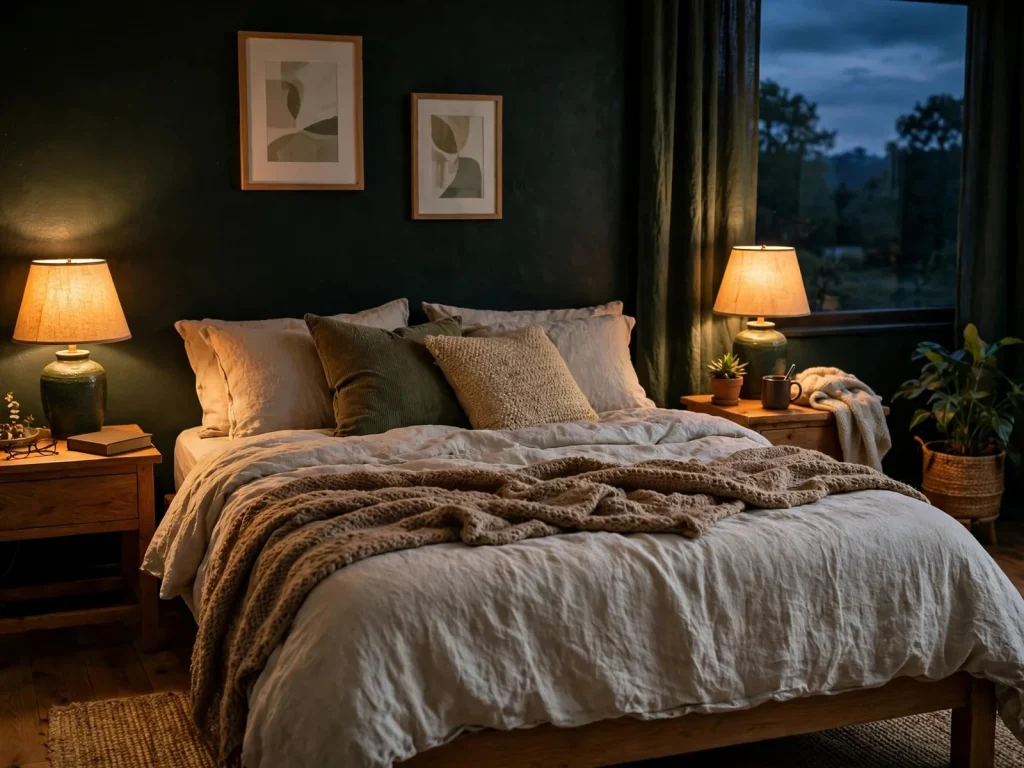
Bulb temperature decides whether dark walls read as rich or as dirty. Bulbs at 2700K or warmer flatter deep teal, aubergine and charcoal alike, because their light carries the same warmth the colors hold. Cool white bulbs at 4000K and above strip that warmth out and leave the walls looking grey and tired.
This is the cheapest idea on the page and the one to do first. Swap the bulbs before you judge any paint sample, because the sample was probably judged under the wrong light in the first place.
Check the pack, not the box art. The Kelvin number is printed on every bulb pack and warm white marketing words cover a wide range. The number is the fact: 2700K or below for every bulb that shines on a dark wall.
Measure: 2700K or warmer for every bulb in the room, no exceptions on the bed wall.
10. Layer light at three heights
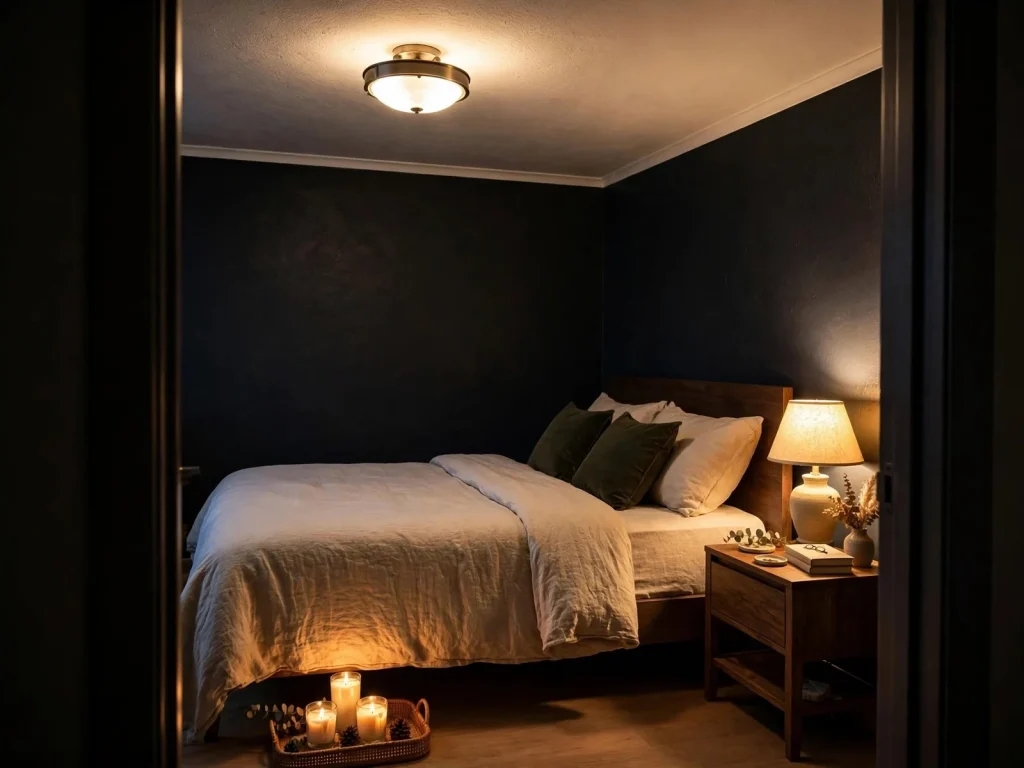
One ceiling light flattens a dark room. Layered light at 3 heights gives the walls something to reflect at every level: the ceiling light for general fill, a lamp with its shade at 40 to 50 inches for the middle band and low candle height light for the glow near the floor. Each layer wakes up a different stretch of wall.
Set the middle layer first, because it does the most work at the hours the room is used. Our bedroom lighting ideas post works through lamp placement for the whole room in the same spirit. Here the rule is simpler: no dark corner should sit more than one lamp away from a lit surface.
Candles and low lanterns are the third layer in most boho rooms. Keep them on a tray or a plate so the glow reads as a chosen pool of light rather than clutter at floor level.
Measure: light at 3 heights in every dark room, with the lamp shade sitting at 40 to 50 inches from the floor.
11. Hang boho bedroom curtains that filter light instead of blocking it
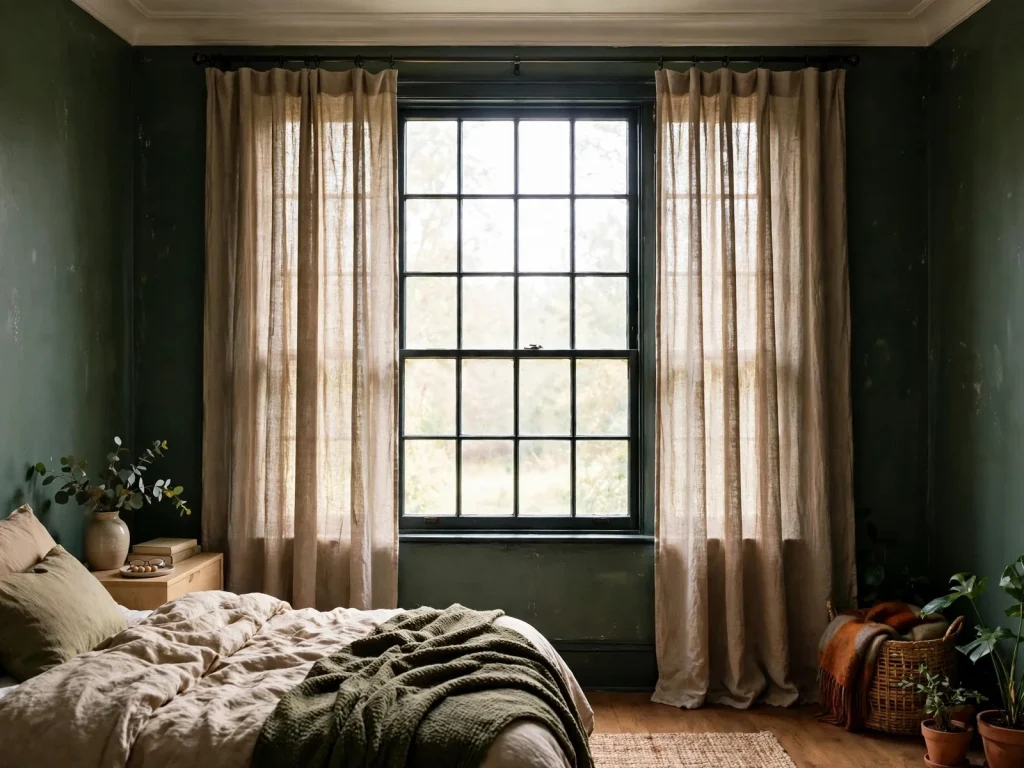
Heavy blackout drapes turn a dark room into a box at midday. Boho bedroom curtains in woven cotton or linen filter the light instead, so the window stays a soft bright panel against the deep walls. That contrast is what keeps the room reading as moody rather than shut in.
Hang them high and wide. Panels mounted near the ceiling and stacked mostly on the wall make the window look taller and the extra linen area adds one more texture family to the count from idea 5.
The catch is privacy and sleep. Sheer linen alone will not darken a room for a late sleeper. Layer a plain roller blind behind the linen if you need real darkness and let the woven panel do the daytime work.
Renter-friendly: linen panels on a tension rod filter light with no drilling and no permission needed.
12. Put the warmest light beside the bed
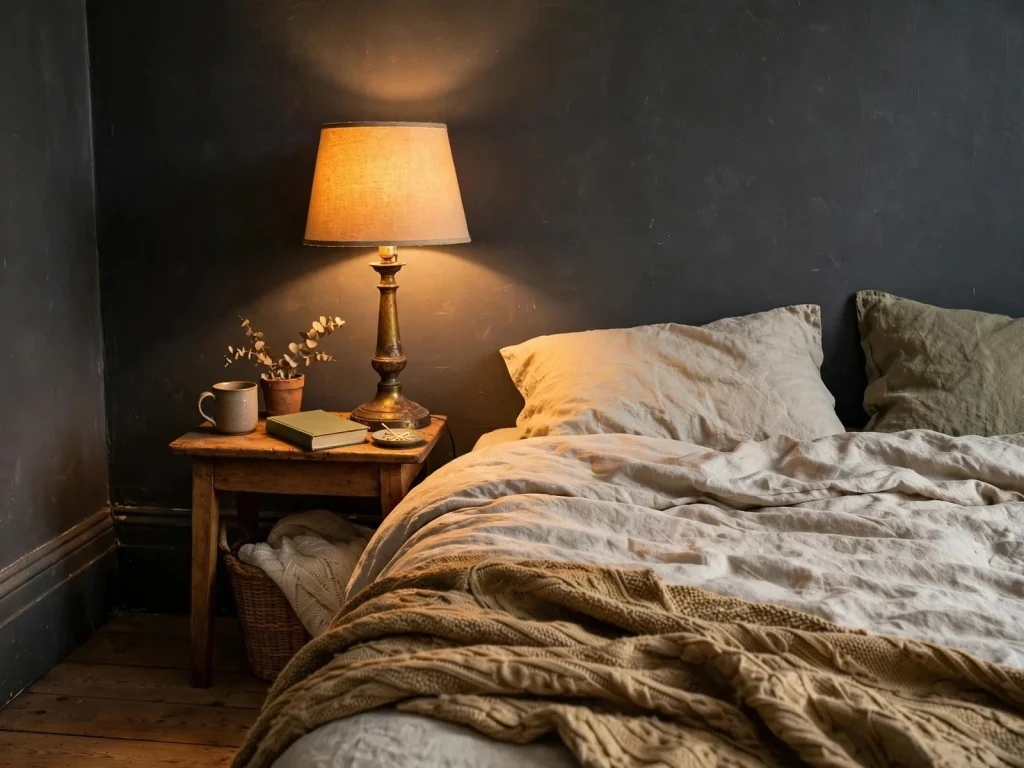
The bedside lamp is the light you actually live by in a dark bedroom. It should be the warmest source in the room, at 2700K or warmer, with the shade low enough to pool light on the bed rather than spray it at the ceiling. A lamp shade sitting in the 40 to 50 inch band from the floor puts reading light on the page and a warm wash on the wall behind.
Match the lamp base to the metals rule coming in idea 14: aged brass or matte black. A chrome or glossy white base shouts against deep walls and breaks the palette every single night.
Small rooms can swap the table lamp for a plug-in wall lamp beside the bed. The height rule stays the same and the nightstand top stays clear for books and water.
Measure: bedside shade in the 40 to 50 inch band, bulb 2700K or warmer, base in aged brass or matte black.
Pattern, metal and the finishing pieces
13. Run one large pattern and one small pattern per view
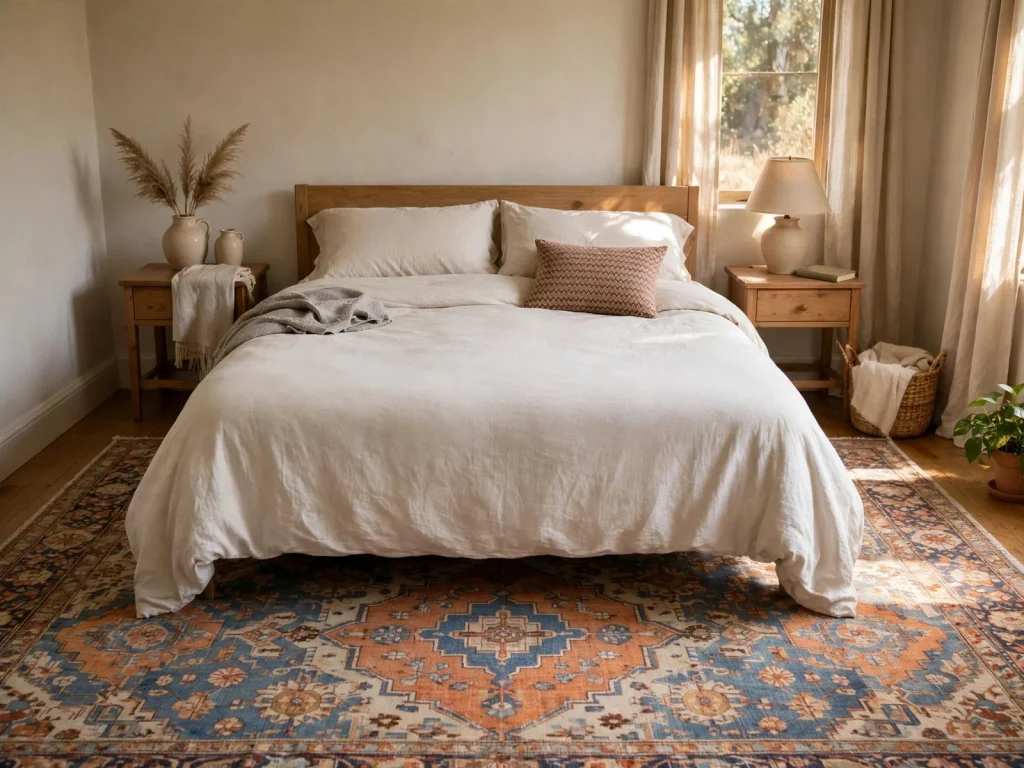
Pattern scale is a dosage rule like the wall color. Each view of the room gets one large-scale pattern, usually the rug or the throw, plus one small-scale pattern on a cushion or a curtain. Two large patterns in one view compete and the eye reads the fight as mess rather than richness.
Pick the large pattern first and let it set the palette. The small pattern then borrows one color from the large one and repeats it at a size the eye catches second. That order is the whole trick.
Flat rooms fail this test in the other direction. No pattern at all on deep walls reads stark, which is why the small pattern matters as much as the large one. A single patterned cushion is enough to start.
Measure: one large-scale pattern plus one small-scale pattern per view, never two large patterns competing.
14. Keep the metals to aged brass and matte black
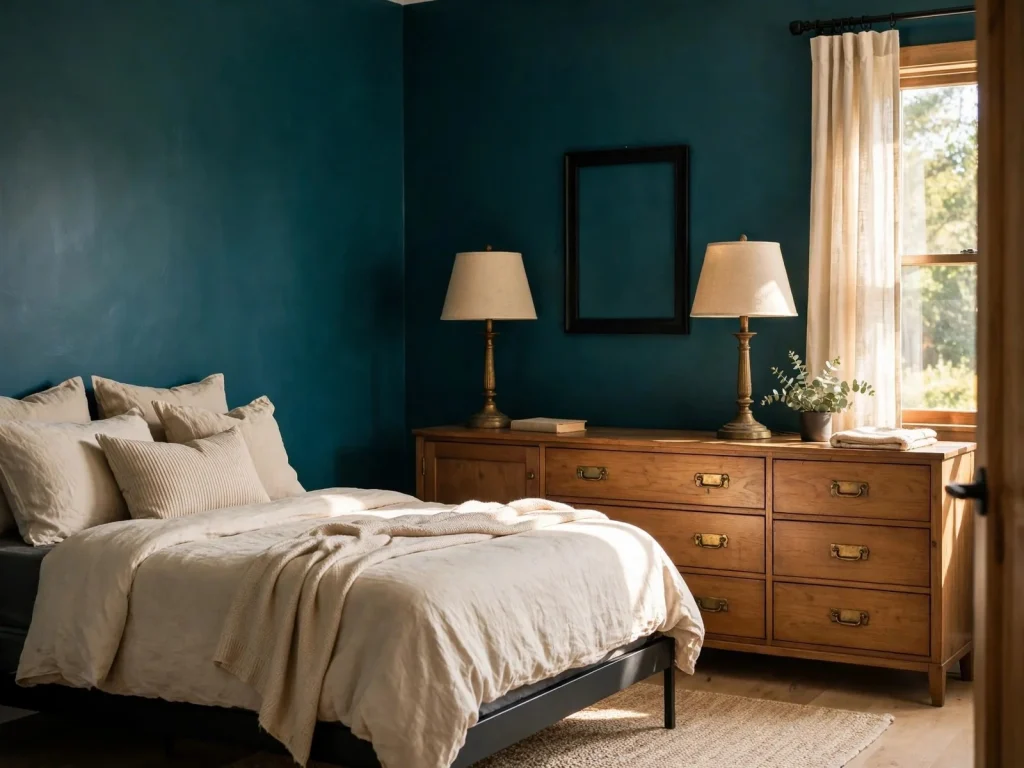
Two metals run this whole style. Aged brass brings the warmth and matte black brings the edge. Together they cover lamps, frames, curtain hardware and handles without a single piece looking lost. A third metal, especially chrome or shiny gold, breaks the spell because it reflects light at a temperature the room does not have.
Repeat each metal at least twice. One brass lamp alone reads as an accident. A brass lamp plus a brass frame reads as a decision.
The catch is existing hardware. Rental door handles and hinges may be chrome and beyond your control. Ignore fitted hardware and hold the rule on everything you bring into the room yourself.
Budget: two metals only, aged brass and matte black, each repeated at least twice across the room.
15. Choose mid to dark wood tones and skip the pale sets
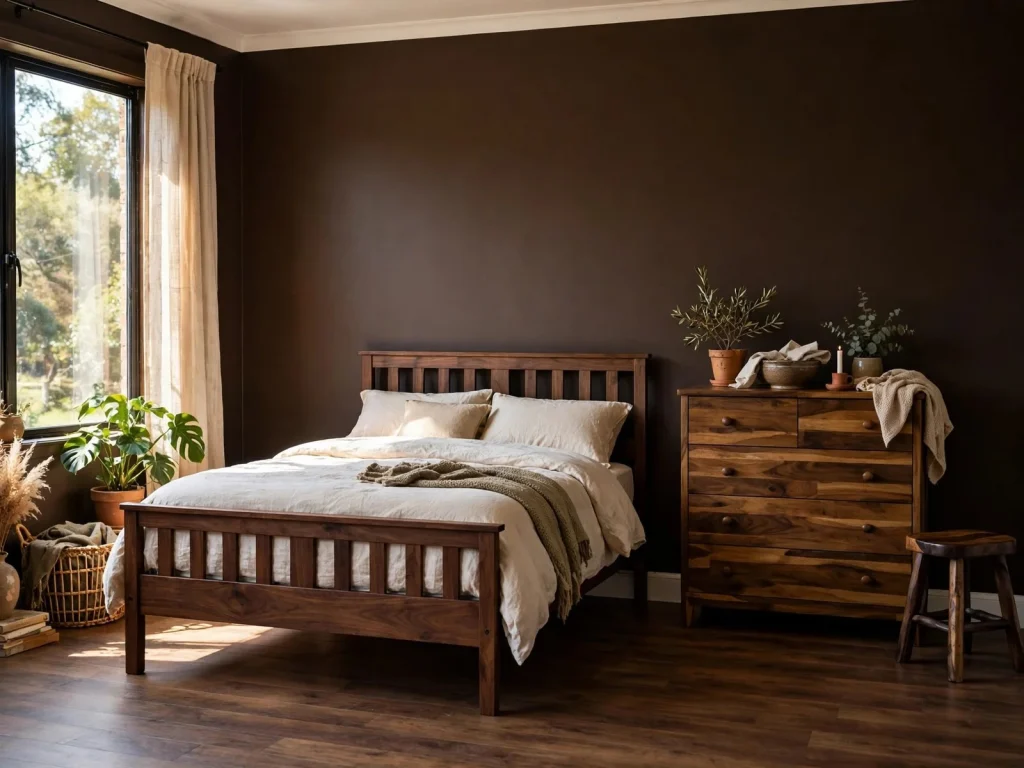
Wood is the quiet background of a dark boho bedroom and its tone has a range: mid to dark. Walnut, acacia and mango wood all sit in that range, with grain that stays visible under warm light. Pale pine and whitewashed finishes belong to the light boho version and look chalky against deep walls.
You do not need every piece in the same wood. Mixed mid tone woods read as collected, which is the point of the style. What they must share is depth: no piece lighter than the bedding base.
If a pale piece has to stay, move it off the dark wall. A light wood stool against an off-white wall causes no trouble. The same stool against charcoal looks like it wandered in from another room.
Measure: wood tones mid to dark only (walnut, acacia, mango wood), with no piece lighter than the bedding base.
16. Skip the matching set and the extra clutter
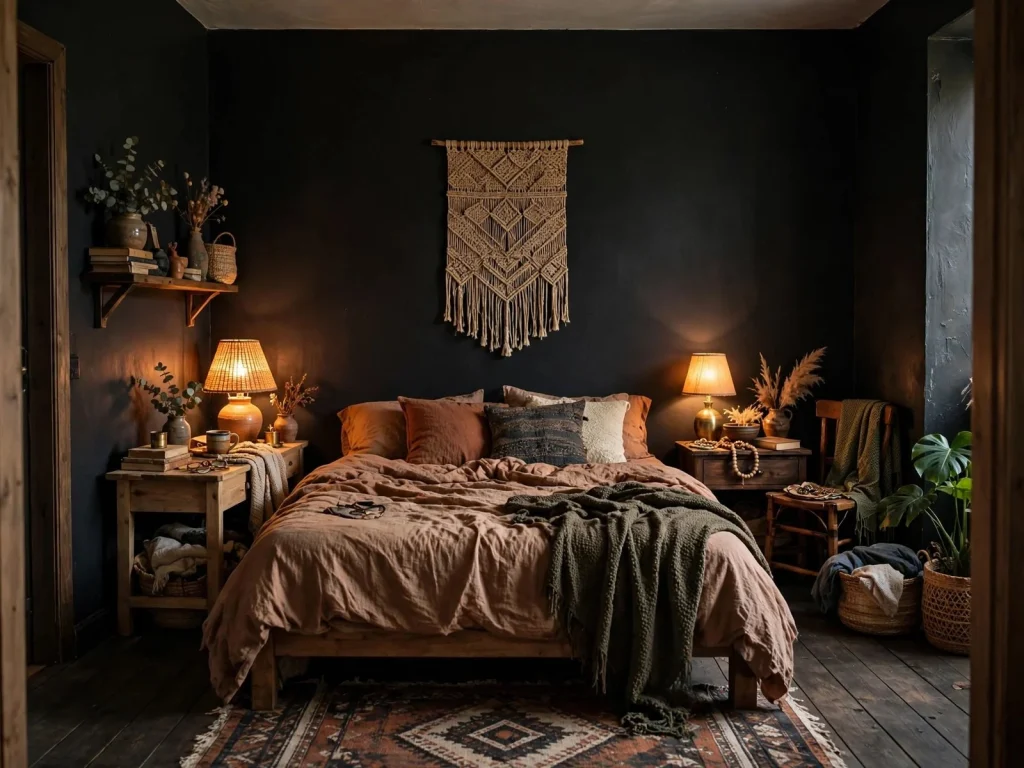
The last idea is a skipping list. Skip the matching bedroom set, because matched pieces in one finish flatten the collected feel the textures are building. Skip the third and fourth wall hanging in a small room, because the woven piece from idea 7 needs empty dark wall around it to read. Skip glossy finishes anywhere, since shine fights the matte depth of the palette.
Edit by the view test. Stand at the door and name what the room shows: deep wall, lit texture, warm light, one pattern large and one small. Anything you cannot name in that list is a candidate to leave the room.
This restraint is what keeps a gypsy boho bedroom energy without the flea market pile-up. Rich comes from the dosage and the layers, not from the count of objects.
Budget: spend on the rug and the bulbs first; skip new decor until the texture count and the light pass.
Dark boho bedroom ideas for renters
Renting takes paint off the table and dark boho survives the loss well because most of its effect is textile anyway. Start with the wall swap: peel and stick dark wallpaper on the bed wall or a large dark textile hung as a wall panel where paper is banned too. Both give the deep backdrop and both leave with you.
Carry the color in the bedding next. A deep duvet cover in aubergine or charcoal over a pale base sheet set gives the one dark wall effect at bed height and the texture count still applies: woven cotton bedding, a wool throw and one rattan or cane piece beside the bed. The rug from idea 6 then lightens the floor plane, which matters more in a rental because the flooring is rarely yours to love.
Light finishes the job without a single screw. Plug-in lamps at 2700K or warmer, a plug-in wall lamp beside the bed and linen curtains on a tension rod rebuild the three light heights from idea 10 with no drilling anywhere. Keep every fixing to rods, hooks rated for the weight and the floor and the deposit stays out of the conversation.
Mistakes that make it fall flat
- Dark color everywhere with no texture count. Four dark walls, flat bedding and a bare floor give the eye nothing to hold, so the room reads as a cave. Dose the color by room size and count 3 texture families on the bed before adding anything else.
- Cool white bulbs on dark walls. A 4000K bulb strips the warmth out of deep teal and aubergine and leaves them grey. Swap every bulb to 2700K or warmer before judging the paint, because the paint is usually innocent.
- Buying the matching furniture set. One finish across bed, dresser and nightstands flattens the collected look and fights the layered textiles. Mix mid to dark woods such as walnut, acacia and mango wood and let the rug tie them together.
Questions people ask about this
How dark can I go in a small bedroom without it feeling like a cave?
In a room under 120 square feet, keep deep color to 1 or 2 walls and let the bed wall go first. Hold the ceiling light, keep at least 3 texture families on the bed and run bulbs at 2700K or warmer. The room reads rich instead of closed in when the light and the texture do their share.
Which colors count as dark boho?
The deep families are charcoal, deep teal, aubergine, espresso brown and blackened green. Charcoal and blackened green read cool, while aubergine and espresso read warm. All of them pair with the same texture set: woven cotton, linen, wool, jute, rattan and carved wood.
How do I do dark boho in a rental where I cannot paint?
Move the color onto things that leave with you. Peel and stick dark wallpaper or a large dark textile panel covers the bed wall, a deep duvet cover carries the color at bed height and a pale jute or wool rug lightens the floor. Plug-in lamps at 2700K or warmer finish the light layers with no drilling.
The bottom line
Dark boho is a dosage, not a mood. The color goes on a measured share of the walls, the texture gets counted on the bed and the light stays warm enough to make both glow. This week, before any paint is bought, swap the bedroom bulbs for 2700K and stand in the room at 9 pm: the walls you already have will tell you how dark you actually need to go.