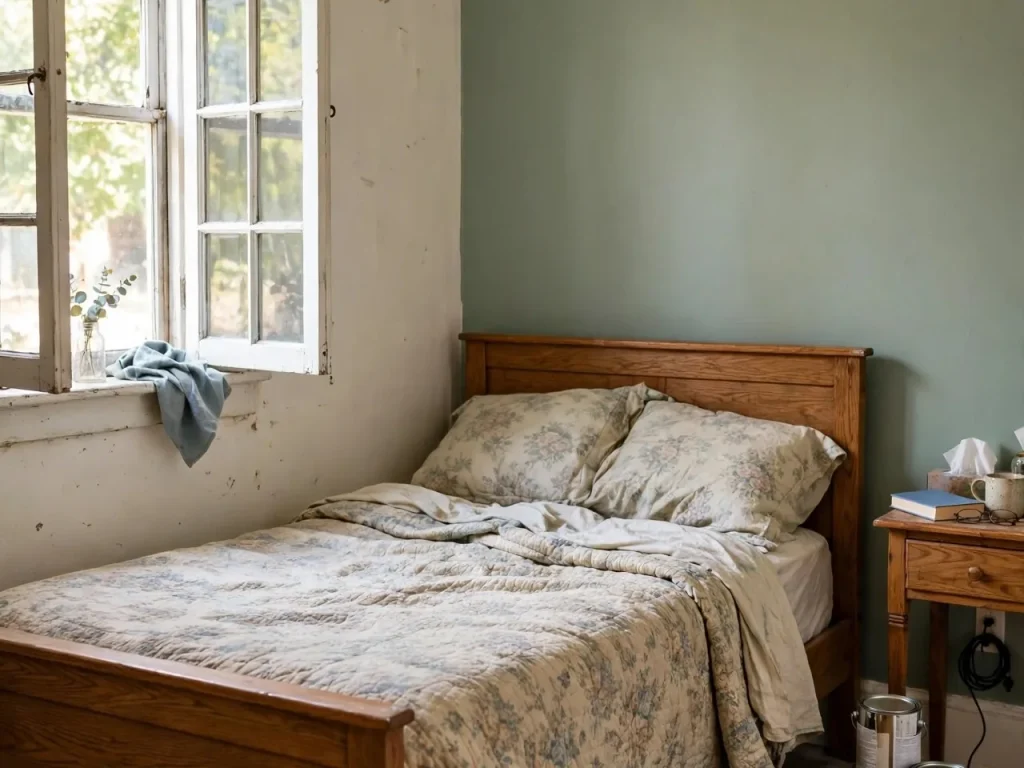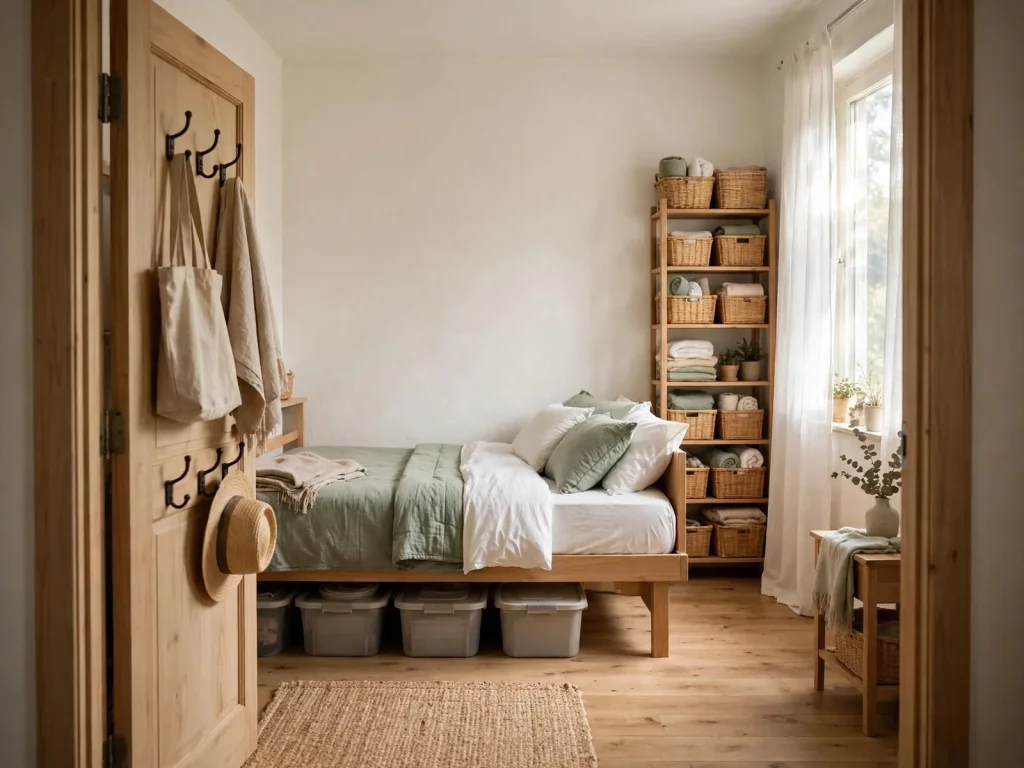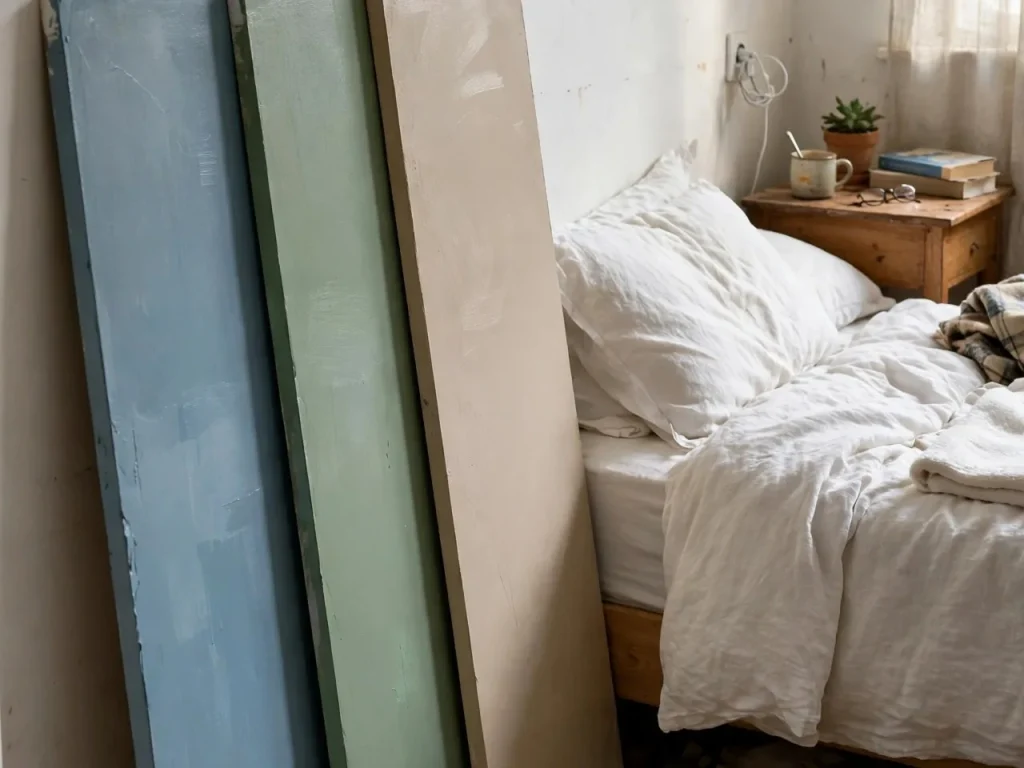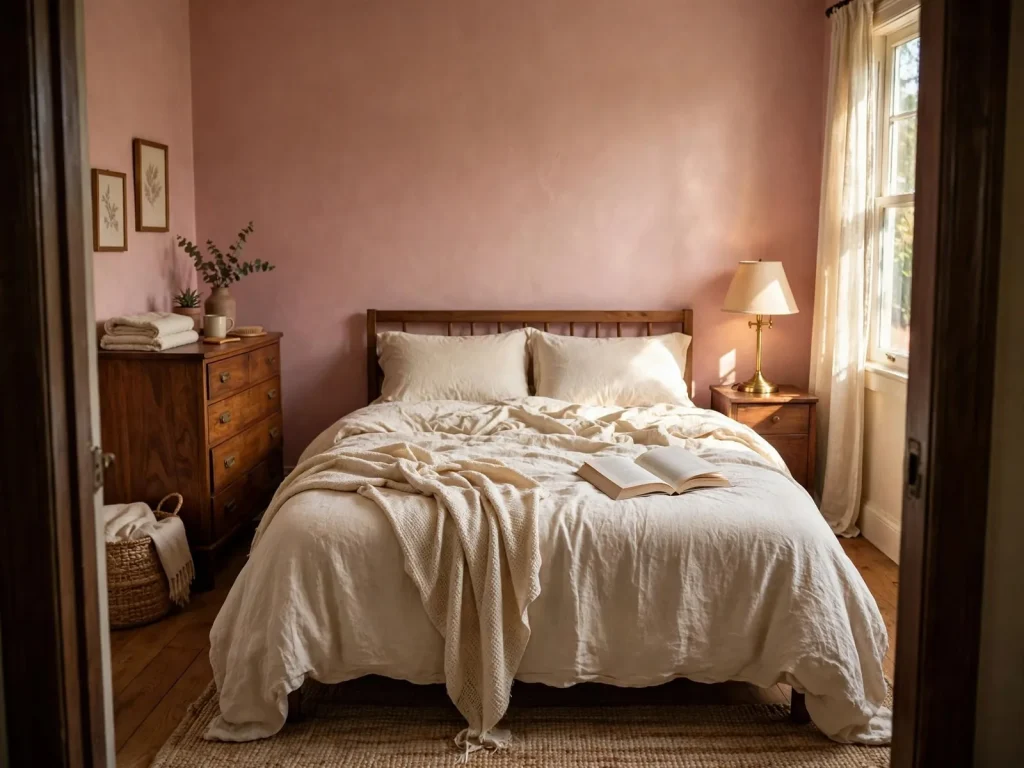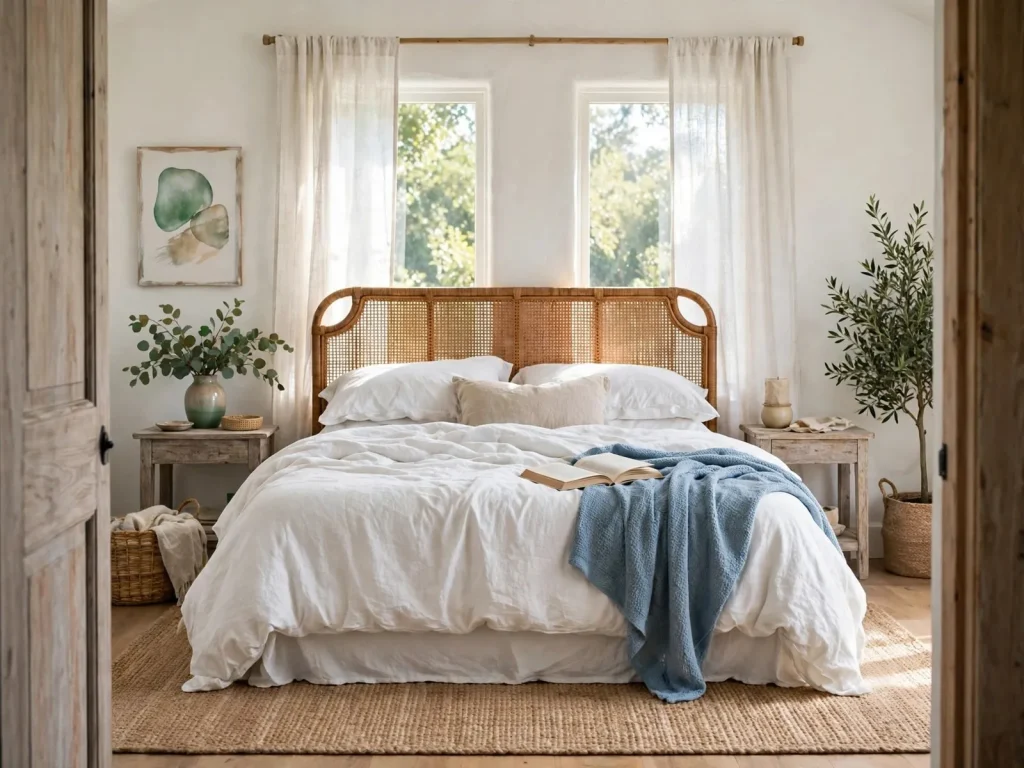
You have seen the photos. A brown and cream bedroom that looks like warm light made solid, rich without a single dark wall and calm without going white. Then the same pairing in a real room comes out flat: the cream reads yellow, the brown reads muddy and the whole room feels like a waiting room with better bedding. The pairing is not the problem. The shades and their proportions are.
This page names everything. Which creams form the base and which browns layer on top, shade by shade in order. The wood tones that carry the pairing and the ones that fight it. And the count that keeps cream soft instead of yellow: about 60 percent cream, 30 percent mid brown and 10 percent dark brown across the visible surfaces. Brown bedroom ideas are everywhere; brown and cream bedroom ideas with the shades named are the useful version and they start here. The wider palette family lives in our bedroom color ideas post.
Before you start: measure, budget, rules
Start with light, because this palette lives or dies by it. Note which way your windows face and look at the room twice before buying anything: once in morning daylight and once under lamplight after dark. Cream shifts yellow under warm lamplight and grey in north-facing daylight and a shade that passed at noon can fail at nine in the evening.
The rough cost notes on this page run in layers. Paint and bedding carry the palette for the least money. Wood pieces and upholstery cost the most and change the slowest, so they come last and only where the existing pieces fight the pairing. Every idea names its layer so you can stop when the room already reads right.
Renters, most of this page is yours. The cream base can be bedding and curtains instead of paint, the browns can be textiles and one leather piece and the wood rule is about what you bring in, not what you alter. Where an idea assumes painted walls, the same move in fabric is named inside it.
Start with the cream base
1. Put cream on the biggest surfaces first
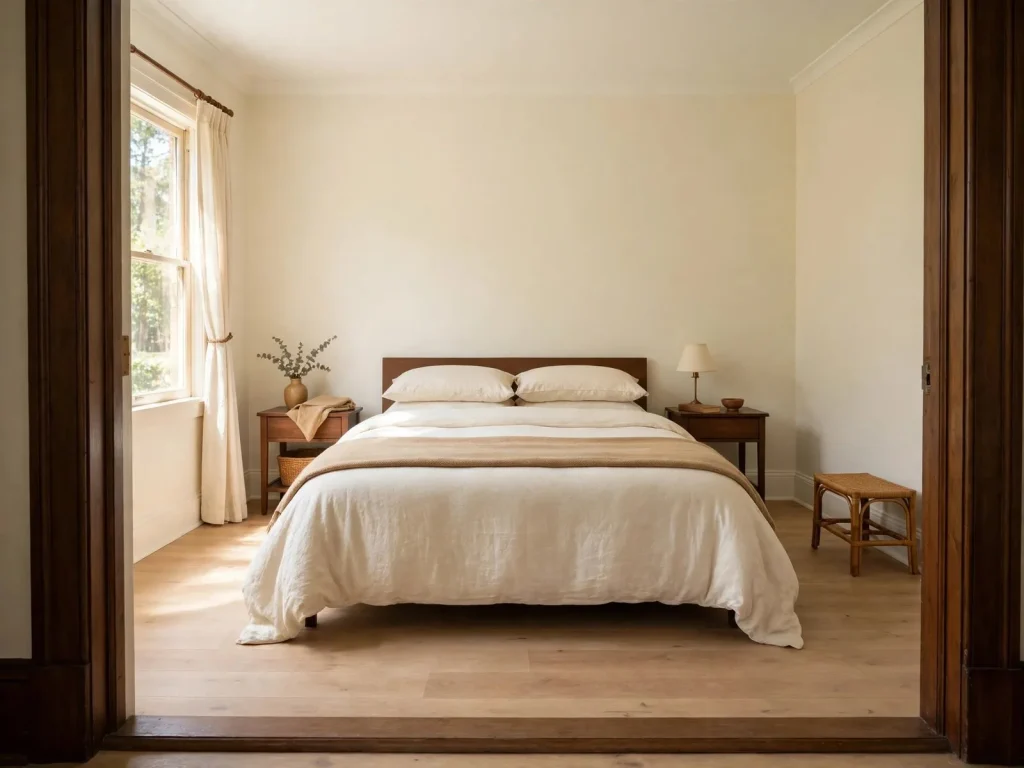
The base decides the room. Cream and ivory go on the surfaces with the most area: the walls where paint is allowed and the bedding everywhere. That is the 60 percent of the count and it is what makes the room read light and warm before a single brown object enters.
Work from the largest surface down. Walls first, then the duvet and sheet set, then curtains. If the walls must stay a landlord white, reverse the order and put the full cream weight into the bedding and curtains, which together cover nearly as much visible area from the doorway.
The catch is stark white. Pure white bedding against warm browns reads blue-grey and makes the cream elsewhere look dirty. Choose ivory and warm cream tones for the base pieces and let true white appear only in tiny doses, such as a sheet edge or a lampshade.
Measure: about 60 percent of visible surfaces in cream and ivory, counted across walls, bedding and curtains from the doorway view.
2. Layer two creams instead of matching one
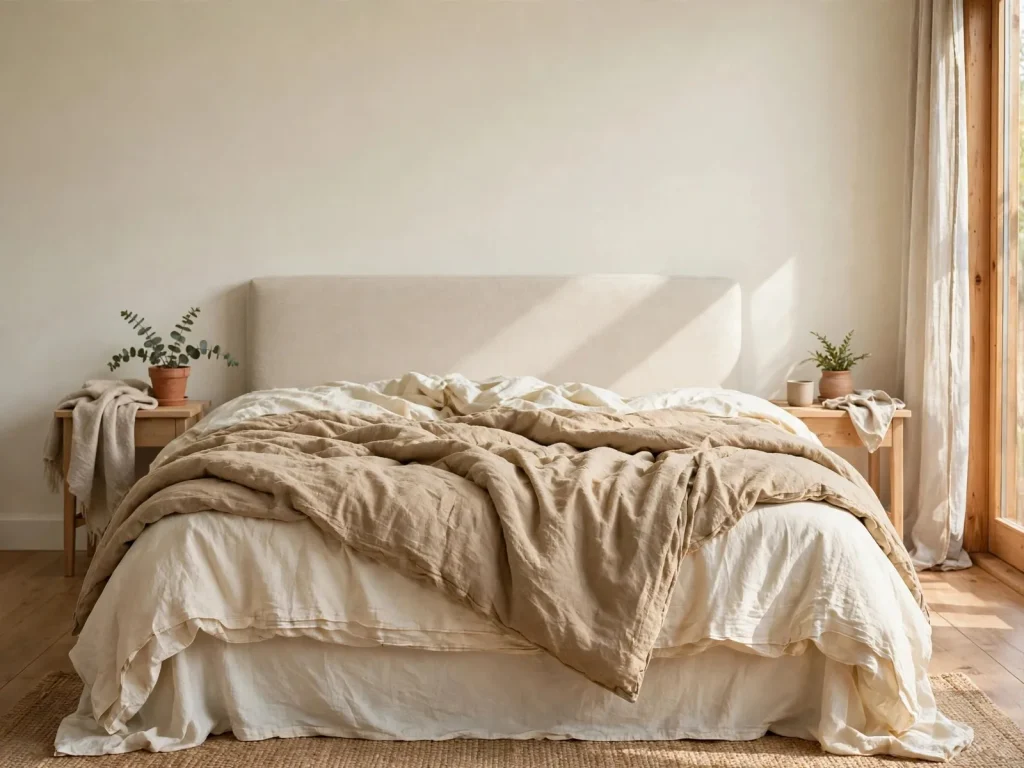
A single cream repeated everywhere flattens into one beige sheet. Two creams, one on the walls and one a step deeper on the bedding, give the base its depth while staying inside the same family. The step between them should be visible in daylight and gentle, like the difference between ivory and a soft oat tone.
Test the pair together, not apart. Hold the bedding fabric against the wall color in the room’s own light at both times of day. Two creams that agree at the shop can split under warm lamplight, one going pink and the other going yellow and the split is what readers describe when they say the room feels off without knowing why.
The catch is the third cream. Curtains in a third cream tone push the base from layered to muddled. Match the curtains to one of the two existing creams, usually the bedding tone and let texture do the separating instead.
Budget: paint for the walls and one bedding set carry this whole idea. Sample both creams first; two sample pots cost less than one wrong gallon.
3. Run beige and brown together on the bed
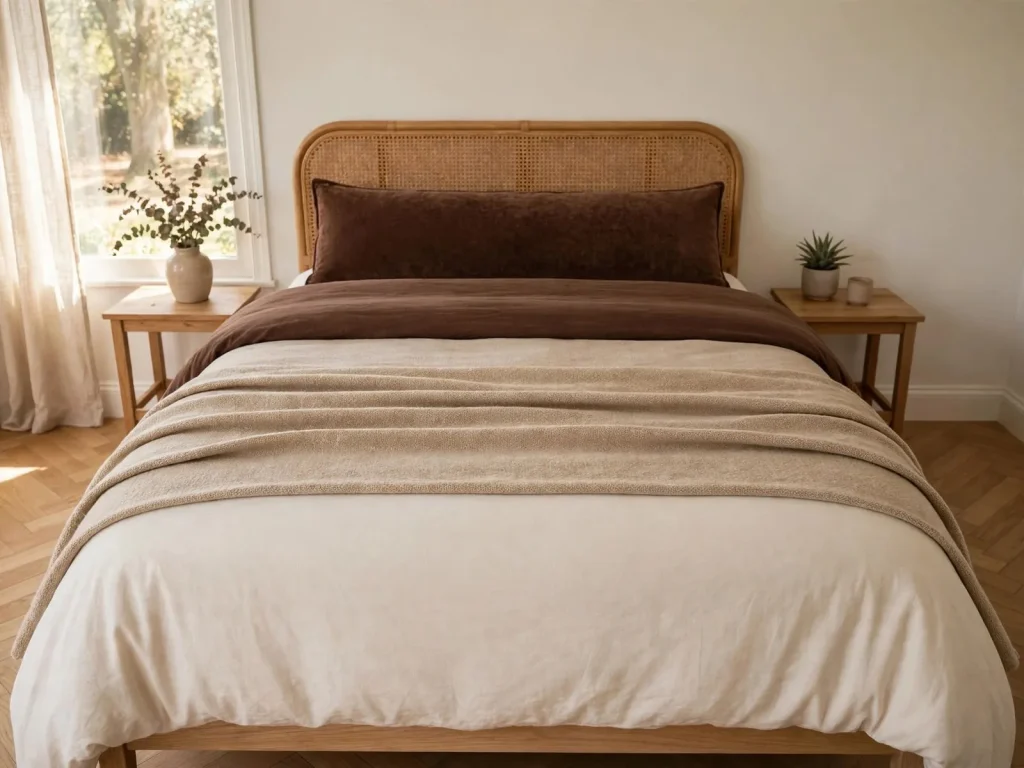
The bed is where beige and brown bedroom ideas prove themselves, because it is the largest soft surface in the room. Build it in bands: cream sheets and duvet as the base, a beige or tan throw across the foot as the bridge and one deeper brown cushion as the first dark note. Each band touches the next, so the eye reads a gradient instead of a contrast.
Widths keep the gradient believable. The throw should cross the full width of the bed and hang a little over each side and the dark cushion sits in front of the sleeping pillows where the brown reads as a decision. A narrow runner that stops short of the edges reads as laundry, not layering.
The catch is matching the beige to the room’s creams. Beige is a brown family member wearing a light coat and a cool beige against warm creams splits the same way two creams can. Hold the throw against the duvet before the tags come off.
Measure: the bed built in 3 bands, cream base, beige or tan bridge and one dark brown accent, with the throw crossing the full bed width.
4. Keep the window wall in the cream family
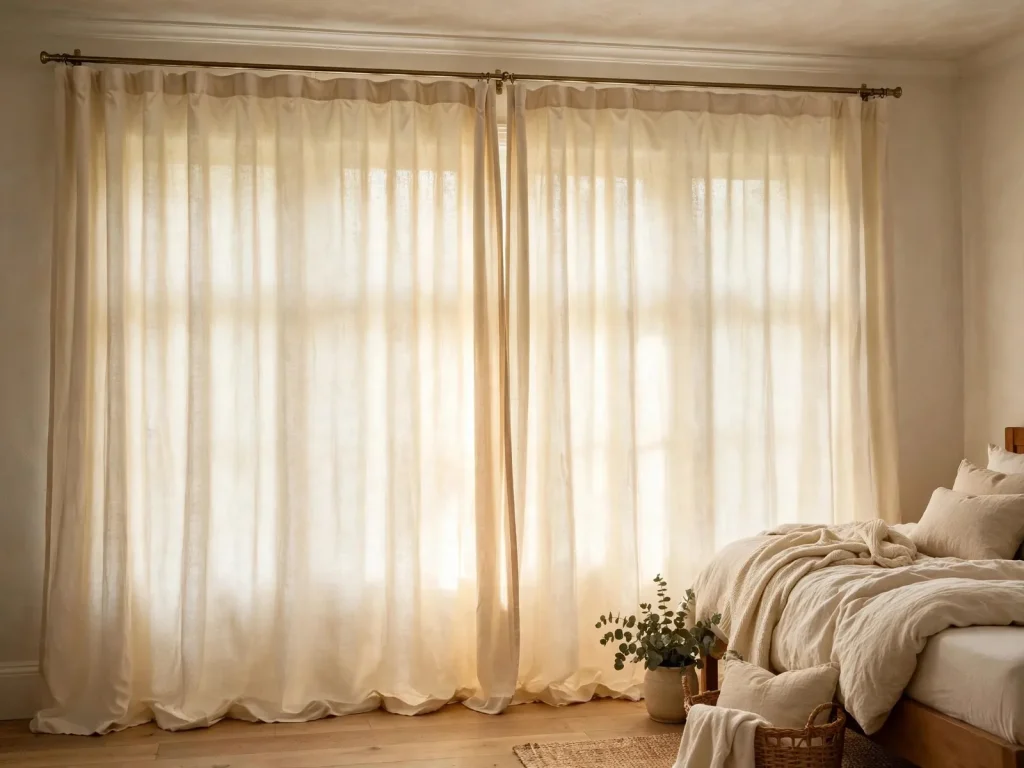
Curtains are the second largest soft surface and the one most often bought in the wrong family. A cream room with grey or white curtains has a cold hole at the window. Panels in the same cream as the bedding or one step deeper into beige, close the wall into the palette and soften the light that enters through them.
Hang them to work as a surface, not a strip. Panels wide enough to cover the glass with soft folds when closed read as part of the room’s color count. Skimpy panels read as an afterthought and shrink the 60 percent base you counted on.
The catch is daylight through fabric. A cream that matches the wall in the evening can glow yellow when the sun comes through it at noon. Hold a panel up to the window at midday before committing to four of them. Our neutral bedroom ideas post runs the same window test across the wider neutral family.
Measure: curtains matched to one of the room’s two creams and hung wide enough to cover the glass fully when closed.
Add the browns in layers
5. Bring camel and tan in as the middle layer
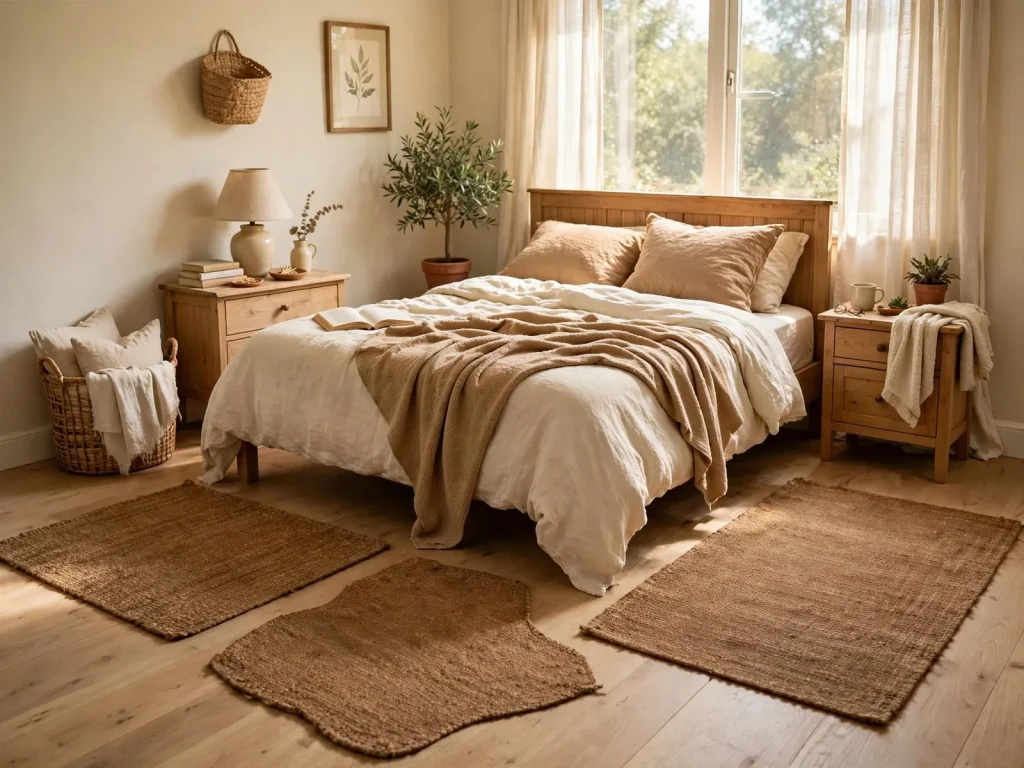
Between cream and chocolate sits the layer that does the daily work: camel, tan and cognac. These mid browns belong on the pieces you touch and see at middle distance: the throw, the cushion covers, the rug underfoot and a bench or ottoman at the foot of the bed. Together they form the 30 percent of the count.
Mid tones forgive. A tan that leans warm sits happily beside walnut and beside cream, where a near-black piece would argue with both. If the room currently holds one dark brown piece that feels too heavy, surrounding it with camel and tan at the same level of the room usually settles it without a replacement.
The catch is orange. Cognac and some tans carry an orange cast that turns loud against cream under warm bulbs. Check mid browns under the room’s evening light, the same two-look rule from the start of this page, before the set is bought.
Measure: mid browns held near 30 percent of visible surfaces, spread across at least 3 pieces so no single piece carries the layer alone.
6. Anchor the room with chocolate in three places
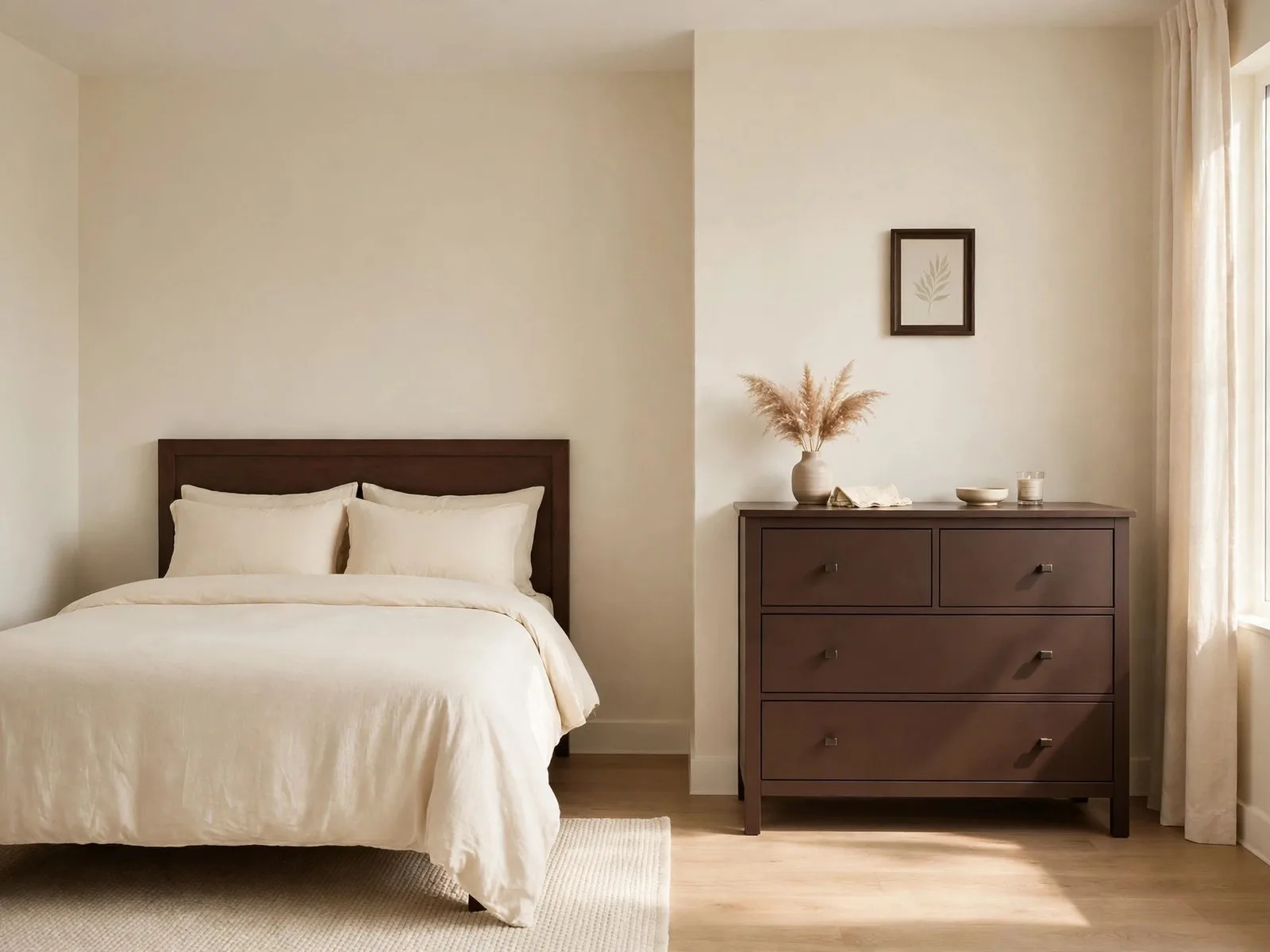
Dark brown works by repetition, not by size. The darkest brown in the room, chocolate or espresso, should appear in at least 3 spots: the headboard or bed frame, one piece of case furniture or a door and one small piece such as a tray or a frame. Three appearances read as a plan. One appearance reads as the piece you could not match.
Keep the three anchors at different heights. One low at the bed frame, one at mid height on a dresser and one small and high, such as a picture frame or a lamp base. The triangle lets the eye travel and accept the depth without the room turning dark, because each anchor is modest on its own.
The catch is the fourth anchor. Chocolate brown bedroom ideas fail when every new purchase defaults to the darkest tone and the 10 percent cap quietly becomes 30. Buy dark pieces against a count, not against a mood.
Measure: the darkest brown in at least 3 spots at 3 heights and held near 10 percent of visible surfaces in total.
7. Use espresso on the smallest pieces for depth
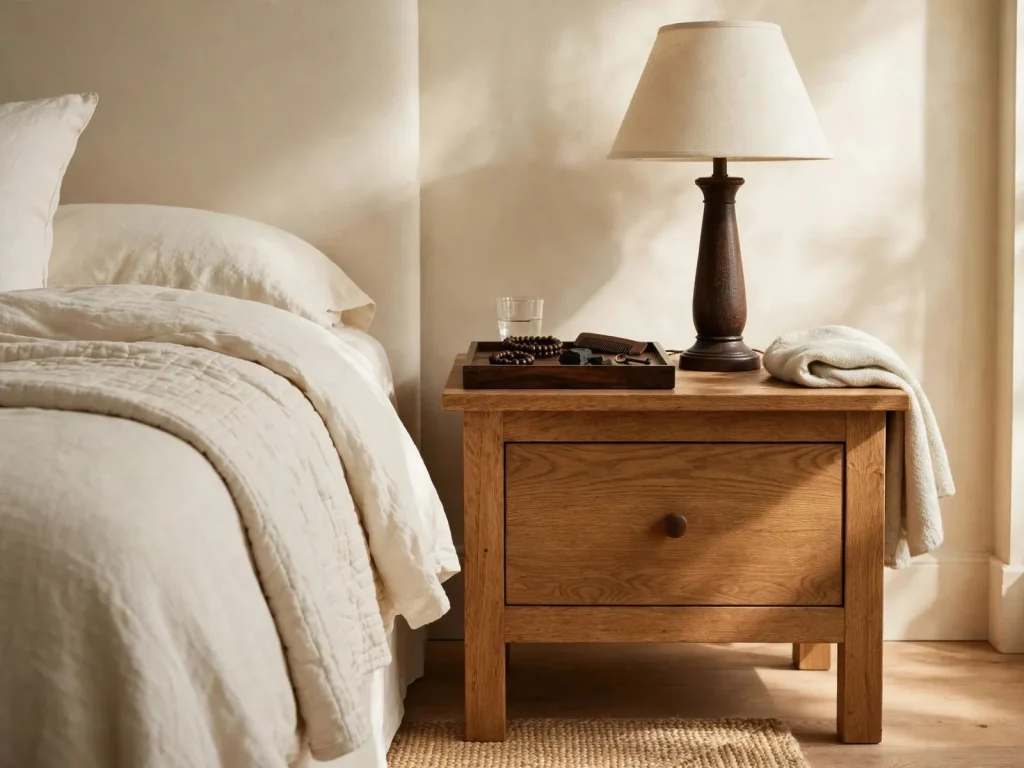
Espresso is a seasoning. On picture frames, a lamp base, a bedside tray and the legs of a bench, the near-black brown gives cream rooms their outline without the commitment of dark furniture. Small pieces can also move, so the depth can be tuned room by room and season by season.
This is the budget end of the dark layer. Four small espresso pieces cost less than one dark dresser and deliver most of the same visual structure. Thrifted frames painted in a deep brown and a tray in dark stained wood do the job without new furniture money.
The catch is black creep. Espresso sits close to black and pieces bought as espresso across different shops can land as true black, which cools the room. Keep one reference piece at home and compare new candidates against it in daylight before they join the set.
Budget: the dark outline of the room from small pieces only, frames, a tray and a lamp base, usually under $80 total and often thrifted.
8. Build one cozy corner in leather and chocolate
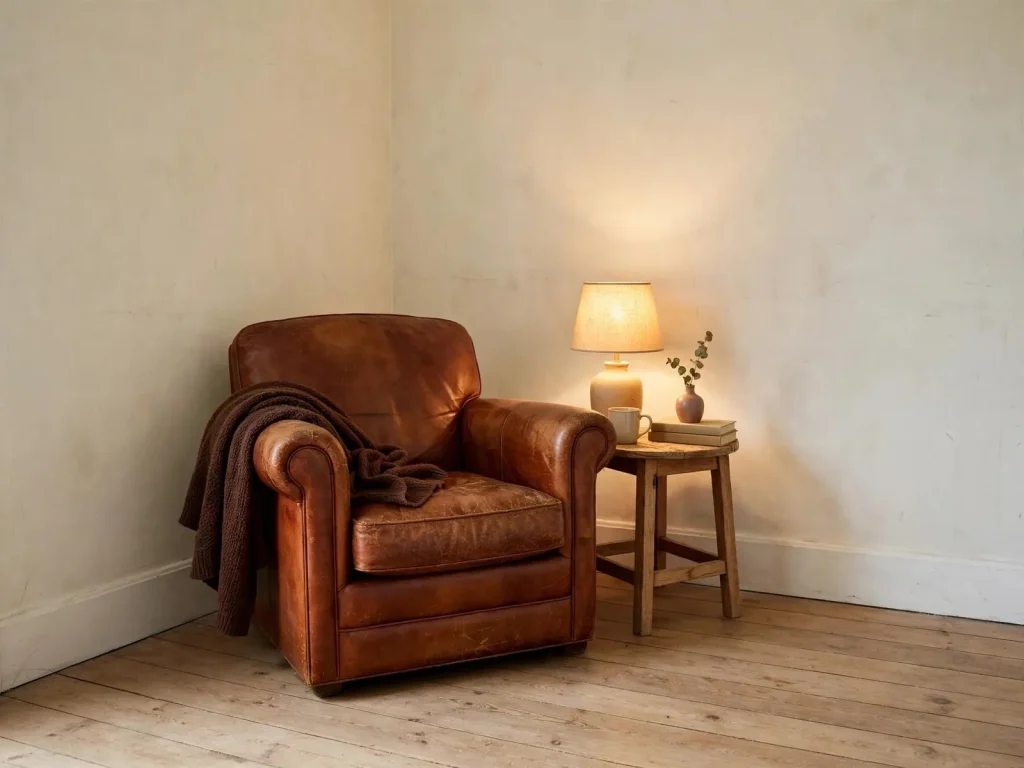
Cozy brown bedroom decor concentrates in one corner better than it spreads. A reading chair in worn leather, a chocolate throw over its arm and a small wood side table make the corner of the room carry the whole promise of the palette: warm, deep and soft at once. The rest of the room stays lighter, which is why the corner reads as an invitation instead of a warning.
Size the corner honestly. A chair needs its footprint plus room to angle, roughly a 36 by 36 inch square of floor and a table within arm’s reach. A chair jammed against the bed with no table is furniture storage, not a corner.
The catch is leather tone. Worn leather in cognac or mid brown bridges cream and chocolate; very dark leather jumps straight to the anchor layer and needs one of the three anchor spots from idea 6. Count it before it lands.
Measure: one cozy corner on about 36 by 36 inches of floor, chair, throw and side table inside it, with the leather counted in the palette’s layers.
Wood tones that carry the pairing
9. Pair walnut beside cream upholstery
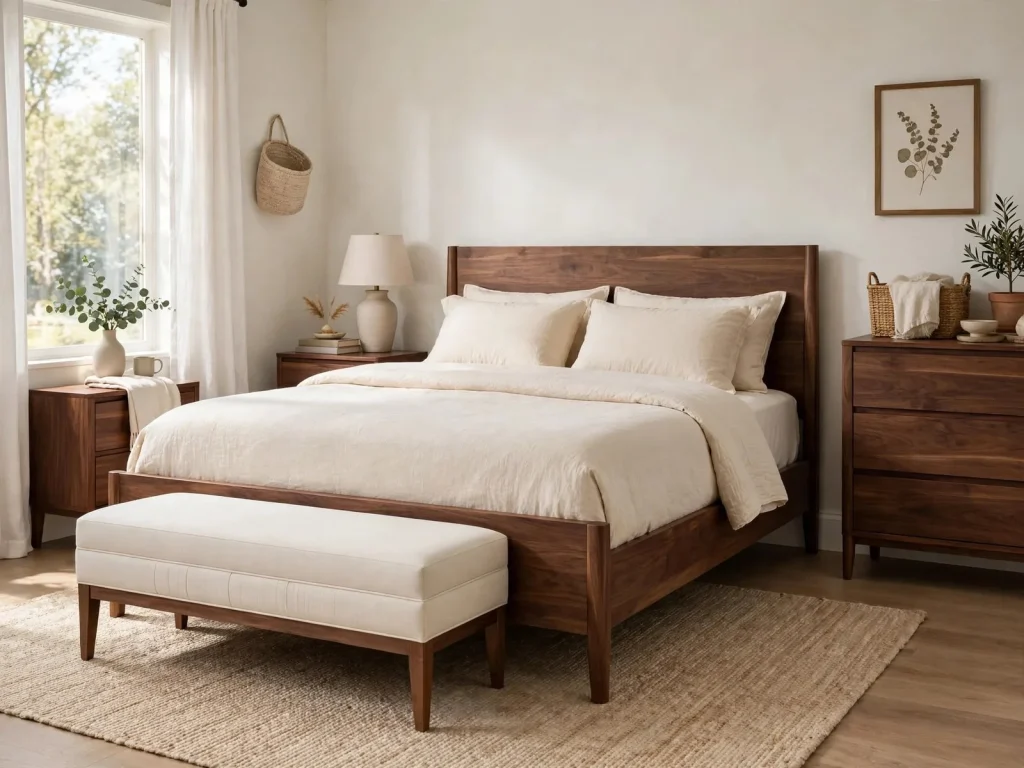
Walnut is the working wood of this palette. Its mid-dark tone sits exactly between cream and chocolate, so a walnut bed or dresser beside cream bedding and a cream headboard needs no help to belong. If you own one wood piece worth building around in a brown bedroom, it is this one.
Let the walnut carry a large surface. A bed frame or a dresser in walnut gives the room its mid anchor and lets smaller pieces stay light. Cream upholstery against it, an upholstered headboard or a bench in ivory fabric, is the pairing in the photos you saved, whether the captions said so or not.
The catch is walnut’s variation. Real walnut runs from honeyed to near espresso in one board. Buy pieces for the same room from the same range or accept the spread as part of the mid layer and never place the lightest and darkest walnut pieces side by side.
Measure: walnut as 1 of the room’s maximum 2 wood tones, placed on a large piece beside cream upholstery.
10. Use dark-stained oak where the room needs weight
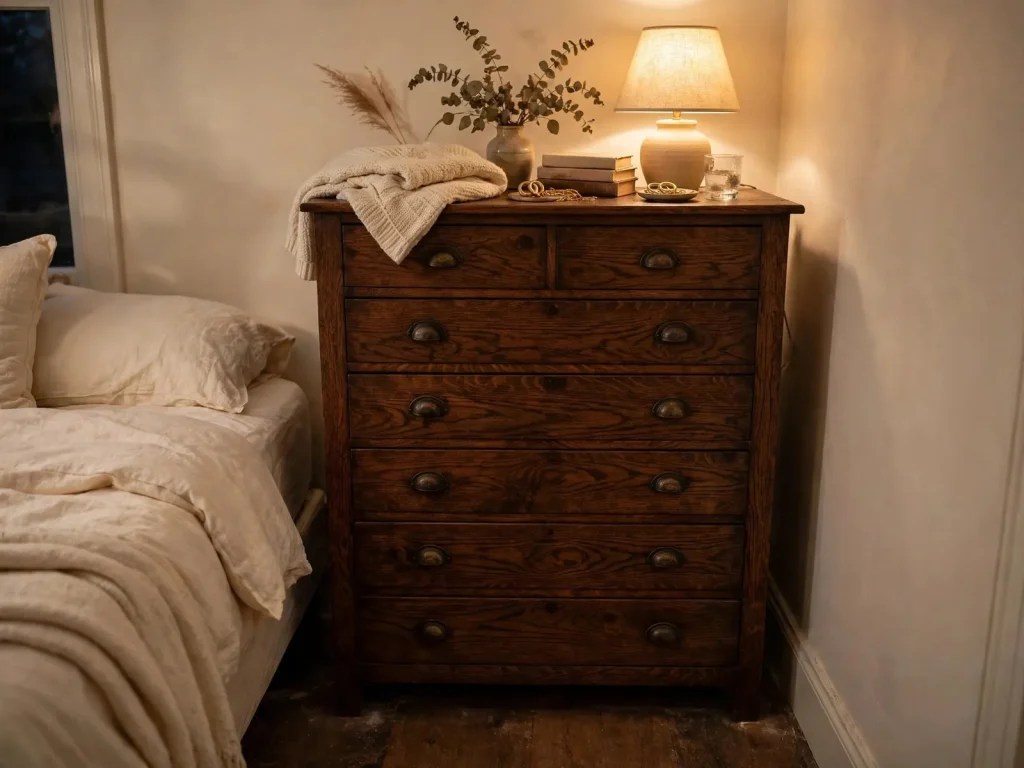
Some rooms float. High ceilings, big windows and pale floors can leave a cream palette looking washed out and dark-stained oak is the corrective. A dresser or a pair of nightstands in a deep oak stain adds the furniture weight that lets the creams stay soft without turning insubstantial.
Count dark oak inside the anchor layer. It sits closer to chocolate than to walnut in value, so a dark oak dresser is anchor spot material and should be balanced by mid browns at other heights, per idea 6. Two dark oak pieces plus a chocolate headboard is a room deciding to be dark, whatever the walls say.
The catch is stain honesty. Oak stained very dark can read as painted black under warm light and lose its grain, which is the entire point of choosing it. Check the piece under evening light and keep it if the grain still shows.
Measure: dark-stained oak counted inside the 10 percent dark layer, with its grain still visible under the room’s evening light.
11. Switch to pale white oak when the browns run deep
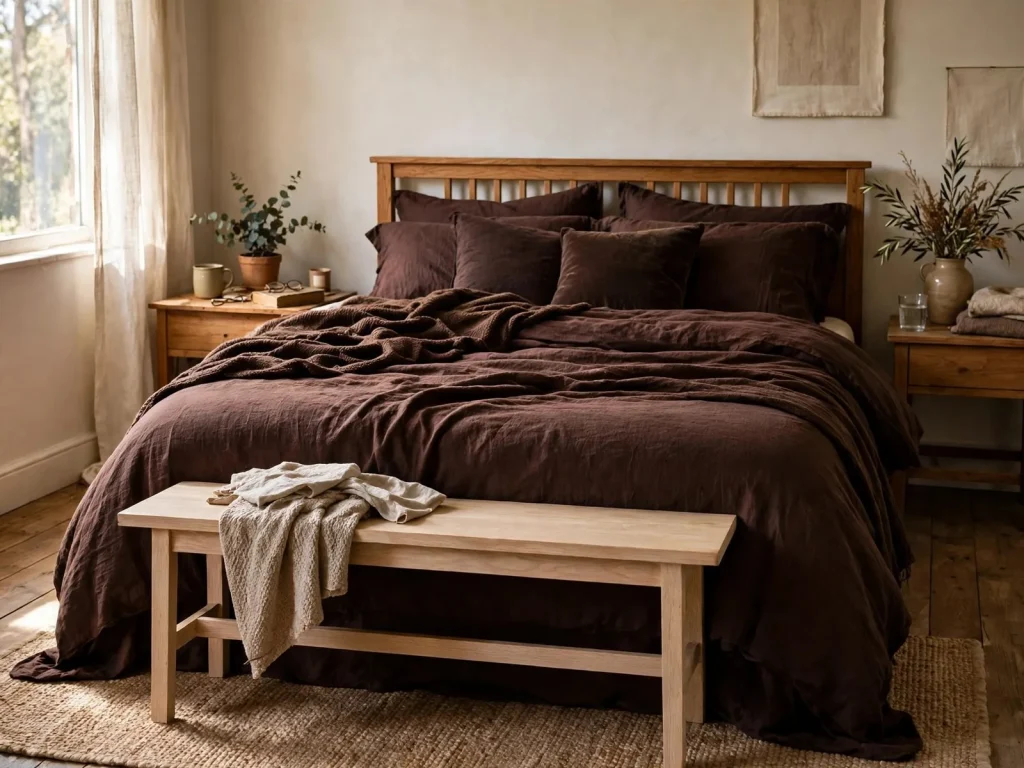
When the palette leans dark, chocolate anchors, deep textiles and a leather chair, the wood has to lighten or the room closes in. Pale white oak is the release valve. Its honeyed lightness sits beside deep browns without competing and keeps a floor or a bench inside the cream family in spirit.
Use it on the pieces nearest the floor or the window. A white oak bench at the foot of the bed or pale oak nightstands lift the lower half of the room where dark pieces gather and the contrast makes the deep browns look chosen rather than heavy.
The catch is tone discipline. White oak beside walnut beside dark oak is three woods arguing. The rule for this palette is no more than 2 wood tones in one room, so choosing white oak usually means the walnut or the dark oak leaves or moves to another room. Our earthy bedroom ideas post runs the same two-wood discipline across its warmer palette.
Measure: pale white oak as the light wood when browns run deep and never a third wood tone in the room.
12. Stop at two wood tones and repeat each one twice
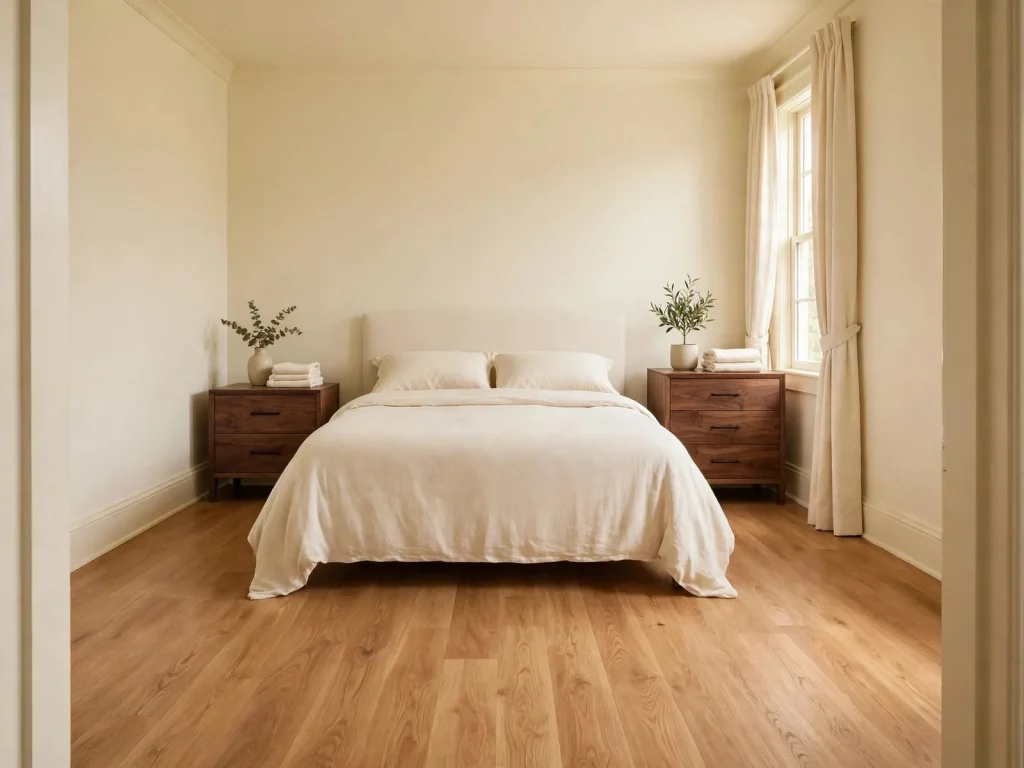
Here is the wood rule stated whole: no more than 2 wood tones in one room and each tone appears at least twice. Two tones give a room its rhythm, light and dark, warm and deep. Three tones give it a furniture showroom’s restlessness, because no tone gets enough repetition to read as a plan.
Audit your room from the doorway. Name each wood you can see and count its appearances. The single orphan piece, a lone pine stool among walnut and oak, is the usual offender and it can be stained, painted into the cream family or retired to another room.
The catch is flooring. The floor is a wood tone too or the nearest thing to one. A mid oak floor plus walnut furniture leaves exactly one slot, so spend it on the tone the room needs more, depth or lightness, per ideas 10 and 11.
Measure: maximum 2 wood tones including the floor, each repeated at least 2 times in the room.
Texture and light that keep it warm
13. Stack three textures on and around the bed
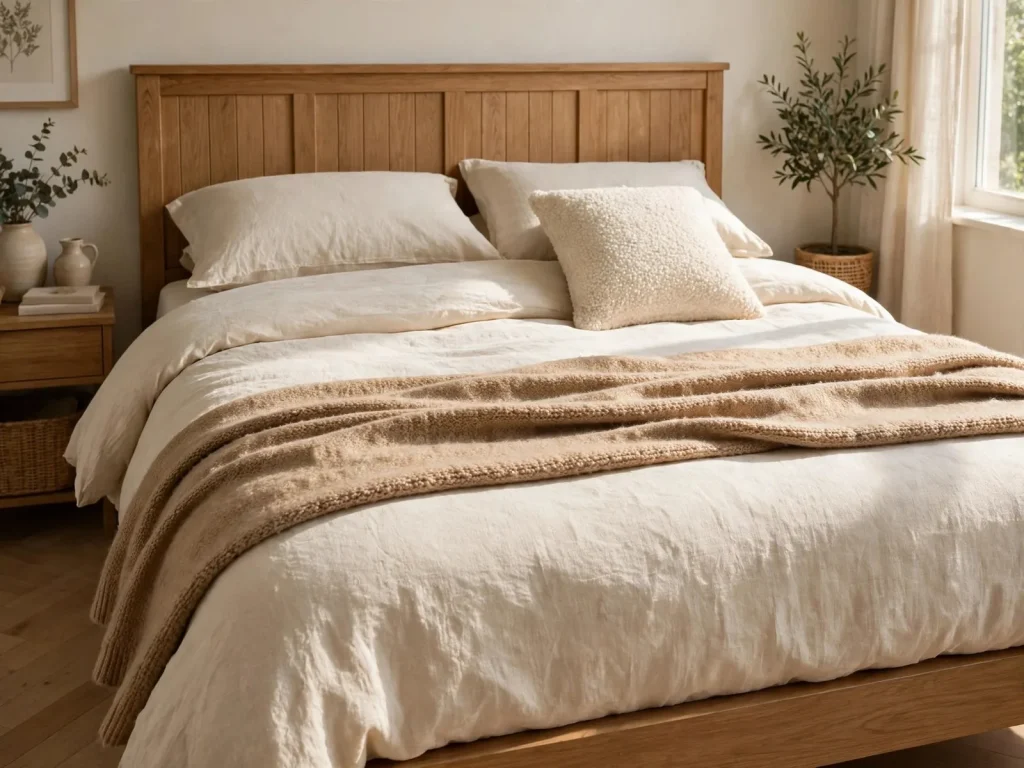
Two flat colors need texture the way a plain wall needs light. The rule is at least 3 textures in the room, chosen from linen, wool, bouclé, velvet and worn leather. The bed is the easiest place to bank two of them: a linen or linen-look duvet for its slub and a wool throw for its loft.
Spread the third texture away from the bed. A bouclé cushion on the chair or a velvet shade on the lamp puts texture at a second height and distance, so the room reads layered from the doorway and not just well dressed at the bed.
The catch is fiber honesty under light. Synthetic versions of these textures can shine and shine reads cold against matte browns. Choose matte finishes and check the throw under lamplight for sheen before the tags come off.
Measure: at least 3 textures from linen, wool, bouclé, velvet and worn leather, with at least 1 placed away from the bed.
14. Let velvet and worn leather carry the warmth
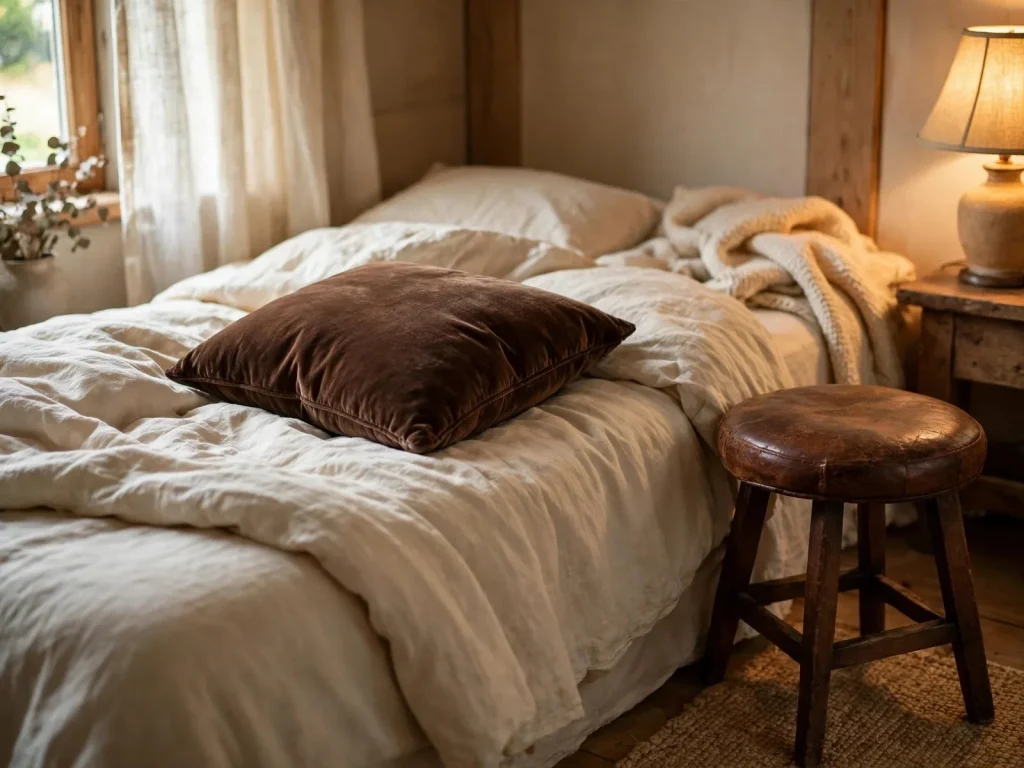
Of the five texture carriers, two do the warmth work directly. Velvet absorbs light and deepens any brown it touches, so a single velvet cushion in chocolate or camel makes the whole bed read richer. Worn leather brings the patina that new rooms lack, the sense that the palette has been lived in and softened.
Use each once and let them be the best versions you can manage. One real velvet cushion cover beats three shiny imitations and a leather piece with genuine wear beats a distressed print that repeats its pattern in a grid your eye will find within a week.
The catch is placement in sun. Velvet fades unevenly in direct sun and leather dries at a sunlit window. Keep both on the shaded side of the room or behind the curtain line and condition the leather once a year.
Budget: one velvet cushion cover and one worn leather piece, thrifted where possible. These two purchases warm the room more than any third item.
15. Light the palette at 2700K
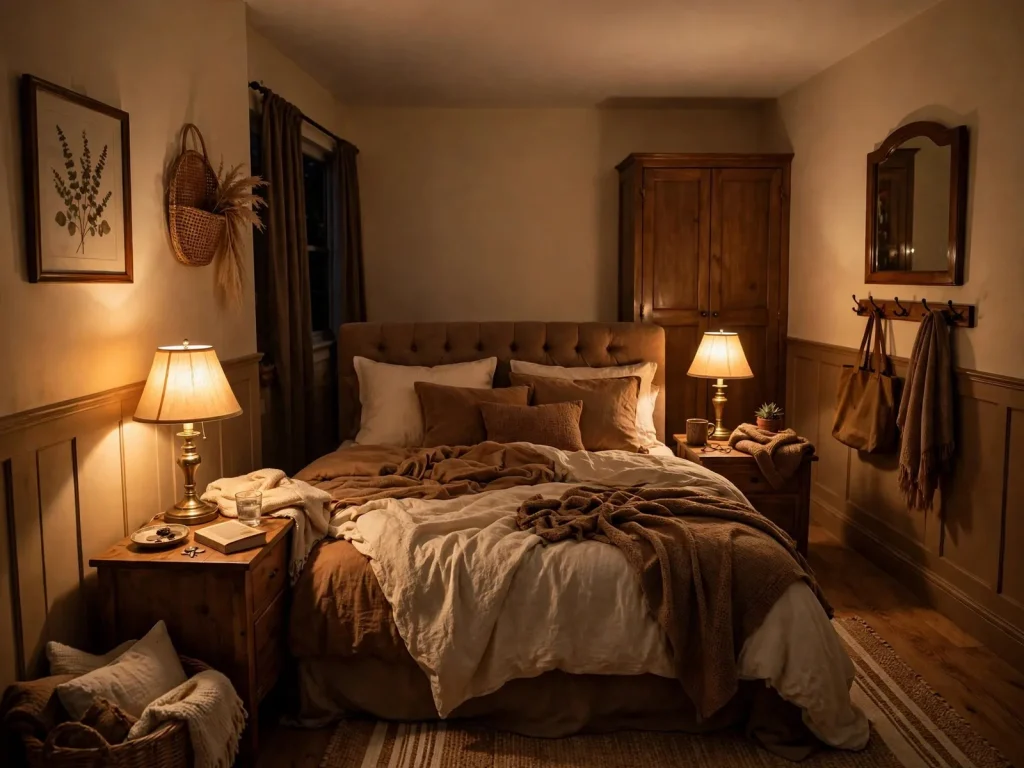
Bulbs are part of this palette whether you invite them or not. At 2700K, warm lamplight deepens browns and keeps cream on the honey side. Cooler bulbs push the same cream toward grey and flatten the browns into mud, which is why a room can pass its daylight check and fail every evening.
Match every bulb in the room to the same temperature, including the one in the ceiling fixture nobody uses. Mixed temperatures split the room into a warm half and a cold half at lamp height and the split lands right across the bed.
The catch is shopping by the box. Bulb boxes print the temperature in small type and the shelf mixes temperatures in one display. Buy all the room’s bulbs in one trip from one box batch and keep one spare from the same batch.
Measure: every bulb at 2700K, bought in one batch, with the ceiling bulb matched even if it is rarely switched on.
16. Test the whole pairing at both ends of the day
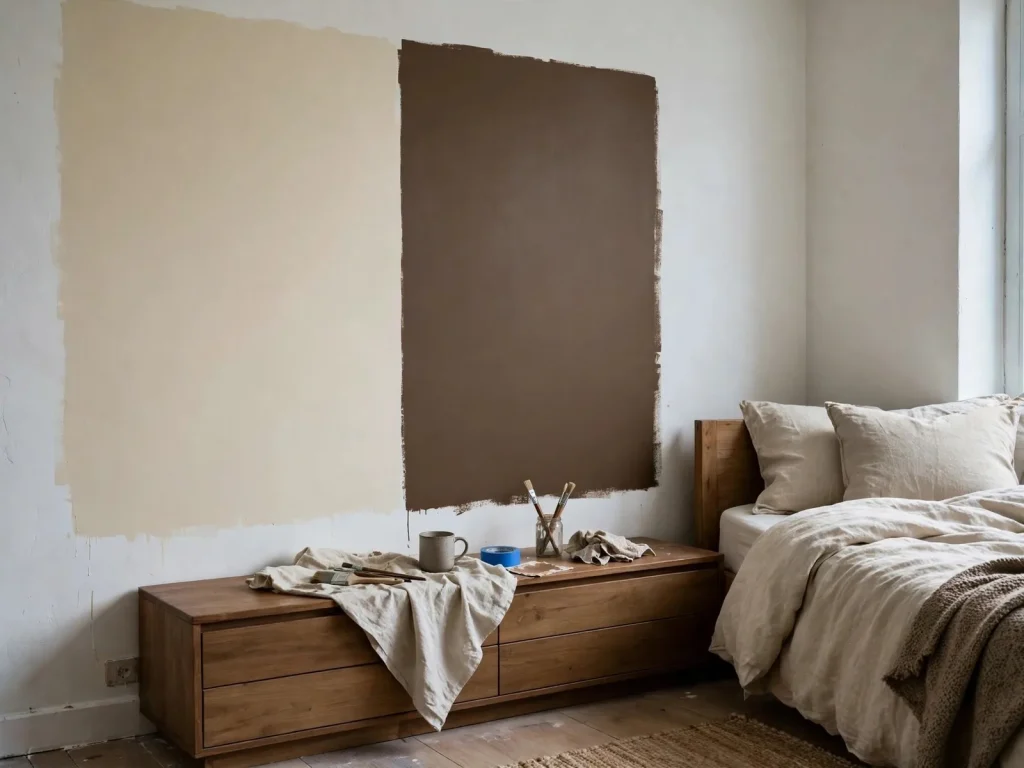
The final rule of the page gathers the others. Cream shifts yellow under warm lamplight and grey in north-facing daylight, so a brown and cream palette is only ever approved twice: once in the morning and once after dark. Swatches, a bedding corner and one mid brown piece are enough to run the test before the full spend.
Give the test a full day. Morning light tells you whether the cream holds its warmth against a north window. Evening light tells you whether the browns deepen or disappear and whether the cream slides toward yellow past the point you enjoy. A pairing that passes both is safe to buy in full.
The catch is impatience at the paint counter. The wall color is the one element that touches every other choice, so it is the worst one to rush. Two days of swatch watching is the cheapest insurance on this whole page.
Measure: judge every shade twice, morning daylight and lamplight after dark, before any full purchase. North-facing rooms get judged on the morning look first.
Brown and cream in a small bedroom
Small rooms take this palette well if the proportions shift, not the shades. Cream still leads, but push its share higher, toward 70 percent and let the dark anchors shrink to the smallest of their three spots: a frame, a tray and the legs of a bench rather than a full headboard. The room reads warm without spending its little light on large dark surfaces.
Wood discipline matters more, not less. One wood tone plus the floor is often the right count in a small room, with the second tone appearing only in picture frames or a single stool. Texture does the work that extra pieces would do in a big room: linen, wool and one velvet cushion give a small bed the full layered read.
Keep the window wall light. Cream curtains at full width soften the daylight and hold the base, where a deep curtain in a small room eats the wall the light comes from. The cozy corner from idea 8 shrinks to a cushion pile on the bed itself and the palette survives the translation intact.
Mistakes that make it fall flat
- Starting with the brown furniture. Dark pieces bought first force the creams to match them and the base ends up chosen under pressure. Set the cream base and the count first, then let browns and woods apply for their spots in order.
- Letting white sneak in as a neutral. Stark white sheets, frames and lampshades sit outside this palette and make every cream look yellow by comparison. Swap the whites for ivory one piece at a time and watch the room settle as each one leaves.
- Stacking three wood tones because each piece is lovely. Lovely individually and restless together. The two-tone cap is the rule that saves the room from its own good taste. Move the third tone to another room and let it be lovely there.
- Judging the palette at noon only. A cream approved under daylight can turn yellow at nine in the evening and a brown can vanish into the wall. The two-look test is not caution. It is the only honest way this palette can be chosen.
Questions people ask about this
Which cream shades work with brown without turning yellow? Ivory and warm oat creams hold best, because they start a step deeper than stark white and have less room to slide. The real fix is the test: check the cream under the room’s lamplight after dark, since warm bulbs are what push cream toward yellow. If it yellows, go one step deeper and one step more neutral, not brighter.
How much brown is too much in a small bedroom? Past about 40 percent of visible surfaces, a small room starts spending its light on the palette. Keep cream near 70 percent, mid browns near 25 and the dark anchors as three small spots rather than one large piece. The shades do not change in a small room; only the proportions move.
What wood tones go with a brown and cream palette? Walnut beside cream upholstery is the anchor pairing, dark-stained oak works where a room needs weight and pale white oak is the release when the browns run deep. The cap is 2 wood tones in the room including the floor and each tone should appear at least twice to read as a plan.
The bottom line
Brown and cream fails on vagueness, not on taste. Name the creams, layer the browns in order and cap the woods at two tones and the pairing that looked flat starts behaving like the photos. This week, hold your bedding fabric against your wall color at nine in the evening with the lamps on. That one check, before anything is bought, tells you more about your room than any shopping trip.