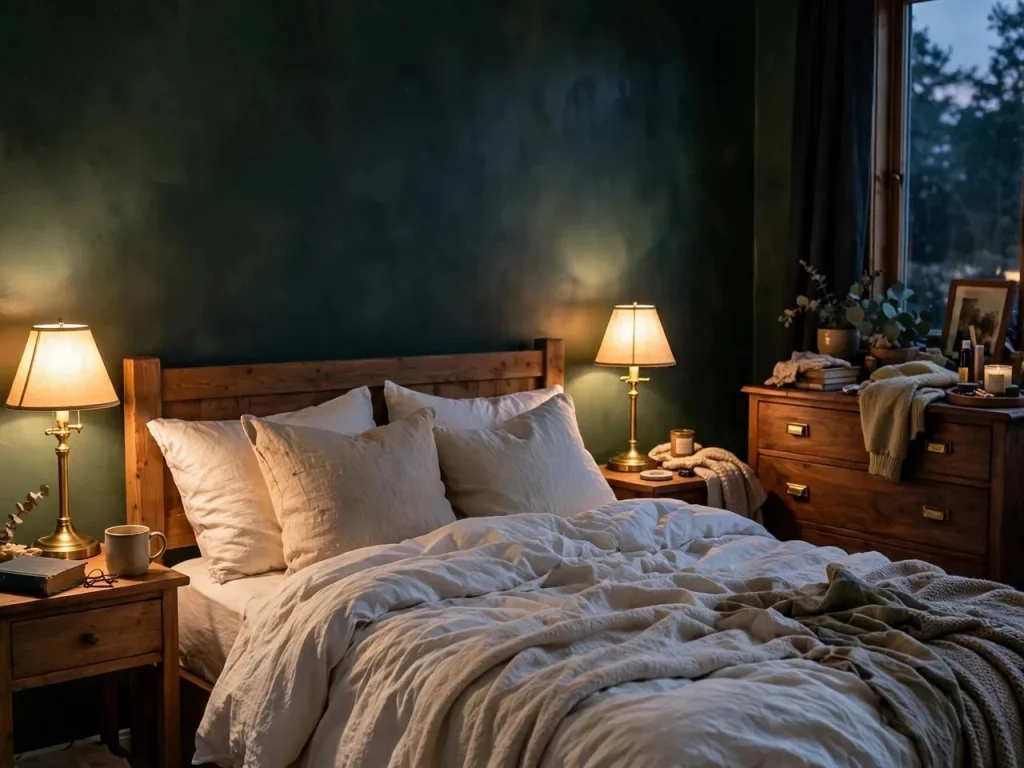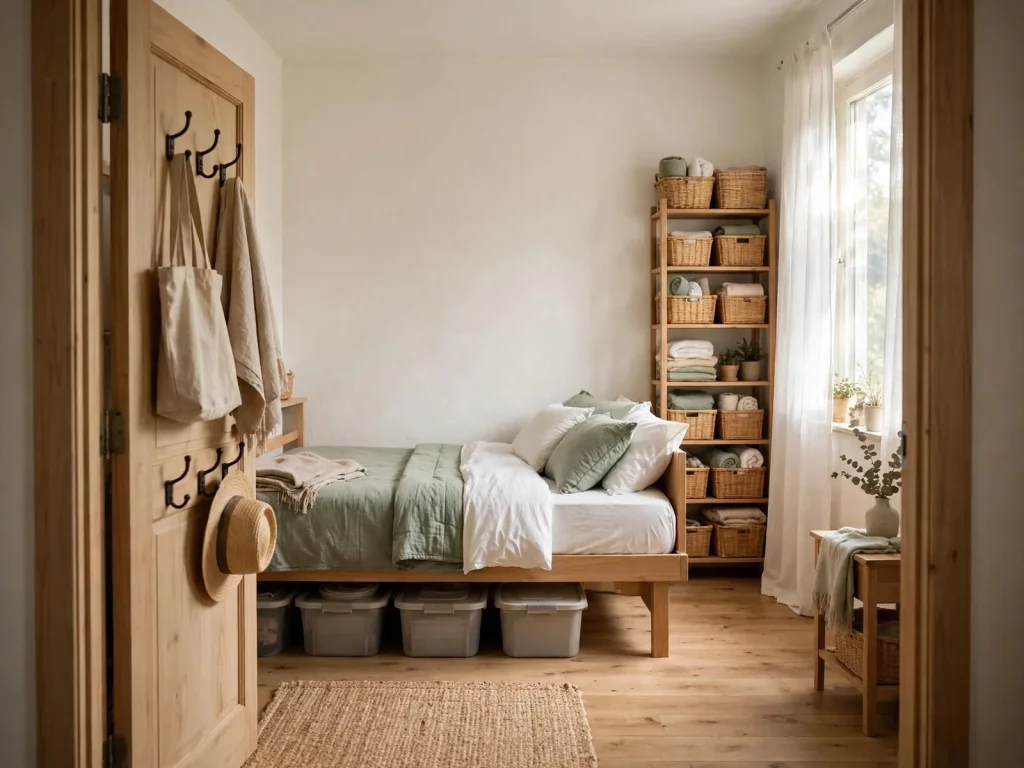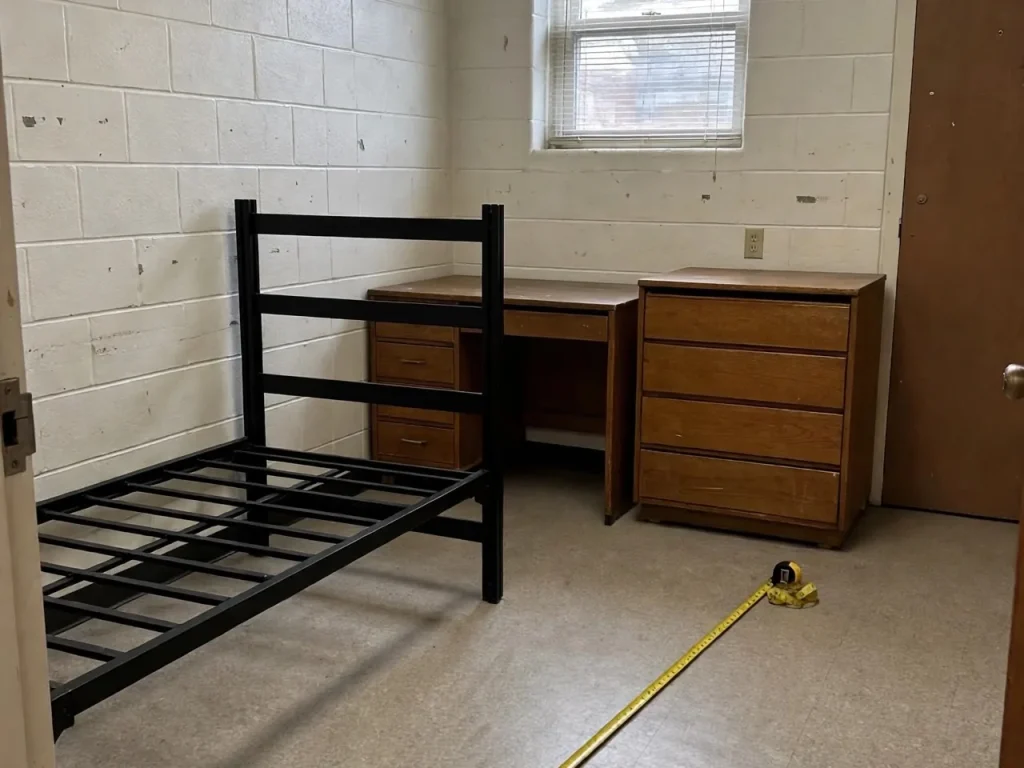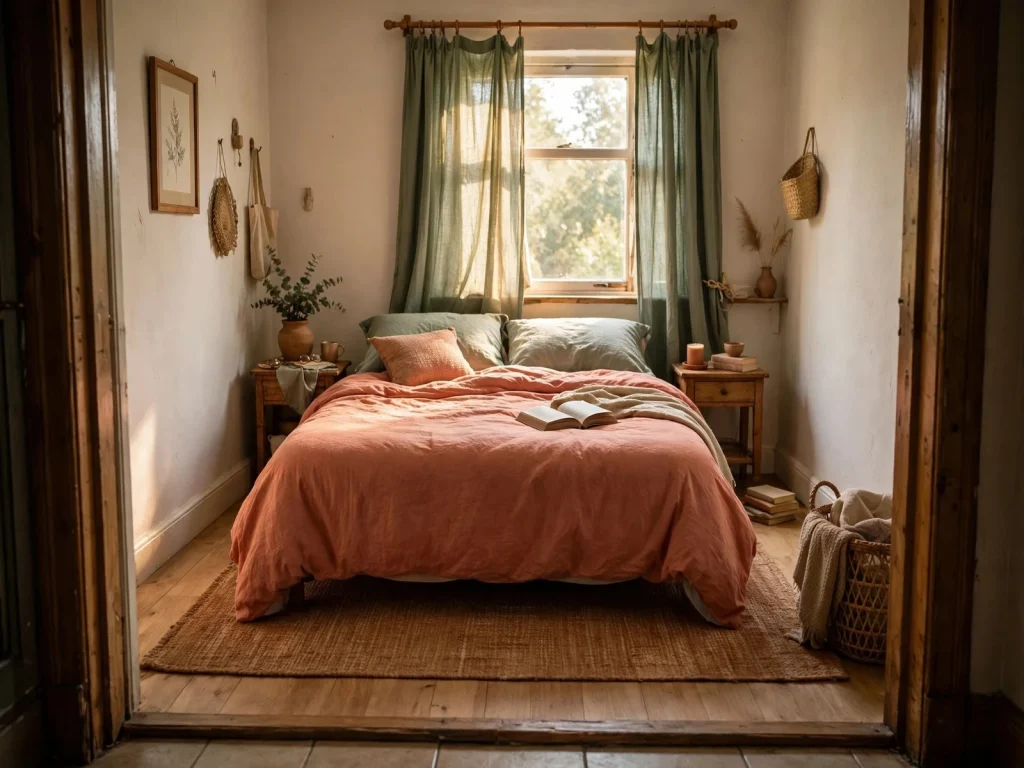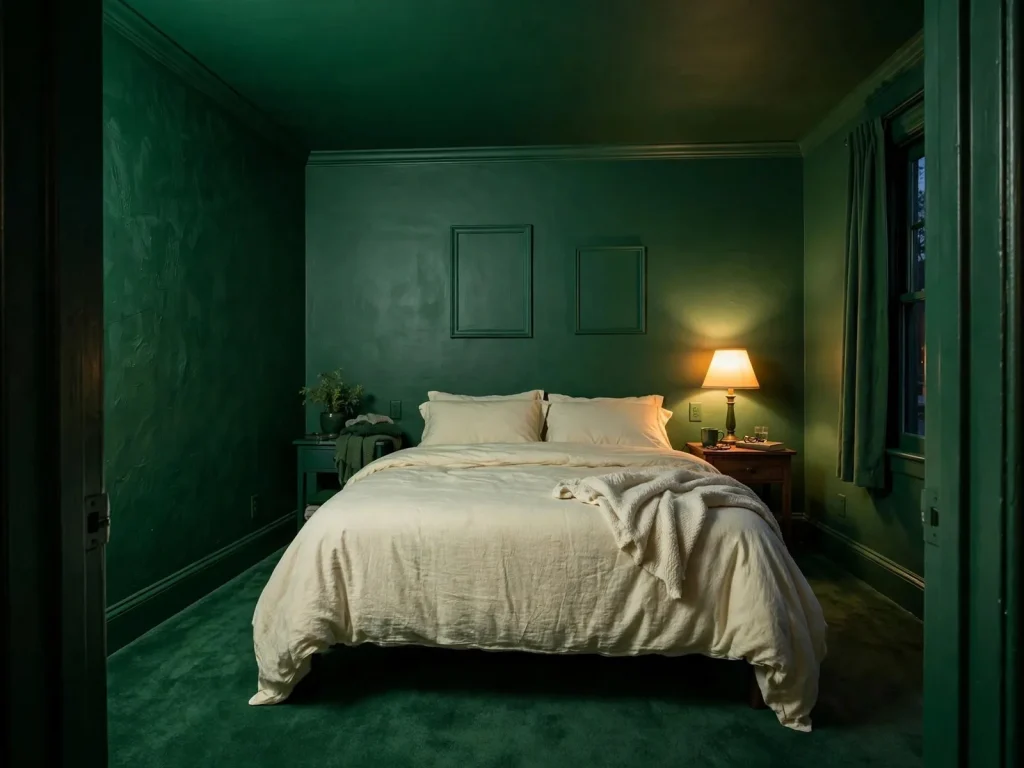
The bed is in. The dresser is in. The rug is down and the lamps even match. Stand in the doorway though and the room still reads unfinished, as if the last hour of work never happened. Nothing is wrong with the furniture. What is missing is the set of small decisions that make pieces sit like they belong together.
Stylists are not working with better taste. They work from heights, clearances, counts and proportions they check the same way in every room. These bedroom decor secrets state each rule with the number that decides it, so you can walk your own room with a tape measure and fix the gaps in one pass. The wider idea bank for whole rooms sits in our bedroom ideas pillar.
Before you start: measure, budget, rules
Take four measurements before touching anything. The height from the floor to the top of your mattress. The width of your bed from edge to edge. The width and height of your window frame on the outside edges. The empty wall space above your headboard and above your dresser. Every rule on this page hangs on one of those four numbers.
The rough cost notes on this page are gentle. Most of these bedroom styling tips cost nothing at all, because they move, rehang or regroup things you already own. The money shows up in three places: curtain panels long enough to reach the floor, a rug wide enough to pass the border test and a lamp of the right total height. Each idea states its cost plainly where it applies.
Renters, the news is good. Fourteen of the fifteen rules are placement and proportion, not construction. The two that touch a wall are art hanging, which is one nail per piece and patches in minutes and curtain rods, where the idea itself names tension and adhesive options that leave nothing behind.
The measuring rules
1. Hang art with its center at 57 inches
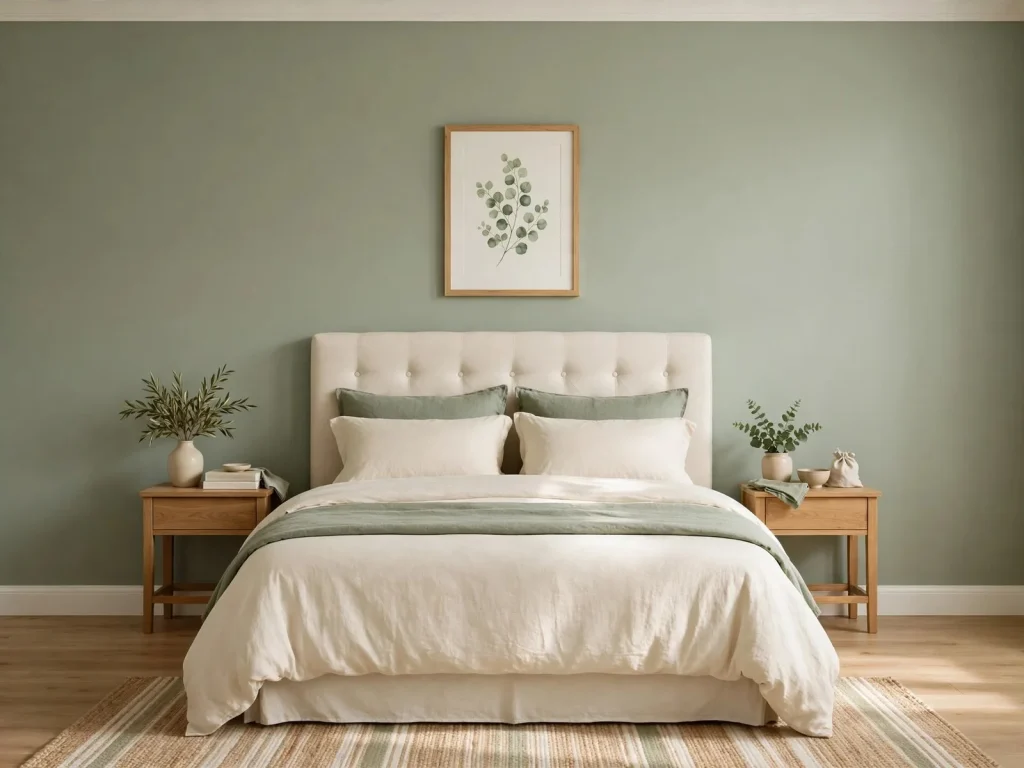
Eye level is a number, not a feeling. The center of a piece of art wants to sit at 57 inches from the floor, which is the gallery standard because it meets a standing adult’s eye without a tilt of the head. Bedroom art hung by feel usually lands 6 to 10 inches too high and that gap is one of the quiet reasons a finished furniture set still reads as unfinished.
Over the bed the same rule bends to the furniture. Keep 6 to 8 inches of clear wall between the top of the headboard and the bottom of the frame, so the art reads as part of the bed wall and not as a separate event floating above it. The same 6 to 8 inch gap applies above a dresser top. Measure from the floor to 57 inches for the center, mark it with tape and then hang to the mark.
The catch is groupings. A pair or a grid hangs as one piece, so measure the whole arrangement’s center to 57 inches and keep the internal spacing even at 2 to 3 inches between frames.
Measure: art center at 57 inches from the floor, with 6 to 8 inches clear above the headboard or dresser top.
2. Set the nightstand level with the mattress top
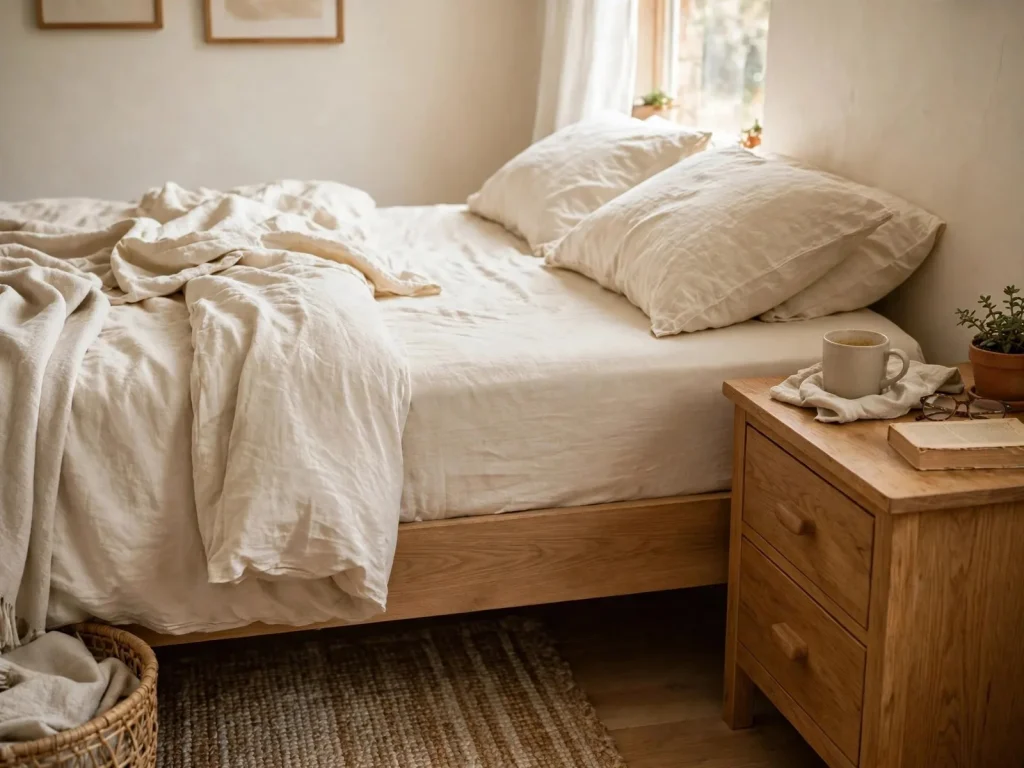
A nightstand at the wrong height makes the whole bed wall look improvised. The surface of the nightstand should land within 2 inches of the top of the mattress, above or below. Inside that band, a book, a glass of water and a phone all sit at a natural reach from a pillow. Outside it, you are either reaching up like a child at a counter or dropping things down a well every night.
Measure before you shop or rearrange. Bed frames, box springs and mattress depths vary so much that two beds in the same house can differ by 4 inches at the top surface. If your current nightstand sits low, a stack of large books or a small riser block closes a 2 inch gap honestly. If it towers above the mattress, it belongs on the other side of the room as a plant stand.
The catch is the lamp that stands on it, which has its own height rule and gets its turn in idea 10. Get the table right first, because the lamp height is measured from the table surface up.
Measure: nightstand surface within 2 inches of the mattress top. Measure your own bed before buying, since frame and mattress combos vary by inches.
3. Mount curtains above the frame and wider than the glass
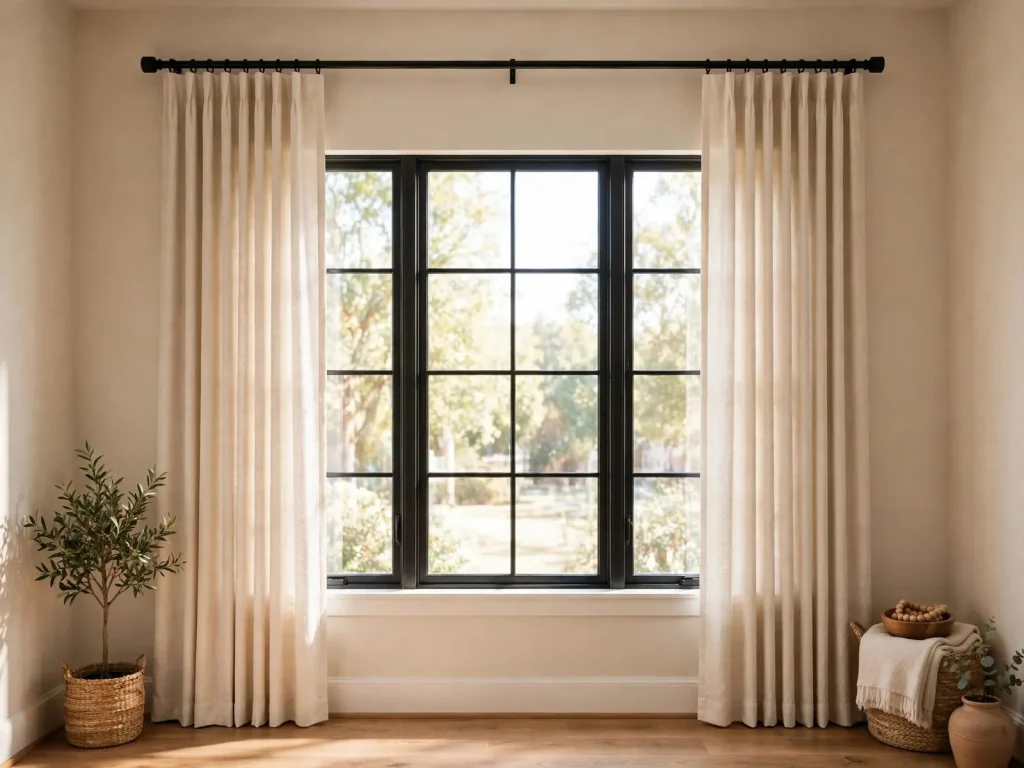
Curtains hung tight to the window frame shrink the window and chop the wall. The rod wants to sit 4 to 6 inches above the frame and run 8 to 12 inches wider than the frame on each side. That width lets the opened panels stack back onto wall instead of covering glass, so the room keeps its daylight and the window reads a full size larger.
Panel length finishes the job. Panels should end about half an inch above the floor, close enough to read as a full drop and high enough to sweep without dragging. In a bedroom with a baseboard heater or a deep sill, stop at the sill rather than letting fabric pool against heat.
The catch is hardware reach. A rod 8 to 12 inches wider per side needs brackets that can land on studs or solid anchors at the new width and renters can run a tension rod inside a deep frame or adhesive hooks for light panels when drilling is off the table.
Needs drilling: rod 4 to 6 inches above the frame and 8 to 12 inches wider per side for most rooms. Renters can use a tension rod inside the frame and still gain the panel length.
4. Give the rug 18 inches past each side of the bed
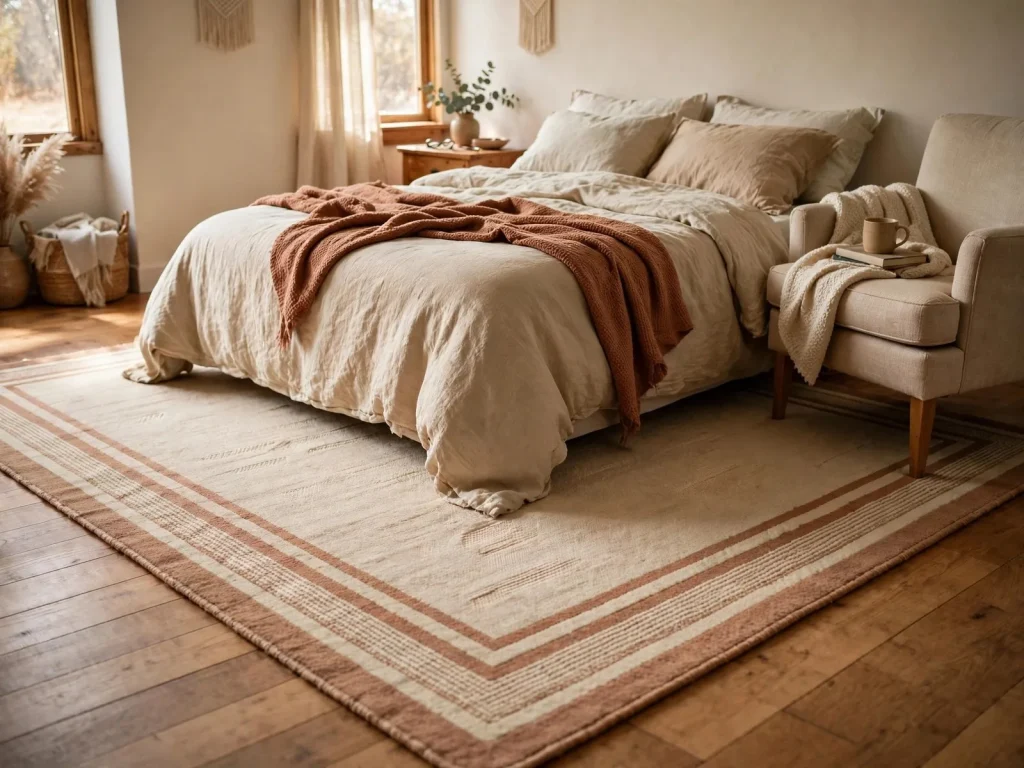
A rug that ends flush with the bed frame is a mat with ambitions. The rule is 18 inches of rug past each side of the bed at minimum, so bare feet land on fiber in the morning and the bed reads as resting on something instead of standing next to it. At the foot, the same border carries the eye out into the room.
Check your bed width against the rug before anything decorative is discussed. A queen at 60 inches wide needs an 8 by 10 rug to clear 18 inches on both sides with the rug run two-thirds under the bed. A rug one size down passes in the shop photo and fails at the bedside, which is why this is a measuring rule and not a style opinion.
The catch is furniture at the edges. The front legs of a reading chair should sit on the rug, fully or not at all. A chair half on the border rocks on the edge and drags the rug out of square within a week.
Measure: at least 18 inches of rug past each side of the bed, with reading chair front legs fully on the rug.
The styling rules
5. Count the room in 60, 30 and 10
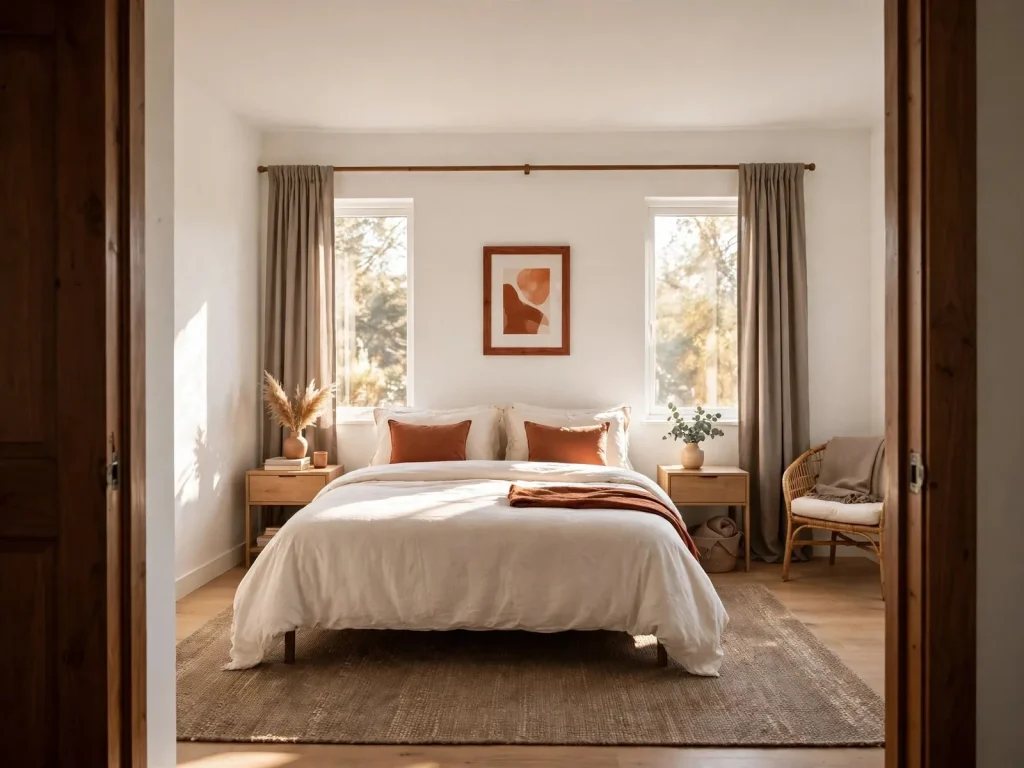
The 60 30 10 rule is the fastest of the bedroom design tips to apply and the one that explains most almost-right rooms. Sixty percent of the visible color is the dominant shade, usually walls and bedding. Thirty percent is a secondary shade carried by curtains, the rug and upholstery. Ten percent is the accent, small and bright and repeated.
Count it across the room, not inside one object. Stand in the doorway and squint. If the accent is the only thing you see, it is running at 30 percent and the walls have gone quiet. If you cannot find the accent at all, the room reads flat no matter how good each piece is.
The catch is that the count includes wood tones and metals. A walnut bed is part of your 30 or your 60, not a free neutral that sits outside the math. Our bedroom color ideas post works whole palettes through this same count.
Measure: 60 percent dominant color, 30 percent secondary and 10 percent accent, counted across walls, bedding and small pieces together.
6. Style every surface in groups of three
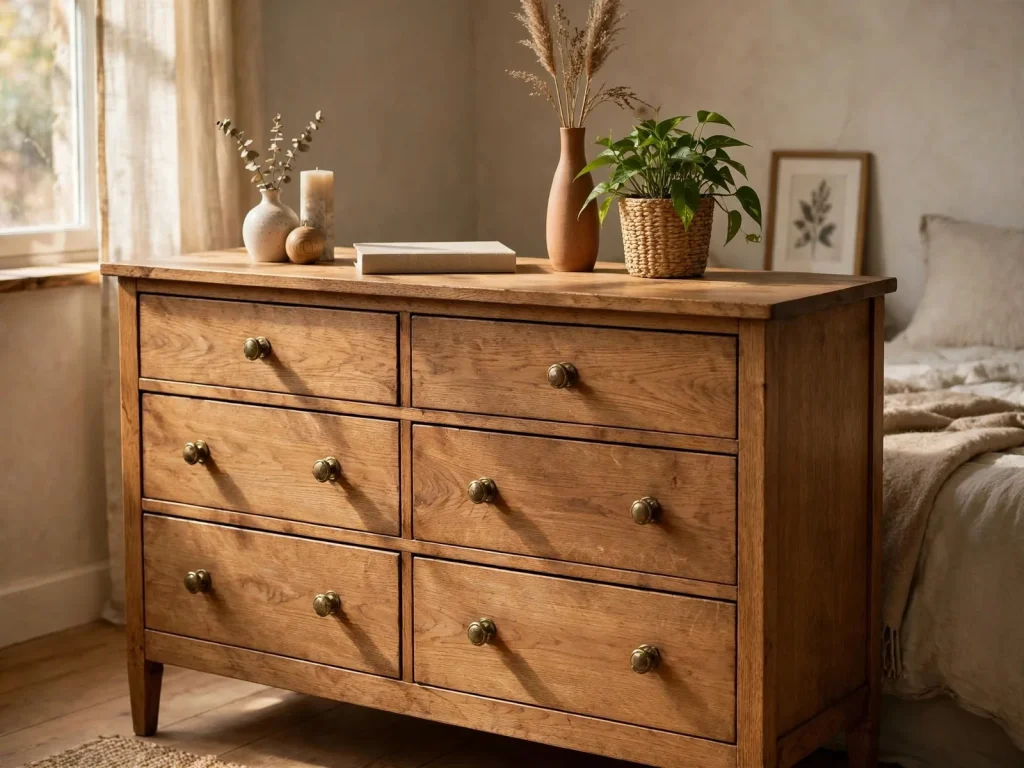
A dresser top with five loose objects reads as storage. The same surface with one group of three reads as styling. The group wants one tall item, one medium item and one flat item: a lamp or a vase, a small stack or a plant and a book or a tray lying flat under or beside them. Height steps are what the eye reads as intention.
Work the nightstands and the dresser with the same recipe and leave the rest of each surface empty. Empty space beside a group is part of the rule. A group pushed into a corner with clutter filling the rest of the top gets none of the credit.
The catch is scale. The tall item should reach roughly a third of the distance to the next horizontal line above it, such as a mirror bottom or a shelf. Three small items in a row are just three small items, no matter how carefully they are spaced.
Measure: groups of 3 per surface, one tall, one medium and one flat, with the tall item near a third of the height to the line above it.
7. Repeat the accent color three times before you judge it
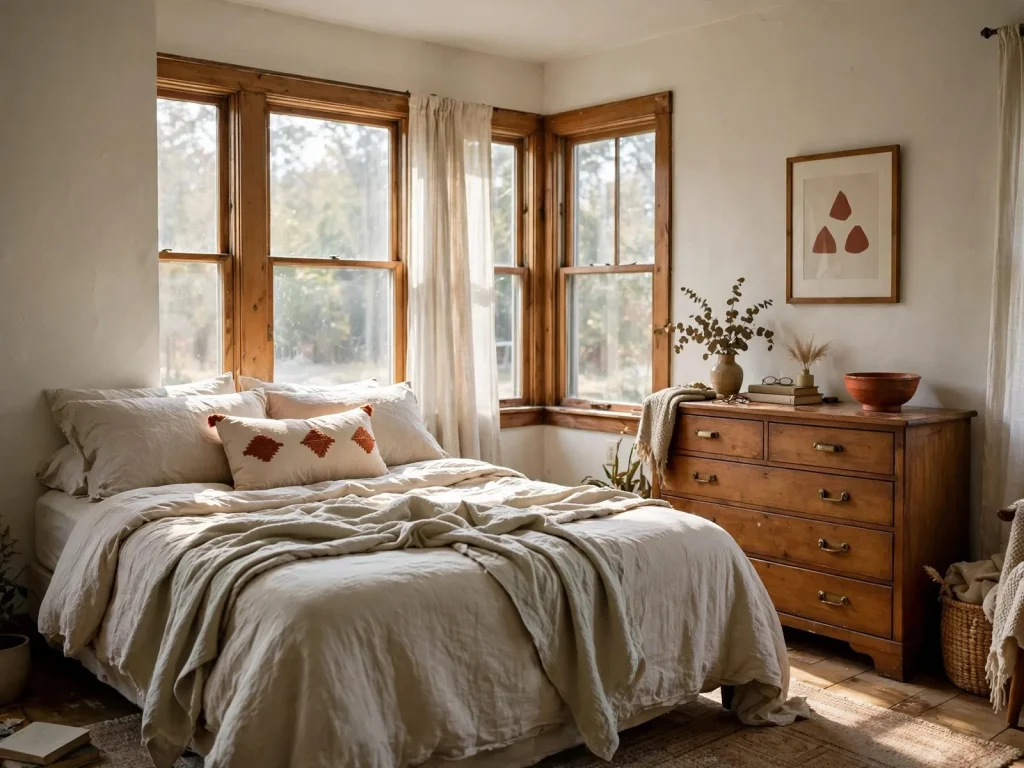
One accent object is a mistake the room has not explained yet. The same accent in three places becomes the room’s signature. This is the rule of three doing quiet work: a cushion on the bed, a book spine or a bowl on the dresser and a print that carries the same thread of color tie the far corners of the room together.
Place the three repeats so they form a loose triangle from the doorway view. Bed, dresser and window wall is the standard triangle in a bedroom. Your eye travels the triangle and reads the room as planned, even though each repeat can be small enough to hold in one hand.
The catch is dosage. The three repeats together are your 10 percent from idea 5, so each one stays small. A whole accent duvet plus accent curtains is not a repeat pattern. It is a second dominant color arguing with the first.
Budget: the three repeats can be a cushion cover, a thrifted bowl and a print you already own. This rule usually costs under $30 or nothing at all.
8. Dress the bed in odd numbers
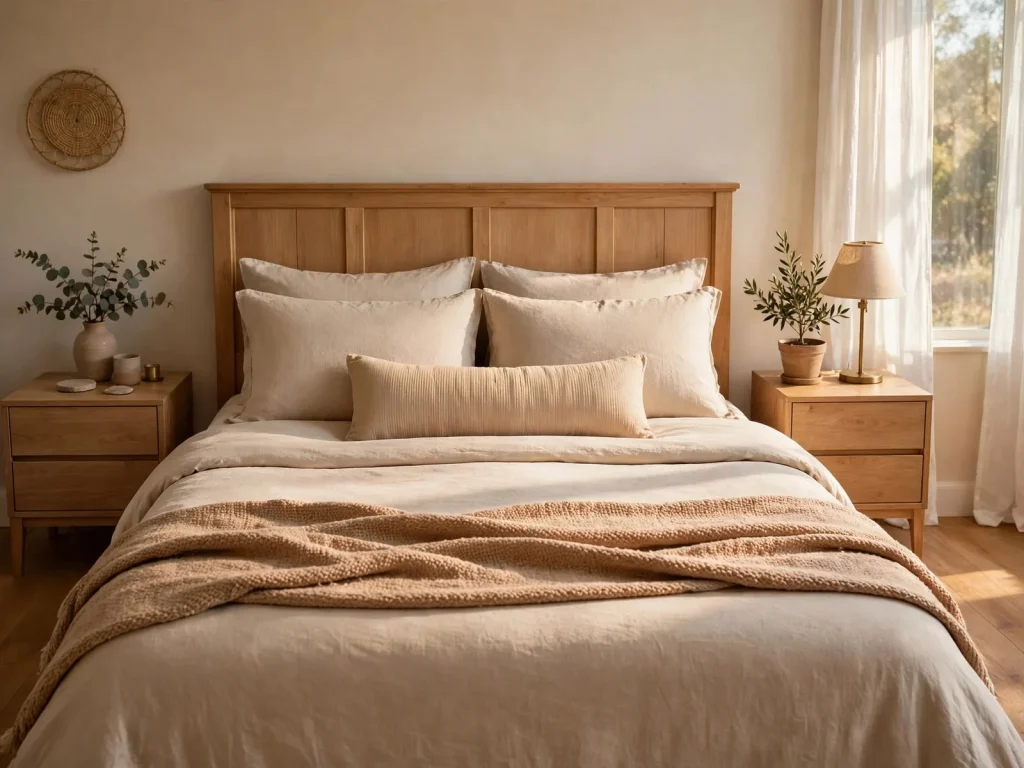
Beds styled in even numbers read as hotel symmetry, tidy and a little stiff. Beds styled in odd numbers read as homes. Two sleeping pillows per sleeper is the base. Then add one lumbar cushion or a single folded throw and the arrangement relaxes into something the eye trusts.
The count that matters is what faces the door. One long lumbar across the front of the sleeping pillows does more for the finished look than a pyramid of six cushions that gets thrown on the floor every night and resented every morning.
The catch is daily life. Every decorative layer is a nightly removal, so cap the dressed bed at what you will happily rebuild in under a minute. For most people that is the lumbar and the throw and the throw earns its place by being used on cold feet by Friday.
Measure: sleeping pillows plus 1 feature piece, a lumbar or a throw, as the front count. If the rebuild takes over a minute, remove a layer.
The light and layer rules
9. Put a light source at three heights
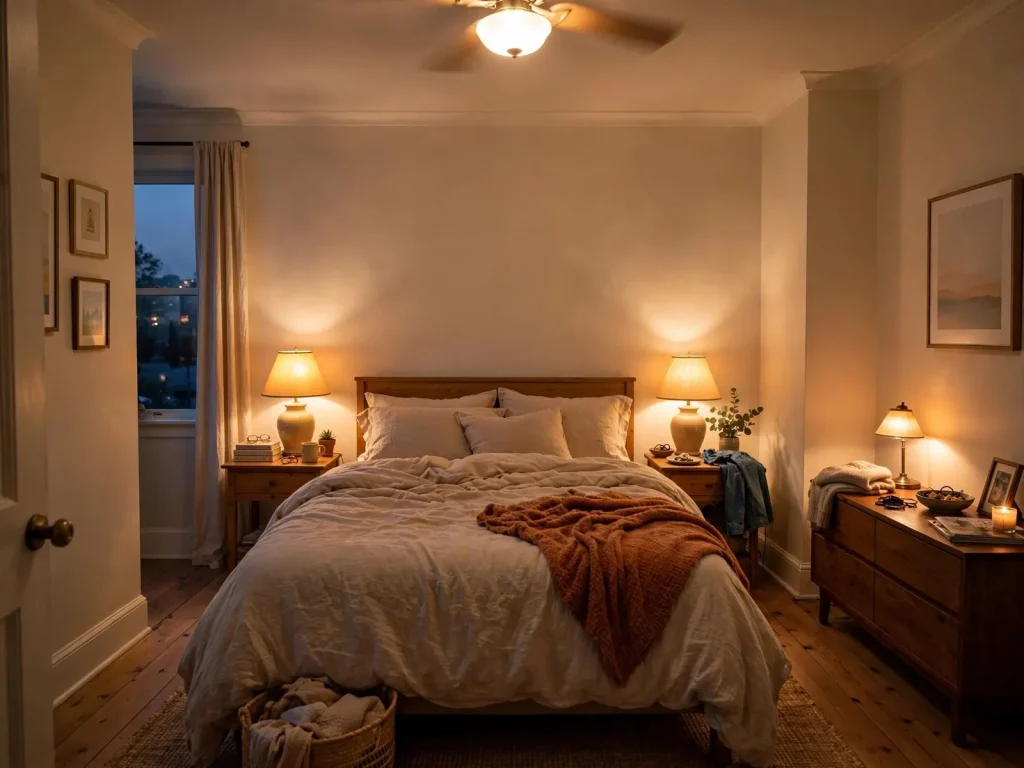
One ceiling light flattens everything it touches. Finished rooms layer light at three heights: something overhead or high for general light, lamps at seated eye level for reading and one low source such as a small lamp on a dresser or a candle-style light near the floor for the last hour of the evening. Each height does a job the others cannot.
Count your sources from the bed, because that is where the room is judged. If turning off the ceiling light leaves the room dark at the corners and bright at the pillows, the middle layer is missing and the fix is a lamp, not new paint.
The catch is bulb temperature, which can split a layered plan into three different rooms. Keep every bulb in the room at the same warmth, around 2700K, so the layers blend. Our bedroom lighting ideas post plans whole rooms around this layering.
Measure: 3 light heights in the room, overhead, lamp level and low, with all bulbs matched near 2700K.
10. Size the lamp so the shade meets your eye sitting up
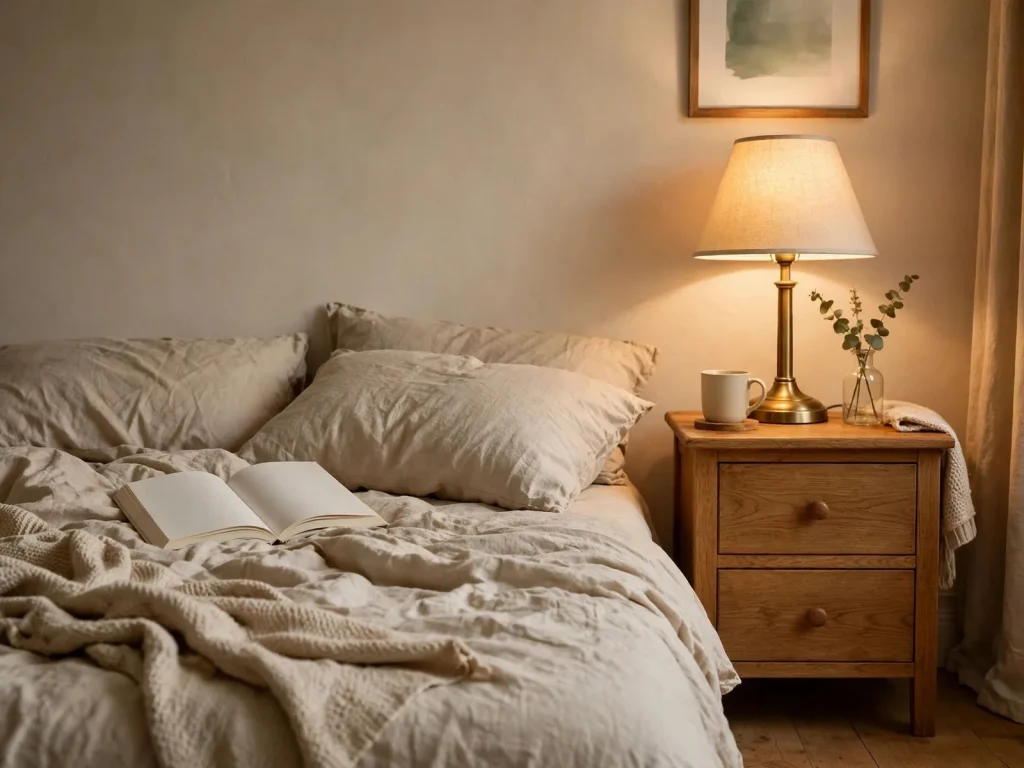
A bedside lamp is a reading tool before it is a decoration. Total lamp height, base to shade top, wants to land between 24 and 28 inches, measured from the nightstand surface. At that height the bottom of the shade sits near eye level when you are sitting up against the headboard, so light falls on the book and the bulb stays out of your eyes.
This is where idea 2 pays off. A lamp that is right on a level nightstand turns wrong the moment the table sits 4 inches low, because the shade drops below eye line and glares across the pillow. Measure table height and lamp height as one sum before you buy either piece.
The catch is shade width. A lamp at the right height with a narrow shade throws a reading cone too small for a paperback opened flat. A shade around 12 to 14 inches across at the bottom covers a book and a lap comfortably.
Measure: total lamp height 24 to 28 inches from the nightstand surface, with a shade about 12 to 14 inches wide at its base.
11. Layer the bed in three textiles
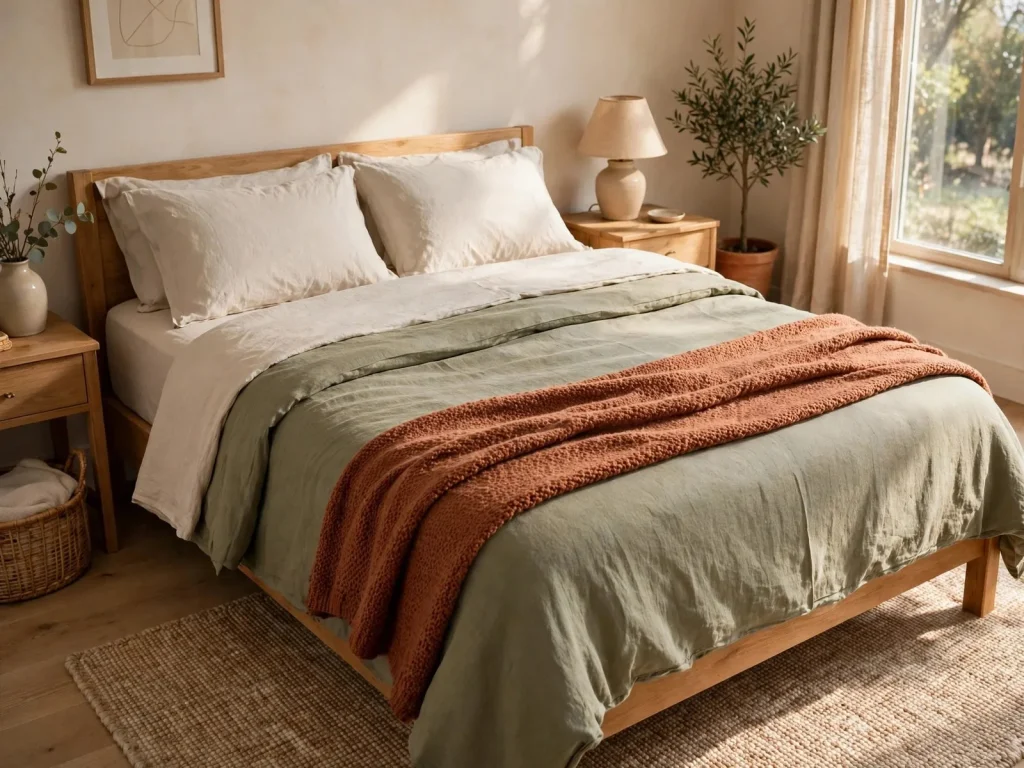
A bed made with one flat layer looks like a bed waiting for someone to finish it. The finished version runs three textiles: the sheet set as the base, a duvet or quilt as the middle and one folded throw across the foot as the top note. Each layer shows a border of the one beneath it, which is what makes the bed read as dressed rather than covered.
Fold the duvet back about a third of the bed length so the sheet layer shows at the pillows. Lay the throw across the foot third, straight or in a loose fold. Two folds are enough; a throw arranged in four careful waves will be kicked straight by the second night.
The catch is heat. Three layers in a warm climate means the middle layer should be a quilt or a coverlet rather than a full duvet, so the look survives July. Layers are about visible borders, not about total warmth.
Budget: a folded throw is the only purchase here if your sheets and duvet already exist. Cotton throws that wash well run $25 to $50.
12. Mix three textures so flat surfaces stop looking flat
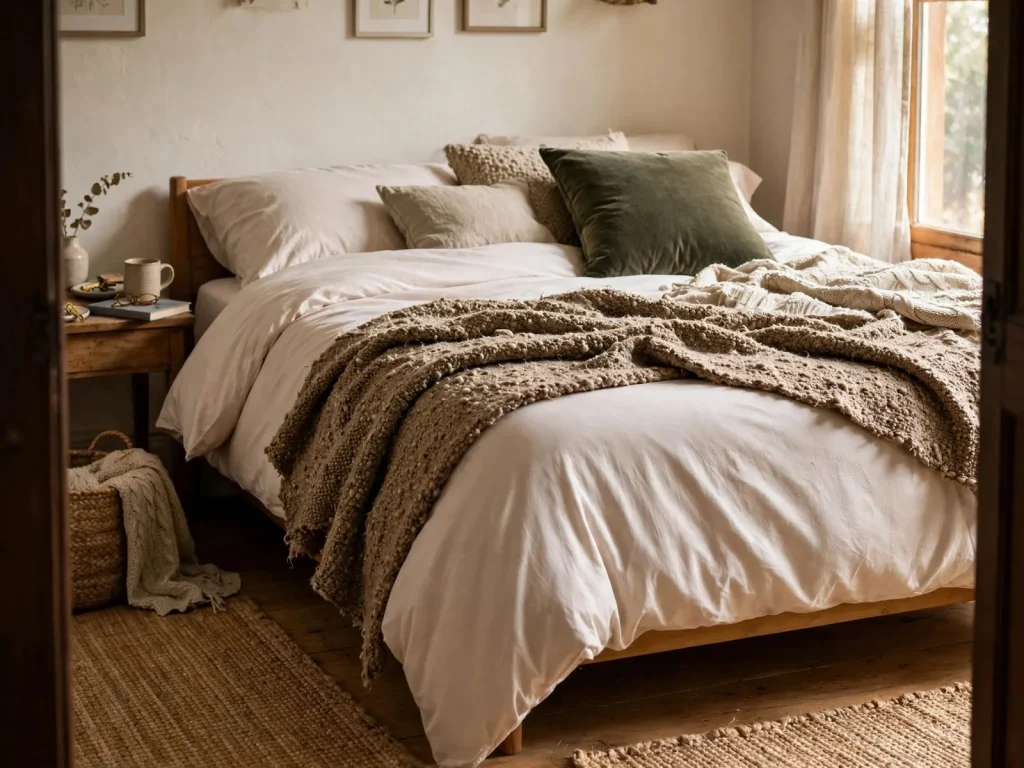
Color gets the credit, but texture is what a camera and a doorway view actually register. A room with smooth bedding, smooth walls and a smooth rug reads as one flat sheet of color. Add three texture families and the same palette gains depth: one rough (woven wool, jute or raw linen), one smooth (cotton percale, painted wood) and one soft (velvet, bouclé or a knitted throw).
Place one texture at each of the room’s three distances. Something rough underfoot or at the foot of the bed, something smooth at the furniture line and something soft where a hand lands, such as the cushion you actually lean on. The mix fails when all three textures crowd onto the bed and the rest of the room stays slick.
The catch is cleaning. Rough textures hold dust and soft ones hold pet hair, so put the washable member of each family in the high-contact spot and save the delicate one for the foot of the bed.
Measure: 3 texture families in the room, rough, smooth and soft, with one placed at floor level, one at furniture level and one at hand level.
The finishing rules
13. Corral the small stuff on one tray per surface
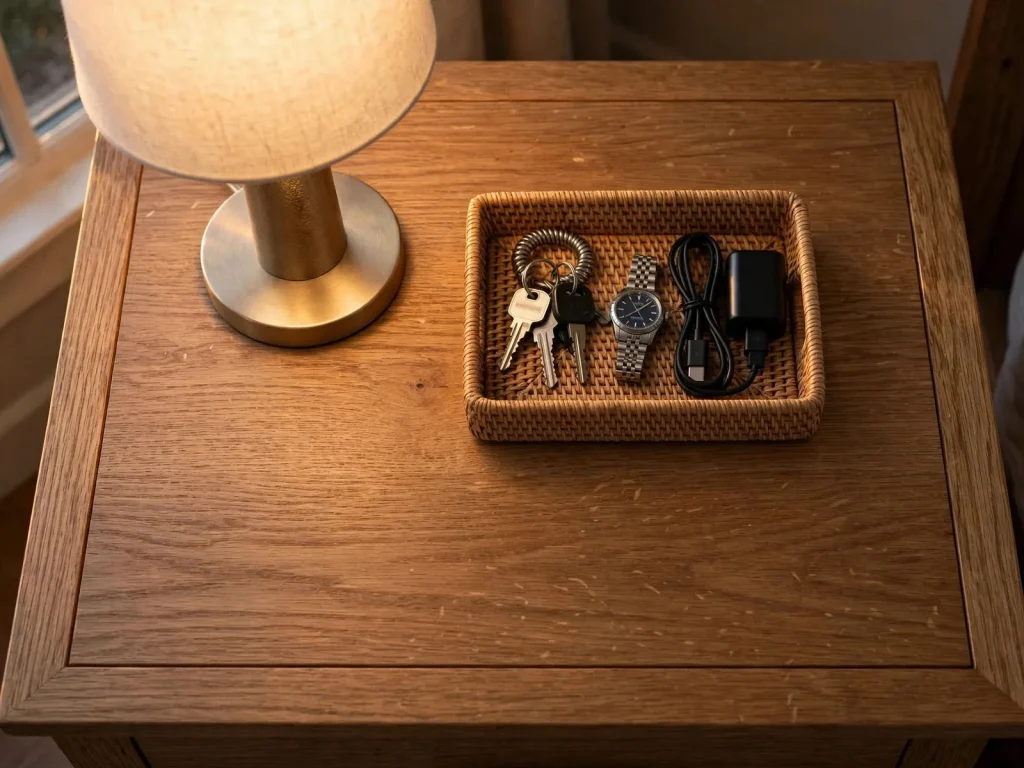
Loose small objects are where finished rooms quietly unravel. Keys, lip balm, a watch, two chargers and a hair tie spread across a dresser read as a spill. The same objects on one tray read as a collection, because the tray gives the group a border and the eye a single shape to file.
Size the tray to the spill, not to the dresser. A tray around 12 by 8 inches holds a nightstand’s nightly cargo. Bigger trays invite bigger spills, so resist the serving tray that spans half the surface. This is the flat item from idea 6 earning a second job.
The catch is the second tray. One tray per surface is the rule; two trays side by side is just a wider spill with better marketing. If cargo overflows one tray, the overflow goes in a drawer, not on a second tray.
Measure: 1 tray per surface, about 12 by 8 inches on a nightstand. Overflow goes in the drawer, never on a second tray.
14. Hide the cords behind the nightstand line
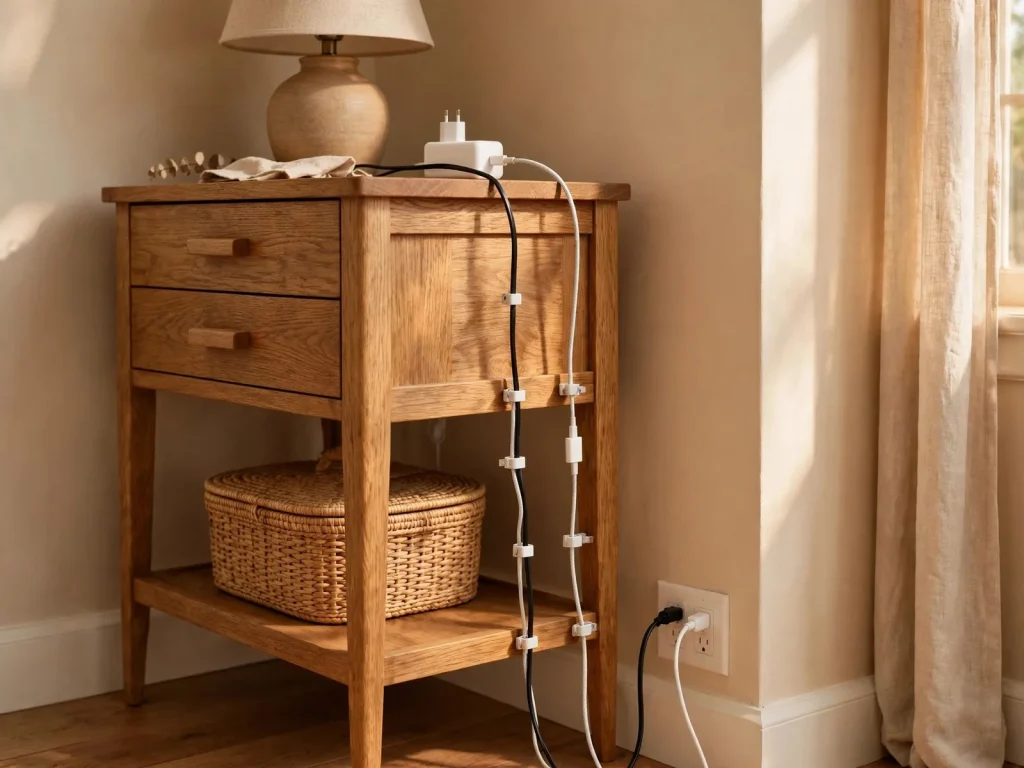
Nothing dates a styled bedside like a white charger cord looped across the floor and a power strip glowing under the bed. Run cords down the back leg of the nightstand and fix them with adhesive clips, so the run from lamp and charger to outlet stays invisible from the doorway and from the bed.
A small basket or a lidded box on the lower shelf takes the power strip and the spare cable length. Keep the strip off the floor for dust and vacuum reasons and leave its switch reachable without moving furniture, because a hidden strip you cannot switch off will simply stay on forever.
The catch is heat and access. Chargers warm up in use, so the box needs a lid that sits open a crack or holes at the back. A sealed box of warm chargers is a tidiness win and a safety loss.
Renter-friendly: adhesive cord clips and a lidded basket hide the whole run with no holes and no tools. The set costs under $15.
15. Finish with one living or woven piece
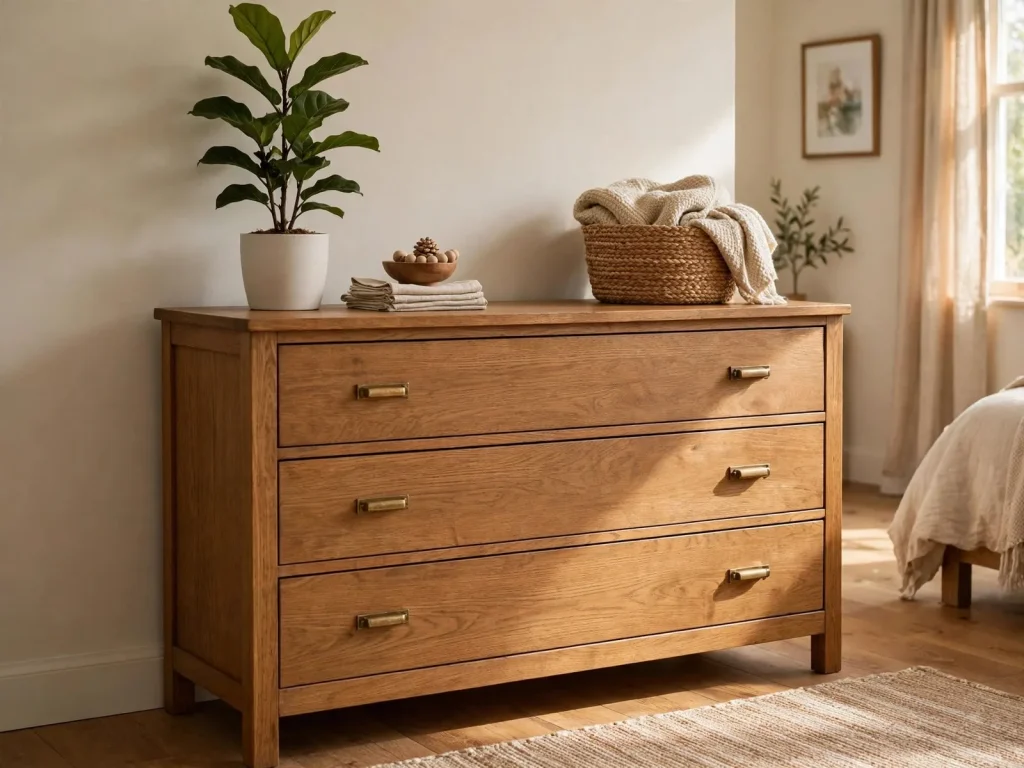
The last of the bedroom decor secrets is the one showrooms fake with plastic. A finished room carries one thing that is alive or was clearly made by hand: a plant on the dresser, a woven basket holding the spare throw or a knitted cushion with visible irregular stitches. It gives the eye one organic shape among all the rectangles.
Scale it to the room’s math. The living piece counts inside your accent 10 percent or your texture count, not as an extra layer on top of them. A plant that needs the brightest spot belongs on the dresser near the window, in the tall slot of the group of three from idea 6.
The catch is honesty. A plant you will not water becomes the room’s most visible failure within a month. Choose the woven basket without shame if your record with plants is poor; the rule is one organic shape, not one living sacrifice.
Budget: a woven basket or a hardy pothos in a plain pot runs $10 to $25 and finishes the group of three on the dresser.
Bedroom decor secrets in a small or rented room
Small rooms do not need fewer rules. They need the same rules at tighter numbers. The art still centers at 57 inches, but in a small room one well-sized piece beats a gallery wall of small frames, because the group spacing rule eats wall the room does not have. The rug border can drop toward 12 inches on the side against the wall and hold the full 18 on the side you actually step out of.
Renters get the same math with different hardware. Curtain panels at the right length matter more than the rod position you cannot drill for, so run a tension rod inside the frame and spend the effort on panels that end half an inch above the floor. Groups of three, trays and cord clips are all landlord-proof, since none of them touches a wall.
Order matters most when the room is small. Start with the layout decisions, where the bed and dresser stand, before any styling rule is applied on top of a bad plan. Our bedroom layout ideas post works the small-room floor plan first. Then hang the art, set the groups and count the color, in that order and the room finishes fast.
Mistakes that make it fall flat
- Hanging art where it looks right from a ladder. You hang at your standing eye height plus the reach of your arms, which lands the center near 65 inches. Everyone else views it from the floor at 57. Mark the center line with tape and step back to the doorway before the nail goes in.
- Treating the rules as a shopping list. Most unfinished rooms need rehanging, regrouping and recounting, not new furniture. Buying more pieces for a room that fails on proportion adds cost and keeps the failure. Apply the free rules first and let a week pass before spending anything.
- Matching every finish in the room. Lamp, frame, hardware and handles all in one metal reads as a kit, not a room. Two finishes in conversation with each other look collected. Repeat each finish at least twice so neither reads as an accident.
- Styling for the photo instead of the night. A bedside with no water glass, no book and no charger is a stage set. The rules above assume real cargo and give it a tray and a cord path. A room that only works when empty is not finished. It is tidied.
Questions people ask about this
Why does my bedroom look unfinished even with all the furniture in it?
Because furniture fills space and finishing is proportion. Art usually hangs too high, surfaces carry loose singles instead of groups of three and the color count drifts until nothing leads. Run the measuring rules first, since they are free: art center at 57 inches, nightstand within 2 inches of the mattress top and 18 inches of rug at each side of the bed.
How high should I hang art above the bed?
Leave 6 to 8 inches of clear wall between the top of the headboard and the bottom of the frame. That gap ties the art to the bed instead of floating it. Where there is no headboard, hang the piece so its center sits at 57 inches from the floor like any other wall.
What is the 60 30 10 rule and how do I count it?
It is the color budget for the room: 60 percent dominant color on walls and bedding, 30 percent secondary on curtains, rug and upholstery and 10 percent accent in small pieces. Count from the doorway with a squint and count wood tones and metals inside the budget instead of treating them as free neutrals.
The bottom line
A finished bedroom is not a bigger budget. It is a short list of numbers applied in the right order and most of them cost nothing but a tape measure and an hour. This week, take the four measurements from the start of this page and rehang your art to the 57 inch center line. That single fix, done before any shopping, is the one guests will feel without ever knowing why.